作者:
出版社:
简介:Summary:
Publisher Summary 1
`Fourteen elephants were employed to carry our tents, which consisted of two large round tents, six field officers, three Captains and several smaller tents for the cavalry, infantry &c. by whom we were escorted. Four elephants were employed in carrying a part of our baggage; two were not loaded that had been trained for carrying howdahs, which we sometimes rode when the weather was not too oppressive. We had two camels, which were mostly used for carrying messages, and one hundred bullocks to draw the bandies in which all the rest of our baggage was to be conveyed.'
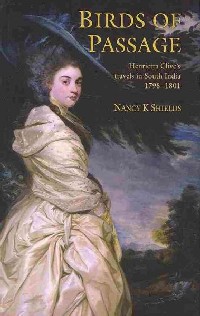
The journals of Lady Henrietta Clive, a feisty, independent-minded traveller, are among the very earliest written accounts of India by a British woman. Married to Lord Edward Clive, son of Clive of India and Governor of Madras (1798-1803), she travelled through southern India with her daughters and retinue in the aftermath of the war against Tipu Sultan.
In this their first publication, Nancy K Shields skillfully interweaves extracts from the journals with passages from the diary of Charly, Henrietta's precocious twelve-year-old daughter, who went on to tutor the future Queen Victoria, first Empress of India. She also includes extracts from Henrietta's impassioned correspondence with her beloved, Byronic brother, the rakish George Herbert, Earl of Powis, beside whom Edward Clive appears to have been a very dull spouse.
Important as an historical and as a social document, and also as an early female travel text, Birds of Passage is illustrated with watercolours by Anna Tonelli, who accompanied the party on their voyage.
Publisher Summary 2
With a background in English literature and years of studying in various cultures, especially in Asia, Shields partly quotes and partly summarizes the journal that Clive (1758-1830) kept as she lived and traveled in South India with her husband Lord Robert Clive, son of Clive of India. Among the stages of her journey are aboard the Dover Castle, miserable in Madras, traveling the Great Horn, traveling through the Guzelhutty Pass into Coimbatoor Country August 14th to September eighth of 1800, Coromandel Coast to Madras, aboard the Castle Eden, the Cape of Good Hope, the British colony at St. Helena, and home again to England. A glossary of terms she uses, a map, biographical sketches for everyone, an introduction, and a brief bibliography, and an index are included. Distributed in the US by Dufour Editions. Annotation 漏2010 Book News, Inc., Portland, OR (booknews.com)
Publisher Summary 3
Takes us on a double journey, across war-torn southern India and into the troubled minds of three ancestors aristocratic women in the last decade of the 18th Century.