共找到 71 项 “David Hume” 相关结果
- 全部分类
- 全部
- 文学
- 历史
- 哲学/宗教
- 法律
- 政治/社会
- 医学
- 教育/心理学
- 艺术/传媒
- 研究生考试
- 资格认证考试
- 公开课
- 语言
- 经济金融
- 管理学
- IT/计算机
- 自然科学
- 工学/工程
- 体育
- 行业资料
- 音乐
- 汽车机械制造
- 文档模板
- 创业
- 农学
- 生活
- 数据库教程
- 民族
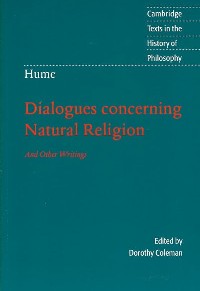
Dialogues concerning natural religion and other writings /
作者: David Hume ; edited by Dorothy Coleman.
简介:Summary: Publisher Summary 1 A new edition of Hume's influential work on religion, including several of his shorter texts. Publisher Summary 2 David Hume's Dialogues concerning Natural Religion, first published in 1779, is one of the most influential works in the philosophy of religion and the most artful instance of philosophical dialogue since the dialogues of Plato. It presents a fictional conversation between a sceptic, an orthodox Christian, and a Newtonian theist concerning evidence for the existence of an intelligent cause of nature based on observable features of the world. This new edition presents it together with several of Hume's other, shorter writings about religion, and with brief selections from the work of Pierre Bayle, who influenced both Hume's views on religion and the dialectical style of the Dialogues. The volume is completed by an introduction which sets the Dialogues in its philosophical and historical contexts.
简介:Photojournalism, Fifth Edition includes new interviews with well known photojournalists such as, Anne Wells story of a Pulitzer Prize winning photo, John Gaps III, formerly of the Associated Press, David Hume Kennerly of Newsweek, Diana Walker and PF Bently of Time. Individual case studies draw upon the experience of leading photojournalists to show readers how working professionals handle on-the-job challenges. A blend of insightful interviews, practical experience, and high-impact photographs creates the definitive text on photojournalism. * DVD of short video documentaries that show photojournalists at work * Extensive material on how to turn Pro, from developing a portfolio and freelancing to findind a job * Interviews with celebrated photojournalists are accompanied by hundreds of black and white, and color photographs
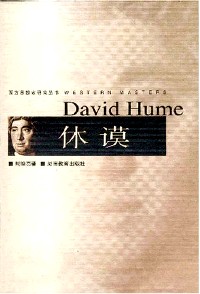
作者: (英)大卫·休谟(David Hume)著;刘仲敬译
简介: 大卫·休谟的杰作《英国史》创作历时十五年,全书超过一百万字,再版超过一百次,讲述了从罗马—不列颠时代到光荣革命的英国历史,甫一上市便成为畅销书,并一举使休谟跻身历史学家行列。本册为罗马—不列颠时代到金雀花王朝的历史。
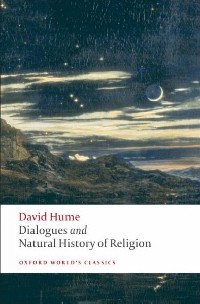
简介:David Hume is one of the most provocative philosophers to have written in English. His Dialoguesask if a belief in God can be inferred from what is known of the universe, or whether such a belief is even consistent with such knowledge. The Natural History of Religioninvestigates the origins of belief, and follows its development from polytheism to dogmatic monotheism. Together, these works constitute the most formidable attack upon religious belief ever mounted by a philosopher. This new edition includes Section XI of The Enquiry Concerning Human Understandingand a letter by Hume in which he discusses Dialogues. About the Series:For over 100 years Oxford World's Classicshas made available the broadest spectrum of literature from around the globe. Each affordable volume reflects Oxford's commitment to scholarship, providing the most accurate text plus a wealth of other valuable features, including expert introductions by leading authorities, voluminous notes to clarify the text, up-to-date bibliographies for further study, and much more.
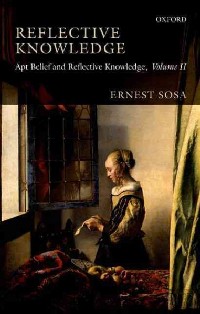
简介:Summary: Publisher Summary 1 Reflective Knowledgeargues for a reflective virtue epistemology based on a kind of virtuous circularity that may be found explicitly or just below the surface in the epistemological writings of Descartes, Moore, and now Davidson, who on Sosa's reading also relies crucially on an assumption of virtuous circularity. Along the way various lines of objection are explored. In Part I Sosa considers historical alternatives to the view developed in Part II. He begins with G.E. Moore's legendary proof, and the epistemology that lies behind it. That leads to classical foundationalism, a more general position encompassing the indirect realism advocated by Moore. Next he turns to the quietist naturalism found in David Hume, Ludwig Wittgenstein, and P.F. Strawson. After that comes Thomas Reid's commonsense alternative. A quite different option is the subtle and complex epistemology developed by Wilfrid Sellars over the course of a long career. Finally, Part I concludes with a study of Donald Davidson's distinctive form of epistemology naturalized (as Sosa argues). The second part of the book presents an alternative beyond the historical positions of Part I, one that defends a virtue epistemology combined with epistemic circularity. This alternative retains elements of the earlier approaches, while discarding what was found wanting in them.
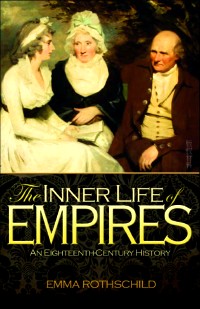
简介:"They were abolitionists, speculators, slave owners, government officials, and occasional politicians. They were observers of the anxieties and dramas of empire. And they were from one family. The Inner Life of Empires tells the intimate history of the Johnstones--four sisters and seven brothers who lived in Scotland and around the globe in the fast-changing eighteenth century. Piecing together their voyages, marriages, debts, and lawsuits, and examining their ideas, sentiments, and values, renowned historian Emma Rothschild illuminates a tumultuous period that created the modern economy, the British Empire, and the philosophical Enlightenment. One of the sisters joined a rebel army, was imprisoned in Edinburgh Castle, and escaped in disguise in 1746. Her younger brother was a close friend of Adam Smith and David Hume. Another brother was fluent in Persian and Bengali, and married to a celebrated poet. He was the owner of a slave known only as "Bell or Belinda," who journeyed from Calcutta to Virginia, was accused in Scotland of infanticide, and was the last person judged to be a slave by a court in the British isles. In Grenada, India, Jamaica, and Florida, the Johnstones embodied the connections between European, American, and Asian empires. Their family history offers insights into a time when distinctions between the public and private, home and overseas, and slavery and servitude were in constant flux. Based on multiple archives, documents, and letters, The Inner Life of Empires looks at one family's complex story to describe the origins of the modern political, economic, and intellectual world"--
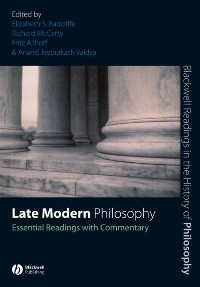
简介:Summary: Publisher Summary 1 The 24 selections present writings by and criticism of towering 18th-century British empiricists John Locke, George Berkeley, and David Hume. Kant, of course, would not be left out of the conversation, and if not him then certainly not Leibniz nor Rousseau. Quieter voices are also heard, such as Adam Smith, Jeremy Bentham and Mary Wollstonecraft. Annotation 漏2007 Book News, Inc., Portland, OR (booknews.com) Publisher Summary 2 Part of the Blackwell Readings in the History of Philosophyseries, this survey of late modern philosophy focuses on the key texts and philosophers of the period whose beliefs changed the course of western thought. Gathers together the key texts from the most significant and influential philosophers of the late modern era to provide a thorough introduction to the period. Features the writings of Locke, Berkeley, Hume, Leibniz, Kant, Rousseau, Bentham and other leading thinkers. Examines such topics as empiricism, rationalism, and the existence of God. Readings are accompanied by expert commentary from the editors, who are leading scholars in the field.
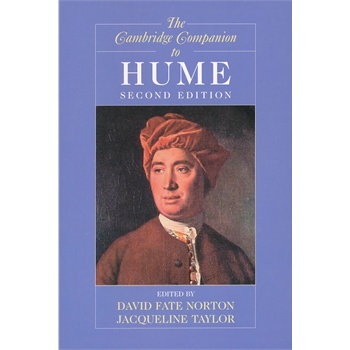
The Cambridge Companion to Hume
出版社:Cambridge University Press 2011-12-1
简介: Each Cambridge Companion to a philosophical figure is made upof specially commissioned essays by an international team ofscholars, providing students and non-specialists with anintroduction to a major philosopher. The series aims to dispel theintimidation that readers may feel when faced with the work of achallenging thinker. David Hume is now considered one of the mostimportant philosophers of the Western world. Although best knownfor his contributions to the theory of knowledge, metaphysics, andphilosophy of religion, Hume also influenced developments in thephilosophy of mind, psychology, ethics, political and economictheory, political and social history, and aesthetic theory. Thefifteen essays in this volume address all aspects of Hume"sthought. The picture of him that emerges is that of a thinker who,though often critical to the point of skepticism, was nonethelessable to build on that skepticism a constructive, viable, andprofoundly important view of the world. Also included in thisvolume are Hume"s two brief autobiographies and a bibliographysuited to those beginning their study of Hume. This second editionof one our most popular Companions includes six new essays and anew introduction, and the remaining essays have all been updated orrevised.
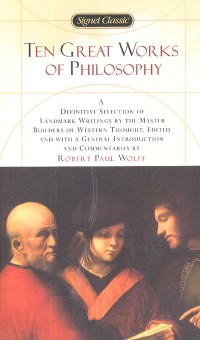
简介: From ancient Greece to nineteenth-century America, this collection traces the history of our civilization through the seminal works of its most influential thinkers. Perfect for anyone interested in understanding the progression of Western thought, this volume includes: Plato: Apology, Crito, and Death of Socrates from Phaedo Aristotle: Poetics St. Anselm: The Ontological Proof of St. Anselm, from Proslogium St. Thomas Aquinas: St. Thomas' Proofs of God's Existence, from The Summa Theologica René Descartes: Meditations on the First Philosophy David Hume: An Inquiry Concerning Human Understanding Immanuel Kant: Prolegomena to Any Future Metaphysics John Stuart Mill: Utilitarianism William James: The Will to Believe
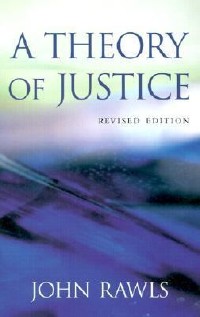
简介: A Theory of Justice is a widely-read book of political and moral philosophy by John Rawls. It was originally published in 1971 and revised in both 1975 (for the translated editions) and 1999. In A Theory of Justice, Rawls attempts to solve the problem of distributive justice by utilising a variant of the familiar device of the social contract. The resultant theory is known as "Justice as Fairness", from which Rawls derives his two famous principles of justice: the liberty principle and the difference principle. [edit] Objective In A Theory of Justice Rawls argues for a principled reconciliation of liberty and equality. Central to this effort is an account of the circumstances of justice (inspired by David Hume), and a fair choice situation (closer in spirit to Kant) for parties facing such circumstances, and seeking principles of justice to guide their conduct. These parties face moderate scarcity, and they are neither naturally altruistic nor purely egoistic: they have ends they seek to advance, but desire to advance them through cooperation with others on mutually acceptable terms. Rawls offers a model of a fair choice situation (the original position with its veil of ignorance) within which parties would hypothetically choose mutually acceptable principles of justice. Under such constraints, Rawls believes that parties would find his favoured principles of justice to be especially attractive, winning out over varied alternatives, including utilitarian and libertarian accounts. [edit] The "original position" Main article: Original position Like Hobbes, Locke, Rousseau and Kant, Rawls belongs to the social contract tradition. However, Rawls' social contract takes a slightly different form from that of previous thinkers. Specifically, Rawls develops what he claims are principles of justice through the use of an entirely and deliberately artificial device he calls the Original position, in which everyone decides principles of justice from behind a veil of ignorance. This "veil" is one that essentially blinds people to all facts about themselves that might cloud what notion of justice is developed. "no one knows his place in society, his class position or social status, nor does anyone know his fortune in the distribution of natural assets and abilities, his intelligence, strength, and the like. I shall even assume that the parties do not know their conceptions of the good or their special psychological propensities. The principles of justice are chosen behind a veil of ignorance." According to Rawls, ignorance of these details about oneself will lead to principles which are fair to all. If an individual does not know how he will end up in his own conceived society, he is likely not going to privilege any one class of people, but rather develop a scheme of justice that treats all fairly. In particular, Rawls claims that those in the Original Position would all adopt a maximin strategy which would maximise the position of the least well-off. They are the principles that rational and free persons concerned to further their own interests would accept in an initial position of equality as defining the fundamentals of the terms of their association [Rawls, p 11] It is important to keep in mind that the agreement that stems from the original position is both hypothetical and nonhistorical. It is hypothetical in the sense that the principles to be derived are what the parties would, under certain legitimating conditions, agree to, not what they have agreed to. In other words, Rawls seeks to persuade us through argument that the principles of justice that he derives are in fact what we would agree upon if we were in the hypothetical situation of the original position and that those principles have moral weight as a result of that. It is nonhistorical in the sense that it is not supposed that the agreement has ever, or indeed could actually be entered into as a matter of fact. Rawls claims that the parties in the original position would adopt two such principles, which would then govern the assignment of rights and duties and regulate the distribution of social and economic advantages across society. [edit] The First Principle of Justice “ First: each person is to have an equal right to the most extensive scheme of equal basic liberties compatible with a similar scheme of liberties for others.[1] ” The basic liberties of citizens are, roughly speaking, political liberty (i.e., to vote and run for office); freedom of speech and assembly, liberty of conscience and freedom of thought, freedom of the person along with the right to hold (personal) property; and freedom from arbitrary arrest. It is a matter of some debate whether freedom of contract can be inferred as being included among these basic liberties. The first principle is more or less absolute, and may not be violated, even for the sake of the second principle, above an unspecified but low level of economic development (i.e. the first principle is, under most conditions, lexically prior to the second principle). However, because various basic liberties may conflict, it may be necessary to trade them off against each other for the sake of obtaining the largest possible system of rights. There is thus some uncertainty as to exactly what is mandated by the principle, and it is possible that a plurality of sets of liberties satisfy its requirements. [edit] The Second Principle of Justice Social and economic inequalities are to be arranged so that (Rawls, 1971, p.303): a) they are to be of the greatest benefit to the least-advantaged members of society (the difference principle). b) offices and positions must be open to everyone under conditions of (fair equality of opportunity) Rawls' claim in b) is that departures from equality of a list of what he calls primary goods – 'things which a rational man wants whatever else he wants' [Rawls, 1971, pg. 92] – are justified only to the extent that they improve the lot of those who are worst-off under that distribution in comparison with the previous, equal, distribution. His position is at least in some sense egalitarian, with a proviso that equality is not to be achieved by worsening the position of the least advantaged. An important consequence here, however, is that inequalities can actually be just on Rawls's view, as long as they are to the benefit of the least well off. His argument for this position rests heavily on the claim that morally arbitrary factors (for example, the family we're born into) shouldn't determine our life chances or opportunities. Rawls is also keying on an intuition that we do not deserve inborn talents, thus we are not entitled to all the benefits we could possibly receive from them, meaning that at least one of the criteria which could provide an alternative to equality in assessing the justice of distributions is eliminated. The stipulation in a) is prior to that in b) and requires more than meritocracy. 'Fair equality of opportunity' requires not merely that offices and positions are distributed on the basis of merit, but that all have reasonable opportunity to acquire the skills on the basis of which merit is assessed. It is often thought that this stipulation, and even the first principle of justice, may require greater equality than the difference principle, because large social and economic inequalities, even when they are to the advantage of the worst-off, will tend to seriously undermine the value of the political liberties and any measures towards fair equality of opportunity. [edit] Relationship to Rawls's later work Although Rawls never retreated from the core argument of A Theory of Justice, he modified his theory substantially in subsequent works. The discussion in this entry is limited to his views as they stood in A Theory of Justice, which stands on its own as an important (if controversial and much criticized) work of political philosophy. His subsequent work is discussed in the entry titled John Rawls. Of particular note is his work Justice as Fairness: A Restatement (2001), in which he clarified and re-organised much of the argument of A Theory of Justice. [edit] Critics of A Theory of Justice A Theory of Justice made a significant contribution to re-establishing interest in political philosophy, and so it has served as the basis for much of the debate since, meaning that it has been much criticized. In particular, Rawls's colleague at Harvard Robert Nozick wrote a defence of libertarian justice in the aftermath of A Theory of Justice, called Anarchy, State, and Utopia, which was critical of Rawls's work. Because it is, in part, a reaction to A Theory of Justice, the two books are now often read together. Another colleague of Rawls's from Harvard, Michael Walzer, wrote a defence of communitarian political philosophy, entitled "Spheres of Justice," as a result of a seminar he co-taught with Nozick. Robert Paul Wolff wrote Understanding Rawls: A Critique and Reconstruction of A Theory of Justice immediately following the publication of A Theory of Justice, which criticized Rawls from a roughly Marxist perspective. Wolff argues in this work that Rawls's theory is an apology for the status quo insofar as it constructs justice from existing practice and forecloses the possibility that there may be problems of injustice embedded in capitalist social relations, private property or the market economy. Feminist critics of Rawls largely focused on the extent to which Rawls's theory could account for, at all, injustices and hierarchies embedded in familial relations. Rawls argued that justice ought only to apply to the "basic structure of society" for instance, and feminists rallying around the theme of "the personal is political" took Rawls to task for failing to account for injustices found in patriarchal social relations and the sexual division of labor. The assumptions of the original position, and in particular, the use of maximin reasoning, have also been criticized, with the implication either that Rawls designed the original position to derive the two principles, or that an original position more faithful to its initial purpose would not lead to his favored principles. However Rawls does not deny this, he uses the original position in conjunction with an intuitive argument to justify his claim of justice as fairness. Some critics allege that Rawls' argument is weakened in failing to denote healthcare as a primary good. Proponents respond by asserting that affordable and accessible healthcare arises as an inevitable result of the benefits attained by following through with the Original Position. One of the most influential recent criticisms of Rawls' theory has come from the philosopher G.A. Cohen, in a series of influential papers that culminate in his 2000 book If You're An Egalitarian, How Come You're So Rich? Cohen's criticisms are levelled against Rawls' avowal of inequality under the difference principle, against his application of the principle only to social institutions, and against Rawlsian fetishism with primary goods (the metric which Rawls chooses as his currency of equality).
作者: 周晓亮著
出版社:湖南教育出版社,1999
简介: 休谟是一位创立体系的哲学家,他的思想和理论涉及了哲学的各主要学科,有十分丰富的内容。本书不可能对休谟了哲学面面俱到,只能有所选择、有所侧重,在有限的篇幅内尽可能地勾勒出它的主要轮廓,并对某些重要部分作比较详细的分析与论述。 休谟继承了近代西方哲学的认识论主流,认识论是休谟哲学的核心,是其他一切问题讨论的基础,也是休谟哲学中最有价值、最值得注意的部分。本书将着重考察休谟的认识论。其中包括观念学说、因果关系理论、信念理论、怀疑论等。此外,本书还将考察休谟的伦理学。休谟认为伦理学是情感科学,道德活动主要与人的情感活动相关,与理智无关。在伦理学中,休谟充分发展了他的哲学理论的另一重要方面,即情感主义的方面。由于篇幅所限,对于休谟的美学和宗教哲学,本书没有专门讨论,但是作为它们之基础的主要原则,比如休谟在美学中提倡的情感主义、联想主义,在宗教哲学中主张的怀疑主义等,已经在对他的认识论和伦理学的论述中阐明了。为了使读者能从历史发展的广阔视野更好地理解休谟哲学的地位和现实意义,本书在对具体问题的讨论之前,首先介绍了休谟哲学的时代背景、学术氛围和思想来源,同时在本书最后专设一章介绍休谟哲学对后来哲学发展的影响。此外,休谟是“文如其人”的哲学家,为使读者对于理解休谟的哲学观点和思想倾向有一些感性的认识,同时提供一些必要的资料,本书还用一定篇幅介绍休谟的生平和著述。其中除了对主要史实作概括叙述外,还特别注意结合历史事件和著作,简要介绍休谟的政治思想、经济理论和宗教态度,以部分弥补本书在这些方面的不足,相信读者是会感兴趣的。
简介:This new reader in the history of economic thought is edited by two of the most respected figures in the field. With clearly written summaries putting each selection into context and useful questions for discussion, this book will be of great use to students and lecturers of the history of economic thought and goes beyond the simple reprinting of articles. Selections and discussions include such thinkers as Aristotle, John Locke, Fran莽ois Quesnay, David Hume, Jean Baptiste Say, Karl Marx, William Stanley Jevons, Irving Fisher and Thorstein Veblen. History of Economic Thought: A Readercan be used as a core textbook or as a supplementary text on courses in economic thought and philosophy. It will provide readers with a good foundation in the different schools of thought that run through economics.
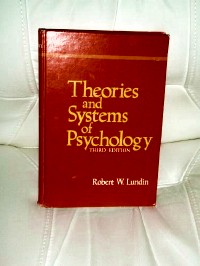
简介:Discusses the theories of Socrates, Plato, Aristotle, Plotinus, St. Augustine, St. Thomas Aquinas, John Locke, George Berkeley, David Hume, David Hartley, Alexander Bain, Herbert Spencer, Immanuel Kant, Johann Herbart, Galen, Marshall Hall, Sir Charles Bell, Franz Joseph Gall, Hermann von Helmholtz, Ewald Hering, Ernest H. Weber, Gustav Theodor Fechner, Charles Darwin, Sir Francis Galton, Wilhelm Maximilian Wundt, William James, John Dewey, James Rowland Angell, Harvey A. Carr, Ivan Petrovich Pavlov, Vladimir Bekhterev, Edward Lee Thorndike, McDougall, Woodworth, John Broadus Watson, Albert P. Weiss, Karl Lashley, Walter S. Hunter, Edwin B. Holt, Edwin R. Guthrie, Clark L. Hull, J. R. Kantor, Burrhus Frederic Skinner, Albert Bandura, Immanuel Kant, John Stuart Mill, Franz Brentano, Carl Stumpf, Ernst Mach, Christian von Ehrenfels, Max Wertheimer, Lewin, Tolman, Jean Piaget, Noam Chomsky, Leibnitz, Schopenhauer, Nietzsche, Sigmund Freud, Alfred Adler, Carl Jung, Karen Horney, Erich Fromm, Harry Stack Sullivan, Erik Erikson, Carl Rogers, Soren Kierkegaard, Martin Heidegger, Jean-Paul Sartre, Karl Jaspers, Adrian von Kaam, Ludwig Binswanger, Medard Boss, Rollo May, and others.
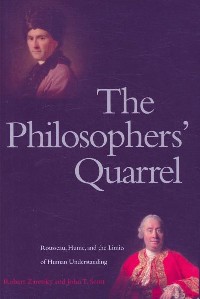
简介:The rise and spectacular fall of the friendship between the two great philosophers of the eighteenth century, barely six months after they first met, reverberated on both sides of the Channel. As the relationship between Jean-Jacques Rousseau and David Hume unraveled, a volley of rancorous letters was fired off, then quickly published and devoured by aristocrats, intellectuals, and common readers, alike. Everyone took sides in this momentous dispute between the greatest of Enlightenment thinkers.In this lively and revealing book, Robert Zaretsky and John T. Scott explore the unfolding rift between Rousseau and Hume. The authors are particularly fascinated by the connection between the thinkers' lives and thought, especially the way that their failure to understand one another (and themselves) illuminates the limits of human understanding. In addition, they situate the philosophers' quarrel in the social, political, and intellectual milieu that informed their actions, as well as the actions of the other participants in the dispute, such as James Boswell, Adam Smith, and Voltaire. By examining the conflict through the prism of each philosopher's contribution to Western thought, Zaretsky and Scott reveal the implications for the two men as individuals and philosophers as well as for the contemporary world, which remains deeply influenced by the Enlightenment.
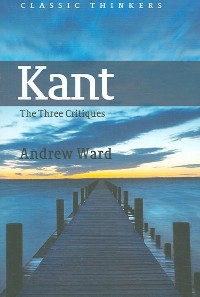
简介:Summary: Publisher Summary 1 Ward (philosophy, U. of York) interprets the main themes in German philosopher Immanuel Kant's (1724-1804) three Critiques so as to put them squarely within the tradition of idealism, a tradition that includes Berkeley and Hume. His ideas concerning knowledge of objects in space ad time, the ground of moral obligation, and the judgments of beauty he sees in part as reactions against Hume's empiricism. Distributed in the US by Blackwell Publishing. Annotation 漏2007 Book News, Inc., Portland, OR (booknews.com) Publisher Summary 2 Immanuel Kants three critiques the Critique of Pure Reason, the Critique of Practical Reason and the Critique of Judgment are among the pinnacles of Western Philosophy. This accessible study grounds Kants philosophical position in the context of his intellectual influences, most notably against the background of the scepticism and empiricism of David Hume. It is an ideal critical introduction to Kants views in the key areas of knowledge and metaphysics; morality and freedom; and beauty and design. By examining the Kantian system in the light of contemporary arguments, Ward brings the structure and force of Kants Copernican Revolution in Philosophy into sharp focus. Kant is often misrepresented as a somewhat dry thinker, yet the clarity of Wards exposition of his main themes, science, morality and aesthetics, through the three critiques brings his writings and theories to life. Lucidly and persuasively written, this book will be a valuable resource for students and scholars seeking to understand Kants immense influence.
简介:S">They were abolitionists, speculators, slave owners, government officials, and occasional politicians. They were observers of the anxieties and dramas of empire. And they were from one family. "The Inner Life of Empires" tells the intimate history of the Johnstones--four sisters and seven brothers who lived in Scotland and around the globe in the fast-changing eighteenth century. Piecing together their voyages, marriages, debts, and lawsuits, and examining their ideas, sentiments, and values, renowned historian Emma Rothschild illuminates a tumultuous period that created the modern economy, the British Empire, and the philosophical Enlightenment.One of the sisters joined a rebel army, was imprisoned in Edinburgh Castle, and escaped in disguise in 1746. Her younger brother was a close friend of Adam Smith and David Hume. Another brother was fluent in Persian and Bengali, and married to a celebrated poet. He was the owner of a slave known only as "Bell or Belinda," who journeyed from Calcutta to Virginia, was accused in Scotland of infanticide, and was the last person judged to be a slave by a court in the British isles. In Grenada, India, Jamaica, and Florida, the Johnstones embodied the connections between European, American, and Asian empires. Their family history offers insights into a time when distinctions between the public and private, home and overseas, and slavery and servitude were in constant flux.Based on multiple archives, documents, and letters, "The Inner Life of Empires" looks at one family's complex story to describe the origins of the modern political, economic, and intellectual world.
简介:Summary: Publisher Summary 1 Annette Baier has created an engaging guide to the philosophy of one of the greatest thinkers of Enlightenment Britain. Drawing deeply on a lifetime of scholarship and incisive commentary, she deftly weaves Hume's autobiography together with his writings and correspondence, finding in these personal experiences new ways to illuminate his ideas about religion, human nature, and the social order. Publisher Summary 2 By beginning each chapter with a quote from the autobiographical eulogy Scottish philosopher David Hume (1711-1776) wrote for himself, Baier (emerita, philosophy, U. of Pittsburgh) makes explicit her goal of connecting the life of Hume to the development of his thought in this work aimed at the general reader. Annotation 漏2011 Book News, Inc., Portland, OR (booknews.com) Publisher Summary 3 Marking the tercentenary of David Hume's birth, Annette Baier has created an engaging guide to the philosophy of one of the greatest thinkers of Enlightenment Britain. Drawing deeply on a lifetime of scholarship and incisive commentary, she deftly weaves Hume's autobiography together with his writings and correspondence, finding in these personal experiences new ways to illuminate his ideas about religion, human nature, and the social order.Excerpts from Hume's autobiography at the beginning of each chapter open a window onto the eighteenth-century context in which Hume's philosophy developed. Famous in Christian Britain as a polymath and a nonbeliever, Hume recounts how his early encounters with clerical authority laid the foundation for his lifelong skepticism toward religion. In Scotland, where he grew up, he had been forced to study lists of sins in order to spot his own childish flaws, he reports. Later, as a young man, he witnessed the clergy's punishment of a pregnant unmarried servant, and this led him to question the violent consequences of the Church's emphasis on the doctrine of original sin. Baier's clear interpretation of Hume's Treatise of Human Nature explains the link between Hume's growing disillusionment and his belief that ethics should be based on investigations of human nature, not on religious dogma.Four months before he died, Hume concluded his autobiography with a eulogy he wrote for his own funeral. It makes no mention of his flaws, critics, or disappointments. Baier's more realistic account rivets our attention on connections between the way Hume lived and the way he thought鈥攊nsights unavailable to Hume himself, perhaps, despite his lifelong introspection. Publisher Summary 4 Marking the tercentenary of Hume's birth, Annette Baier has created an engaging guide to the philosophy of one of the greatest thinkers of Enlightenment Britain. Drawing on a lifetime of scholarship and incisive commentary, she finds in Hume's personal experiences new ways to illuminate his ideas about religion, human nature, and the social order.
简介:Summary: Publisher Summary 1 Each Cambridge Companion to a philosophical figure is made up of specially commissioned essays by an international team of scholars, providing students and non-specialists with an introduction to a major philosopher. The series aims to dispel the intimidation that readers may feel when faced with the work of a challenging thinker. David Hume is now considered one of the most important philosophers of the Western world. Although best known for his contributions to the theory of knowledge, metaphysics, and philosophy of religion, Hume also influenced developments in the philosophy of mind, psychology, ethics, political and economic theory, political and social history, and aesthetic theory. The fifteen essays in this volume address all aspects of Hume's thought. The picture of him that emerges is that of a thinker who, though often critical to the point of skepticism, was nonetheless able to build on that skepticism a constructive, viable, and profoundly important view of the world. Also included in this volume are Hume's two brief autobiographies and a bibliography suited to those beginning their study of Hume. This second edition of one our most popular Companions includes six new essays and a new introduction, and the remaining essays have all been updated or revised. Publisher Summary 2 The fifteen essays in this second edition of this highly popular Companion address all aspects of Hume's wide-ranging thought.
简介:Summary: Publisher Summary 1 "Kenneth R. Merrill's The A to Z of Hume's Philosophy is a most valuable new tool for students of David Hume. The work is much more than a dictionary; the beginning of the book contains extensive eassys on Hume's life, as well as on the political and intellectual context in which he lived and wrote. These engaging essays are followed by the dictionary, a series of well-crafted entries on central concepts, themes, and philosopher related to Hume's philosophical work. The entries are clear, concise, and extensively cross-referenced. This handy reference work provides the reader with an excellent starting point for further scholarly investigation. It will be a particularly useful supplement in upper-division undergraduate courses on Hume."---Saul Traiger, professor of philosophy, Occidental College, Los Angeles, and past president of the Hume Society "The only historical dictionary devoted to Hume's philosophical, critical, and historical works. It is a useful and important book on many levels. For the person approaching Hume for the first time, it provides an extensive sketch of Hume's life and philosophical views. Most of the dictionary entries focus on Hume's philosophical doctrines, giving both an overview of the (largely) uncontroversial elements of his position as well as points of interpretative disagreements. Other entries concern some of the historical figures to whom Hume refers in his works and philosophers who were influenced by Hume's work. Merrill's extensive bibliography gives students an excellent starting point for their own research on Hume. To seasoned Hume scholars, it provides a `ready reference' that will remind them of connections among areas in Hume's works that they ight easily overlook. While it is a histrocial dictionary, one should not assume that it is concerned solely with historical issues. Merrill regularly connects Hume's dicussions with later philosophical movements and contemporary philosophical discussions. His entry on women, for example, concerns feminist interpretations of Hume as well as more general issues in feminist philosophy. Merrill's The A to Z of Hume's Philosophy deserves a place in all research libraries as well as the personal libraries of anyone who takes Hume's work seriously."---Dan Flage, professor of philosophy, James Madison University, Harrisonburg, Va. Publisher Summary 2 The A to Z of Hume's Philosophyis the only Hume dictionary in existence. The book provides a substantial account of David Hume's life and the times in which he lived, and it provides an overview of his philosophical doctrines. This is done through a chronology, an introductory essay, a bibliography, and over a hundred cross-referenced dictionary entries covering key terms, as well as brief discussions of Hume's major works and of some of his most important predecessors, contemporaries, and successors.