

简介
"This outstanding collection of essays examines the very important question of how Machiavelli's work influenced modern political thought and practice. Its excellent contributors consider a wide variety of issues in their several ways, making a powerful contribution to our understanding of the subject."
Donald Kagan, Yale University
"This important volume is the best and most accessible source for the 'Straussian' perspective on Machiavelli's influence over modern political thought. It suggests how Machiavelli's 'lowering' of classical moral-political standards (by supplanting the good, moderation and justice with necessity, appetite, and domination) was absorbed and transmitted during the English Commonwealth, Scottish Enlightenment and American Founding. Since the volume heralds Machiavelli's decisive break with Aristotelian and Ciceronian republicanism, it will assume a prominent place alongside Machiavelli and Republicanism (Cambridge, 1990), which posited the opposite, 'Cambridge School,' view of Machiavelli as a faithful conduit of civic republicanism into modernity. While the real Machiavelli very likely corresponds with neither of these two diametrically opposed interpretations, Machiavelli's Liberal Republican Legacy is undoubtedly a major statement in this vibrant debate."
John P. McCormick, University of Chicago
"This deeply thought-provoking collection of original essays constitutes a major enrichment of our understanding of the sources and grounding of liberal republicanism. Machiavelli's subtle, complex, and manifold influence on our civic tradition has never before been explored in such range and depth."
Thomas L. Pangle, University of Texas, Austin
"This book is destined to takes its place among a small but distinguished shelf of works dealing with the role of Machiavelli in fashioning the world of Anglo-American republicanism. As such, it will garner readers for years to come. It will be of special interest to those wishing to understand the true, as opposed to the alleged, influence of Machiavelli on the generation of the American founders."
Steven B. Smith, Yale University
"Rahe and his collaborators attempt to supply a reading of the Machiavellian 'legacy' or tradition different from the one pioneered by J.G.A. Pocock some decades ago. They start from a different understanding of Machiavelli , explained subtly and intelligently in a lead-off essay by Markus Fischer, and end up seeing the Machiavellian tradition in richer and more modernist terms than Pocock did. Among other things, they avoid Pocock's untenable distinction between an antique Machiavellian republicanism and a modernist liberalism, a dichotomy which their treatment of Machiavelli's successors renders quite incredible. The volume, moreover, manages to combine the strengths of a single-authored book with those of a collection. The authors of the individual essays are expert in their subject, yet the collection as a whole has much of the unity of theme and manner of treatment one might expect in a single-authored book. Many of the individual essays are gems and the whole works as a book."
Michael Zuckert, University of Notre Dame
"I would strongly recommend this volume to all scholars who are interested in Machiavelli's influence on the evolution of that peculiar species of liberal republicanism that continues to survive and thrive in the United States."
Perspectives on Politics, John Langton, Westminster College
"The authors provide a valuable synopsis of some major, as well as some lesser-known, political thinkers in the Anglo-American tradition. I recommend this book to all those with an interest in the history of Anglo-American political thought, as well as those looking to transcend the standard liberal republican dichotomies in contemporary interpretations of the American founding."
Canadian Journal of History
Product Description
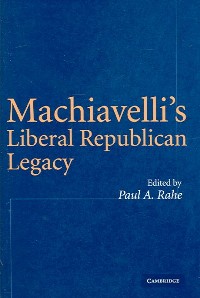
The significance of Machiavelli's political thinking for the development of modern republicanism is a matter of great controversy. This reassessment examines the character of Machiavelli's own republicanism by charting his influence on Marchamont Nedham, James Harrington, John Locke, Algernon Sidney, John Trenchard, Thomas Gordon, David Hume, the baron de Montesquieu, Benjamin Franklin, George Washington, John Adams, Thomas Jefferson, James Madison, and Alexander Hamilton. Concluding that although Machiavelli himself was not liberal, Paul Rahe argues that he did, nonetheless, set the stage for the emergence of liberal republicanism in England.
目录
Cover 1
Half-title 3
Title 5
Copyright 6
Dedication 7
Contents 9
Contributors 11
Acknowledgments 13
Abbreviations and Brief Titles 15
Introduction 21
Machiavelli\u2019s Modern Populism 23
The English Commonwealthmen 24
The Moderate Enlightenment 27
The American Founding 29
Prologue 33
Machiavelli\u2019s Break with Classical Republicanism 36
The Civil Way of Life: Orders and Laws 40
Necessary Evil 44
The Mixed Regime 46
The Elite and the Multitude 49
Founding, Good Customs, Corruption, and Return to Beginnings 53
War and Empire 58
Well-Ordered License 61
Machiavelli's Project 62
Part I The English Commonwealthmen 65
1 Machiavelli in the English Revolution 73
The Excellencie of a Free State 76
The Spirit of Popular Distrust 79
The End of Government 83
The Commonwealth of Oceana 86
A Republic Tongue-Ty\u2019d 93
An Immortal Commonwealth 96
2 The Philosophy of Liberty 100
The Liberation from Heaven 102
The Liberation from Teleology 107
Arms of One\u2019s Own 114
Conclusion 120
3 Muted and Manifest English Machiavellianism 122
Sidney\u2019s Muted Machiavellianism 125
Cato\u2019s Manifest Machiavellianism 139
Conclusion 150
Part II The Moderate Enlightenment 151
4 Getting Our Bearings 158
Machiavelli and the Tradition 161
Machiavelli and His Successors 168
Hume and Machiavelli 172
Conclusion 180
5 The Machiavellian Spirit of Montesquieu\u2019s Liberal Republic 185
Necessity and Republican Faction 188
The Moderation of Machiavellism in The Spirit of Laws 195
Separation of Powers and the Constitutional Politics of Moderation 197
The Moderating Spirit of Judging and the Rule of Law 201
Machiavellian Moderation and the Perpetuation of Liberal Constitutionalism 204
6 Benjamin Franklin's \u201cMachiavellian\u201d Civic Virtue 207
Franklin\u2019s Realpolitik 208
Franklin and Modern Science 211
Franklin and Modern Philosophy 214
Humanity and Religion 221
Civility 225
Part III The American Founding 231
7 The American Prince? 234
Washington\u2019s Virtue 237
The Washingtonian Moment 239
New Modes and Orders? 243
Thoughts on Machiavelli and Washington 246
Conclusion 250
8 John Adams\u2019s Machiavellian Moment 253
\u201cReason in Matters of Government\u201d 255
Reviving the \u201cAncient Politics\u201d 264
Conclusion 270
9 Thomas Jefferson\u2019s Machiavellian Political Science 272
The Politics of Distrust 274
Wolves and Sheep 276
Institutions vs. Tumults 277
Prerogative 278
Anticipation, Resistance, and Revolution 282
The Logic of Jefferson\u2019s Legislative Program 285
Popular Education, Ward Republics, and Political Jealousy 289
10 James Madison\u2019s Princes and Peoples 293
Founding and the Few 296
Maintenance and the Many 306
11 Was Alexander Hamilton a Machiavellian Statesman? 318
By Our Own Arms and Virtue 320
Waging War and Sustaining Liberty 328
Hamilton\u2019s Anti-Machiavellian Republic 338
Index 343
Half-title 3
Title 5
Copyright 6
Dedication 7
Contents 9
Contributors 11
Acknowledgments 13
Abbreviations and Brief Titles 15
Introduction 21
Machiavelli\u2019s Modern Populism 23
The English Commonwealthmen 24
The Moderate Enlightenment 27
The American Founding 29
Prologue 33
Machiavelli\u2019s Break with Classical Republicanism 36
The Civil Way of Life: Orders and Laws 40
Necessary Evil 44
The Mixed Regime 46
The Elite and the Multitude 49
Founding, Good Customs, Corruption, and Return to Beginnings 53
War and Empire 58
Well-Ordered License 61
Machiavelli's Project 62
Part I The English Commonwealthmen 65
1 Machiavelli in the English Revolution 73
The Excellencie of a Free State 76
The Spirit of Popular Distrust 79
The End of Government 83
The Commonwealth of Oceana 86
A Republic Tongue-Ty\u2019d 93
An Immortal Commonwealth 96
2 The Philosophy of Liberty 100
The Liberation from Heaven 102
The Liberation from Teleology 107
Arms of One\u2019s Own 114
Conclusion 120
3 Muted and Manifest English Machiavellianism 122
Sidney\u2019s Muted Machiavellianism 125
Cato\u2019s Manifest Machiavellianism 139
Conclusion 150
Part II The Moderate Enlightenment 151
4 Getting Our Bearings 158
Machiavelli and the Tradition 161
Machiavelli and His Successors 168
Hume and Machiavelli 172
Conclusion 180
5 The Machiavellian Spirit of Montesquieu\u2019s Liberal Republic 185
Necessity and Republican Faction 188
The Moderation of Machiavellism in The Spirit of Laws 195
Separation of Powers and the Constitutional Politics of Moderation 197
The Moderating Spirit of Judging and the Rule of Law 201
Machiavellian Moderation and the Perpetuation of Liberal Constitutionalism 204
6 Benjamin Franklin's \u201cMachiavellian\u201d Civic Virtue 207
Franklin\u2019s Realpolitik 208
Franklin and Modern Science 211
Franklin and Modern Philosophy 214
Humanity and Religion 221
Civility 225
Part III The American Founding 231
7 The American Prince? 234
Washington\u2019s Virtue 237
The Washingtonian Moment 239
New Modes and Orders? 243
Thoughts on Machiavelli and Washington 246
Conclusion 250
8 John Adams\u2019s Machiavellian Moment 253
\u201cReason in Matters of Government\u201d 255
Reviving the \u201cAncient Politics\u201d 264
Conclusion 270
9 Thomas Jefferson\u2019s Machiavellian Political Science 272
The Politics of Distrust 274
Wolves and Sheep 276
Institutions vs. Tumults 277
Prerogative 278
Anticipation, Resistance, and Revolution 282
The Logic of Jefferson\u2019s Legislative Program 285
Popular Education, Ward Republics, and Political Jealousy 289
10 James Madison\u2019s Princes and Peoples 293
Founding and the Few 296
Maintenance and the Many 306
11 Was Alexander Hamilton a Machiavellian Statesman? 318
By Our Own Arms and Virtue 320
Waging War and Sustaining Liberty 328
Hamilton\u2019s Anti-Machiavellian Republic 338
Index 343
- 名称
- 类型
- 大小
光盘服务联系方式: 020-38250260 客服QQ:4006604884
云图客服:
用户发送的提问,这种方式就需要有位在线客服来回答用户的问题,这种 就属于对话式的,问题是这种提问是否需要用户登录才能提问
Video Player
×
Audio Player
×
pdf Player
×
