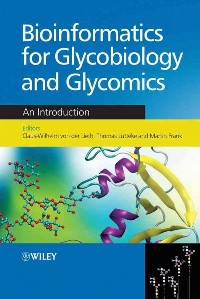
Bioinformatics for glycobiology and glycomics : an introduction /
作者: edited by Claus-Wilhelm von der Lieth, Thomas L?tteke and Martin Frank.
出版社:
简介:Summary:
Publisher Summary 1
This book is the first to be dedicated to the bioinformatics of carbohydrates and glycoproteins. It provides an introduction to this emerging field of science both for the experimentalist working in glycobiology and glycomics, and also for the computer scientist looking for background information for the development of highly sophisticated algorithmic approaches. The book provides an overview of the state-of-the-art in the field, with reviews on databases, and the tools in use for analysis, interpretation, and prediction of the structures of complex carbohydrates, and demonstrates the value of bioinformatics for glycobiology.
The availability of comprehensive databases and corresponding bioinformatics tools, to access and analyse the large amounts of experimental data relating to the structure of carbohydrates, will be a prerequisite for the success of the large-scale glycomics projects that aim to decipher new, so far unknown, biological functions of glycans. Efficient bioinformatics descriptions and tools can considerably enhance the efficiency of glycomics research, in terms of data quality, analysis and experimental costs.
For a complete understanding of the molecular processes in which carbohydrates are involved, such as proteincarbohydrate interactions and the impact of glycosylation on protein function, knowledge of the 3D structure of the carbohydrate, the protein-carbohydrate complex, or the glycoprotein is often indispensable. This book provides a thorough introduction into methods used for conformational analysis of carbohydrates.
Publisher Summary 2
Glycobiology has been described as a "Cinderella field" of research, since it focuses on the analysis of complex carbohydrates (or glycans), rather than sexier genomes and proteins; furthermore, classical proteomics databases and tools cannot not be directly applied in glycomics. In this valuable contribution to the field, now that carbohydrates are understood to play a key role in normal cell development and disease, the late von der Lieth (formerly at the German Cancer Research Center, Heidelberg) and German colleagues introduce the bioinformatics software tools available to interpret results from mass spectrometry in glycobiology,. In 22 chapters, international scientists in the molecular biosciences and related fields treat the emerging study of post-translational protein modifications and related topics. Appendices provide websites and a glossary. Annotation 漏2010 Book News, Inc., Portland, OR (booknews.com)
Publisher Summary 3
This book is the first to be dedicated to the bioinformatics of carbohydrates and glycoproteins.聽 聽It provides an introduction to this emerging field of science both for the experimentalist working in glycobiology and glycomics, and also for the computer scientist looking for background information for the development of highly sophisticated algorithmic approaches.聽 The book provides an overview of the state-of-the-art in the field, with reviews on databases, and the tools in use for analysis, interpretation, and prediction of the structures of complex carbohydrates, and demonstrates the value of bioinformatics for glycobiology.聽The availability of comprehensive databases and corresponding bioinformatics tools, to access and analyse the large amounts of experimental data relating to the structure of carbohydrates, will be a prerequisite for the success of the large-scale glycomics projects that aim to decipher new, so far unknown, biological functions of glycans.聽 聽Efficient bioinformatics descriptions and tools can considerably enhance the efficiency of glycomics research, in terms of data quality, analysis and experimental costs.For a complete understanding of the molecular processes in which carbohydrates are involved, such as protein鈥揷arbohydrate interactions and the impact of glycosylation on protein function, knowledge of the 3D structure of the carbohydrate, the protein鈥揷arbohydrate complex, or the glycoprotein is often indispensable. This book provides a thorough introduction into methods used for conformational analysis of carbohydrates.Key features:Describes bioinformatic approaches to handle carbohydrate-active enzymes and glycosylation.Provides an overview on bioinformatics tools that facilitate analysis of carbohydrate structures.Gives introduction into molecular modelling of carbohydrate 3D structure and carbohydrates contained in the Protein Databank.Assumes only a basic knowledge of biology and bioinformatics.聽