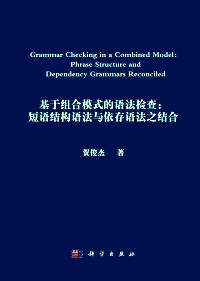
Grammar checking in a combined model: phrase structure and dependency grammars reconciled
作者: 贺俊杰著
出版社:科学出版社,2011
简介: grammar checking is an interesting field within computational linguistics. different technologies and methods have been used in this area. to name a few of them, kukich (1992), atwell and elliott (1987),douglas and dale (1992), golding and schabes (1996; kukich, 1992),bustamante and le6n (1996), gojenola and oronoz (2000) have tackled this problem from various points of view with different methodologies. besides these, there are some valuable research projects that are directly aimed at conducting grammar checking on a practical scale. kuenning's ispell and atkinson's aspell, bernth's easyenglish, jensen, heidorn, and richardson's critique, bustamante and le6n's gramcheck and bredenkamp, crysmann, and petrea's flag are examples of these projects.
even though researches on grammar checking can be carried out through deterministic or non-deterministic methods, checking the grammaticality using an appropriate parsing technology is a way that deserves our interest and exertion. in order to build up a robust grammar checking program, we need a robust parsing system, which is reliably accurate and fast. up till now numerous parsers have been developed within different frameworks with different strategies,among which, the link grammar parser, designed by sleator and temperley (1991; lafferty, sleator, & temperley, 1992) is a good candidate to our needs. rather than on a model that requires to examine the basic context of a word within a sentence, the link parser is based on a model that words within a text form "links" with one another. in this respect, the link grammar is theoretically linked with the grammar school of dependency grammar. the fundamental working mechanism of the link parser is that the linking requirement of all the words in the sentence should be satisfied. the importance ofthis mechanism lies in its potentiality of helping determine the grammaticality of sentences. this is a peculiar quality that most other parsing systems lack, whether they are in the statistical framework or in the rule-based framework.