作者:
出版社:
简介:
Book Description
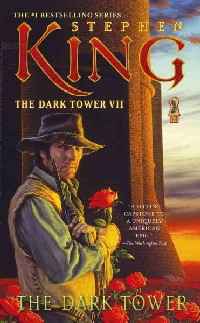
All good things must come to end. Constant Listener, and not even Stephen King can write a story that goes on forever. The tale of Ronald Deschain's relentless quest for the Dark Tower has, the author fears, sorely tried the patience of those who have followed it from its earliest chapters. But attend to it a while longer, if it pleases you, for this volume is the last, and often the last things are best.
Roland's ka-tet remains intact, though scattered over wheres and whens. Susannah-Mia has been carried from the Dixie Pig (in the summer of 1999) to a birthing room -- really a chamber of horrors - in Thunderclap's Fedic Station; Jake and Father Callahan, with Oy between them, have entered the restaurant on Lex and 61st with weapons drawn, little knowing how numerous and noxious are their foes. Roland and Eddie are with John Cullum in Maine, in 1977, looking for the site on Turtleback Lane where "walk-ins" have been often seen. They want desperately to get back to the others, to Susannah especially, and yet they have come to realize that the world they need to escape is the only one that matters.
Thus the audiobook opens, like a door to the uttermost reaches of Stephen King's imagination. You've come this far. Come a little father. Come all the way. The sound you hear may be the slamming of the door behind you. Welcome to The Dark Tower.
Amazon.com
At one point in this final book of the Dark Tower series, the character Stephen King (added to the plot in Song of Susannah) looks back at the preceding pages and says "when this last book is published, the readers are going to be just wild." And he's not kidding.
After a journey through seven books and over 20 years, King's Constant Readers finally have the conclusion they've been both eagerly awaiting and silently dreading. The tension in the Dark Tower series has built steadily from the beginning and, like in the best of King's novels, explodes into a violent, heart-tugging climax as Roland and his ka-tet finally near their goal. The body count in The Dark Tower is high. The gunslingers come out shooting and face a host of enemies, including low men, mutants, vampires, Roland's hideous quasi-offspring Mordred, and the fearsome Crimson King himself. King pushes the gross-out factor at times--Roland's lesson on tanning (no, not sun tanning) is brutal--but the magic of the series remains strong and readers will feel the pull of the Tower as strongly as ever as the story draws to a close. During this sentimental journey, King ties up loose ends left hanging from the 15 non-series novels and stories that are deeply entwined in the fabric of Mid-World through characters like Randall Flagg (The Stand and others) or Father Callahan (Salem's Lot). When it finally arrives, the long awaited conclusion will leave King's myriad fans satisfied but wishing there were still more to come.
In King's memoir On Writing, he tells of an old woman who wrote him after reading the early books in the Dark Tower series. She was dying, she said, and didn't expect to see the end of Roland's quest. Could King tell her? Does he reach the Tower? Does he save it? Sadly, King said he did not know himself, that the story was creating itself as it went along. Wherever that woman is now (the clearing at the end of the path, perhaps?), let's hope she has a copy of The Dark Tower. Surely she would agree it's been worth the wait.
--Benjamin Reese
From Publishers Weekly
A pilgrimage that began with one lone man's quest to save multiple worlds from chaos and destruction unfolds into a tale of epic proportions. While King saw some criticism for the slow pace of 1982's The Gunslinger, the book that launched this series, The Drawing of the Three (Book II, 1987), reeled in readers with its fantastical allure. And those who have faithfully journeyed alongside Roland, Eddie, Susannah, Jake and Oy ever since will find their loyalty toward the series' creator richly rewarded.The tangled web of the tower's multiple worlds has manifested itself in many of King's other works— The Stand (1978), Insomnia (1994) and Hearts in Atlantis (1999), to name a few. As one character explains here, "From the spring of 1970, when he typed the line The man in black fled across the desert, and the gunslinger followed... very few of the things Stephen King wrote were 'just stories.' He may not believe that; we do." King, in fact, intertwines his own life story deeper and deeper into the tale of Roland and his surrogate family of gunslingers, and, in this final installment, playfully and seductively suggests that it might not be the author who drives the story, but rather the fictional characters that control the author.This philosophical exploration of free will and destiny may surprise those who have viewed King as a prolific pop-fiction dispenser. But a closer look at the brilliant complexity of his Dark Tower world should explain why this bestselling author has finally been recognized for his contribution to the contemporary literary canon. With the conclusion of this tale, ostensibly the last published work of his career, King has certainly reached the top of his game. And as for who or what resides at the top of the tower... The many readers dying to know will have to start at the beginning and work their way up. 12 color illus. by Michael Whelan.
From The Washington Post's Book World/washingtonpost.com
The long march to the Dark Tower began in 1970 when Stephen King, still a fledgling writer with outsized ambitions, was an undergraduate at the University of Maine. It was then that he wrote the opening chapters of the first book in the series. The project faltered for a while, was eventually revived and has since proceeded in fits and starts, with gaps as long as six years between installments. Recently, in the aftermath of his near-fatal accident in 1999, King turned his full attention to this long, protracted saga, producing three large volumes in rapid succession. The seventh and final volume, The Dark Tower, should more than satisfy his voracious readers. It is an absorbing, constantly surprising novel filled with true narrative magic, a fitting capstone to a uniquely American epic.
Inspiration for that epic comes from all points of the aesthetic compass. The primary source is Robert Browning's narrative poem "Childe Roland to the Dark Tower Came," which provided King with his central motif and a name for his carved-from-granite protagonist: Roland Deschain of Gilead. Other sources include J.R.R. Tolkien, L. Frank Baum, Clifford D. Simak and the work of filmmakers such as John Sturges, Akira Kurosawa and -- most centrally -- Sergio Leone. Leone's sprawling "spaghetti western" "The Good, the Bad, and the Ugly," created the template for Roland -- a distinctly Clint Eastwood-like figure -- and for the alternately brutal and beautiful landscape through which he journeys.
That journey begins with the memorable opening sentence: "The man in black fled across the desert and the gunslinger followed." Roland, a lineal descendant of King Arthur, is the last gunslinger in a rapidly decaying world. He has embarked on a quest for the eponymous tower, which stands at the nexus of all times and places, binding together an infinite number of parallel worlds. The tower, held in place by a number of intersecting "beams," is under attack by a psychotic entity known as the Crimson King, who plans to tear it down and rule forever in the chaos that will follow. Roland's twin goals are to preserve the tower -- and, by extension, the worlds it supports -- and to climb to the room at the top of that tower, where an unknown fate awaits him.
The first few volumes focus on Roland's efforts to draw a trio of prospective companions from three different versions of 20th-century America. The first of these is Eddie Dean, a heroin addict rapidly running out of hope and chances. The second is Odetta Holmes, a crippled civil rights activist with multiple personalities who eventually becomes known as Susannah. The third is Jake Chambers, an 11-year-old boy who returns from the dead to join Roland's cadre of apprentice gunslingers. These three form the core of the "ka-tet" (i.e., sacred fellowship) that will accompany Roland on his quest. They are joined, at various stages, by many others, including Father Donald Callahan, a central figure in Salem's Lot (1975), and a popular (and endangered) novelist named Stephen King, who has a crucial story to tell.
By the time the final volume opens, the ka-tet is closer to the tower after surviving a daunting array of pitched battles, supernatural encounters, out-of-body experiences and journeys between worlds. On the heels of the multiple cliffhangers that ended the previous volume, Song of Susannah, a number of critical developments are under way. Jake and Father Callahan move toward a fateful meeting in a Manhattan restaurant called the Dixie Pig. Susannah gives birth to a murderous, shape-shifting entity named Mordred. Roland himself, accompanied by Eddie Dean, travels to the town of Lowell, Maine, where the border between worlds has grown thin and permeable. In time, the diminished ka-tet reassembles, resuming its increasingly treacherous journey. Their path leads from Algul Siente, where imprisoned "breakers" chip away at the two remaining beams, back to Maine, where Stephen King awaits his life-altering encounter with an out-of-control Dodge Caravan. From there, the path moves through a blighted, wintry landscape leading to a field of roses where the Tower awaits.
King combines these diverse elements into an archetypal quest fantasy distinguished by its uniquely Western flavor, its emotional complexity and its sheer imaginative reach. In the course of nearly 4,000 pages, the Dark Tower saga fuses slightly skewed autobiography with an extravagant portrait of an imperiled multiverse. The series as a whole -- and this final volume in particular -- is filled with brilliantly rendered set pieces (including a stand-up comedy routine that turns unexpectedly lethal), cataclysmic encounters and moments of desolating tragedy. In the end, King holds it all together through sheer narrative muscle and his absolute commitment to his slowly unfolding -- and deeply personal -- vision.
As King notes in his afterword, the series has become his "ubertale." As such, it has gradually established a web of connections with much of his earlier fiction. The most prominent example is the reappearance of Father Callahan, who was last seen in ignominious retreat from the vampire-infested village of Jerusalem's Lot. In his new incarnation, "Pere" Callahan is an affecting, multidimensional character for whom redemption, which once seemed impossible, has come suddenly within reach.
Elsewhere in the series, Randall Flagg, architect of the apocalypse in The Stand (1978), shows up in a variety of guises, among them that of the man in black whose flight across the desert in volume one began the story. Also back are Dinky Earnshaw (Everything's Eventual) and Ted Brautigan ("Low Men in Yellow Coats"), who now work together as conscripted, ultimately rebellious "breakers." And Patrick Danville, who appeared briefly onstage in Insomnia, joins the ka-tet in the final stages of its journey and plays a pivotal role in the climactic confrontation with the Crimson King. Other, less overt references -- names, phrases and images that deliberately echo similar elements of earlier books -- are scattered throughout the text, creating the sense of a coherent, if loosely connected, fictional universe.
Although King's detractors -- a vocal, often contentious bunch -- will doubtless disagree, The Dark Tower stands as an imposing example of pure storytelling. King has always believed in the primal importance of story, and his entire career -- encompassing 40 novels and literally hundreds of shorter works -- is a reflection of that belief. On one level, the series as a whole is actually about stories, about the power of narrative to shape and color our individual lives. It is also, beneath its baroque, extravagant surface, about the things that make us human: love, loss, grief, honor, courage and hope. On a deeper level still, it is a meditation on the redemptive possibility of second chances, a subject King knows intimately. In bringing this massive project to conclusion, King has kept faith with his readers and made the best possible use of his own second chance. The Dark Tower is a humane, visionary epic and a true magnum opus. It will be around for a very long time.
Reviewed by Bill Sheehan
From Booklist
The end of King's quantitative magnum opus, the Dark Tower, some 34 years in the making and god knows how many thousands of pages long, begins where Song of Susannah [BKL My 1 04] left off. Boy gunslingers Jake and Pere Callahan (once upon a time, the priest of 'Salem's Lot) are entering the Dixie Pig Cafe in Manhattan, in whose backrooms the heir of two fathers--the evil Crimson King, lord of the Dark Tower, and the saga's hero, the gunslinger Roland Deschain--is aborning. Chief gunslinger Roland and Eddie Dean, whose fellow gunslinger and wife, Susannah, is bearing the horrid child in tandem with the formerly immortal Mia (two dads require two moms, though the moms are merged, the dads poles apart), are speeding to the rescue from Maine. Neither birth nor rescue is short-circuited, but abandon all hope that either develops straightforwardly. The tower is ever so digressively approached, and many die in the process. It would be unforgivable to leak just who in Roland's ka-tet--he, Eddie and Susannah, Jake, and the billybumbler Oy--achieves the tower with him, but saying that the tower is achieved gives nothing essential away. Despite plenty of action and quite a few unforeseen bombshells, this massive conclusion may strike some as drawn out. King leans on his talent for covering 30 seconds of action in, say, 30 pages, rather too often. But what the vast, allusive (to several other King books and plenty of others) tale is all about is more teasingly evident than ever before: it's a fable, possibly theological, of creativity--among, indubitably, other things.
Ray Olson
From Bookmarks Magazine
"I’ve told my tale all the way to the end," King writes in the coda, "and am satisfied." Most readers will be, too. Satisfied, but also sad that after 22 years, nearly 4,000 pages, and seven installments, this archetypal fantasy quest series has ended. As in Song of Susannah, Dark Tower’s predecessor, King pens stunning set pieces, invents cataclysmic battles, and touches on familiar themes of good vs. evil. His writing is as powerful as ever—just imagine a demonic Mordred devouring his mother. But if there’s unanimous admiration for King’s genius, there’s no consensus about Dark Tower. Some critics argue that each piece of the convoluted plot fits into King’s larger vision. Others call the work imperfect for this lofty ambition of a greater whole. Some view King’s insertion of himself as a character as brilliant while others fault it as pretentious. But King fans and novices alike will find Dark Tower a "fitting capstone to a uniquely American epic" (Washington Post). Just don’t start in the middle.
Book Dimension
length: (cm)17.2 width:(cm)10.5