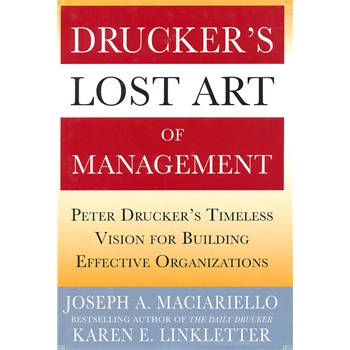
Druckers Lost Art Of Management 德鲁克:管理中损失的艺术
作者: Joseph A Maciariello 等著
出版社:McGraw-Hill 2011年4月
简介:A framework for improving managerial effectivenessbased on thetimeless principles of Peter Drucker Peter Drucker believed thatmanagement, at its core, is a liberal artthat it is inherently ahuman activity and, as such, must be informed by the disciplinesthat affect human character development, cooperation, performance,innovation, and change. Managers informed by philosophy,literature, law, art, psychology, and other such disciplines,according to Drucker, make the best managers. In Drucker's Lost Artof Management, the world's foremost Drucker scholar and the firstDrucker archivist investigate their subject's timeless vision tocreate a new, more effective management approach. Maciariello andLinkletter explain Drucker's vision for creating a society offunctioning organizationsa society in which citizenship andbusiness interests benefited one another. His management principleswere at the core of this vision. Each of the five chapters in thebook integrates disciplines in the liberal arts with requirementsto successfully manage organizations by addressing key issues,including: The effective distribution of power and authority Thedevelopment of human beings at work, both intellectually andmorally The creation of leaders who are dedicated to the mission oftheir organization and possess the skill and judgment necessary toachieve their missions The advancement of the practice ofmanagement through the use of the liberal arts The application ofsystematic processes for creating new wealth through innovation andchange Today, more than ever, Drucker's concepts need to be putinto action. Drucker's Lost Art of Managementis a clarion call forimproving management practices presently in a state of acutecrisis. Introduction; Chapter 1:Origins of Management as a LiberalArt in Peter Drucker's Writings; Chapter 2:Management and LiberalArts Traditions: Bridging the Two Worlds; Chapter 3:Contributionsof Management as a Liberal Art; Chapter 4:Federalism and theDistribution of Power and Authority; Chapter 5:The Human Dimensionand Management as a Liberal Art; Chapter 6:Effective Leadership asa Liberal Art; Chapter 7:Social Ecology and the Practice ofManagement as a Liberal Art; Chapter 8:Applied Social Ecology:Innovation and Change for a Hopeful and Bearable Society;Conclusion