作者:
出版社:
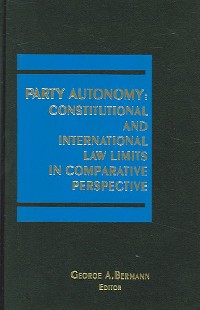
简介:This volume treats, through comparative law, the question of the restrictions on private autonomy that increasingly flow from international treaties and national constitutions. While limitations on private autonomy traditionally found their basis in various doctrines in the relevant private law field (such as contracts, property or trusts and estates), it is "higher" law - notably constitutional and international law - that more and more often prescribe those limitations. This particular interface between "private" and "public" law has seldom been explored, least of all comparatively.
Unsurprisingly, in a matter as new and evolving as this one, sharp differences emerge among states in the extent to which constitutional and international norms play an identifiable role in the resolution of disputes over the free assertion and disposition of private law rights. Some, but not all states have experienced remarkable developments in the recognition of either constitutional or international norms - and occasionally both - in this regard. Some make a concerted effort to integrate these limitations (notwithstanding their constitutional or international law origins) into the doctrinal fabric of private law (again be it contracts, property or trusts and estates). Others permit constitutional and international treaty norms to perform this function in a more autonomous and clearly identifiable way, which may have the effect, depending on the country, of heightening or lessening the legal force of these restrictions compared to those derived from private law proper.
Finally, states diverge even more when it comes to determining the modalities by which international and constitutional restrictions on party autonomy are to be enforced. In addition to the ordinary array of private law remedies that a legal system has developed for the assertion of claims within the private law field, some states have established special enforcement mechanisms designed to reflect the special character and status of those autonomy-limiting claims that find their origins in national constitutions or in international treaties to which the state in question may be a party.
The subject of Party Autonomy: Constitutional and International Limits in Comparative Perspective was among the topics addressed at the latest (XVIth) international congress of comparative law, held in Brisbane, Australia, in July 2002. National reports from 12 countries were presented, as was a synthetic report by the general reporter of the congress for this topic. These general and national reports comprise the body of this new volume.
Chapter Authors: John Trone, Australia -T C Beirne School of Law, University of Queensland Philippe Vincent, Belgium -Assistant Senior Lecturer, Faculty of Law, University of Liege Véra Jacob de Fradera, Brazil -Professor at the Federal University of Rio Grande do Sul, Brasil. Frédérique Sabourin, Canada -Attorney, Department of Justice, Québec, Director of Legal Affairs Michel Grimaldi, France -Professor, University at Panthéon-Assas (Paris II) Francois Barrière, Doctor of Law Dr. Georg Nolte, Germany -Professor of Law, University of Goettingen Prof. Dr. László Bodnar, Hungary - Professor and Vice Dean, Faculty of Law Jozsef Attila University, Budapest Mariko Kawano, Japan -Associate Professor of International Law, Institute of Social Sciences, University of Tsukuba, Japan Martijn van Empel, Netherlands -Professor at LUISS Guido Carli University, Rome, Partner, at Stibbe Amsterdam. Marianne de Jong, Netherlands -Ph.D Research Associate, Amsterdam Center for International Law Anna Wyrozumska, Poland -Professor of Public International Law, Faculty of Law and Administration, University of Lodz, Poland. Max du Plessis, South Africa -Senior Lecturer, Howard College School of Law, University of Natal; Advocate of the High Court of South Africa. Jolyon Ford, Lecturer, Faculty of Law, University of Sydney Paul B. Stephan, United States -Lewi