作者:
出版社:
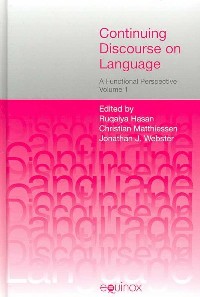
简介:Table of Contents: Volume One Part One: The Beginnings 1. M.A.K. Halliday: The Early Years 1925-70 (Jonathan Webster, City University of Hong Kong); 2. The Development of Systemic-Functional Linguistics in China (Huang Guowen, Sun Yat-sen University, Guangzhou, China); 3. SFL: A Working Model of Language (Christian Matthiessen, Macquarie University, and Ruqaiya Hasan) Part Two: Around Language 4. Language and Society (Ruqaiya Hasan); 5. Method and Imagination in Halliday's Science of Linguistics (David Butt, University of Sydney); 6. Topics in Multimodality (Radan Martinec); 7. Interpersonal Gateway to Meaning and Mind (Paul Thibault, Universita Ca' Foscari di Venezia) Part Three: With Language 8. What People Do to Know (Astika Kappagoda, University of Wollongong); 9. Developing Dimensions of an Educational Linguistics (Frances Christie, University of Sydney and Len Unsworth, University of New England, Australia); 10. Designing Literacy Pedagogy (J.R. Martin and David Rose); 11. Grammatics in Schools (Geoff Williams, University of Sydney); 12. SFL in Text Based Web-Enhanced Language Study (Carol Taylor Torsello and Anthony Baldry, both Universita di Padova); 13. SFL in Computational Contexts (Mick O'Donnell and John Bateman, University of Bremen); 14. Acquired Language Disorders Perspective (Elizabeth Armstrong, Macquarie University, Alison Ferguson, University of Newcastle, Australia, Lynne Mortensen, Macquarie University and Leanne Togher, University of Sydney); 15. SFL and the Study of Literature (Jonathan Webster and Annabelle Lukin); 16. Semantic Variation (Geoff Williams); 17. Halliday and Translation Theory (Erich Steiner, Universitat des Saarlandes) Volume Two Part Four: Inside Language 18. The 'Architecture' of LanguageAccording to Systemic Functional Theory (Christian Matthiessen); 19. From Microfunction to Metaphor (Clare Painter, University of New South Wales, Beverley Derewianka, University of Wollongong, and Jane Torr, Macquarie University); 20. The Work of Concepts (David Butt and Rebekah Wegener, Macquarie University; 21. Field in Multimodal Texts (Wendy Bowcher, Tokyo Gakugei University); 22. Models of Discourse (Carmel Cloran, University of Wollangong, Virginia Stuart-Smith and Lynne Young, Carleton University); 23. Unfolding Theme (Geoff Thompson, University of Liverpool); 24. Semantic Networks (Ruqaiya Hasan, Carmel Cloran, Geoff Williams, University of Sydney, and Annabelle Lukin, Macquarie University); 25. Invoking Attitude (J.R. Martin, University of Sydney, and Susan Hood, University of Technology, Sydney) 26. Sydney SFL Grammar (Christian Matthiessen); 27. A Systemic-Functional Approach to the Typology of MOOD Process (Kazuhiro Teruya, Ernest Akerejola, Macquarie University, Alice Caffarel, University of Sydney, Julia Lavid, Universidade Computense, Christian Matthiessen, Uwe Helm Petersen, Odense Universitet, Flemming Smedegaard, Odense Universitet, Thomas Hestbaek Andersen, Odense Universitet, and Pattama Patpong, Macquarie University); 28. Auxiliary Extensions (Robin Fawcett, Cardiff University); 29. Between Lexis and Grammar (Gordon Tucker, Cardiff University); 30. Intonation in Systemic Functional Linguistics (William Greaves, York University, Canada). 1000p, 2 vols. (Equinox Publishing 2005 (vol 1), 2007 (vol 2))