作者:
出版社:
简介:Summary:
Publisher Summary 1
`A much-needed assessment of the crisis from the Latin American perspective. Juan Corradi provides a structural view of late capitalism and the necessary conditions for recovery and growth... Food-for-thought for those interested in the future of this region.' --- Alejandro Rausch, Consultant for Private Sector Development, Poverty, HD and MDGs Cluster, United Nations Development Program Regional Bureau for Latin America and the Caribbean
`South of the Crisis is not your usual academic treatise. This exploration of the effects of the 2007-09 financial crisis on the emerging market economies mixes rational insights with just and compassionate policy prescriptions. With an emphasis on Latin America, Juan Corradi unveils the variable effects of advanced capitalism on the developing countries, as well as the political opportunities for more equitable reform that the crisis itself has offered up.' ---Carol Wise, Associate Professor, University of Southern California School of International Relations
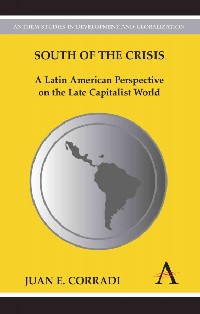
South of the Crisis examines why and how global capitalism has entered a phase of unsustainable crises of accumulation and legitimacy, and looks at various solutions to such crises, from mild reform to radical overhaul. The book then examines the various scenarios from a Latin American perspective, and explains how different countries are likely to try diverse experiments in adapting to the crisis - with significantly different outcomes. Yet the common challenge faced by all Latin American countries, albeit with different modalities, is how to achieve economic growth with social inclusion. Corradi investigates the pros and cons of different policy solutions to the challenge of inclusion.
Publisher Summary 2
In the words of its author, this work is "a set of polemical perspectives on the dynamics of globalization by a Latin American who stands in a New York observatory." Corradi (sociology, New York U.) addresses the nature of the economic crisis that began in the United States and spread outward to Latin America and the rest of the world and considers how Latin American countries might respond to it, suggesting that the crisis has revealed and reinforced the limits of US power and has thus afforded a number of Latin American countries with greater room to establish new alliances and experiment with new methods of development, or "other capitalisms." Later he offers a specific focus on the paths available to Cuba, Argentina, Brazil, and Mexico. Distributed in the US by Books International, Inc. Annotation 漏2011 Book News, Inc., Portland, OR (booknews.com)