

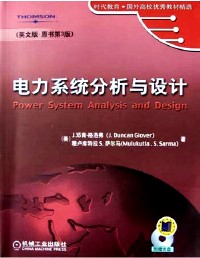
简介
序
本书的主要内容是介绍电力系统分析和设计的方法,使学生对有关电力系统工程的宽范围
内的课题有清楚的认识,特别是可以借助个人计算机,使大学本科生充分地理解电力系统的基
本理论和方法,并得到相应的训练。
本书的主要特点有:
1.对于电气工程专业的大学生来说,本书内容十分全面,这是美国教材不同于我国教材之
处。对于本书的内容,国内通常是分成几本教材来编写出版的,类似的教材如《电力系统分
析》、《电力工程》、《电能系统基础》等都没有本书全面。
2.编写内容新。本书是第3版,内容反映了电力系统领域内的最新问题和研究成果,包括
电力市场环境下电力系统的一些问题。
3.每章开始均有“案例研究”(CaseStudy)部分,介绍与本章学习内容有关的历史、最新
进展等,并提出一些问题。例如,第6章“潮流”的案例研究介绍了可视化电网和潮流研究计
算的简要历史。可视化电网是最新的研究成果,也是今后电力系统潮流计算、研究的方向。其
中关于潮流管理、网络控制、电力市场环境下的线路阻塞、三维网络图、市场力等问题都是很
新的。第13章“暂态稳定性”的案例研究讲述了美国的大停电,这能使学生更加明确学习本课
程的意义,很能激发学生的学习兴趣。
4.本书附有一张CD光盘,内容是“电力世界仿真器”(Power World Simulator)。Power
WorldSimulator是一个优秀的软件包,能够处理任何规模的电力系统,在大学、公司、政府管理
人员、电力市场人员等中被广泛使用。本书的CD在该软件平台上集成了计算例题、问题和课
程设计,对学生学习及理解概念和方法很有帮助。
5.每章都有丰富的习题和问题,有助于学生理解课程内容和基本概念。特别是书中还安排
了6个课程设计(Design Project),如“设计电力系统规划”、 “潮流/短路研究”等,学生可借
助于PowerWorld Simulator来完成这些设计。而在国内教学中,设计这一项基本被取消了。实际
上,对于科大学生来说,这是很重要的。本书中的设计(Design)内容,很值得国内教学借鉴。
本书两位作者都来自美国东北大学,该校在电力方面的教学和科学研究是比较优秀的。作
者编写本书时,同时也吸收了其他院校的一些教学成果。
本书适合作为本科电力系统或电气工程专业,以及机电类专业“电气工程”相关课程的双
语教学教材,也可作为相关专业研究生或电气工程师的参考书。
清华大学
周双喜
2004年5月
目录
preface
list of symbols, units, and notation xv
chapter i introduction i
case study: restructuring and reregulation of the u.s. electric utility
industry 2
1.1 history of electric power systems 5
1.2 present and future trends 12
1.3 electric utility industry structure 15
1.4 computers in power system engineering 16
1.5 powerworld simulator 17
chapter 2 fundamentals 25
case study: restructuring the thin-stretched grid 26
2.1 phasors 34
2.2 instantaneous power in single-phase ac circuits 36
2.3 complex power 41
2.4 network equations 46
2.5 balanced three-phase circuits 49
2.6 power in balanced three-phase circuits 57
2.7 advantages of balanced three-phase versus single-phase systems 61
chapter 3 power transformers 71
.case study: how electric utilities buy quality when they buy
transformers 72
3.1 the ideal transformer 76
3.2 equivalent circuits for practical transformers 82
3.3 the per-unit system 88
3.4 three-phase transformer connections and phase shift 96
3.5 per-unit equivalent circuits of balanced three-phase two-winding
transformers 101
3.6 three-winding transformers 106
3.7 autotransformers 109
3.8 transformers with off-nominal turns ratios 111
chapter 4 transmission-line parameters 130
case study: special report--transmission structures 131
4.1 transmission line design considerations 145
4.2 resistance 151
4.3 conductance 154
4.4 inductance: solid cylindrical conductor 154
4.5 inductance: single-phase two-wire line and three-phase three-wire
line with equal phase spacing 159
4.6 inductance: composite conductors, unequal phase spacing, bundled
conductors 162
4.7 series impedances: three-phase line with neutral conductors and
earth return 170
4.8 electric field and voltage: solid cylindrical conductor 175
4.9 capacitance: single-phase two-wire line. and three-phase three-wire
line with equal phase spacing 178
4.10 capacitance: stranded conductors, unequal phase spacing, bundled
conductors 180
4.11 shunt admittances: lines with neutral conductors and earth
return 184
4.12 electric field strength at conductor surfaces and at ground level 189
4.13 parallel circuit three-phase lines 192
chapter 5 transmission lines: steady. state operation 199
case study: facts technology development: an update 200
5.1 medium and short line approximations 208
5.2 transmission-line differential equations 215
5.3 equivalent circuit 221
5.4 lossless lines 223
5.5 maximum power flow 232
5.6 line loadability 234
5.7 reactive compensation techniques 239
chapter 6 power flows 250
case study: visualizing the electric grid 251
6.1 direct solutions to linear algebraic equations: gauss
elimination 261
6.2 iterative solutions to linear algebraic equations: jacobi and
gauss-seidel 265
6.3 iterative solutions to nonlinear algebraic equations:
newton-raphson 271
6.4 the power-flow problem 275
6.5 power-flow solution by gauss-seidel 281
6.6 power-flow solution by newton-raphson 284
6.7 control of power flow 292
6.8 sparsity techniques 296
6.9 fast decoupled power flow 299
design projects 1-5 307
chapter 7 symmetrical faults 319
case study: the problem of arcing faults in low-voltage power distribution
systems 320
7.1 series r-l circuit transients 322
7.2 three-phase short circuit--unloaded synchronous machine 325
7.3 power system three-phase short circuits 328
7.4 bus impedance matrix 332
7.5 circuit breaker and fuse selection 340
design project 4 (continued) 354
chapter 8 symmetrical components 3s6
8.1 definition of symmetrical components 357
8.2 sequence networks of impedance loads 362
8.3 sequence networks of series impedances 370
8.4 sequence networks of three-phase lines 372
8.5 sequence networks of rotating machines 374
8.6 per-unit sequence models of three-phase two-winding
transformers 380
8.7 per-unit sequence models of three-phase three-winding
transformers 385
8.8 power in sequence networks 388
chapter 9 unsymmetrical faults 396
case study: fires at u.s. utilities 397
9.1 system representation 398
9.2 single line-to-ground fault 403
9.3 line-to-line fault 408
9.4 double line-to-ground fault 410
9.5 sequence bus impedance matrices 417
design project 4 (continued) 435
design project 6 436
chapter 10 system protection 438
case study: digital relay reports verify power system models 439
10.1 system protection components 449
10.2 instrument transformers 450
10.30vercurrent relays 457
10.4 radial system protection 461
10.5 reclosers and fuses 466
10.6 directional relays 469
10.7 protection of two-source system with directional relays 471
10.8 zones of protection 472
10.9 line protection with impedance (distance) relays 475
10.10 differential relays 482
10.11 bus protection with differential relays 484
10.12 transformer protection with differential relays 485
10.13 pilot relaying 490
10.14 digital relaying 491
chapter ii power system controls 504
case study: meet the emerging transmission market segments 507
11.1 generator-voltage control 516
11.2 turbine-governor control 517
11.3 load-frequency control 521
11.4 economic dispatch 525
11.5 optimal power flow 538
chapter 12 transmission lines: transient operation 547
case study: protecting computer systems against power transients 548
case study: varistar type aze surge arresters 555
12.1 traveling waves on single-phase lossless lines 558
12.2 boundary conditions for single-phase lossless lines 561
12.3 bewley lattice diagram 570
12.4 discrete-time models of single-phase lossless lines and lumped
rlc elements 575
12.5 lossy lines 582
12.6 multiconductor lines 586
12.7 power system overvoltages 589
12.8 insulation coordination 596
chapter 13 transient stability 608
case study: the great blackout 610
13.1 the swing equation 613
13.2 simplified synchronous machine model and system equivalents 619
13.3 the equal-area criterion 621
13.4 numerical integration of the swing equation 628
13.5 multimachine stability 633
13.6 design methods for improving transient stability 638
appendix 644
index 648
list of symbols, units, and notation xv
chapter i introduction i
case study: restructuring and reregulation of the u.s. electric utility
industry 2
1.1 history of electric power systems 5
1.2 present and future trends 12
1.3 electric utility industry structure 15
1.4 computers in power system engineering 16
1.5 powerworld simulator 17
chapter 2 fundamentals 25
case study: restructuring the thin-stretched grid 26
2.1 phasors 34
2.2 instantaneous power in single-phase ac circuits 36
2.3 complex power 41
2.4 network equations 46
2.5 balanced three-phase circuits 49
2.6 power in balanced three-phase circuits 57
2.7 advantages of balanced three-phase versus single-phase systems 61
chapter 3 power transformers 71
.case study: how electric utilities buy quality when they buy
transformers 72
3.1 the ideal transformer 76
3.2 equivalent circuits for practical transformers 82
3.3 the per-unit system 88
3.4 three-phase transformer connections and phase shift 96
3.5 per-unit equivalent circuits of balanced three-phase two-winding
transformers 101
3.6 three-winding transformers 106
3.7 autotransformers 109
3.8 transformers with off-nominal turns ratios 111
chapter 4 transmission-line parameters 130
case study: special report--transmission structures 131
4.1 transmission line design considerations 145
4.2 resistance 151
4.3 conductance 154
4.4 inductance: solid cylindrical conductor 154
4.5 inductance: single-phase two-wire line and three-phase three-wire
line with equal phase spacing 159
4.6 inductance: composite conductors, unequal phase spacing, bundled
conductors 162
4.7 series impedances: three-phase line with neutral conductors and
earth return 170
4.8 electric field and voltage: solid cylindrical conductor 175
4.9 capacitance: single-phase two-wire line. and three-phase three-wire
line with equal phase spacing 178
4.10 capacitance: stranded conductors, unequal phase spacing, bundled
conductors 180
4.11 shunt admittances: lines with neutral conductors and earth
return 184
4.12 electric field strength at conductor surfaces and at ground level 189
4.13 parallel circuit three-phase lines 192
chapter 5 transmission lines: steady. state operation 199
case study: facts technology development: an update 200
5.1 medium and short line approximations 208
5.2 transmission-line differential equations 215
5.3 equivalent circuit 221
5.4 lossless lines 223
5.5 maximum power flow 232
5.6 line loadability 234
5.7 reactive compensation techniques 239
chapter 6 power flows 250
case study: visualizing the electric grid 251
6.1 direct solutions to linear algebraic equations: gauss
elimination 261
6.2 iterative solutions to linear algebraic equations: jacobi and
gauss-seidel 265
6.3 iterative solutions to nonlinear algebraic equations:
newton-raphson 271
6.4 the power-flow problem 275
6.5 power-flow solution by gauss-seidel 281
6.6 power-flow solution by newton-raphson 284
6.7 control of power flow 292
6.8 sparsity techniques 296
6.9 fast decoupled power flow 299
design projects 1-5 307
chapter 7 symmetrical faults 319
case study: the problem of arcing faults in low-voltage power distribution
systems 320
7.1 series r-l circuit transients 322
7.2 three-phase short circuit--unloaded synchronous machine 325
7.3 power system three-phase short circuits 328
7.4 bus impedance matrix 332
7.5 circuit breaker and fuse selection 340
design project 4 (continued) 354
chapter 8 symmetrical components 3s6
8.1 definition of symmetrical components 357
8.2 sequence networks of impedance loads 362
8.3 sequence networks of series impedances 370
8.4 sequence networks of three-phase lines 372
8.5 sequence networks of rotating machines 374
8.6 per-unit sequence models of three-phase two-winding
transformers 380
8.7 per-unit sequence models of three-phase three-winding
transformers 385
8.8 power in sequence networks 388
chapter 9 unsymmetrical faults 396
case study: fires at u.s. utilities 397
9.1 system representation 398
9.2 single line-to-ground fault 403
9.3 line-to-line fault 408
9.4 double line-to-ground fault 410
9.5 sequence bus impedance matrices 417
design project 4 (continued) 435
design project 6 436
chapter 10 system protection 438
case study: digital relay reports verify power system models 439
10.1 system protection components 449
10.2 instrument transformers 450
10.30vercurrent relays 457
10.4 radial system protection 461
10.5 reclosers and fuses 466
10.6 directional relays 469
10.7 protection of two-source system with directional relays 471
10.8 zones of protection 472
10.9 line protection with impedance (distance) relays 475
10.10 differential relays 482
10.11 bus protection with differential relays 484
10.12 transformer protection with differential relays 485
10.13 pilot relaying 490
10.14 digital relaying 491
chapter ii power system controls 504
case study: meet the emerging transmission market segments 507
11.1 generator-voltage control 516
11.2 turbine-governor control 517
11.3 load-frequency control 521
11.4 economic dispatch 525
11.5 optimal power flow 538
chapter 12 transmission lines: transient operation 547
case study: protecting computer systems against power transients 548
case study: varistar type aze surge arresters 555
12.1 traveling waves on single-phase lossless lines 558
12.2 boundary conditions for single-phase lossless lines 561
12.3 bewley lattice diagram 570
12.4 discrete-time models of single-phase lossless lines and lumped
rlc elements 575
12.5 lossy lines 582
12.6 multiconductor lines 586
12.7 power system overvoltages 589
12.8 insulation coordination 596
chapter 13 transient stability 608
case study: the great blackout 610
13.1 the swing equation 613
13.2 simplified synchronous machine model and system equivalents 619
13.3 the equal-area criterion 621
13.4 numerical integration of the swing equation 628
13.5 multimachine stability 633
13.6 design methods for improving transient stability 638
appendix 644
index 648
- 名称
- 类型
- 大小
光盘服务联系方式: 020-38250260 客服QQ:4006604884
云图客服:
用户发送的提问,这种方式就需要有位在线客服来回答用户的问题,这种 就属于对话式的,问题是这种提问是否需要用户登录才能提问
Video Player
×
Audio Player
×
pdf Player
×
亲爱的云图用户,
光盘内的文件都可以直接点击浏览哦
无需下载,在线查阅资料!
