

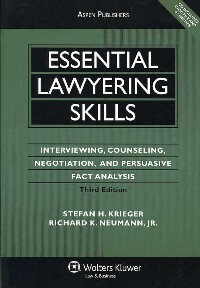
Essential lawyering skills : interviewing, counseling, negotiation, and persuasive fact analysis...
副标题:无
作 者:Stefan H. Krieger, Richard K. Neumann, Jr.
分类号:
ISBN:9780735564053
微信扫一扫,移动浏览光盘
简介
Summary:
Publisher Summary 1
This textbook instructs students in every specialty on the skills of interviewing, counseling, negotiation, and persuasive fact analysis in the practice of law. Krieger and Neumann (both law, Hofstra U.) stress themes of professionalism, working with and for the client, problem-solving, and communication and multicultural skills. Ethical issues are discussed in connection with all of the skills. In this edition, new topics such as decision theory, using creativity in generating options, drafting deals, the financial analysis of proposed agreements, and transactional bargaining are covered. More on narrative theory and legal storytelling is included, and a CD-ROM with a case file and planning exercises is provided. The volume teaches 18 of 26 effectiveness factors delineated by Marjorie Schultz and Sheldon Zedick, who are working on developing a law school admissions test that is more accurate than the LSAT. Annotation 漏2007 Book News, Inc., Portland, OR (booknews.com)
目录
TABLE OF CONTENTS
Acknowledgments xix
PART 1 BECOMING A LAWYER 1
Chapter 1 What This Book Is About 3
Chapter 2 Professionalism 7
§2.1 The Reflective Practitioner of Law 7
§2.2 Some Things Effective Lawyers Know 8
§2.3 What Is Happening to You 17
Chapter 3 Lawyering for and with the Client 19
§3.1 Client-Centered Lawyering 19
§3.2 The Client as a Colleague and Collaborator 20
§3.3 Who Decides What 23
§3.4 What Clients Dislike in a Lawyer 25
§3.5 How to Work Better with Clients 26
§3.6 Confidentiality 28
Chapter 4 Lawyering as Problem-Solving 29
§4.1 Solving Professional Problems 29
§4.1.1 How Diagnosis, Prediction, and Strategy Are
Intertwined in the Practice of Law 29
§4.1.2 How Lawyers Diagnose, Predict, and
Strategize 31
§4.2 Strategic Styles 35
§4.2.1 What Weak Strategy Looks Like 35
§4.2.2 How to Start Developing Your Own
Strategic Style 35
§4.3 The Inclusive Solution 39
Chapter 5 Communications Skills 43
§5.1 Why Communication Through the Spoken Word Is a
Core Lawyerly Skill 43
§5.2 Eight Oral Communication Skills 45
Macey on Corporation Laws 12/6/06 17:27:58 [pp-11]
Chapter 6 Multicultural Lawyering 53
§6.1 How Culture Matters in Lawyering 55
§6.2 How Cultural Differences Can Matter in
Lawyering 54
§6.3 Why You Should Care about Multicultural
Lawyering 56
§6.4 The Risks of Stereotyping 57
§6.5 Multicultural Skills 57
§6.6 Do Men and Women Practice Law Differently? 59
PART II INTERVIEWING 63
Chapter 7 Observation, Memory, Facts, and Evidence 65
§7.1 The Differences between Facts, Inferences, and
Evidence 65
§7.2 The Myths 66
§7.3 What Science Knows about Observation and
Memory 70
§7.3.1 What Affects Observation 70
§7.3.2 What Affects Retention in Memory 73
§7.3.3 What Affects Retrieval from Memory 74
§7.4 How Courts Treat Observation and Memory 75
§7.5 The Problem of States of Mind 76
§7.6 How to Explore Memory Accurately in an
Interview 76
Chapter 8 Interviewing the Client 81
§8.1 Client Interviewing As Problem-Solving 81
§8.1.1 Your Purposes in Interviewing Clients 82
§8.1.2 Interviewing Dynamics 83
§8.2 Organizing the Interview 87
§8.2.1 Preparing 88
§8.2.2 Beginning the Interview 88
§8.2.3 Information Gathering 89
§8.2.4 Ascertaining the Client¿s Goals 91
§8.2.5 Considering a Strategy During the
Interview 93
§8.2.6 Closing 95
§8.3 Questions 96
§8.3.1 What to Ask About 96
§8.3.2 Organizing and Formulating
Questions 100
§8.4 Special Problems in Client Interviewing 102
§8.4.1 Ethics in Client Interviewing 102
§8.4.2 Handling Private or Embarrassing
Material 103
xii Table of Contents
§8.4.3 When the Client Is Distraught 104
§8.4.4 Handling Possible Client Fabrication 104
§8.4.5 When the Client Wants a Prediction on the
Spot 106
§8.4.6 Negotiating a Fee Agreement 106
Chapter 9 Interviewing Witnesses 109
§9.1 How Witness Interviewing Is Different from Client
Interviewing 109
§9.2 Handling Yourself Ethically 110
§9.3 Getting Cooperation from Neutral and Hostile
Witnesses 118
§9.4 Finding Out Everything the Witness Knows 120
§9.5 Handling Yourself Ethically (Revisited)¿Who Should
Interview the Witness 125
PART III PERSUASIVE FACT ANALYSIS 129
Chapter 10 How We Organize and Think about Facts 131
§10.1 Facts in the Lawyering Process 131
§10.2 Schemas and the Processing of Information 132
§10.3 Different Modes of Thinking about Facts 134
Chapter 11 The Legal Elements Model of Organizing Facts 141
CHART 11A Sources of Legal Elements 144
CHART 11B Legal ElementsFactual Propositions 144
CHART 11C Ransom Legal Elements Chart 145
Chapter 12 The Chronology Model of Organizing Facts 149
CHART 12A Chronology Template 150
CHART 12B Ransom Chronology 153
Chapter 13 The Story Model of Organizing Facts 159
§13.1 Introduction 159
§13.2 Identifying Uncontested Facts 160
§13.3 Identifying Your Audience 161
§13.4 Developing a Unifying Theme 164
§13.5 Choosing Persuasive Images 167
§13.6 Selecting a Story Genre 169
§13.7 Finding the Story in the Facts 172
§13.8 Ethical Storytelling 175
Chapter 14 Selecting a Model for Presentation of the Case 177
Chapter 15 Strengthening the Persuasiveness of Your Facts 181
§15.1 Assessing the Legal Sufficiency of Your Facts 181
Macey on Corporation Laws 12/6/06 17:27:59 [pp-13]
Table of Contents xiii
§15.2 Assessing the Sources of Your Facts 184
§15.2.1 Tangible and Oral Sources of Facts 184
§15.2.2 Credibility of Oral Sources of Facts 185
§15.3 Assessing Your Contextual Facts 187
§15.3.1 Focus on Facts, Not Conclusions 187
§15.3.2 Setting the Scene 189
§15.3.3 Identifying the Stage Directions 190
§15.3.4 Explanatory Facts 190
§15.3.5 Personal Facts 191
§15.3.6 Developing Additional Contextual
Facts 192
§15.4 Assessing Your Circumstantial Evidence 192
CHART 15A Assessment of Circumstantial Evidence
Template 193
CHART 15B Drawing the Inference 193
CHART 15C The Landlord¿s Inference 194
CHART 15D Ransom¿s Inference 194
§15.5 Assessing the Structural Integrity of Your Story 195
Chapter 16 Investigating the Facts 199
§16.1 A Fact Investigation Case Study 199
§16.2 Developing Additional Sources of Proof 205
§16.3 Tracking Down Additional Sources 206
§16.3.1 Following the People Trail 206
§16.3.2 Following the Paper and Electronic
Trails 207
§16.3.3 Probing the Institutional Context 210
§16.3.4 Exploring Organizational
Relationships 210
§16.3.5 Understanding an Organization¿s
Operations 211
§16.3.6 Vehicles for Tracking Down Additional
Facts 211
§16.4 Ethics in Fact Investigation 212
Chapter 17 Responding to Your Adversary¿s Facts 213
§17.1 Imagining Your Adversary¿s Facts 213
§17.2 Attacking Your Adversary¿s Sources of Fact 214
§17.3 Attacking Your Adversary¿s Inferences 215
CHART 17A Attacking Dusak¿s Inference 216
§17.4 Attacking Your Adversary¿s Contextual Facts 216
§17.5 Attacking Your Adversary¿s Story 217
PART IV COUNSELING 219
Chapter 18 What Happens When a Lawyer Counsels a Client 221
§18.1 Counseling and Advice in Legal Work 221
§18.2 Transactional Counseling 223
xiv Table of Contents
§18.3 Dispute Resolution Counseling 224
§18.4 ¿¿Decision-Making Is an Art¿¿ 227
§18.5 The Process of Helping Another Person Make a
Decision 227
§18.6 The Four Challenges in Counseling 228
Chapter 19 An Example of Counseling: The Plant Closing 231
§19.1 Preparing to Counsel the Employees 231
§19.2 Meeting with the Steering Committee 235
Chapter 20 Preparing for Counseling: Structuring the Options 237
§20.1 Focusing on Client Goals and Preferences 237
§20.2 Developing Potential Solutions 239
§20.3 Predicting What Each Potential Solution Would
Cause 239
§20.3.1 The Potential Solution¿s Chances of
Achieving the Client¿s Goals 241
§20.3.2 Transaction Costs, Expected Value, the Time
Value of Money and Tax 244
§20.3.3 Side-Effects-Desirable and Undesirable 248
§20.3.4 Decision Tree 249
§20.4 Adapting to the Client¿s Tolerance for Risk 255
§20.5 Why Do Some Clients Exclude their Lawyers from
Inportant Decisions? 256
Chapter 21 The Counseling Meeting with the Client 261
§21.1 Mood, Setting, and the Lawyer¿s Affect 261
§21.2 Beginning the Meeting 264
§21.3 Discussing the Choices and What They Would
Do 265
§21.4 If the Client Asks for a Recommendation, Should You
Give One? 266
§21.5 Asking the Client to Decide 269
§21.6 What to Do if the Client is Persuaded by Cognitive
Illusions 269
Chapter 22 Overcoming Special Problems in Counseling 271
§22.1 When the Client¿s Goals Cannot Be
Accomplished 271
§22.2 When the Lawyer Suspects that the Client¿s Stated
Goal Might Not Represent What the Client Really
Wants 273
§22.3 When the Client Makes a Decision the Lawyer
Considers Extremely Unwise 274
§22.4 Ethical Issues in Counseling 276
PART V NEGOTIATION 281
Chapter 23 How Negotiation Works 283
§23.1 Aims of Negotiation 283
Macey on Corporation Laws 12/6/06 17:28:00 [pp-15]
Table of Contents xv
§23.2 Context of Negotiation: Interests, Rights, and
Power 284
§23.2.1 Interests of the Parties 285
§23.2.2 Rights of the Parties 285
§23.2.3 Power of the Parties 286
§23.3 Approaches to Negotiation 287
§23.3.1 Adversarial Approach to Negotiation 287
§23.3.2 Problem-Solving Approach to
Negotiation 288
§23.3.3 Use of the Different Approaches 290
§23.4 Roles of the Lawyer in Negotiation 291
§23.5 Discharging Your Ethical Responsibilities 292
Chapter 24 Negotiation Preparation: Assessing the Parties 295
§24.1 Interests, Rights, and Power 295
§24.2 Assessing the Parties¿ Interests 295
§24.2.1 Types of Interests 295
§24.2.2 Identification of Parties¿ Interests 297
§24.2.3 Prioritizing Interests 299
CHART 24A Assessment of Parties¿ Interests 299
§24.3 Assessing the Parties¿ Rights 299
CHART 24B Assessment of Parties¿ Rights-Dispute 300
CHART 24C Assessment of Parties¿ Rights-
Transaction 302
§24.4 Assessing the Parties¿ Power 302
§24.4.1 Types of Power 303
CHART 24D Assessment of Parties¿ Power 303
§24.4.2 Shifting the Power Relationship 306
§24.5 Obtaining Your Client¿s Authority 308
§24.6 Is a Structured Settlement in your Clients
Interest? 309
Chapter 25 Developing a Negotiation Strategy 313
§25.1 Determining Your Client¿s BATNA 313
§25.2 Determining the Other Party¿s BATNA 315
§25.3 Selecting an Approach to the Negotiation 316
§25.4 Crafting a Plan: Adversarial Approach 318
CHART 25A Your Own Bargaining Range 320
CHART 25B Both Parties¿ Bargaining Range 320
§25.5 Crafting a Plan: Problem-Solving Approach 321
§25.5.1 Brainstorming Process 321
§25.5.2 A Case Study of the Brainstorming
Process 323
§25.6 Information Gathering, Disclosing, and
Concealing 325
§25.7 Planning the Agenda 327
xvi Table of Contents
§25.7.1 Issues Agenda 327
§25.7.2 Venue Agenda 328
§25.7.3 Timing Agenda 330
§25.8 Adapting Your Strategy 331
Chapter 26 Styles and Rituals 333
§26.1 Creating Negotiating Styles 333
§26.1.1 Selecting a Style for a Particular
Negotiation 333
§26.1.2 Recognizing Cross-Cultural
Differences 336
§26.2 Negotiation Rituals 338
Chapter 27 Following Through on Your Plan 341
§27.1 Adversarial Approach 341
§27.1.1 Making Initial Offers 341
§27.1.2 Deciding How Much to Offer 342
§27.1.3 Presenting Your Initial Offer 343
§27.1.4 Making Subsequent Demands and
Concessions 345
§27.2 Problem-Solving Approach 348
§27.2.1 Making Initial Offers 348
§27.2.2 Handling the Other Side¿s Reluctance to
Problem Solve 350
§27.2.3 Problem-Solving with the Other Party 352
Chapter 28 Negotiation Tactics 355
§28.1 Information Bargaining 355
§28.1.1 Gathering Information 355
§28.1.2 Concealing Information 358
§28.1.3 Verifying what you think you know 359
§28.2 Communicating about Rights and Power 360
§28.2.1 Arguing about Rights 360
§28.2.2 Making and Handling Threats 363
§28.3 Handling Special Problems 365
§28.3.1 Expressing Anger 365
§28.3.2 Handling the Difficult Adversary 366
§28.4 Closing the Deal 367
§28.4.1 Concluding the Negotiation and Discussing it
with your Client 367
§28.4.2 Drafting the Agreement or Stipulation of
Settlement 367
Index xxx
Essential lawyering skills : interviewing, counseling, negotiation, and persuasive fact analysis...
- 名称
- 类型
- 大小
光盘服务联系方式: 020-38250260 客服QQ:4006604884
云图客服:
用户发送的提问,这种方式就需要有位在线客服来回答用户的问题,这种 就属于对话式的,问题是这种提问是否需要用户登录才能提问
Video Player
×
Audio Player
×
pdf Player
×
亲爱的云图用户,
光盘内的文件都可以直接点击浏览哦
无需下载,在线查阅资料!
