

简介
Summary:
Publisher Summary 1
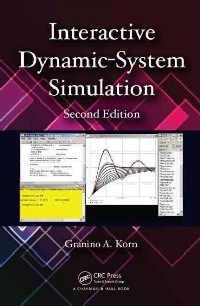
Korn, who runs a software company in Washington State, offers engineers and scientists a hands-on practical tutorial on interactive dynamic-system modeling and simulation, and includes the full-strength, open-source simulation package Desire on the accompanying disk, which opens and runs easily on a personal computer under Windows or Linux. The text covers a gallery of simple simulation programs, introduction to control system simulation, function generators and submodels, programming the experimental protocol, models using vectors and matrices, modeling tricks and treats, and general-purpose mathematics. No date is cited for the first edition. Annotation 漏2011 Book News, Inc., Portland, OR (booknews.com)
目录
Table Of Contents:
Preface xv
Chapter 1 Interactive Dynamic-System Simulation 1(20)
1.1 Dynamic-System Models And Simulation Programs 1(4)
1.1.1 Introduction 1(2)
1.1.2 Time Histories, State-Transition Models, and Differential Equations 3(1)
1.1.3 Differential Equation Systems with Defined Variables 4(1)
1.2 Simulation Programs Exercise Models 5(6)
1.2.1 Interpreted Experiment Protocols Call Compiled Simulation Runs 5(1)
1.2.2 Multirun Simulation Studies 5(1)
1.2.3 What a Simulation Run Does: Updating Variables 6(1)
1.2.4 What a Simulation Run Does: Output Timing 7(1)
1.2.4.1 Time-History Sampling 7(1)
1.2.4.2 Operations with Sampled Data 8(1)
1.2.5 What a Simulation Run Does: Numerical Integration 9(1)
1.2.5.1 Euler Integration 9(1)
1.2.5.2 Improved Integration Rules 9(2)
1.2.5.3 Integration through Discontinuities 11(1)
1.3 Hands-On Simulation On The PC Desktop 11(8)
1.3.1 A Wish List for Interactive Modeling 11(1)
1.3.2 The Very Simplest Way to Install and Uninstall Programs 12(1)
1.3.3 Linux versus Windows® 12(1)
1.3.4 Getting Started: User Programs and Editor Windows 13(1)
1.3.4.1 Start Desire 13(1)
1.3.4.2 Enter and Run a Simulation Program 13(1)
1.3.5 Interactive Modeling with Multiple Editor Windows 14(1)
1.3.6 A Complete Simulation Program 14(3)
1.3.7 Time-History Output 17(1)
1.3.7.1 Programming Time-History Graphs and Listings 17(1)
1.3.7.2 Display Scaling and Stripchart-Type Displays 17(1)
1.3.7.3 Time-History Storage and Printing 18(1)
1.3.8 Preparing Publication Copy 19(1)
References 19(2)
Chapter 2 A Gallery of Simple Simulation Programs 21(28)
2.1 Introduction 21(2)
2.1.1 Basics 21(1)
2.1.2 Experiment-Protocol Programs and Commands 21(2)
2.1.3 term and if Statements in DYNAMIC Program Segments 23(1)
2.2 Examples From Physics 23(9)
2.2.1 Classical Applications and Higher-Order Differential Equations 23(1)
2.2.2 Nonlinear Oscillators and Phase-Plane Plots 24(1)
2.2.2.1 Van der Pol's Differential Equation 24(2)
2.2.2.2 Simulation of a Simple Pendulum 26(2)
2.2.2.3 Lorenz Differential Equations Produce Chaos 28(1)
2.2.3 A Simple Nuclear Reactor Simulation 28(1)
2.2.4 An Electric Circuit Simulation with 1401 Differential Equations 29(3)
2.3 Aerospace And Related Applications 32(11)
2.3.1 Ballistic Trajectories 32(3)
2.3.2 Simple Flight Simulation 35(1)
2.3.2.1 Pitch-Plane Flight Equations 35(1)
2.3.2.2 Linearized Flight Equations 36(1)
2.3.3 A Simplified Autopilot 37(1)
2.3.4 Torpedo Trajectory 38(3)
2.3.5 Translunar Satellite Orbit 41(2)
2.4 Modeling Population Dynamics 43(4)
2.4.1 Simulation of Epidemic Propagation 43(2)
2.4.2 Simulation in Ecology: A Host-Parasite Problem 45(1)
2.4.2.1 A Host-Parasite Problem 45(1)
2.4.2.2 Generalizations 45(2)
References 47(2)
Chapter 3 Introduction to Control System Simulation 49(20)
3.1 Simulation And Control System Design 49(8)
3.1.1 Introduction 49(1)
3.1.2 Simulation of a Simple Servomechanism 49(2)
3.1.3 Simulation Studies and Parameter Optimization 51(1)
3.1.3.1 Test Inputs and Error Measures 51(1)
3.1.3.2 Parameter-Influence Studies 52(1)
3.1.3.3 Iterative Parameter Optimization 53(3)
3.1.4 Where Do We Go from Here? 56(1)
3.1.4.1 More Elaborate Controllers 56(1)
3.1.4.2 More Elaborate Plant Models and Control System Noise 56(1)
3.1.4.3 Control System Transfer Functions and Frequency Response 56(1)
3.2 Dealing With Sampled Data 57(2)
3.2.1 Models Using Difference Equations 57(1)
3.2.2 Sampled-Data Operations 58(1)
3.2.3 Changing the Sampling Rate 59(1)
3.3 Difference Equation Programming 59(5)
3.3.1 Primitive Difference Equations 59(1)
3.3.2 General Difference Equation Systems 60(1)
3.3.3 Combined Systems Imply Sample/Hold Operations 61(1)
3.3.3.1 Difference Equation Code and Differential Equation Code 61(3)
3.3.3.2 Transferring Sampled Data 64(1)
3.3.3.3 Simulation of Sampled-Data Reconstruction 64(1)
3.4 A Sampled-Data Control System 64(3)
3.4.1 Simulation of an Analog Plant with a Digital PID Controller 64(3)
References 67(2)
Chapter 4 Function Generators and Submodels 69(30)
4.1 Overview 69(1)
4.1.1 Introduction 69(1)
4.2 General-Purpose Function Generation 69(5)
4.2.1 Library Functions 69(1)
4.2.2 Function Generators Using Function Tables 70(1)
4.2.2.1 Functions of One Variable 70(1)
4.2.2.2 Functions of Two Variables 71(1)
4.2.2.3 General Remarks 72(1)
4.2.3 User-Defined Functions 73(1)
4.3 Limiters And Noncontinuous Functions 74(6)
4.3.1 Limiters 74(1)
4.3.1.1 Introduction 74(1)
4.3.1.2 Simple Limiters 74(1)
4.3.1.3 Useful Relations between Limiter Functions 75(1)
4.3.1.4 Maximum and Minimum Functions 76(1)
4.3.1.5 Output-Limited Integrators 76(1)
4.3.2 Switches and Comparators 76(1)
4.3.3 Signal Quantization 77(1)
4.3.4 Noise Generators 77(2)
4.3.5 Integration through Discontinuities and the Step Operator 79(1)
4.4 Very Useful Models Employ Simple Recurrence Relations 80(9)
4.4.1 Introduction 80(1)
4.4.2 Track/Hold Circuits and Maximum/Minimum Tracking 81(2)
4.4.3 Models with Hysteresis 83(1)
4.4.3.1 Simple Backlash and Hysteresis 83(1)
4.4.3.2 A Comparator with Hysteresis 83(1)
4.4.3.3 A Deadspace Comparator with Hysteresis 84(1)
4.4.4 Signal Generators 84(1)
4.4.4.1 Square Wave, Triangle, and Sawtooth Waveforms 84(3)
4.4.4.2 Signal Modulation 87(1)
4.4.5 Generation of Inverse Functions 88(1)
4.5 Submodels Clarify System Design 89(3)
4.5.1 Submodel Declaration and Invocation 89(1)
4.5.1.1 Submodels 89(1)
4.5.1.2 Submodel Declaration 89(1)
4.5.1.3 Submodel Invocation and Invoked State Variables 90(1)
4.5.2 A Simple Example: Coupled Oscillators 90(2)
4.6 A Bang-Bang Control System Simulation Using Submodels 92(5)
4.6.1 A Satellite Roll-Control Simulation 92(3)
4.6.2 Bang-Bang Control and Integration 95(2)
References 97(2)
Chapter 5 Programming the Experiment Protocol 99(16)
5.1 Introduction 99(1)
5.2 Program Control 99(4)
5.2.1 Labels and Branching 99(1)
5.2.2 Conditional Branching 100(1)
5.2.3 for, while, and repeat Loops 101(1)
5.2.4 Experiment-Protocol Procedures 101(2)
5.3 Arrays And Subscripted Variables 103(4)
5.3.1 Arrays, Vectors, and Matrices 103(1)
5.3.1.1 Simple Array Declarations 103(1)
5.3.1.2 Equivalent Arrays 104(1)
5.3.1.3 STATE Arrays 105(1)
5.3.2 Filling Arrays with Data 105(1)
5.3.2.1 Simple Assignments 105(1)
5.3.2.2 data Lists and read Assignments 106(1)
5.3.2.3 Text-File Input 107(1)
5.4 Experiment-Protocol Output And Input 107(4)
5.4.1 Console, Text-File, and Device Output 107(1)
5.4.1.1 Console Output 107(1)
5.4.1.2 File and Device Output 108(1)
5.4.1.3 Closing Files or Devices 109(1)
5.4.2 Console, File, and Device Input 109(1)
5.4.2.1 Interactive Console Input 109(1)
5.4.2.2 File or Device Input 109(1)
5.4.3 Multiple Dynamic Program Segments 110(1)
5.5 Experiment-Protocol Debugging, Notebook File, And Help Files 111(2)
5.5.1 Interactive Error Correction 111(1)
5.5.2 Debugging Experiment-Protocol Scripts 112(1)
5.5.3 The Notebook File 112(1)
5.5.4 Help Facilities 113(1)
Reference 113(2)
Chapter 6 Models Using Vectors and Matrices 115(30)
6.1 Overview 115(1)
6.1.1 Introduction 115(1)
6.2 Vectors And Matrices In Experiment-Protocol Scripts 116(2)
6.2.1 Null Matrices and Identity Matrices 116(1)
6.2.2 Matrix Transposition 117(1)
6.2.3 Matrix/Vector Sums and Products 117(1)
6.2.4 MATRIX Products 117(1)
6.2.5 Matrix Inversion and Solution of Linear Equations 118(1)
6.3 Vectors And Matrices In Dynamic-System Models 118(5)
6.3.1 Vector Expressions in DYNAMIC Program Segments 118(1)
6.3.2 Matrix/Vector Products in Vector Expressions 119(1)
6.3.2.1 Matrix/Vector Products 119(1)
6.3.2.2 Example: Rotation Matrices 120(1)
6.3.3 Matrix/Vector Models of Linear Systems 121(2)
6.4 Vector Index-Shift Operations 123(6)
6.4.1 Index-Shifted Vectors 123(2)
6.4.2 Simulation of an Inductance/Capacitance Delay Line 125(1)
6.4.3 Programming Linear-System Transfer Functions 125(1)
6.4.3.1 Analog Systems 125(1)
6.4.3.2 Digital Filters 126(3)
6.5 Dot Products, Sums, And Vector Norms 129(2)
6.5.1 DOT Products and Sums of DOT Products 129(1)
6.5.2 Euclidean Norms 130(1)
6.5.3 Simple Sums: Taxicab and Hamming Norms 131(1)
6.6 More Vector/Matrix Operations 131(3)
6.6.1 Vector Difference Equations 131(1)
6.6.2 Dynamic-Segment Matrix Operations 132(1)
6.6.2.1 Vector Products 132(1)
6.6.2.2 Simple Matrix Assignments 132(1)
6.6.2.3 A More General Technique 133(1)
6.6.3 Submodels with Vectors and Matrices 133(1)
6.7 Model Replication: A Glimpse Of Advanced Applications 134(4)
6.7.1 Model Replication 134(1)
6.7.1.1 Vector Assignments Replicate Models 134(1)
6.7.1.2 Parameter-Influence Studies 135(2)
6.7.1.3 Vectorized Monte Carlo Simulation 137(1)
6.7.1.4 Neural Network Simulation 137(1)
6.7.2 Other Applications 138(1)
6.8 Time History Function Storage In Arrays 138(6)
6.8.1 Function Storage and Recovery with Store and get 138(1)
6.8.1.1 store and get Operations 138(3)
6.8.1.2 Application to Automatic Display Scaling 141(1)
6.8.2 Time Delay Simulation 141(3)
References 144(1)
Chapter 7 Modeling Tricks and Treats 145(26)
7.1 Overview, And A First Example 145(1)
7.1.1 Introduction 145(1)
7.1.2 A Benchmark Problem with Logarithmic Plotting 145(1)
7.2 Multiple Runs Can Splice Complicated Time Histories 146(7)
7.2.1 Simulation of Hard Impact: The Bouncing Ball 146(3)
7.2.2 The Eurosim Peg-And-Pendulum Benchmark [1] 149(2)
7.2.3 The Eurosim Electronic-Switch Benchmark 151(2)
7.3 Two Physiological Models 153(6)
7.3.1 Simulation of a Glucose Tolerance Test 153(1)
7.3.2 Simulation of Human Blood Circulation 154(5)
7.4 A Program With Multiple Dynamic Segments 159(1)
7.4.1 Crossplotting Results from Multiple Runs: The Pilot Ejection Problem 159(1)
7.5 Forrester-Type System Dynamics 160(9)
7.5.1 A Look at System Dynamics 160(4)
7.5.2 World Simulation 164(5)
References 169(2)
Chapter 8 General-Purpose Mathematics 171(14)
8.1 Introduction 171(1)
8.1.1 Overview 171(1)
8.2 Compiled Programs Need Not Be Simulation Programs 172(4)
8.2.1 Dummy Integration Simply Repeats DYNAMIC-Segment Code 172(1)
8.2.2 Fast Graph Plotting 172(1)
8.2.2.1 A Simple Function Plot 172(1)
8.2.2.2 Array-Value Plotting 173(1)
8.2.3 Fast Array Manipulation 174(1)
8.2.4 Statistical Computations 175(1)
8.3 Integers, Complex Numbers, And Interpreter Graphics 176(4)
8.3.1 Integer And Complex Quantities 176(1)
8.3.2 Octal And Hexadecimal Integer Conversions 177(1)
8.3.3 Complex Number Operations and Library Functions 177(1)
8.3.4 Interpreter Graphics, Complex Number Plots, and Conformal Mapping 178(1)
8.3.4.1 Interpreter Plots 178(1)
8.3.4.2 Complex Number Plots 178(2)
8.4 Fast Fourier Transforms And Convolutions 180(3)
8.4.1 Fast Fourier Transforms 180(1)
8.4.1.1 Simple Fourier Transformations 180(1)
8.4.2 Simultaneous Transformation of Two Real Arrays 180(1)
8.4.3 Cyclical Convolutions 181(2)
Reference 183(2)
APPENDIX: SIMULATION ACCURACY AND INTEGRATION TECHNIQUES 185(12)
A.1 Simulation Accuracy And Test Programs 185(4)
A.1.1 Introduction 185(1)
A.1.2 Roundoff Errors 185(1)
A.1.3 Choice of Integration Rule and Integration Step Size 186(3)
A.2 Integration Rules And Stiff Differential Equation Systems 189(6)
A.2.1 Runge-Kutta and Euler Rules 189(2)
A.2.2 Implicit Adams and Gear Rules 191(1)
A.2.3 Stiff Differential Equation Systems 191(1)
A.2.4 Examples Using Gear-Type Integration 192(2)
A.2.5 Perturbation Methods Can Improve Accuracy 194(1)
A.2.6 Avoiding Division 195(1)
References 195(2)
Index 197
Preface xv
Chapter 1 Interactive Dynamic-System Simulation 1(20)
1.1 Dynamic-System Models And Simulation Programs 1(4)
1.1.1 Introduction 1(2)
1.1.2 Time Histories, State-Transition Models, and Differential Equations 3(1)
1.1.3 Differential Equation Systems with Defined Variables 4(1)
1.2 Simulation Programs Exercise Models 5(6)
1.2.1 Interpreted Experiment Protocols Call Compiled Simulation Runs 5(1)
1.2.2 Multirun Simulation Studies 5(1)
1.2.3 What a Simulation Run Does: Updating Variables 6(1)
1.2.4 What a Simulation Run Does: Output Timing 7(1)
1.2.4.1 Time-History Sampling 7(1)
1.2.4.2 Operations with Sampled Data 8(1)
1.2.5 What a Simulation Run Does: Numerical Integration 9(1)
1.2.5.1 Euler Integration 9(1)
1.2.5.2 Improved Integration Rules 9(2)
1.2.5.3 Integration through Discontinuities 11(1)
1.3 Hands-On Simulation On The PC Desktop 11(8)
1.3.1 A Wish List for Interactive Modeling 11(1)
1.3.2 The Very Simplest Way to Install and Uninstall Programs 12(1)
1.3.3 Linux versus Windows® 12(1)
1.3.4 Getting Started: User Programs and Editor Windows 13(1)
1.3.4.1 Start Desire 13(1)
1.3.4.2 Enter and Run a Simulation Program 13(1)
1.3.5 Interactive Modeling with Multiple Editor Windows 14(1)
1.3.6 A Complete Simulation Program 14(3)
1.3.7 Time-History Output 17(1)
1.3.7.1 Programming Time-History Graphs and Listings 17(1)
1.3.7.2 Display Scaling and Stripchart-Type Displays 17(1)
1.3.7.3 Time-History Storage and Printing 18(1)
1.3.8 Preparing Publication Copy 19(1)
References 19(2)
Chapter 2 A Gallery of Simple Simulation Programs 21(28)
2.1 Introduction 21(2)
2.1.1 Basics 21(1)
2.1.2 Experiment-Protocol Programs and Commands 21(2)
2.1.3 term and if Statements in DYNAMIC Program Segments 23(1)
2.2 Examples From Physics 23(9)
2.2.1 Classical Applications and Higher-Order Differential Equations 23(1)
2.2.2 Nonlinear Oscillators and Phase-Plane Plots 24(1)
2.2.2.1 Van der Pol's Differential Equation 24(2)
2.2.2.2 Simulation of a Simple Pendulum 26(2)
2.2.2.3 Lorenz Differential Equations Produce Chaos 28(1)
2.2.3 A Simple Nuclear Reactor Simulation 28(1)
2.2.4 An Electric Circuit Simulation with 1401 Differential Equations 29(3)
2.3 Aerospace And Related Applications 32(11)
2.3.1 Ballistic Trajectories 32(3)
2.3.2 Simple Flight Simulation 35(1)
2.3.2.1 Pitch-Plane Flight Equations 35(1)
2.3.2.2 Linearized Flight Equations 36(1)
2.3.3 A Simplified Autopilot 37(1)
2.3.4 Torpedo Trajectory 38(3)
2.3.5 Translunar Satellite Orbit 41(2)
2.4 Modeling Population Dynamics 43(4)
2.4.1 Simulation of Epidemic Propagation 43(2)
2.4.2 Simulation in Ecology: A Host-Parasite Problem 45(1)
2.4.2.1 A Host-Parasite Problem 45(1)
2.4.2.2 Generalizations 45(2)
References 47(2)
Chapter 3 Introduction to Control System Simulation 49(20)
3.1 Simulation And Control System Design 49(8)
3.1.1 Introduction 49(1)
3.1.2 Simulation of a Simple Servomechanism 49(2)
3.1.3 Simulation Studies and Parameter Optimization 51(1)
3.1.3.1 Test Inputs and Error Measures 51(1)
3.1.3.2 Parameter-Influence Studies 52(1)
3.1.3.3 Iterative Parameter Optimization 53(3)
3.1.4 Where Do We Go from Here? 56(1)
3.1.4.1 More Elaborate Controllers 56(1)
3.1.4.2 More Elaborate Plant Models and Control System Noise 56(1)
3.1.4.3 Control System Transfer Functions and Frequency Response 56(1)
3.2 Dealing With Sampled Data 57(2)
3.2.1 Models Using Difference Equations 57(1)
3.2.2 Sampled-Data Operations 58(1)
3.2.3 Changing the Sampling Rate 59(1)
3.3 Difference Equation Programming 59(5)
3.3.1 Primitive Difference Equations 59(1)
3.3.2 General Difference Equation Systems 60(1)
3.3.3 Combined Systems Imply Sample/Hold Operations 61(1)
3.3.3.1 Difference Equation Code and Differential Equation Code 61(3)
3.3.3.2 Transferring Sampled Data 64(1)
3.3.3.3 Simulation of Sampled-Data Reconstruction 64(1)
3.4 A Sampled-Data Control System 64(3)
3.4.1 Simulation of an Analog Plant with a Digital PID Controller 64(3)
References 67(2)
Chapter 4 Function Generators and Submodels 69(30)
4.1 Overview 69(1)
4.1.1 Introduction 69(1)
4.2 General-Purpose Function Generation 69(5)
4.2.1 Library Functions 69(1)
4.2.2 Function Generators Using Function Tables 70(1)
4.2.2.1 Functions of One Variable 70(1)
4.2.2.2 Functions of Two Variables 71(1)
4.2.2.3 General Remarks 72(1)
4.2.3 User-Defined Functions 73(1)
4.3 Limiters And Noncontinuous Functions 74(6)
4.3.1 Limiters 74(1)
4.3.1.1 Introduction 74(1)
4.3.1.2 Simple Limiters 74(1)
4.3.1.3 Useful Relations between Limiter Functions 75(1)
4.3.1.4 Maximum and Minimum Functions 76(1)
4.3.1.5 Output-Limited Integrators 76(1)
4.3.2 Switches and Comparators 76(1)
4.3.3 Signal Quantization 77(1)
4.3.4 Noise Generators 77(2)
4.3.5 Integration through Discontinuities and the Step Operator 79(1)
4.4 Very Useful Models Employ Simple Recurrence Relations 80(9)
4.4.1 Introduction 80(1)
4.4.2 Track/Hold Circuits and Maximum/Minimum Tracking 81(2)
4.4.3 Models with Hysteresis 83(1)
4.4.3.1 Simple Backlash and Hysteresis 83(1)
4.4.3.2 A Comparator with Hysteresis 83(1)
4.4.3.3 A Deadspace Comparator with Hysteresis 84(1)
4.4.4 Signal Generators 84(1)
4.4.4.1 Square Wave, Triangle, and Sawtooth Waveforms 84(3)
4.4.4.2 Signal Modulation 87(1)
4.4.5 Generation of Inverse Functions 88(1)
4.5 Submodels Clarify System Design 89(3)
4.5.1 Submodel Declaration and Invocation 89(1)
4.5.1.1 Submodels 89(1)
4.5.1.2 Submodel Declaration 89(1)
4.5.1.3 Submodel Invocation and Invoked State Variables 90(1)
4.5.2 A Simple Example: Coupled Oscillators 90(2)
4.6 A Bang-Bang Control System Simulation Using Submodels 92(5)
4.6.1 A Satellite Roll-Control Simulation 92(3)
4.6.2 Bang-Bang Control and Integration 95(2)
References 97(2)
Chapter 5 Programming the Experiment Protocol 99(16)
5.1 Introduction 99(1)
5.2 Program Control 99(4)
5.2.1 Labels and Branching 99(1)
5.2.2 Conditional Branching 100(1)
5.2.3 for, while, and repeat Loops 101(1)
5.2.4 Experiment-Protocol Procedures 101(2)
5.3 Arrays And Subscripted Variables 103(4)
5.3.1 Arrays, Vectors, and Matrices 103(1)
5.3.1.1 Simple Array Declarations 103(1)
5.3.1.2 Equivalent Arrays 104(1)
5.3.1.3 STATE Arrays 105(1)
5.3.2 Filling Arrays with Data 105(1)
5.3.2.1 Simple Assignments 105(1)
5.3.2.2 data Lists and read Assignments 106(1)
5.3.2.3 Text-File Input 107(1)
5.4 Experiment-Protocol Output And Input 107(4)
5.4.1 Console, Text-File, and Device Output 107(1)
5.4.1.1 Console Output 107(1)
5.4.1.2 File and Device Output 108(1)
5.4.1.3 Closing Files or Devices 109(1)
5.4.2 Console, File, and Device Input 109(1)
5.4.2.1 Interactive Console Input 109(1)
5.4.2.2 File or Device Input 109(1)
5.4.3 Multiple Dynamic Program Segments 110(1)
5.5 Experiment-Protocol Debugging, Notebook File, And Help Files 111(2)
5.5.1 Interactive Error Correction 111(1)
5.5.2 Debugging Experiment-Protocol Scripts 112(1)
5.5.3 The Notebook File 112(1)
5.5.4 Help Facilities 113(1)
Reference 113(2)
Chapter 6 Models Using Vectors and Matrices 115(30)
6.1 Overview 115(1)
6.1.1 Introduction 115(1)
6.2 Vectors And Matrices In Experiment-Protocol Scripts 116(2)
6.2.1 Null Matrices and Identity Matrices 116(1)
6.2.2 Matrix Transposition 117(1)
6.2.3 Matrix/Vector Sums and Products 117(1)
6.2.4 MATRIX Products 117(1)
6.2.5 Matrix Inversion and Solution of Linear Equations 118(1)
6.3 Vectors And Matrices In Dynamic-System Models 118(5)
6.3.1 Vector Expressions in DYNAMIC Program Segments 118(1)
6.3.2 Matrix/Vector Products in Vector Expressions 119(1)
6.3.2.1 Matrix/Vector Products 119(1)
6.3.2.2 Example: Rotation Matrices 120(1)
6.3.3 Matrix/Vector Models of Linear Systems 121(2)
6.4 Vector Index-Shift Operations 123(6)
6.4.1 Index-Shifted Vectors 123(2)
6.4.2 Simulation of an Inductance/Capacitance Delay Line 125(1)
6.4.3 Programming Linear-System Transfer Functions 125(1)
6.4.3.1 Analog Systems 125(1)
6.4.3.2 Digital Filters 126(3)
6.5 Dot Products, Sums, And Vector Norms 129(2)
6.5.1 DOT Products and Sums of DOT Products 129(1)
6.5.2 Euclidean Norms 130(1)
6.5.3 Simple Sums: Taxicab and Hamming Norms 131(1)
6.6 More Vector/Matrix Operations 131(3)
6.6.1 Vector Difference Equations 131(1)
6.6.2 Dynamic-Segment Matrix Operations 132(1)
6.6.2.1 Vector Products 132(1)
6.6.2.2 Simple Matrix Assignments 132(1)
6.6.2.3 A More General Technique 133(1)
6.6.3 Submodels with Vectors and Matrices 133(1)
6.7 Model Replication: A Glimpse Of Advanced Applications 134(4)
6.7.1 Model Replication 134(1)
6.7.1.1 Vector Assignments Replicate Models 134(1)
6.7.1.2 Parameter-Influence Studies 135(2)
6.7.1.3 Vectorized Monte Carlo Simulation 137(1)
6.7.1.4 Neural Network Simulation 137(1)
6.7.2 Other Applications 138(1)
6.8 Time History Function Storage In Arrays 138(6)
6.8.1 Function Storage and Recovery with Store and get 138(1)
6.8.1.1 store and get Operations 138(3)
6.8.1.2 Application to Automatic Display Scaling 141(1)
6.8.2 Time Delay Simulation 141(3)
References 144(1)
Chapter 7 Modeling Tricks and Treats 145(26)
7.1 Overview, And A First Example 145(1)
7.1.1 Introduction 145(1)
7.1.2 A Benchmark Problem with Logarithmic Plotting 145(1)
7.2 Multiple Runs Can Splice Complicated Time Histories 146(7)
7.2.1 Simulation of Hard Impact: The Bouncing Ball 146(3)
7.2.2 The Eurosim Peg-And-Pendulum Benchmark [1] 149(2)
7.2.3 The Eurosim Electronic-Switch Benchmark 151(2)
7.3 Two Physiological Models 153(6)
7.3.1 Simulation of a Glucose Tolerance Test 153(1)
7.3.2 Simulation of Human Blood Circulation 154(5)
7.4 A Program With Multiple Dynamic Segments 159(1)
7.4.1 Crossplotting Results from Multiple Runs: The Pilot Ejection Problem 159(1)
7.5 Forrester-Type System Dynamics 160(9)
7.5.1 A Look at System Dynamics 160(4)
7.5.2 World Simulation 164(5)
References 169(2)
Chapter 8 General-Purpose Mathematics 171(14)
8.1 Introduction 171(1)
8.1.1 Overview 171(1)
8.2 Compiled Programs Need Not Be Simulation Programs 172(4)
8.2.1 Dummy Integration Simply Repeats DYNAMIC-Segment Code 172(1)
8.2.2 Fast Graph Plotting 172(1)
8.2.2.1 A Simple Function Plot 172(1)
8.2.2.2 Array-Value Plotting 173(1)
8.2.3 Fast Array Manipulation 174(1)
8.2.4 Statistical Computations 175(1)
8.3 Integers, Complex Numbers, And Interpreter Graphics 176(4)
8.3.1 Integer And Complex Quantities 176(1)
8.3.2 Octal And Hexadecimal Integer Conversions 177(1)
8.3.3 Complex Number Operations and Library Functions 177(1)
8.3.4 Interpreter Graphics, Complex Number Plots, and Conformal Mapping 178(1)
8.3.4.1 Interpreter Plots 178(1)
8.3.4.2 Complex Number Plots 178(2)
8.4 Fast Fourier Transforms And Convolutions 180(3)
8.4.1 Fast Fourier Transforms 180(1)
8.4.1.1 Simple Fourier Transformations 180(1)
8.4.2 Simultaneous Transformation of Two Real Arrays 180(1)
8.4.3 Cyclical Convolutions 181(2)
Reference 183(2)
APPENDIX: SIMULATION ACCURACY AND INTEGRATION TECHNIQUES 185(12)
A.1 Simulation Accuracy And Test Programs 185(4)
A.1.1 Introduction 185(1)
A.1.2 Roundoff Errors 185(1)
A.1.3 Choice of Integration Rule and Integration Step Size 186(3)
A.2 Integration Rules And Stiff Differential Equation Systems 189(6)
A.2.1 Runge-Kutta and Euler Rules 189(2)
A.2.2 Implicit Adams and Gear Rules 191(1)
A.2.3 Stiff Differential Equation Systems 191(1)
A.2.4 Examples Using Gear-Type Integration 192(2)
A.2.5 Perturbation Methods Can Improve Accuracy 194(1)
A.2.6 Avoiding Division 195(1)
References 195(2)
Index 197
- 名称
- 类型
- 大小
光盘服务联系方式: 020-38250260 客服QQ:4006604884
云图客服:
用户发送的提问,这种方式就需要有位在线客服来回答用户的问题,这种 就属于对话式的,问题是这种提问是否需要用户登录才能提问
Video Player
×
Audio Player
×
pdf Player
×
亲爱的云图用户,
光盘内的文件都可以直接点击浏览哦
无需下载,在线查阅资料!
