

简介
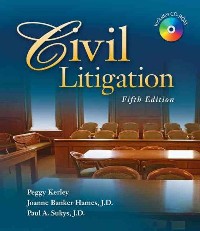
From Publishers Website: Civil Litigation, fifth edition, combines the principles of litigation practice with practical applications that are geared especially to the needs of the paralegal student. The text provides information and the critical skills necessary for any area of legal practice. The litigation process is covered in detail in a variety of contexts so that students see the relevance of litigation to other legal specialties, such as personal injury, real estate, employment and intellectual property law. Civil Litigation, fifth edition, provides a number of sample legal documents, such as complaints, interrogatories and deposition summaries, as well as case commentaries that set text material into a practical context. To help students understand difficult concepts, legal vocabulary and various charts and tables are available in each chapter to clarify challenging material. The new CD-ROM also includes an array of useful study materials. Each chapter focuses briefly on the impact of technology on the litigation field, and also contains useful references to litigation focused Web Sites.
目录
Preface
Acknowledgments
About the authors
Part 1: Introduction To Civil Litigation
1: Litigation and the paralegal
Objectives
What civil litigation is
Civil law versus criminal law
Substantive versus procedural law
Overview of civil litigation
Different types of civil lawsuits
Alternatives and limitations to litigation
Alternative dispute resolution
Administrative agency hearings
Legislative limitations
Judicial limitations
Sources of the law
Primary sources
Secondary sources
Role of the litigation paralegal
Litigation law firm
Litigation paralegal job description
What a litigation paralegal cannot do
Skills required of the litigation paralegal
Continuing legal education
Professional organizations
Practical tips for success in the law firm
Forms file-invaluable aid
How to build a litigation training manual
Summary
Key terms
Review questions
Chapter exercises
Chapter project --
2: Courts and jurisdiction
Objectives
Courts and litigation
Trial courts
Courts of appeals
Courts of last resort
Federal court system
United States District Courts
Miscellaneous federal trial courts
United States Courts of Appeals
United States Supreme Court
State court systems
Jurisdiction
Subject matter jurisdiction
Personal jurisdiction
In rem jurisdiction
Quasi in rem jurisdiction
Venue
Federal court venue
State court venue
Changing venue
Summary
Key terms
Review questions
Chapter exercises
Chapter project
Part 2: Initiating Litigation
3: Preliminary considerations and procedures
Objectives
Determining the existence of a cause of action
Time limitations
Statue of limitations
Claim statutes
Laches
Tickler systems
Feasibility of the lawsuit
Turning down a case
Ethical considerations in accepting a case
Competency to handle the case
Frivolous claims --
Conflict of interest
Ethical considerations after accepting a case
Communication with the client
Communication with the opposing party
Confidentiality
Honesty
Attorney fees
Written fee agreements
Fee sharing
Property of client-trust accounts
Special ethical concerns for paralegals
Influence of preliminary considerations on legal office procedures
Summary
Key terms
Review questions
Chapter exercises
Chapter project
4: Investigation and evidence
Objectives
Client interview
Preparing for the initial client interview
Paralegal's role in the interview
Interview summary
Locating fact witnesses or elusive defendants
Steps for locating the agent of corporations or partnerships
Techniques for interviewing fact witnesses
Evidence
Direct evidence versus circumstantial evidence
Forms of evidence
Federal rules of evidence
Relevancy
Evidence of character and habit
Documentary evidence --
Self-authentication
Best evidence rule
Hearsay rule
Exceptions to hearsay
Privileged communications
State rules of evidence
Additional resources relating to evidence
Methods for locating and preserving evidence
Evidence control and retrieval
Preservation of evidence
Expert witnesses
Summary
Key terms
Review questions
Chapter exercises
Chapter project --
5: Complaint
Objectives
Nature and purpose of pleadings
Elements and format of a complaint
Indentifying and describing the parties
Real party in interest
Status
Capacity
Special problems with parties
Joining multiple parties
Class actions
Interpleader
Alleging jurisdiction and venue
Pleading the cause of action
Alleging multiple claims
Multiple parties and causes of action
Request for damages or other relief
Money damages
Equitable relief
Provisional remedies
Drafting the complaint
Caption
Causes of action
Prayer
Subscription
Request for a jury
Verifications
Disclosure statement by nongovernmental corporate party
Exhibits
Filing the complaint
Electronic filing (e-filing)
Summons
Serving the complaint
Waiver of service
Amending the complaint
Summary
Key terms
Review questions
Chapter exercises
Chapter project
6: Responses to the complaint
Objectives --
Responding to the complaint
Time limits
Stipulations enlarging time
Motions to extend or enlarge time
Types of answers
General denial
Specific denial
Qualified denial
Affirmative defenses
Drafting the answer
Caption
Body
Prayer and signature
Verification
Service and filing
Amending
Counterclaims, cross-claims, and third-party complaints
Counterclaims
Cross-claims
Third-party complaints
Replies and answers
Amending
Legal challenges to the complaint
Failure to answer
Setting aside defaults
Summary
Key terms
Review questions
Chapter exercises
Chapter project
7: Motion practice
Objectives
Motions generally
Preparing, serving, and responding
Preparation of the written papers
Service and filing
Responding to motions
Court procedures involving motions
Hearings
Tentative rulings
Orders after motions
Sanctions
Specific motions
Pretrial motions
Trial motions --
Posttrial motions
Preliminary injunctions and temporary restraining orders
Summary
Key terms
Review questions
Chapter exercises
Chapter project
Part 3: Discovery
8: Overview of the discovery process
Objectives
Nature of discovery
Developments concerning discovery
Electronically stored information
Objectives of discovery
Preliminary decisions regarding discovery
Ethical considerations in discovery
Extent of allowable discovery
Scope of discovery
Limits on discovery
Duty of mutual disclosure under rule
Discovery conference
Mutual disclosures
Duty to supplement
Cooperating with discovery
Voluntary cooperation
Involuntary cooperation
Summary
Key terms
Review questions
Chapter exercises
Chapter project
End notes
9: Depositions
Objectives
Deposition
Nature of the oral deposition
Advantages of the oral deposition
Disadvantages of the oral deposition --
E-discovery and oral depositions
Digital depositions
Telephone and cell phone depositions
Internet depositions
Paralegal's role before the oral deposition
Notice requirement
Subpoena requirement
Recent amendments to rule 45 subpoena
Preparation for the deposition
Paralegal's role during the oral deposition
Notetaking
Witness evaluation
Paralegal's role after the oral deposition
Transcript arrangements
Deposition summary
Deposition upon written questions
Summary
Key terms
Review questions
Chapter exercises
Chapter project
10: Interrogatories
Objectives
Interrogatories
Scope and number of interrogatories
Purposes of interrogatories
Advantages of interrogatories
Disadvantages of interrogatories
ESI and interrogatories
Use of ESI to respond to interrogatories
Downside of electronically stored information
Drafting interrogatories
Preliminary steps in drafting interrogatories --
Form and content of interrogatories
Motion to compel
Drafting answers to interrogatories
Determining time limits
Answering the interrogatories
Fulfilling the duty to supplement
Objecting to interrogatories
Summary
Key terms
Review questions
Chapter exercises
Chapter project
End notes --
11: Physical and mental examinations
Objectives
Physical or mental examination
Types of cases using physical or mental examinations
Reasons for allowing physical and mental examinations
Filing a motion for compulsory examination
Requirements for granting the motion for compulsory examination
Evidence of good cause
Condition in controversy
Granting a motion for compulsory examination
Paralegal's role in physical and mental examinations
Arranging for the examination of an opposing party
Preparing the client for an examination
Summary
Key terms
Review questions
Chapter exercises
Chapter project
12: Request for documents
Objectives
Request for documents
Recent developments concerning mutual disclosure of documents
Mutual disclosures and ESI
Alternative methods of requesting documents
Preliminary decisions regarding requests for documents
Approaches to document production
ESI and document requests --
Document production requests and computer systems
Document production requests and the nature of ESI
Document production requests and storage of ESI
Expense involved in the retrieval of ESI
Protection of documents
Attorney-client privilege
Work product privilege
Common interest privilege
Medical privilege and the confessor-penitent privilege
Overbroad and duplicative requests
Inadmissible and irrelevant evidence
Confidentiality agreements and protective orders
Format objections to document requests
Inadvertent production of documents
Inadvertent production of electronically stored information
Requesting the production of documents
Form and content of the request
Final responsibility in drafting the request
Motion to compel
Reviewing the documents of the opposing party
Responding to a request for documents
Determining a target date
Categorizing the documents
Involving the client in document production --
Organizing the document production
Organizing and indexing the documents after production
Organizing the documents after production
Indexing the documents after production
Inspection of property
Obtaining an inspection
Responding to a demand for inspection
ESI and on-site inspections
Reasons for the on-site inspection of a computer system
Procedures for the on-site inspection of a computer system
Summary
Key terms
Review questions
Chapter exercises
Chapter project
End notes
13: Request for admission
Objectives
Request for admission
Purposes of the request for admission
Uses of the request for admission
Advantages of the request for admission
Drafting the request for admission
Preliminary steps in drafting the request for admission
Form and content of the request for admission
Responding to the request for admission
Alternative responses to the request for admission --
Objections to the request for admission
Summary
Key terms
Review questions
Chapter exercises
Chapter project --
Part 4: Pretrial, Trial, And Posttrial
14: Settlements, dismissals, and alternative dispute resolution
Objectives
Settlement
Decisions regarding settlement
Preliminary investigative work
Settlement offers
Settlement summaries and letters
Settlement brochures
Settlement conference
Settlement agreements and releases
Settlement agreements
Releases
Dismissals, consent decrees, and distribution of funds
Dismissals
Consent decrees
Distribution of settlement funds
Alternative dispute resolution
Court-related ADR
Private ADR
Summary
Key terms
Review questions
Chapter exercises
Chapter project
15: Trial techniques
Objectives
Preliminary preparation for trial
Pretrial conference
File organization
Amending the pleadings
Motions at the beginning of trial
Trial notebook
Preparation of witnesses
Subpoena of witnesses
Communicating with witnesses
Witness preparation meeting --
Preparation of exhibits and briefs
Preparing trial exhibits
Researching for the trial brief
Coordinating trial logistics
Arranging for accommodations
Visiting the courthouse
Contacting court personnel
Preliminary steps in the trial process
Decisions regarding jury trials
Jury process
Preparing a juror profile
Holding a mock jury trial
Using shadow juries
Jury selection
Voir dire process
Peremptory challenges
Trial
Opening statement
Characteristics of a good opening statement
Presentation of evidence
Plaintiff's case in chief
Defendant's case in chief
Presentation of rebuttal evidence
Closing argument
Jury deliberations
Motions during trial
Motions at the end of trial
Paralegal's role at trial
Ensuring the presence of witnesses
Keeping track of exhibits
Participating in jury selection
Taking notes during the trial
Summary
Key terms
Review questions
Chapter exercises --
Chapter project
16: Posttrial practice
Objectives
Posttrial motions
Motion for a new trial
Preliminary steps in the appeal
Notice of appeal
Appeal bond
Ordering the transcript
Transmitting the record
Enlargement of time
Appellate brief
Drafting the appellate brief
Appellant, appellee, and reply briefs
Filing and service of appellate briefs
Coordinating the oral argument
Preparing for the oral argument
Assisting at oral argument
Final procedures
Further appeal procedures
Posttrial judgment procedures
Summary
Key terms
Review questions
Chapter exercises
Chapter project
Appendix A: Sample deposition
Appendix B: Bennett research file
Glossary
Index.
Acknowledgments
About the authors
Part 1: Introduction To Civil Litigation
1: Litigation and the paralegal
Objectives
What civil litigation is
Civil law versus criminal law
Substantive versus procedural law
Overview of civil litigation
Different types of civil lawsuits
Alternatives and limitations to litigation
Alternative dispute resolution
Administrative agency hearings
Legislative limitations
Judicial limitations
Sources of the law
Primary sources
Secondary sources
Role of the litigation paralegal
Litigation law firm
Litigation paralegal job description
What a litigation paralegal cannot do
Skills required of the litigation paralegal
Continuing legal education
Professional organizations
Practical tips for success in the law firm
Forms file-invaluable aid
How to build a litigation training manual
Summary
Key terms
Review questions
Chapter exercises
Chapter project --
2: Courts and jurisdiction
Objectives
Courts and litigation
Trial courts
Courts of appeals
Courts of last resort
Federal court system
United States District Courts
Miscellaneous federal trial courts
United States Courts of Appeals
United States Supreme Court
State court systems
Jurisdiction
Subject matter jurisdiction
Personal jurisdiction
In rem jurisdiction
Quasi in rem jurisdiction
Venue
Federal court venue
State court venue
Changing venue
Summary
Key terms
Review questions
Chapter exercises
Chapter project
Part 2: Initiating Litigation
3: Preliminary considerations and procedures
Objectives
Determining the existence of a cause of action
Time limitations
Statue of limitations
Claim statutes
Laches
Tickler systems
Feasibility of the lawsuit
Turning down a case
Ethical considerations in accepting a case
Competency to handle the case
Frivolous claims --
Conflict of interest
Ethical considerations after accepting a case
Communication with the client
Communication with the opposing party
Confidentiality
Honesty
Attorney fees
Written fee agreements
Fee sharing
Property of client-trust accounts
Special ethical concerns for paralegals
Influence of preliminary considerations on legal office procedures
Summary
Key terms
Review questions
Chapter exercises
Chapter project
4: Investigation and evidence
Objectives
Client interview
Preparing for the initial client interview
Paralegal's role in the interview
Interview summary
Locating fact witnesses or elusive defendants
Steps for locating the agent of corporations or partnerships
Techniques for interviewing fact witnesses
Evidence
Direct evidence versus circumstantial evidence
Forms of evidence
Federal rules of evidence
Relevancy
Evidence of character and habit
Documentary evidence --
Self-authentication
Best evidence rule
Hearsay rule
Exceptions to hearsay
Privileged communications
State rules of evidence
Additional resources relating to evidence
Methods for locating and preserving evidence
Evidence control and retrieval
Preservation of evidence
Expert witnesses
Summary
Key terms
Review questions
Chapter exercises
Chapter project --
5: Complaint
Objectives
Nature and purpose of pleadings
Elements and format of a complaint
Indentifying and describing the parties
Real party in interest
Status
Capacity
Special problems with parties
Joining multiple parties
Class actions
Interpleader
Alleging jurisdiction and venue
Pleading the cause of action
Alleging multiple claims
Multiple parties and causes of action
Request for damages or other relief
Money damages
Equitable relief
Provisional remedies
Drafting the complaint
Caption
Causes of action
Prayer
Subscription
Request for a jury
Verifications
Disclosure statement by nongovernmental corporate party
Exhibits
Filing the complaint
Electronic filing (e-filing)
Summons
Serving the complaint
Waiver of service
Amending the complaint
Summary
Key terms
Review questions
Chapter exercises
Chapter project
6: Responses to the complaint
Objectives --
Responding to the complaint
Time limits
Stipulations enlarging time
Motions to extend or enlarge time
Types of answers
General denial
Specific denial
Qualified denial
Affirmative defenses
Drafting the answer
Caption
Body
Prayer and signature
Verification
Service and filing
Amending
Counterclaims, cross-claims, and third-party complaints
Counterclaims
Cross-claims
Third-party complaints
Replies and answers
Amending
Legal challenges to the complaint
Failure to answer
Setting aside defaults
Summary
Key terms
Review questions
Chapter exercises
Chapter project
7: Motion practice
Objectives
Motions generally
Preparing, serving, and responding
Preparation of the written papers
Service and filing
Responding to motions
Court procedures involving motions
Hearings
Tentative rulings
Orders after motions
Sanctions
Specific motions
Pretrial motions
Trial motions --
Posttrial motions
Preliminary injunctions and temporary restraining orders
Summary
Key terms
Review questions
Chapter exercises
Chapter project
Part 3: Discovery
8: Overview of the discovery process
Objectives
Nature of discovery
Developments concerning discovery
Electronically stored information
Objectives of discovery
Preliminary decisions regarding discovery
Ethical considerations in discovery
Extent of allowable discovery
Scope of discovery
Limits on discovery
Duty of mutual disclosure under rule
Discovery conference
Mutual disclosures
Duty to supplement
Cooperating with discovery
Voluntary cooperation
Involuntary cooperation
Summary
Key terms
Review questions
Chapter exercises
Chapter project
End notes
9: Depositions
Objectives
Deposition
Nature of the oral deposition
Advantages of the oral deposition
Disadvantages of the oral deposition --
E-discovery and oral depositions
Digital depositions
Telephone and cell phone depositions
Internet depositions
Paralegal's role before the oral deposition
Notice requirement
Subpoena requirement
Recent amendments to rule 45 subpoena
Preparation for the deposition
Paralegal's role during the oral deposition
Notetaking
Witness evaluation
Paralegal's role after the oral deposition
Transcript arrangements
Deposition summary
Deposition upon written questions
Summary
Key terms
Review questions
Chapter exercises
Chapter project
10: Interrogatories
Objectives
Interrogatories
Scope and number of interrogatories
Purposes of interrogatories
Advantages of interrogatories
Disadvantages of interrogatories
ESI and interrogatories
Use of ESI to respond to interrogatories
Downside of electronically stored information
Drafting interrogatories
Preliminary steps in drafting interrogatories --
Form and content of interrogatories
Motion to compel
Drafting answers to interrogatories
Determining time limits
Answering the interrogatories
Fulfilling the duty to supplement
Objecting to interrogatories
Summary
Key terms
Review questions
Chapter exercises
Chapter project
End notes --
11: Physical and mental examinations
Objectives
Physical or mental examination
Types of cases using physical or mental examinations
Reasons for allowing physical and mental examinations
Filing a motion for compulsory examination
Requirements for granting the motion for compulsory examination
Evidence of good cause
Condition in controversy
Granting a motion for compulsory examination
Paralegal's role in physical and mental examinations
Arranging for the examination of an opposing party
Preparing the client for an examination
Summary
Key terms
Review questions
Chapter exercises
Chapter project
12: Request for documents
Objectives
Request for documents
Recent developments concerning mutual disclosure of documents
Mutual disclosures and ESI
Alternative methods of requesting documents
Preliminary decisions regarding requests for documents
Approaches to document production
ESI and document requests --
Document production requests and computer systems
Document production requests and the nature of ESI
Document production requests and storage of ESI
Expense involved in the retrieval of ESI
Protection of documents
Attorney-client privilege
Work product privilege
Common interest privilege
Medical privilege and the confessor-penitent privilege
Overbroad and duplicative requests
Inadmissible and irrelevant evidence
Confidentiality agreements and protective orders
Format objections to document requests
Inadvertent production of documents
Inadvertent production of electronically stored information
Requesting the production of documents
Form and content of the request
Final responsibility in drafting the request
Motion to compel
Reviewing the documents of the opposing party
Responding to a request for documents
Determining a target date
Categorizing the documents
Involving the client in document production --
Organizing the document production
Organizing and indexing the documents after production
Organizing the documents after production
Indexing the documents after production
Inspection of property
Obtaining an inspection
Responding to a demand for inspection
ESI and on-site inspections
Reasons for the on-site inspection of a computer system
Procedures for the on-site inspection of a computer system
Summary
Key terms
Review questions
Chapter exercises
Chapter project
End notes
13: Request for admission
Objectives
Request for admission
Purposes of the request for admission
Uses of the request for admission
Advantages of the request for admission
Drafting the request for admission
Preliminary steps in drafting the request for admission
Form and content of the request for admission
Responding to the request for admission
Alternative responses to the request for admission --
Objections to the request for admission
Summary
Key terms
Review questions
Chapter exercises
Chapter project --
Part 4: Pretrial, Trial, And Posttrial
14: Settlements, dismissals, and alternative dispute resolution
Objectives
Settlement
Decisions regarding settlement
Preliminary investigative work
Settlement offers
Settlement summaries and letters
Settlement brochures
Settlement conference
Settlement agreements and releases
Settlement agreements
Releases
Dismissals, consent decrees, and distribution of funds
Dismissals
Consent decrees
Distribution of settlement funds
Alternative dispute resolution
Court-related ADR
Private ADR
Summary
Key terms
Review questions
Chapter exercises
Chapter project
15: Trial techniques
Objectives
Preliminary preparation for trial
Pretrial conference
File organization
Amending the pleadings
Motions at the beginning of trial
Trial notebook
Preparation of witnesses
Subpoena of witnesses
Communicating with witnesses
Witness preparation meeting --
Preparation of exhibits and briefs
Preparing trial exhibits
Researching for the trial brief
Coordinating trial logistics
Arranging for accommodations
Visiting the courthouse
Contacting court personnel
Preliminary steps in the trial process
Decisions regarding jury trials
Jury process
Preparing a juror profile
Holding a mock jury trial
Using shadow juries
Jury selection
Voir dire process
Peremptory challenges
Trial
Opening statement
Characteristics of a good opening statement
Presentation of evidence
Plaintiff's case in chief
Defendant's case in chief
Presentation of rebuttal evidence
Closing argument
Jury deliberations
Motions during trial
Motions at the end of trial
Paralegal's role at trial
Ensuring the presence of witnesses
Keeping track of exhibits
Participating in jury selection
Taking notes during the trial
Summary
Key terms
Review questions
Chapter exercises --
Chapter project
16: Posttrial practice
Objectives
Posttrial motions
Motion for a new trial
Preliminary steps in the appeal
Notice of appeal
Appeal bond
Ordering the transcript
Transmitting the record
Enlargement of time
Appellate brief
Drafting the appellate brief
Appellant, appellee, and reply briefs
Filing and service of appellate briefs
Coordinating the oral argument
Preparing for the oral argument
Assisting at oral argument
Final procedures
Further appeal procedures
Posttrial judgment procedures
Summary
Key terms
Review questions
Chapter exercises
Chapter project
Appendix A: Sample deposition
Appendix B: Bennett research file
Glossary
Index.
- 名称
- 类型
- 大小
光盘服务联系方式: 020-38250260 客服QQ:4006604884
云图客服:
用户发送的提问,这种方式就需要有位在线客服来回答用户的问题,这种 就属于对话式的,问题是这种提问是否需要用户登录才能提问
Video Player
×
Audio Player
×
pdf Player
×
亲爱的云图用户,
光盘内的文件都可以直接点击浏览哦
无需下载,在线查阅资料!
