

简介
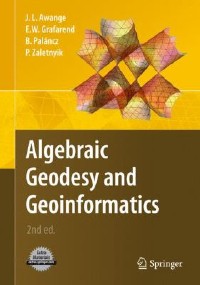
The book presents modern and efficient methods for solving Geodetic and Geoinformatics algebraic problems illustrated with Mathematica using computer algebra techniques of Ring, Polynomials, Groebner basis, Resultants including Dixon resultant, Gauss-Jacobi combinatorial and Procrustes algorithms as well as homotopy methods. These problems are traditionally solved by approximate methods. This book presents alternative algebraic techniques based on computer algebra tools. This new approach meets such modern challenges as resection by laser techniques, solution of orientation in Robotics, transformation and bundle block adjustment in Geoinformatics, densification of Engineering networks, analytical solution for GPS-meteorology and many other problems. For Mathematicians, the book provides some practical examples of application of abstract algebra and multidimensional scaling. The accompanying CD-ROM contains Mathematica notebooks with computational illustrations and application packages to solve for real life problems in geodesy and geoinformatics as resection, intersection, orientation problems.
目录
Introduction p. 1
Motivation p. 1
Modern challenges p. 1
Facing the challenges p. 2
Concluding remarks p. 5
Algebraic symbolic and numeric methods
Basics of ring theory p. 9
Some applications to geodesy and geoinformatics p. 9
Numbers from operational perspective p. 9
Number rings p. 13
Concluding remarks p. 16
Basics of polynomial theory p. 17
Polynomial equations p. 17
Polynomial rings p. 18
Polynomial objects as rings p. 18
Operations 么addition枚 and 么multiplication枚 p. 20
Factoring polynomials p. 21
Polynomial roots p. 21
Minimal polynomials p. 22
Univariate polynomials with real coefficients p. 23
Quadratic polynomials p. 23
Cubic polynomials p. 25
Quartic polynomials p. 26
Methods for investigating roots p. 27
Logarithmic and contour plots on complex plane p. 27
Isograph simulator p. 29
Application of inverse series p. 29|3
Concluding remarks p. 32
Groebner basis p. 33
The origin p. 33
Basics of Groebner basis p. 34
Buchberger algorithm p. 40
Mathematica computation of Groebner basis p. 45
Maple computation of Groebner basis p. 46
Concluding remarks p. 47
Polynomial resultants p. 49
Resultants: An alternative to Groebner basis p. 49
Sylvester resultants p. 49
Multipolynomial resultants p. 51
F. Macaulay formulation p. 52
B. Sturmfels' formulation p. 54
The Dixon resultant p. 55
Basic concepts p. 55
Formulation of the Dixon resultant p. 56
Dixon's generalization of the Cayley-B茅zout method p. 57
Improved Dixon resultant - Kapur-Saxena-Yang method p. 58
Heuristic methods to accelerate the Dixon resultant p. 59
Early discovery of factors: the EDF method p. 60
Concluding remarks p. 61
Linear homotpy p. 63
Introductory remarks p. 63
Background to homotopy p. 63
Definition and basic concepts p. 64
Solving nonlinear equations via homotopy p. 65
Tracing homotopy path as initial value problem p. 69
Types of linear homotopy p. 71
Fixed point homotopy p. 71
Newton homotopy p. 71
Start system for polynomial systems p. 72
Concluding remarks p. 76
Solutions of Overdetermined Systems p. 79
Estimating geodetic and geoinformatics unknowns p. 79
Algebraic LEast Square Solution (ALESS) p. 80
Transforming overdetermined systems to determined p. 80
Solving the determined system p. 82
Gauss-Jacobi combinatorial algorithm p. 84
Combinatorial approach: the origin p. 84
Linear and nonlinear Gauss-Markov models p. 87
Gauss-Jacobi combinatorial formulation p. 88
Combinatorial solution of nonlinear Gauss-Markov model p. 92
Construction of minimal combinatorial subsets p. 92
Optimization of combinatorial solutions p. 93
The Gauss-Jacobi combinatorial algorithm p. 97
Concluding remarks p. 98
Extended Newton-Raphson method p. 101
Introductory remarks p. 101
The standard Newton-Raphson approach p. 102
Examples of limitations of the standard approach p. 102
Overdetermined polynomial systems p. 102
Overdetermined non-polynomial system p. 104
Determined polynomial system p. 105
Underdetermined polynomial system p. 106
Extending the Newton-Raphson approach using pseudoinverse p. 107
Applications of the Extended Newton-Raphson method p. 108
Concluding remarks p. 110
Procrustes solution p. 111
Motivation p. 111
Procrustes: Origin and applications p. 112
Procrustes and the magic bed p. 112
Multidimensional scaling p. 114
Applications of Procrustes in medicine p. 114
Gene recognition p. 114
Identification of malaria parasites p. 115
Partial procrustes solution p. 116
Conventional formulation p. 116
Partial derivative formulation p. 118
The General Procrustes solution p. 119
Extended general Procrustes solution p. 130
Mild anisotropy in scaling p. 130
Strong anisotropy in scalling p. 131
Weighted Procrustes transformation p. 133
Concluding remarks p. 135
Applications to geodesy and geoinformatics
LPS-GNSS orientations and vertical deflections p. 139
Introductory remarks p. 139
Positioning systems p. 140
Global positioning system (GPS) p. 141
Local positioning systems (LPS) p. 142
Local datum choice in an LPS 3-D network p. 142
Relationship between global and local level reference frames p. 144
Observation equations p. 145
Three-dimensional orientation problem p. 146
Procrustes solution of the orientation problem p. 147
Determination of vertical deflection p. 149
Example: Test network Stuttgart Central p. 150
Concluding remarks p. 153
Cartesian to ellipsoidal mapping p. 155
Introductory remarks p. 155
Mapping topographical points onto reference ellipsoid p. 155
Mapping geometry p. 158
Minimum distance mapping p. 160
Grafarend-Lohse's mapping of T2→E2Ea,a,b E p. 163
Groebner basis' mapping of T2→ E2a,a,b p. 164
Extended Newton-Raphson's mapping of T2→ E2a,a,b p. 166
Concluding remarks p. 171
Positioning by ranging p. 173
Applications of distances p. 173
Ranging by global navigation satellite system (GNSS) p. 174
The pseudo-ranging four-points problem p. 174
Sturmfels' approach p. 177
Groebner basis approach p. 179
Ranging to more than four GPS satellites p. 181
Extended Newton-Raphson solution p. 185
Homotopy solution of GPS N-point problem p. 187
Least squares versus Gauss-Jacobi combinatorial p. 189
Ranging by local positioning systems (LPS) p. 191
Planar ranging p. 192
Conventional approach p. 192
Sylvester resultants approach p. 193
Reduced Groebner basis approach p. 194
Planar ranging to more than two known stations p. 198
ALESS solution of overdetermined planar ranging problem p. 200
Three-dimensional ranging p. 203
Closed form three-dimensional ranging p. 203
Conventional approaches p. 204
Solution by elimination approach-2 p. 205
Groebner basis approach p. 206
Polynomial resultants approach p. 207
N-point three-dimensional ranging p. 211
ALESS solution p. 212
Extended Newton-Raphson's solution p. 215
Concluding remarks p. 216
Positioning by resection methods p. 217
Resection problem and its importance p. 217
Geodetic resection p. 220
Planar resection p. 220
Conventional analytical solution p. 220
Groebner basis approach p. 222
Sturmfels' resultant approach p. 223
Three-dimensional resection p. 226
Exact solution p. 226
Solution of Grunert's distance equations p. 226
Groebner basis solution of Grunert's equations p. 228
Polynomial resultants' solution of Grunert's distance equations p. 230
Linear homotopy solution p. 233
Grafarend-Lohse-Schaffrin approach p. 237
3d-resection to more than three known stations p. 240
Photogrammetric resection p. 244
Grafarend-Shan M枚bius photogrammetric resection p. 245
Algebraic photogrammetric resection p. 246
Concluding remarks p. 248
Positioning by intersection methods p. 249
Intersection problem and its importance p. 249
Geodetic intersection p. 250
Planar intersection p. 250
Conventional solution p. 250
Reduced Groebner basis solution p. 251
Three-dimensional intersection p. 254
Closed form solution p. 254
Conventional solution p. 255
Reduced Groebner basis solution p. 255
Sturmfels' resultants solution p. 256
Intersection to more than three known stations p. 259
Photogrammetric intersection p. 261
Grafarend-Shan M枚bius approach p. 262
Commutative algebraic approaches p. 263
Concluding remarks p. 263
GNSS environmental monitoring p. 265
Satellite environmental monitoring p. 265
GNSS remote sensing p. 269
Space borne GNSS meteorology p. 269
Ground based GNSS meteorology p. 271
Refraction (bending) angles p. 273
Transformation of trigonometric equations to algebraic p. 274
Algebraic determination of bending angles p. 276
Application of Groebner basis p. 276
Sylvester resultants solution p. 277
Algebraic analysis of some CHAMP data p. 278
Concluding remarks p. 286
Algebraic diagnosis of outliers p. 289
Outliers in observation samples p. 289
Algebraic diagnosis of outliers p. 290
Outlier diagnosis in planar ranging p. 292
Diagnosis of multipath error in GNSS positioning p. 296
Concluding remarks p. 300
Datum transformation problems p. 303
The 7-parameter datum transformation and its importance p. 303
Algebraic solution of the 7-parameter transformation problem p. 305
Groebner basis transformation p. 305
Dixon resultant solution p. 309
Gauss-Jacobi combinatorial transformation p. 313
The 9-parameter (affine) datum transformation p. 318
Algebraic solution of the 9-parameter transformation p. 320
The 3-point affine transformation problem p. 320
Simplifications for the symbolic solution p. 320
Symbolic solution with Dixon resultant p. 321
Symbolic solution with reduced Groebner basis p. 323
The N-points problem p. 325
ALESS approach to overdetermined cases p. 327
Homotopy solution of the ALLESS-determined model p. 329
Procrustes solution p. 333
Concluding remark p. 337
Appendix p. 339
Definitions p. 339
C. F. Gauss combinatorial approach p. 340
Linear homotopy p. 343
Determined system of the 9-parameter transformation N point problem p. 344
References p. 349
Index p. 371
Motivation p. 1
Modern challenges p. 1
Facing the challenges p. 2
Concluding remarks p. 5
Algebraic symbolic and numeric methods
Basics of ring theory p. 9
Some applications to geodesy and geoinformatics p. 9
Numbers from operational perspective p. 9
Number rings p. 13
Concluding remarks p. 16
Basics of polynomial theory p. 17
Polynomial equations p. 17
Polynomial rings p. 18
Polynomial objects as rings p. 18
Operations 么addition枚 and 么multiplication枚 p. 20
Factoring polynomials p. 21
Polynomial roots p. 21
Minimal polynomials p. 22
Univariate polynomials with real coefficients p. 23
Quadratic polynomials p. 23
Cubic polynomials p. 25
Quartic polynomials p. 26
Methods for investigating roots p. 27
Logarithmic and contour plots on complex plane p. 27
Isograph simulator p. 29
Application of inverse series p. 29|3
Concluding remarks p. 32
Groebner basis p. 33
The origin p. 33
Basics of Groebner basis p. 34
Buchberger algorithm p. 40
Mathematica computation of Groebner basis p. 45
Maple computation of Groebner basis p. 46
Concluding remarks p. 47
Polynomial resultants p. 49
Resultants: An alternative to Groebner basis p. 49
Sylvester resultants p. 49
Multipolynomial resultants p. 51
F. Macaulay formulation p. 52
B. Sturmfels' formulation p. 54
The Dixon resultant p. 55
Basic concepts p. 55
Formulation of the Dixon resultant p. 56
Dixon's generalization of the Cayley-B茅zout method p. 57
Improved Dixon resultant - Kapur-Saxena-Yang method p. 58
Heuristic methods to accelerate the Dixon resultant p. 59
Early discovery of factors: the EDF method p. 60
Concluding remarks p. 61
Linear homotpy p. 63
Introductory remarks p. 63
Background to homotopy p. 63
Definition and basic concepts p. 64
Solving nonlinear equations via homotopy p. 65
Tracing homotopy path as initial value problem p. 69
Types of linear homotopy p. 71
Fixed point homotopy p. 71
Newton homotopy p. 71
Start system for polynomial systems p. 72
Concluding remarks p. 76
Solutions of Overdetermined Systems p. 79
Estimating geodetic and geoinformatics unknowns p. 79
Algebraic LEast Square Solution (ALESS) p. 80
Transforming overdetermined systems to determined p. 80
Solving the determined system p. 82
Gauss-Jacobi combinatorial algorithm p. 84
Combinatorial approach: the origin p. 84
Linear and nonlinear Gauss-Markov models p. 87
Gauss-Jacobi combinatorial formulation p. 88
Combinatorial solution of nonlinear Gauss-Markov model p. 92
Construction of minimal combinatorial subsets p. 92
Optimization of combinatorial solutions p. 93
The Gauss-Jacobi combinatorial algorithm p. 97
Concluding remarks p. 98
Extended Newton-Raphson method p. 101
Introductory remarks p. 101
The standard Newton-Raphson approach p. 102
Examples of limitations of the standard approach p. 102
Overdetermined polynomial systems p. 102
Overdetermined non-polynomial system p. 104
Determined polynomial system p. 105
Underdetermined polynomial system p. 106
Extending the Newton-Raphson approach using pseudoinverse p. 107
Applications of the Extended Newton-Raphson method p. 108
Concluding remarks p. 110
Procrustes solution p. 111
Motivation p. 111
Procrustes: Origin and applications p. 112
Procrustes and the magic bed p. 112
Multidimensional scaling p. 114
Applications of Procrustes in medicine p. 114
Gene recognition p. 114
Identification of malaria parasites p. 115
Partial procrustes solution p. 116
Conventional formulation p. 116
Partial derivative formulation p. 118
The General Procrustes solution p. 119
Extended general Procrustes solution p. 130
Mild anisotropy in scaling p. 130
Strong anisotropy in scalling p. 131
Weighted Procrustes transformation p. 133
Concluding remarks p. 135
Applications to geodesy and geoinformatics
LPS-GNSS orientations and vertical deflections p. 139
Introductory remarks p. 139
Positioning systems p. 140
Global positioning system (GPS) p. 141
Local positioning systems (LPS) p. 142
Local datum choice in an LPS 3-D network p. 142
Relationship between global and local level reference frames p. 144
Observation equations p. 145
Three-dimensional orientation problem p. 146
Procrustes solution of the orientation problem p. 147
Determination of vertical deflection p. 149
Example: Test network Stuttgart Central p. 150
Concluding remarks p. 153
Cartesian to ellipsoidal mapping p. 155
Introductory remarks p. 155
Mapping topographical points onto reference ellipsoid p. 155
Mapping geometry p. 158
Minimum distance mapping p. 160
Grafarend-Lohse's mapping of T2→E2Ea,a,b E p. 163
Groebner basis' mapping of T2→ E2a,a,b p. 164
Extended Newton-Raphson's mapping of T2→ E2a,a,b p. 166
Concluding remarks p. 171
Positioning by ranging p. 173
Applications of distances p. 173
Ranging by global navigation satellite system (GNSS) p. 174
The pseudo-ranging four-points problem p. 174
Sturmfels' approach p. 177
Groebner basis approach p. 179
Ranging to more than four GPS satellites p. 181
Extended Newton-Raphson solution p. 185
Homotopy solution of GPS N-point problem p. 187
Least squares versus Gauss-Jacobi combinatorial p. 189
Ranging by local positioning systems (LPS) p. 191
Planar ranging p. 192
Conventional approach p. 192
Sylvester resultants approach p. 193
Reduced Groebner basis approach p. 194
Planar ranging to more than two known stations p. 198
ALESS solution of overdetermined planar ranging problem p. 200
Three-dimensional ranging p. 203
Closed form three-dimensional ranging p. 203
Conventional approaches p. 204
Solution by elimination approach-2 p. 205
Groebner basis approach p. 206
Polynomial resultants approach p. 207
N-point three-dimensional ranging p. 211
ALESS solution p. 212
Extended Newton-Raphson's solution p. 215
Concluding remarks p. 216
Positioning by resection methods p. 217
Resection problem and its importance p. 217
Geodetic resection p. 220
Planar resection p. 220
Conventional analytical solution p. 220
Groebner basis approach p. 222
Sturmfels' resultant approach p. 223
Three-dimensional resection p. 226
Exact solution p. 226
Solution of Grunert's distance equations p. 226
Groebner basis solution of Grunert's equations p. 228
Polynomial resultants' solution of Grunert's distance equations p. 230
Linear homotopy solution p. 233
Grafarend-Lohse-Schaffrin approach p. 237
3d-resection to more than three known stations p. 240
Photogrammetric resection p. 244
Grafarend-Shan M枚bius photogrammetric resection p. 245
Algebraic photogrammetric resection p. 246
Concluding remarks p. 248
Positioning by intersection methods p. 249
Intersection problem and its importance p. 249
Geodetic intersection p. 250
Planar intersection p. 250
Conventional solution p. 250
Reduced Groebner basis solution p. 251
Three-dimensional intersection p. 254
Closed form solution p. 254
Conventional solution p. 255
Reduced Groebner basis solution p. 255
Sturmfels' resultants solution p. 256
Intersection to more than three known stations p. 259
Photogrammetric intersection p. 261
Grafarend-Shan M枚bius approach p. 262
Commutative algebraic approaches p. 263
Concluding remarks p. 263
GNSS environmental monitoring p. 265
Satellite environmental monitoring p. 265
GNSS remote sensing p. 269
Space borne GNSS meteorology p. 269
Ground based GNSS meteorology p. 271
Refraction (bending) angles p. 273
Transformation of trigonometric equations to algebraic p. 274
Algebraic determination of bending angles p. 276
Application of Groebner basis p. 276
Sylvester resultants solution p. 277
Algebraic analysis of some CHAMP data p. 278
Concluding remarks p. 286
Algebraic diagnosis of outliers p. 289
Outliers in observation samples p. 289
Algebraic diagnosis of outliers p. 290
Outlier diagnosis in planar ranging p. 292
Diagnosis of multipath error in GNSS positioning p. 296
Concluding remarks p. 300
Datum transformation problems p. 303
The 7-parameter datum transformation and its importance p. 303
Algebraic solution of the 7-parameter transformation problem p. 305
Groebner basis transformation p. 305
Dixon resultant solution p. 309
Gauss-Jacobi combinatorial transformation p. 313
The 9-parameter (affine) datum transformation p. 318
Algebraic solution of the 9-parameter transformation p. 320
The 3-point affine transformation problem p. 320
Simplifications for the symbolic solution p. 320
Symbolic solution with Dixon resultant p. 321
Symbolic solution with reduced Groebner basis p. 323
The N-points problem p. 325
ALESS approach to overdetermined cases p. 327
Homotopy solution of the ALLESS-determined model p. 329
Procrustes solution p. 333
Concluding remark p. 337
Appendix p. 339
Definitions p. 339
C. F. Gauss combinatorial approach p. 340
Linear homotopy p. 343
Determined system of the 9-parameter transformation N point problem p. 344
References p. 349
Index p. 371
- 名称
- 类型
- 大小
光盘服务联系方式: 020-38250260 客服QQ:4006604884
云图客服:
用户发送的提问,这种方式就需要有位在线客服来回答用户的问题,这种 就属于对话式的,问题是这种提问是否需要用户登录才能提问
Video Player
×
Audio Player
×
pdf Player
×
亲爱的云图用户,
光盘内的文件都可以直接点击浏览哦
无需下载,在线查阅资料!
