

简介
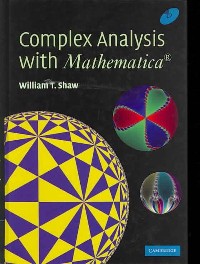
Voted one of Choice magazine's Outstanding Academic Titles for 2007, Complex Analysis with Mathematica offers a new way of learning and teaching a subject that lies at the heart of many areas of pure and applied mathematics, physics, engineering and even art. Yet the way it has been taught has changed little for decades. This book offers teachers and students an opportunity to learn about complex numbers in a state-of-the-art computational environment. The innovative approach also offers insights into the many areas too often neglected in a student treatment, including complex chaos, mathematical art, physics in three or more dimensions and advanced fluid dynamics. Thus readers can also use the book for self-study and for enrichment. Teachers can use the book for a traditional course, and regard Mathematica as a tool for illustration or for checking, for example in the calculation of residues and integrals by the calculus of residues.
Moreover, one can gain full access to the properties of the myriad of special functions built in to Mathematica, and extend the usual dry series treatments of such objects to a full appreciation of their properties by graphical and other means. Furthermore the integration with a computer mathematics system makes it possible to address topics that are usually not presentable on a blackboard, in particular iterative equation-solving leading to chaos and even fractal planets. The use of Mathematica enables the author to cover several topics that are often absent from traditional treatments: for example, tiling of the hyberbolic plane are given, as is a friendly introduction to the theory of twisters, thereby unlocking applications of complex numbers to physics in three and four dimensions. Students are also led, optionally, into cubic or quartic equations, investigations of symmetric chaos and advanced conformal mapping.
A CD is included, which contains a live version of the book and has been updated for use with Mathematica 6. In particular all the Mathematica code enables the user to run computer experiments. - Back cover.
目录
Table Of Contents:
Preface xv
Why this book? xv
How this text is organized xvi
Some suggestions on how to use this text xxi
About the enclosed CD xxii
Exercises and solutions xxiv
Acknowledgements xxiv
Why you need complex numbers 1(9)
Introduction 1(1)
First analysis of quadratic equations 1(2)
Mathematica investigation: quadratic equations 3(7)
Exercises 8(2)
Complex algebra and geometry 10(31)
Introduction 10(1)
Informal approach to 'real' numbers 10(2)
Definition of a complex number and notation 12(1)
Basic algebraic properties of complex numbers 13(1)
Complex conjugation and modulus 14(1)
The Wessel--Argand plane 14(1)
Cartesian and polar forms 15(6)
DeMoivre's theorem 21(4)
Complex roots 25(4)
The exponential form for complex numbers 29(3)
The triangle inequalities 32(1)
Mathematica visualization of complex roots and logs 33(2)
Multiplication and spacing in Mathematica 35(6)
Exercises 35(6)
Cubics, quartics and visualization of complex roots 41(15)
Introduction 41(1)
Mathematica investigation of cubic equations 42(3)
Mathematica investigation of quartic equations 45(6)
The quintic 51(1)
Root movies and root locus plots 51(5)
Exercises 53(3)
Newton--Raphson iteration and complex fractals 56(22)
Introduction 56(1)
Newton--Raphson methods 56(1)
Mathematica visualization of real Newton--Raphson 57(2)
Cayley's problem: complex global basins of attraction 59(3)
Basins of attraction for a simple cubic 62(5)
More general cubics 67(4)
Higher-order simple polynomials 71(2)
Fractal planets: Riemann sphere constructions 73(5)
Exercises 76(2)
A complex view of the real logistic map 78(27)
Introduction 78(1)
Cobwebbing theory 79(1)
Definition of the quadratic and cubic logistic maps 80(1)
The logistic map: an analytical approach 81(8)
What about n=3, 4,...? 89(2)
Summary of our root-finding investigations 91(1)
The logistic map: an experimental approach 91(1)
Experiment one: 0 < λ < 1 92(1)
Experiment two: 1 < λ < 2 93(1)
Experiment three: 2 < λ < √5 93(2)
Experiment four: 2.45044 < λ < 2.46083 95(1)
Experiment five: √5 < λ < √5 + ε 96(1)
Experiment six: √5 < λ 96(2)
Bifurcation diagrams 98(2)
Symmetry-related bifurcation 100(2)
Remarks 102(3)
Exercises 103(2)
The Mandelbrot set 105(33)
Introduction 105(1)
From the logistic map to the Mandelbrot map 105(2)
Stable fixed points: complex regions 107(3)
Periodic orbits 110(4)
Escape-time algorithm for the Mandelbrot set 114(6)
MathLink versions of the escape-time algorithm 120(6)
Diving into the Mandelbrot set: fractal movies 126(3)
Computing and drawing the Mandelbrot set 129(9)
Exercises 135(1)
Appendix: C Code listings 136(2)
Symmetric chaos in the complex plane 138(21)
Introduction 138(1)
Creating and iterating complex non-linear maps 139(4)
A movie of a symmetry-increasing bifurcation 143(2)
Visitation density plots 145(1)
High-resolution plots 146(1)
Some colour functions to try 146(2)
Hit the turbos with MathLink! 148(1)
Billion iterations picture gallery 149(10)
Exercises 154(1)
Appendix: C code listings 155(4)
Complex functions 159(35)
Introduction 159(1)
Complex functions: definitions and terminology 159(4)
Neighbourhoods, open sets and continuity 163(2)
Elementary vs. series approach to simple functions 165(4)
Simple inverse functions 169(2)
Branch points and cuts 171(4)
The Riemann sphere and infinity 175(1)
Visualization of complex functions 176(7)
Three-dimensional views of a complex function 183(4)
Holey and checkerboard plots 187(2)
Fractals everywhere? 189(5)
Exercises 192(2)
Sequences, series and power series 194(14)
Introduction 194(1)
Sequences, series and uniform convergence 194(2)
Theorems about series and tests for convergence 196(6)
Convergence of power series 202(3)
Functions defined by power series 205(1)
Visualization of series and functions 205(3)
Exercises 207(1)
Complex differentiation 208(29)
Introduction 208(1)
Complex differentiability at a point 209(2)
Real differentiability of complex functions 211(1)
Complex differentiability of complex functions 212(1)
Definition via quotient formula 213(1)
Holomorphic, analytic and regular functions 214(1)
Simple consequences of the Cauchy-Riemann equations 214(1)
Standard differentiation rules 215(2)
Polynomials and power series 217(3)
A point of notation and spotting non-analytic functions 220(1)
The Ahlfors--Struble(?) theorem 221(16)
Exercises 233(4)
Paths and complex integration 237(11)
Introduction 237(1)
Paths 237(3)
Contour integration 240(1)
The fundamental theorem of calculus 241(1)
The value and length inequalities 242(1)
Uniform convergence and integration 243(1)
Contour integration and its perils in Mathematica! 244(4)
Exercises 245(3)
Cauchy's theorem 248(15)
Introduction 248(1)
Green's theorem and the weak Cauchy theorem 248(2)
The Cauchy--Goursat theorem for a triangle 250(4)
The Cauchy--Goursat theorem for star-shaped sets 254(1)
Consequences of Cauchy's theorem 255(4)
Mathematica pictures of the triangle subdivision 259(4)
Exercises 261(2)
Cauchy's integral formula and its remarkable consequences 263(15)
Introduction 263(1)
The Cauchy integral formula 263(2)
Taylor's theorem 265(6)
The Cauchy inequalities 271(1)
Liouville's theorem 271(1)
The fundamental theorem of algebra 272(2)
Morera's theorem 274(1)
The mean-value and maximum modulus theorems 275(3)
Exercises 275(3)
Laurent series, zeroes, singularities and residues 278(24)
Introduction 278(1)
The Laurent series 278(4)
Definition of the residue 282(1)
Calculation of the Laurent series 282(4)
Definitions and properties of zeroes 286(1)
Singularities 287(5)
Computing residues 292(1)
Examples of residue computations 293(9)
Exercises 299(3)
Residue calculus: integration, summation and the argument principle 302(36)
Introduction 302(1)
The residue theorem 302(2)
Applying the residue theorem 304(1)
Trigonometric integrals 305(8)
Semicircular contours 313(3)
Semicircular contour: easy combinations of trigonometric functions and polynomials 316(2)
Mousehole contours 318(2)
Dealing with functions with branch points 320(4)
Infinitely many poles and series summation 324(4)
The argument principle and Rouche's theorem 328(10)
Exercises 335(3)
Conformal mapping I: simple mappings and Mobius transforms 338(19)
Introduction 338(1)
Recall of visualization tools 338(2)
A quick tour of mappings in Mathematica 340(7)
The conformality property 347(1)
The area-scaling property 348(1)
The fundamental family of transformations 348(1)
Group properties of the Mobius transform 349(1)
Other properties of the Mobius transform 350(4)
More about ComplexInequalityPlot 354(3)
Exercises 355(2)
Fourier transforms 357(24)
Introduction 357(1)
Definition of the Fourier transform 358(1)
An informal look at the delta-function 359(4)
Inversion, convolution, shifting and differentiation 363(3)
Jordan's lemma: semicircle theorem II 366(2)
Examples of transforms 368(4)
Expanding the setting to a fully complex picture 372(1)
Applications to differential equations 373(3)
Specialist applications and other Mathematica functions and packages 376(5)
Appendix 17: older versions of Mathematica 377(2)
Exercises 379(2)
Laplace transforms 381(20)
Introduction 381(1)
Definition of the Laplace transform 381(2)
Properties of the Laplace transform 383(4)
The Bromwich integral and inversion 387(1)
Inversion by contour integration 387(3)
Convolutions and applications to ODEs and PDEs 390(5)
Conformal maps and Efros's theorem 395(6)
Exercises 398(3)
Elementary applications to two-dimensional physics 401(32)
Introduction 401(1)
The universality of Laplace's equation 401(2)
The role of holomorphic functions 403(3)
Integral formulae for the half-plane and disk 406(2)
Fundamental solutions 408(5)
The method of images 413(2)
Further applications to fluid dynamics 415(10)
The Navier--Stokes equations and viscous flow 425(8)
Exercises 430(3)
Numerical transform techniques 433(18)
Introduction 433(1)
The discrete Fourier transform 433(2)
Applying the discrete Fourier transform in one dimension 435(2)
Applying the discrete Fourier transform in two dimensions 437(2)
Numerical methods for Laplace transform inversion 439(1)
Inversion of an elementary transform 440(1)
Two applications to 'rocket science' 441(10)
Exercises 448(3)
Conformal mapping II: the Schwarz--Christoffel mapping 451(22)
Introduction 451(1)
The Riemann mapping theorem 452(1)
The Schwarz--Christoffel transformation 452(2)
Analytical examples with two vertices 454(2)
Triangular and rectangular boundaries 456(7)
Higher-order hypergeometric mappings 463(2)
Circle mappings and regular polygons 465(5)
Detailed numerical treatments 470(3)
Exercises 470(3)
Tiling the Euclidean and hyperbolic planes 473(40)
Introduction 473(1)
Background 473(2)
Tiling the Eudlidean plane with triangles 475(6)
Tiling the Eudlidean plane with other shapes 481(4)
Triangle tilings of the Poincare disc 485(5)
Ghosts and birdies tiling of the Poincare disc 490(7)
The projective representation 497(2)
Tiling the Poincare disc with hyperbolic squares 499(8)
Heptagon tilings 507(3)
The upper half-plane representation 510(3)
Exercises 512(1)
Physics in three and four dimensions I 513(27)
Introduction 513(1)
Minkowski space and the celestial sphere 514(1)
Stereographic projection revisited 515(1)
Projective coordinates 515(2)
Mobius and Lorentz transformations 517(1)
The invisibility of the Lorentz contraction 518(2)
Outline classification of Lorentz transformations 520(4)
Warping with Mathematica 524(5)
From null directions to points: twistors 529(2)
Minimal surfaces and null curves I: holomorphic parametrizations 531(4)
Minimal surfaces and null curves II: minimal surfaces and visualization in three dimensions 535(5)
Exercises 538(2)
Physics in three and four dimensions II 540(13)
Introduction 540(1)
Laplace's equation in dimension three 540(1)
Solutions with an axial symmetry 541(2)
Translational quasi-symmetry 543(1)
From three to four dimensions and back again 544(4)
Translational symmetry: reduction to 2-D 548(2)
Comments 550(3)
Exercises 551(2)
Bibliograpy 553(5)
Index 558
Preface xv
Why this book? xv
How this text is organized xvi
Some suggestions on how to use this text xxi
About the enclosed CD xxii
Exercises and solutions xxiv
Acknowledgements xxiv
Why you need complex numbers 1(9)
Introduction 1(1)
First analysis of quadratic equations 1(2)
Mathematica investigation: quadratic equations 3(7)
Exercises 8(2)
Complex algebra and geometry 10(31)
Introduction 10(1)
Informal approach to 'real' numbers 10(2)
Definition of a complex number and notation 12(1)
Basic algebraic properties of complex numbers 13(1)
Complex conjugation and modulus 14(1)
The Wessel--Argand plane 14(1)
Cartesian and polar forms 15(6)
DeMoivre's theorem 21(4)
Complex roots 25(4)
The exponential form for complex numbers 29(3)
The triangle inequalities 32(1)
Mathematica visualization of complex roots and logs 33(2)
Multiplication and spacing in Mathematica 35(6)
Exercises 35(6)
Cubics, quartics and visualization of complex roots 41(15)
Introduction 41(1)
Mathematica investigation of cubic equations 42(3)
Mathematica investigation of quartic equations 45(6)
The quintic 51(1)
Root movies and root locus plots 51(5)
Exercises 53(3)
Newton--Raphson iteration and complex fractals 56(22)
Introduction 56(1)
Newton--Raphson methods 56(1)
Mathematica visualization of real Newton--Raphson 57(2)
Cayley's problem: complex global basins of attraction 59(3)
Basins of attraction for a simple cubic 62(5)
More general cubics 67(4)
Higher-order simple polynomials 71(2)
Fractal planets: Riemann sphere constructions 73(5)
Exercises 76(2)
A complex view of the real logistic map 78(27)
Introduction 78(1)
Cobwebbing theory 79(1)
Definition of the quadratic and cubic logistic maps 80(1)
The logistic map: an analytical approach 81(8)
What about n=3, 4,...? 89(2)
Summary of our root-finding investigations 91(1)
The logistic map: an experimental approach 91(1)
Experiment one: 0 < λ < 1 92(1)
Experiment two: 1 < λ < 2 93(1)
Experiment three: 2 < λ < √5 93(2)
Experiment four: 2.45044 < λ < 2.46083 95(1)
Experiment five: √5 < λ < √5 + ε 96(1)
Experiment six: √5 < λ 96(2)
Bifurcation diagrams 98(2)
Symmetry-related bifurcation 100(2)
Remarks 102(3)
Exercises 103(2)
The Mandelbrot set 105(33)
Introduction 105(1)
From the logistic map to the Mandelbrot map 105(2)
Stable fixed points: complex regions 107(3)
Periodic orbits 110(4)
Escape-time algorithm for the Mandelbrot set 114(6)
MathLink versions of the escape-time algorithm 120(6)
Diving into the Mandelbrot set: fractal movies 126(3)
Computing and drawing the Mandelbrot set 129(9)
Exercises 135(1)
Appendix: C Code listings 136(2)
Symmetric chaos in the complex plane 138(21)
Introduction 138(1)
Creating and iterating complex non-linear maps 139(4)
A movie of a symmetry-increasing bifurcation 143(2)
Visitation density plots 145(1)
High-resolution plots 146(1)
Some colour functions to try 146(2)
Hit the turbos with MathLink! 148(1)
Billion iterations picture gallery 149(10)
Exercises 154(1)
Appendix: C code listings 155(4)
Complex functions 159(35)
Introduction 159(1)
Complex functions: definitions and terminology 159(4)
Neighbourhoods, open sets and continuity 163(2)
Elementary vs. series approach to simple functions 165(4)
Simple inverse functions 169(2)
Branch points and cuts 171(4)
The Riemann sphere and infinity 175(1)
Visualization of complex functions 176(7)
Three-dimensional views of a complex function 183(4)
Holey and checkerboard plots 187(2)
Fractals everywhere? 189(5)
Exercises 192(2)
Sequences, series and power series 194(14)
Introduction 194(1)
Sequences, series and uniform convergence 194(2)
Theorems about series and tests for convergence 196(6)
Convergence of power series 202(3)
Functions defined by power series 205(1)
Visualization of series and functions 205(3)
Exercises 207(1)
Complex differentiation 208(29)
Introduction 208(1)
Complex differentiability at a point 209(2)
Real differentiability of complex functions 211(1)
Complex differentiability of complex functions 212(1)
Definition via quotient formula 213(1)
Holomorphic, analytic and regular functions 214(1)
Simple consequences of the Cauchy-Riemann equations 214(1)
Standard differentiation rules 215(2)
Polynomials and power series 217(3)
A point of notation and spotting non-analytic functions 220(1)
The Ahlfors--Struble(?) theorem 221(16)
Exercises 233(4)
Paths and complex integration 237(11)
Introduction 237(1)
Paths 237(3)
Contour integration 240(1)
The fundamental theorem of calculus 241(1)
The value and length inequalities 242(1)
Uniform convergence and integration 243(1)
Contour integration and its perils in Mathematica! 244(4)
Exercises 245(3)
Cauchy's theorem 248(15)
Introduction 248(1)
Green's theorem and the weak Cauchy theorem 248(2)
The Cauchy--Goursat theorem for a triangle 250(4)
The Cauchy--Goursat theorem for star-shaped sets 254(1)
Consequences of Cauchy's theorem 255(4)
Mathematica pictures of the triangle subdivision 259(4)
Exercises 261(2)
Cauchy's integral formula and its remarkable consequences 263(15)
Introduction 263(1)
The Cauchy integral formula 263(2)
Taylor's theorem 265(6)
The Cauchy inequalities 271(1)
Liouville's theorem 271(1)
The fundamental theorem of algebra 272(2)
Morera's theorem 274(1)
The mean-value and maximum modulus theorems 275(3)
Exercises 275(3)
Laurent series, zeroes, singularities and residues 278(24)
Introduction 278(1)
The Laurent series 278(4)
Definition of the residue 282(1)
Calculation of the Laurent series 282(4)
Definitions and properties of zeroes 286(1)
Singularities 287(5)
Computing residues 292(1)
Examples of residue computations 293(9)
Exercises 299(3)
Residue calculus: integration, summation and the argument principle 302(36)
Introduction 302(1)
The residue theorem 302(2)
Applying the residue theorem 304(1)
Trigonometric integrals 305(8)
Semicircular contours 313(3)
Semicircular contour: easy combinations of trigonometric functions and polynomials 316(2)
Mousehole contours 318(2)
Dealing with functions with branch points 320(4)
Infinitely many poles and series summation 324(4)
The argument principle and Rouche's theorem 328(10)
Exercises 335(3)
Conformal mapping I: simple mappings and Mobius transforms 338(19)
Introduction 338(1)
Recall of visualization tools 338(2)
A quick tour of mappings in Mathematica 340(7)
The conformality property 347(1)
The area-scaling property 348(1)
The fundamental family of transformations 348(1)
Group properties of the Mobius transform 349(1)
Other properties of the Mobius transform 350(4)
More about ComplexInequalityPlot 354(3)
Exercises 355(2)
Fourier transforms 357(24)
Introduction 357(1)
Definition of the Fourier transform 358(1)
An informal look at the delta-function 359(4)
Inversion, convolution, shifting and differentiation 363(3)
Jordan's lemma: semicircle theorem II 366(2)
Examples of transforms 368(4)
Expanding the setting to a fully complex picture 372(1)
Applications to differential equations 373(3)
Specialist applications and other Mathematica functions and packages 376(5)
Appendix 17: older versions of Mathematica 377(2)
Exercises 379(2)
Laplace transforms 381(20)
Introduction 381(1)
Definition of the Laplace transform 381(2)
Properties of the Laplace transform 383(4)
The Bromwich integral and inversion 387(1)
Inversion by contour integration 387(3)
Convolutions and applications to ODEs and PDEs 390(5)
Conformal maps and Efros's theorem 395(6)
Exercises 398(3)
Elementary applications to two-dimensional physics 401(32)
Introduction 401(1)
The universality of Laplace's equation 401(2)
The role of holomorphic functions 403(3)
Integral formulae for the half-plane and disk 406(2)
Fundamental solutions 408(5)
The method of images 413(2)
Further applications to fluid dynamics 415(10)
The Navier--Stokes equations and viscous flow 425(8)
Exercises 430(3)
Numerical transform techniques 433(18)
Introduction 433(1)
The discrete Fourier transform 433(2)
Applying the discrete Fourier transform in one dimension 435(2)
Applying the discrete Fourier transform in two dimensions 437(2)
Numerical methods for Laplace transform inversion 439(1)
Inversion of an elementary transform 440(1)
Two applications to 'rocket science' 441(10)
Exercises 448(3)
Conformal mapping II: the Schwarz--Christoffel mapping 451(22)
Introduction 451(1)
The Riemann mapping theorem 452(1)
The Schwarz--Christoffel transformation 452(2)
Analytical examples with two vertices 454(2)
Triangular and rectangular boundaries 456(7)
Higher-order hypergeometric mappings 463(2)
Circle mappings and regular polygons 465(5)
Detailed numerical treatments 470(3)
Exercises 470(3)
Tiling the Euclidean and hyperbolic planes 473(40)
Introduction 473(1)
Background 473(2)
Tiling the Eudlidean plane with triangles 475(6)
Tiling the Eudlidean plane with other shapes 481(4)
Triangle tilings of the Poincare disc 485(5)
Ghosts and birdies tiling of the Poincare disc 490(7)
The projective representation 497(2)
Tiling the Poincare disc with hyperbolic squares 499(8)
Heptagon tilings 507(3)
The upper half-plane representation 510(3)
Exercises 512(1)
Physics in three and four dimensions I 513(27)
Introduction 513(1)
Minkowski space and the celestial sphere 514(1)
Stereographic projection revisited 515(1)
Projective coordinates 515(2)
Mobius and Lorentz transformations 517(1)
The invisibility of the Lorentz contraction 518(2)
Outline classification of Lorentz transformations 520(4)
Warping with Mathematica 524(5)
From null directions to points: twistors 529(2)
Minimal surfaces and null curves I: holomorphic parametrizations 531(4)
Minimal surfaces and null curves II: minimal surfaces and visualization in three dimensions 535(5)
Exercises 538(2)
Physics in three and four dimensions II 540(13)
Introduction 540(1)
Laplace's equation in dimension three 540(1)
Solutions with an axial symmetry 541(2)
Translational quasi-symmetry 543(1)
From three to four dimensions and back again 544(4)
Translational symmetry: reduction to 2-D 548(2)
Comments 550(3)
Exercises 551(2)
Bibliograpy 553(5)
Index 558
- 名称
- 类型
- 大小
光盘服务联系方式: 020-38250260 客服QQ:4006604884
云图客服:
用户发送的提问,这种方式就需要有位在线客服来回答用户的问题,这种 就属于对话式的,问题是这种提问是否需要用户登录才能提问
Video Player
×
Audio Player
×
pdf Player
×
亲爱的云图用户,
光盘内的文件都可以直接点击浏览哦
无需下载,在线查阅资料!
