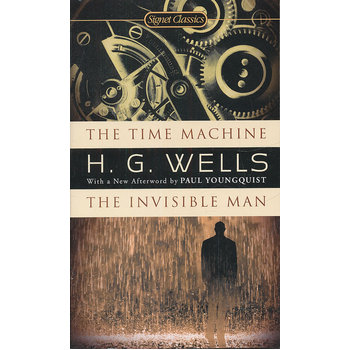
The Time Machine / The Invisible Man
作者: H.G
出版社:Penguin 2007年10月
简介:
The Time Machine (1895) and The Invisible Man(1897) are now more than a century old. Yet they endure as literarytexts, radio plays, and movies, because they appeal directly to twoof our deepest desires: immortality and omnipotence. The timemachine would allow us to escape death and gain knowledge of thefate of the earth, while invisibility would enable us to go andcome as we please, under the noses of friends and enemies. At thesame time, both fictions show us the dangers of fulfilled wishes:The Time Traveller discovers the future of humanity is not brightbut hideously dark, while the Invisible Man drowns in the madnessbrought about by his own experimentation.
Of course, what Herbert George Wells (1866–1946) wanted to expressin these fantasies and what generations of readers have made ofthem are two radically different things. Erroneously labeled“science fiction,” and tricked out in their film versions with allkinds of fanciful devices with flashing lights and ominous buzzersWells never mentions, they are really tales that enact the author’stheories and speculations about human society, human nature, andnatural history in allegorical fashion. That is, the “science” inWells’s fictions is nothing more than stage machinery. But,ironically, it is the machinery that has come to dominate ourcollective imagination.
There is nothing unique in this. Think of Gulliver’s Travels(whose long-forgotten original title is Travels into SeveralRemote Nations of the World), a book that Wells read as a boyand reread throughout his life. In 1726 Jonathan Swift (1667–1745)satirized English political parties, religious quarrels, theoriesof world government, and science, but his work was so grounded ineighteenth-century British culture that today’s readers needextensive preparation to fathom it. The story of Lemuel Gulliver’svisits to lands populated by giants or intelligent horses has,however, become a staple of children’s literature. The same appliesto Robinson Crusoe (1719), by Daniel Defoe (1660–1731). Onlyscholars see the relationship between Crusoe’s shipwreck andDefoe’s ideas on the fate of the middle classes during theRestoration, when Charles II returned to England in 1660. Defoe’smessage and all his political intentions have been lost, but hisstory endures as a wonderful demonstration of self-reliance. In theliterature of the United States, we have the example of HermanMelville (1819–1891) and his Moby-Dick (1851): Most readerslearn about the ambiguous struggle between good and evil embeddedin the work long after they’ve read a novel aboutnineteenth-century whaling and the strange characters engaged inthat dangerous work.
Much the same has taken place with Wells’s Time Machine andThe Invisible Man. Wells cloaked his ideas about the futureof society and the role of science in the world so well thatreaders simply do not see those issues and instead read his shortnovels as examples of a kind of fiction based on the simplest ofpropositions: “What if it were possible to travel through time bymeans of a machine?” or “What if it were possible to make oneselfinvisible?” In a world—one we share with Wells despite the factthat more than a hundred years separates the moment he publishedthese two works from our own age—when scientists seem to makediscoveries every day, it requires no great leap of imagination, no“willing suspension of disbelief,” to accept the basic premise ofeach text.
This is what differentiates Wells from Jules Verne (1828–1905),author of Voyage to the Center of the Earth (1864) andAround the World in Eighty Days (1873). Wells, in a 1934preface to a collection of his early fictions comments on why theyare not comparable to Verne’s writings:
These tales have been compared with the work of Jules Verne andthere was a disposition on the part of literary journalists at onetime to call me the English Jules Verne. As a matter of fact thereis no literary resemblance whatever between the anticipatoryinventions of the great Frenchman and these fantasies. His workdealt almost always with actual possibilities of invention anddiscovery, and he made some remarkable forecasts. . . . But thesestories of mine . . . do not pretend to deal with possible things;they are exercises of the imagination in a quite different field.They belong to a class of writing which includes the Golden Assof Apuleius, the True Histories of Lucian, PeterSchlemil, and the story of Frankenstein. . . . They areall fantasies; they do not aim to project a serious possibility;they aim indeed only at the same amount of conviction as one getsin a good gripping dream (The Complete Science Fiction Treasuryof H. G. Wells).
Wells links himself to a tradition, but at the same time hemisleads the reader. It is true, as he says in the same preface,that “The invention is nothing in itself,” by which he means thatthe applied science of Verne is of no interest in his kind of tale.It is also the reason why rediscoveries of Verne, especially films,are always set in the past: His projections became fact veryquickly. By the same token, this explains why Wells’s inventionsand their ramifications will always be modern.