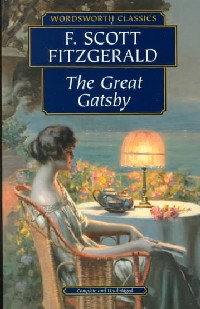
The great Gatsby /
作者: by F. Scott Fitzgerald ; introduction and notes by Guy Reynolds.
出版社:
简介:弗?司各特?菲茨拉德(F.Scott Fitzgerald ,1896——1940)是二十世纪美国著名作家,"迷惘一代"的代表作家,短暂一生中只写有为数不多的几部作品,《了不起的盖茨比》是作家最具代表性的作品。
Book Description
The Wordsworth Classics covers a huge list of beloved works of literature in English and translations. This growing series is rigorously updated, with scholarly introductions and notes added to new titles.
This novel is a summary of the "roaring twenties", and a devastating expose of the "Jazz Age". Through the narration of Nick Carraway, it explores the superficially glittering world of mansions on the Long Island shore, and his encounter with Jay Gatsby and the mystery that surrounds him.
Synopsis:
"He talked a lot about the past and I gathered that he wanted to recover something, some idea of himself perhaps, that had gone into loving Daisy. His life had been confused and disordered since then, but if he could once return to a certain starting place and go over it all slowly, he could find out what that thing was . . ."
The Great Gatsby (1925), F. Scott Fitzgerald's masterpiece, stands among the greatest of all American fiction. Jay Gatsby's lavish lifestyle in a mansion on Long Island's gold coast encapsulates the spirit, excitement, and violence of the era Fitzgerald named 'the Jazz Age'. Impelled by his love for Daisy Buchanan, Gatsby seeks nothing less than to recapture the moment five years earlier when his best and brightest dreams - his 'unutterable visions' - seemed to be incarnated in her kiss.
A moving portrayal of the power of romantic imagination, as well as the pathos and courage entailed in the pusuit of an unattainable dream, The Great Gatsby is a classic fiction of hope and disillusion. This edition is fully annotated with a fine Introduction incorporating new interpretation and detailing Fitzgerald's struggle to write the novel, its critical reception and its significance for future generations.
Amazon.com
In 1922, F. Scott Fitzgerald announced his decision to write "something new--something extraordinary and beautiful and simple + intricately patterned." That extraordinary, beautiful, intricately patterned, and above all, simple novel became The Great Gatsby, arguably Fitzgerald's finest work and certainly the book for which he is best known. A portrait of the Jazz Age in all of its decadence and excess, Gatsby captured the spirit of the author's generation and earned itself a permanent place in American mythology. Self-made, self-invented millionaire Jay Gatsby embodies some of Fitzgerald's--and his country's--most abiding obsessions: money, ambition, greed, and the promise of new beginnings. "Gatsby believed in the green light, the orgiastic future that year by year recedes before us. It eluded us then, but that's no matter--tomorrow we will run faster, stretch out our arms farther.... And one fine morning--" Gatsby's rise to glory and eventual fall from grace becomes a kind of cautionary tale about the American Dream.
It's also a love story, of sorts, the narrative of Gatsby's quixotic passion for Daisy Buchanan. The pair meet five years before the novel begins, when Daisy is a legendary young Louisville beauty and Gatsby an impoverished officer. They fall in love, but while Gatsby serves overseas, Daisy marries the brutal, bullying, but extremely rich Tom Buchanan. After the war, Gatsby devotes himself blindly to the pursuit of wealth by whatever means--and to the pursuit of Daisy, which amounts to the same thing. "Her voice is full of money," Gatsby says admiringly, in one of the novel's more famous descriptions. His millions made, Gatsby buys a mansion across Long Island Sound from Daisy's patrician East Egg address, throws lavish parties, and waits for her to appear. When she does, events unfold with all the tragic inevitability of a Greek drama, with detached, cynical neighbor Nick Carraway acting as chorus throughout. Spare, elegantly plotted, and written in crystalline prose, The Great Gatsby is as perfectly satisfying as the best kind of poem.
From AudioFile
Christopher Reeve's smooth rhythm and soft-spoken tone accentuate Fitzgerald's flowing, elegant style. Since his character is an onlooker to events which take place in Gatsby's glittering but superficial world, Reeve also projects an appropriate distant quality. However, his vocal attempts to make each character well-defined seem to be an overwhelming task for one reader. Occasionally, it is hard to tell which character is speaking. Nonetheless, Reeve's ability to accurately evoke the emotions of the characters transcends this flaw. As a result, he delivers a noteworthy performance. M.P.T.
About Author
F. Scott Fitzgerald was born in St. Paul, Minnesota, in 1896, attended Princeton University, and published his first novel, This Side of Paradise, in 1920. That same year he married Zelda Sayre and the couple divided their time between New York, Paris, and the Riviera, becoming a part of the American expatriate circle that included Gertrude Stein, Ernest Hemingway, and John Dos Passos. Fitzgerald was hailed early on as a major new voice in American fiction; his other novels include The Beautiful and Damned and Tender Is the Night. He died of a heart attack in 1940 at the age of forty-four, while working on The Love of the Last Tycoon.
Book Dimension :
length: (cm)19.8 width:(cm)12.6
点击链接进入中文版:
伟大的盖茨比