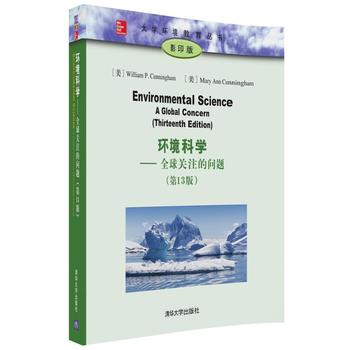
环境科学——全球关注的问题
作者: William
出版社:清华大学出版社 2018年01月
简介:
All Rights reserved. No part of this publication may be reproduced or transmitted in any form or by any means, electronic or mechanical, includingwithout limitation photocopying, recording, taping, or any database, information or retrieval system, without the prior written permission of the publisher.This authorized English reprint edition is jointly published by McGraw-Hill Education and Tsinghua University Press Limited. This edition is authorizedfor sale in the People’s Republic of China only, excluding Hong Kong, Macao SAR and Taiwan.Copyright . 2018 by McGraw-Hill Education and Tsinghua University Press Limited.
【目录】
Introduction 1
1Understanding Our Environment 11
2 Principles of Science and Systems 33
3 Matter, Energy, and Life 48
4 Evolution, Biological Communities,
and Species Interactions 71
5
Biomes: Global Patterns of Life 95
6 Population Biology 113
7 Human Populations 127
8
Environmental Health and
Toxicology 148
9Food and Hunger 173
10 Farming: Conventional and Sustainable
Practices 191
11 Biodiversity: Preserving Species 218
12 Biodiversity: Preserving Landscapes 242
13 Restoration Ecology 265
14 Geology and Earth Resources 289
15 Climate Change 308
16
Air Pollution 335
17 Water Use and Management 362
18
Water Pollution 385
19 Conventional Energy 410
20 Sustainable Energy 433
21 Solid, Toxic, and Hazardous Waste 459
22
Urbanization and Sustainable Cities 479
23 Ecological Economics 499
24 Environmental Policy, Law, and
Planning 523
25
What Then Shall We Do? 543
【免费在线读】
1
Understanding Our Environment
Learning Outcomes
After studying this chapter, you should be able to:
1.1 Explain what environmental science is, and how it draws on different kinds of knowledge.
1.2 Identify some early thinkers on environment and resources, and contrast some of their ideas.
1.3 Describe sustainable development and its goals.
1.4 Explain core concepts in sustainable development.
1.5 Identify ways in which ethics and faith might promote sustainability and conservation.
“Working together, we have proven that sustainable development is possible; that reforestation of degraded land is possible; and that exemplary governance is possible when ordinary citizens are informed, sensitized, mobilized and involved in direct action for their environment.”
– Wangari Maathai (1940–2011)Winner of 2004 Nobel Peace Prize
11
CASE STUDY
continued
CHAPTER 1 Understanding Our Environment 13
produce it for $45 per kg, and expects to drive prices down even further in coming years. Stronger state regulation is also helpful, as the central government can establish strong policies and streamline installation rules, pushing utilities to switch to renewable power.
The case of Rizhao demonstrates some central themes in environmental science that you’ll be considering throughout this book. Environmental science is a global concern, which unites our interests and our needs for understanding and managing resources. As our collective demand for resources grows, it becomes more urgent to help developing areas improve their lot without destroying the environmental systems on which we all depend. In this book we’ll ask, What are resources? What are environmental systems, and what methods do scientists use to understand them? How have human populations grown and changed, and why? How can we make smart, environmentally informed policy decisions that will protect our communities and the other species, over the long term?
China, with one-fifth of the world’s population, has become a test case for many of our ideas about resources, population, policy, urbanization, and many other major changes. With good planning, China could help lead the way toward more sustainable futures.
Political Science Which policies lead to sustainable solutions? Sociology How do people adopt new ideas? Urban Planning What urban designs can reduce energy use? Engineering Can we design