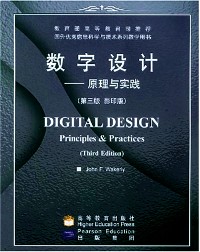
Digital design : principles and practices =数字设计—原理与实践 / 3rd ed., photocopy ed.
作者: John F. Wakerly.
出版社:
简介: Early coverage of modern CMOS logic families-Includes low voltage and LVCMOS/LVTTL.
Students learn the technology they'll use in the lab and on the job.
Coverage of Complex Programmable Logic Devices (CPLDs) and Field-Programmable Gate Arrays (FPGAs).
Provides the general background needed for associated CPLD- and FPGA-based lab courses.
Earlier introduction of HDL-based digital design.
HDL concepts can be used throughout the course.
HDL coverage and examples-Includes VHDL as well as ABEL.
VHDL is an industry-standard language that also provides a good foundation for Verilog if required.
Programming examples written in C rather than Pascal.
Most computer engineering students are familiar with C.
Faster progression through non-automated methods-Such as Karnaugh maps and state-machine synthesis.
While these are used to illustrate some basic concepts, more emphasis is given to the methods and tools that areactually used on the job.
Description of automated methods-including simulation and synthesis.
Students can relate basic principles to a wide variety of automated tools.
More and larger design examples.
More opportunity to "learn by example."
Drill problems and exercises.
Always helpful in core courses.
Includes CD-ROMS with the complete Xilinx Foundation 1.5 (Student Edition), including schematic entry, ABEL, VHDL, and Verilog compilers, simulator, and documentation.
Students with a PC can create and simulate designs using a high-quality set of commercial tools, and thereby learn the practical side of digital design first-hand.
. Instructor's website-Includes: Individual, importable files for all figures and tables; drill and exercise solutions; supplementary exercise solutions; sample exams and solutions.
Instant access to important instructor materials and updates.
Student's web site includes: Source files for all ABEL, VHDL, and C examples; Foundation 1.5 schematics for large examples; supplementary exercises; updated references and web links; appendices including "Electrical Circuits Review" and "IEEE Standard Symbols;" and up-to-date errata.
Instant access to useful supplementary materials and updates.
Easy-to-follow, practical writing style and extensive use of illustrations.
Students will actually "read the book."
High-quality, user-friendly color production.
Easy to locate key concepts and definitions.