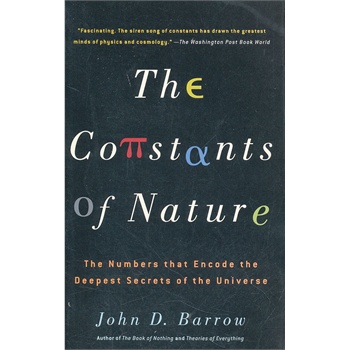
Constants Of Nature
作者: John Barrow 著
出版社:Random House US 2004-3-1
简介:From Publishers Weekly In this lively volume, Cambridge physicist Barrow (The Book ofNothing) considers the natural constants-the handful of seeminglyeternal numerical values, such as the speed of light, the weight ofthe proton, Planck's constant or the four dimensions of space andtime-that constitute the "bedrock" of physical reality. Theseconstants quantify some of the simplest statements that sciencemakes about the world, but as this fascinating work of popularscience demonstrates, they have profound implications for the fateof the universe and our place within it. And, Barrow hints, theymight not be truly constant. He traces scientists' evolvingunderstanding of the natural constants as they grew to assume acentral role in modern relativity theory and quantum mechanics, andoutlines ongoing attempts to determine whether they are justinexplicable facts of nature or the logical consequence of somefundamental Theory of Everything. He also raises importantphilosophical and even religious questions. The natural constantsare delicately balanced to make the universe safe for livingorganisms: altering them more than a hair would make stars burnout, atoms fly apart, and the world as we know it impossible. Isthis a happy accident? Proof of Intelligent Design? Or is it acoincidence of our inhabiting one of an infinity of universes thatjust happens to have living observers? Barrow explores these issuesin erudite but lucid prose that draws on an array of thinkers fromEinstein to Freud, and, because he withholds his answer to thechanging constants question until the end, his book has surprisingnarrative pull. His account makes some of the most challengingfrontiers of science accessible, even enthralling, to laypeople.B&w photos and illustrations. Copyright 2003 Reed Business Information, Inc. --This text refersto an out of print or unavailable edition of this title. From Library Journal A writer in cosmology with roughly a dozen books for lay readersto his credit (e.g., The Book of Nothing), Barrow here discussesthe efforts of various scientists, including himself, to discernsome deeper meaning in the various fundamental constants ofphysics-for example, the so-called fine-structure constant, thegravitational constant, and the speed of light in a vacuum. Why dothese constants have the values that they do? What might be theirinterrelationships? And might these constants turn out to be subtlyvariable instead of truly "constant"? Barrow gives us the historyof early attempts to answer such questions and then describes thecurrent state of thinking. Along the way, he shows how theseconsiderations relate to the structure and ultimate fate of theuniverse. Barrow acknowledges that this field is very much in astate of flux, explaining what is known in a readable fashion fornonspecialists-though he does assume a moderate degree ofscientific literacy on the part of his readers. Stronglyrecommended for college and larger public libraries. Jack W. Weigel, Ann Arbor, MI Copyright 2002 Reed Business Information, Inc. --This text refersto an out of print or unavailable edition of this title.