

简介
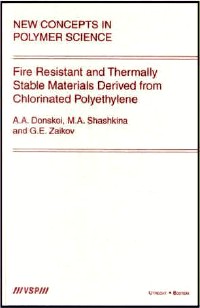
Donskoi, M. A. Shashkina (both: Institute of Aviation Materials, Moscow) and G. E. Zaikov (biochemical physics, Russian Academy of Sciences) take advantage of the relatively freer publishing climate in post-Soviet Russia to present data on the development of polymeric materials with reduced combustibility that can be used for heat shields in aviation. They focus on chlorinated polyolefins as organic polymers. The study might interest graduate students, engineers, and scientists working in material science and engineering, especially those dealing with new polymeric materials for aircraft, ships, or automobiles. Distributed in the US by Brill. Annotation (c)2003 Book News, Inc., Portland, OR (booknews.com)
目录
Author affiliation iii
Preface v
Introduction 3
1. Combustion of polymeric materials and methods to reduce it.
The mechanism of fire and heat shield covers 5
2. Investigation methods for fire and heat shield materials and
covers based on them 31
3. Chlorinated polymers as the base for materials with reduced
combustibility 41
3.1. Current state of chlorinated polyolefins production and
application 42
3.1.1. Chlorination methods 42
3.1.2. Structure and properties 48
4. Vulcanization 67
4.1. Vulcanization effect on physical and mechanical properties and
stability of materials 67
4.2. Study of vulcanization mechanism and the effect of fillers 79
5. Fillers 89
5.1. Inorganic fillers and their function in decreasing
combustibility 91
5.2. Organic compounds increasing fire shield properties
of materials 100
5.3. Combustion decelerators. Operation mechanism and
injection methods 102
5.4. Methods of antipyren injection into materials 107
5.5. Application of phosphorus-containing compounds on
the silicon dioxide surface from the liquid phase 112
5.6. Obtaining of phosphorus-containing silica filler by
mechanochemical method 115
5.7. Study of biological activity of phosphorus-containing
silicon dioxides 117
5.8. Study of fire and heat shield properties of materials filled
with modified silicon dioxide 119
6. Plasticizers 123
6.1. Influence of plasticizers on glass transition temperature
and flow rate of polymers 124
6.2. Classification of plasticizers 130
6.3. Selection of plasticizers 130
6.3.1. Miscibility of plasticizers with polymers 131
6.3.2. Plasticizer effect on mechanical, fire and heat shield,
and electrical properties of composite materials 131
7. Tests of materials. Study of operation mechanism at
high-temperature influence 134
7.1. Coke formation as the investigation method of fire
and heat shield materials and covers 135
7.2. The role of intumescence in the problem of fire protection
of polymers 138
7.2.1. Intumescence chemistry 138
7.2.2. Protection through intumescence 139
7.2.3. The role of ammonium polyphosphates in protection
of polymers from fire 141
8. Development of fire and heat shield materials 156
9. Climatic natural and artificial aging of materials 170
10. Multilayer materials for increasing efficiency of covers 176
10.1. Materials with surface reinforcement 176
10.2. Heat-accumulating materials in cover compositions 177
10.3. Estimation of thermophysical properties of
heataccumulating materials 186
11. Tests of materials as covers for flight information
recorders under conditions modeling an accident 192
Conclusion 196
References 198
Subject Index 218
- 名称
- 类型
- 大小
光盘服务联系方式: 020-38250260 客服QQ:4006604884
云图客服:
用户发送的提问,这种方式就需要有位在线客服来回答用户的问题,这种 就属于对话式的,问题是这种提问是否需要用户登录才能提问
Video Player
×
Audio Player
×
pdf Player
×
