

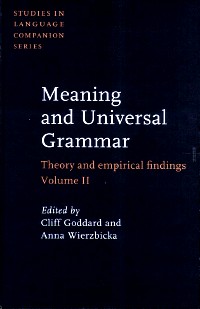
简介
This two-volume set of studies takes as its starting point an old idea: the idea that universal grammar is based on meaning. It seeks to give this idea a solid theoretical foundation, and to explore its viability through detailed empirical studies in a set of typologically divergent languages (Lao, Malay, Mandarin Chinese, Mangaaba- Mbula, Polish and Spanish). As the twentieth century recedes, linguists seem increasingly to agree that the "anti-semantic turn" inaugurated by Leonard Bloomfield and continued by Noam Chomsky was a wrong turn. It is now widely believed that the grammatical properties of a word follow, at least in large measure, from its meaning. But it is true to say that in generative linguistics, semantics is still in a theoretically and methodologically underdeveloped state. It would not be going too far to compare much modern semantic work to phonology before the advent of phonemic analysis. There is little agreement on fundamental methodological problems such as how to distinguish semantic invariants from contextual effects, how to distinguish polysemy from semantic generality, and, above all, on the nature of semantic representation itself. All too often, individual researchers cobble together frameworks to suit their immediate needs, with little regard to how these frameworks can be integrated into a comprehensive system. Viewed against this background, the natural semantic metalanguage (NSM) framework stands out sharply (cf. Wierzbicka 1972, 1980, 1992, 1996; Goddard 1998; Goddard and Wierzbicka Eds 1994; and many other studies listed in this volume, chapter 1). It has been developed and refined over some thirty years. It provides a comprehensive system equally applicable to lexical, grammatical, and illocutionary meaning. It provides a clear and practical methodology for semantic analysis, which has proved itself in literally hundreds of studies in descriptive semantics.
目录
Meaning and Universal Grammar 1
Editorial page 2
Title page 3
Copyright page 4
Table of contents 5
Acknowledgements 11
List of Contributors 13
List of Maps and Tables 15
Typographical Conventions and Symbols 15
Opening Statement: Meaning and Universal Grammar 17
References 19
1 The Search for the Shared Semantic Core of All Languages 21
1.0 Introduction 21
1.1 Identifying semantic primes and their exponents 29
1.2 How were the primes identified in the first place? 32
1.3 Allolexy and portmanteaus 36
1.4 When exponents of primes have secondary, polysemic meanings 40
1.5 Non-compositional polysemy (motivated homonymy) between primes 42
1.6 The syntax of semantic primes 47
Abbreviations 49
Notes 49
References 49
2 Semantic Primes and Universal Grammar 57
2.0 Preliminaries 57
2.1 Substantive phrase 60
2.2 Specifiers 63
2.3 Predicates and predicate phrases 67
2.4 Temporal and locational adjuncts 82
2.5 Other elements 87
2.6 The textual structure of NSM explications 95
Abbreviations 98
Notes 98
References 98
3 Semantic Primes and Universal Grammar in Malay (Bahasa Melayu) 103
3.0 Introduction 103
3.1 Substantives 105
3.1.1 aku l, kau YOU 105
3.1.2 sesuatu SOMETHING 106
3.1.3 seseorang SOMEONE, orang PEOPLE 109
3.1.4 badan BODY 114
3.2 Mental predicates 115
3.2.1 fikir THINK, tahu KNOW 115
3.2.2 mahu/nak WANT 117
3.2.3 nampak SEE, dengar HEAR 117
3.2.4 rasa FEEL 118
3.3 Speech 121
3.3.1 kata SAY, henar TRUE 121
3.3.2 perkataan WORDS 123
3.4 Actions, events and movement 125
3.4.1 buat DO 125
3.4.2 terjadi HAPPEN 127
3.4.3 bergerak MOVE 128
3.5 Existence and possession 130
3.5.1 ada THERE IS 130
3.5.2 ada HAVE 133
3.6 Life and death 134
3.6.1 hidup LIVE 134
3.6.2 mati DIE 136
3.7 Determiners 137
3.7.1 ini THIS 137
3.7.2 sama/yang sama THE SAME 139
3.7.3 lain OTHER 141
3.8 Quantifiers 142
3.8.1 satu ONE, dua TWO 142
3.8.2 semua ALL, banyak MUCH/MANY 143
3.8.3 berberapa SOME 144
3.9 Evaluators 148
3.9.1 baik GOOD and buruk BAD 148
3.10 Descriptors 152
3.11 Time 152
3.11.1 bila WHEN, masa/waktu TIME 152
3.11.2 sekarang NOW 155
3.11.3 sebelum/dulu BEFORE, selepas AFTER 156
3.11.5 beberapa lama [?] FOR SOME TIME 160
3.11.6 saat MOMENT 161
3.12 Space 162
3.12.1 (di) mana/tempat WHERE/PLACE, (di) sini HERE 162
3.12.2 dekat NEAR jauh FAR, (di) atas ABOVE, (di) bawah BELOW 163
3.12.3 (di) dalam INSIDE 164
3.12.4 di sebelah ON (ONE) SIDE 165
3.13 Logical concepts 167
3.13.1 sebab BECAUSE, kalau IF 167
3.13.2 tidak/tak NOT, mungkin MAYBE 171
3.13.3 boleh CAN 172
3.14 Augmentor 173
3.15 Intensifier 175
3.16 Taxonomy and partonomy 176
3.17 Similarity 177
3.18 Review 178
Appendix 3.1: Two natural semantic metalanguage texts in Malay 180
Appendix 3.2: Exponents of semantic primes in Malay 184
Abbreviations 185
Acknowledgements 185
Notes 185
References 186
4 La Metalengua Sem谩ntica Natural:The Natural Semantic Metalanguage of Spanish 189
4.0 Introduction 189
4.1 Substantives 193
4.1.1 yo I, usted YOU 193
4.1.2 alguien SOMEONE, algo SOMETHING 199
4.1.3 gente PEOPLE 200
4.2 Mental predicates 202
4.2.1 saber KNOW 202
4.2.2 pensar THINK 204
4.2.3 querer WANT 207
4.2.4 ver SEE, o铆r HEAR 210
4.2.5 sentir FEEL 210
4.3 Speech 212
4.3.1 decir SAY 212
4.3.2 palabras WORDS 213
4.4 Actions, events and movement 214
4.4.1 hacer DO 214
4.4.2 pasar HAPPEN 216
4.4.3 moverse MOVE 217
4.5 Existence and possession 218
4.5.1 hay THERE IS 218
4.5.2 tener HAVE 219
4.6 Life and death 220
4.7 Determiners 220
4.7.1 estoTms 220
4.7.2 lo mismo THE SAME 222
4.7.3 otro OTHER 222
4.8 Quantifiers 223
4.8.1 uno ONE, dos TWO 223
4.8.2 todo ALL 224
4.8.3 mucho MUCH/MANY 224
4.8.4 algunos SOME 225
4.9 Evaluators 226
4.10 Descriptors 229
4.11 Time 231
4.11.1 cu谩ndo/tiempo WHEN/TIME 231
4.11.2 ahora NOW 233
4.11.3 antes BEFORE, despu茅s AFTER 233
4.11.4 mucho tiempo A LONG TIME, poco tiempo A SHORT TIME 235
4.11.5 por un tiempo FOR SOME TIME 235
4.11.6 momento MOMENT 236
4.12 Space 237
4.12.1 d贸nde/sitio WHERE/PLACE 237
4.12.4 lejos de FAR, cerca de NEAR 240
4.12.5 a un lado ON (ONE) SIDE 240
4.12.6 dentro de INSIDE 241
4.13 Logical concepts 241
4.13.1 Interclausal linkers', porque BECAUSE, si IF 241
4.13.2 Clause operators: no NOT, tal vez MAYBE 243
4.13.3 Metapredicate: poder CAN 245
4.14 Augmentor 246
4.15 Intensifier 246
4.16 Taxonomy and partonomy 247
4.17 Similarity 248
4.18 Conclusion 249
Appendix 4.1: Two natural semantic metalanguage texts in Spanish 250
Appendix 4.2: Exponents of semantic primes in Spanish 254
Abbreviations 255
Acknowledgements 255
References 256
5 The Universal Syntax of Semantic Primes in Mandarin Chinese 259
5.0 Typological features of Mandarin 259
5.0.1 Classifier constructions 261
5.0.2 Verb complementation 262
5.0.3 Stative verbs 262
5.0.4 Complex clauses 263
5.1 Substantives 264
5.1.1 w艔 l, n沫 YOU 264
5.1.2 y艔u r茅n ~ sh茅i SOMEONE 264
5.1.3sh茅nme~ y艔u sh茂 ~ d艒ngxi SOMETHING/THING 265
5.1.4 r茅nmen ~ r茅n PEOPLE 266
5.1.5 sh锚nt沫 BODY 267
5.2 Determiners 268
5.2.1 zh猫 TEIS 268
5.2.2 tongy脿ng ~ t贸ng y墨 ~ y墨y脿ng THE SAME 270
5.2.3 bi茅(de) OTHER 272
5.3 Quantifiers 274
5.3.1 y墨 ONE 275
5.3.2 H盲ng ~ 猫r TWO 275
5.3.3 y艔u-de ~y艔u-xi膿 ~ y墨xi膿 SOME 275
5.3.4 d艒u ~su艔y艔u (de) ALL 277
5.3.5 (h臅n) du艒 ~ xudu艒 MUCH/MANY 278
5.4 Evaluators 279
5.4.1 hao GOOD 280
5.4.2 hu脿i ~ b霉 hao BAD 282
5.5 Descriptors 282
5.5.1 d脿 BIG, xiao SMALL 282
5.6 Mental predicates 283
5.6.1 xiang THINK, zhidao KNOW 284
5.6.2 y脿o WANT 285
5.6.3 ganju茅 FEEL 286
5.6.4 t墨ngd脿o HEAR, k脿nd脿o SEE 287
5.7 Speech 288
5.7.1 shu艒 SAY 288
5.7.2 z矛 ~ hu脿 WORDS 292
5.7.3 zh毛n TRUE 294
5.8 Actions, events and movement 294
5.8.1 zu貌 DO 294
5.8.2 f盲sheng HAPPEN 296
5.8.3 d贸ng MOVE 299
5.9 Existence and possession 301
5.9.1 y艔u THERE IS 301
5.9.2 y艔u HAVE 302
5.10 Life and death 303
5.10.1 sh锚nghu贸~ hu贸 LIVE 303
5.10.2 s沫 DIE 305
5.11 Time 306
5.11.1 sh铆hou WHEN/TIME 306
5.11.2 xi脿nz脿i NOW 308
5.11.3 y铆qi谩n BEFORE, y沫h貌u AFTER 308
5.11.4 h臅n jiu A LONG TIME, yihu矛r A SHORT TIME 310
5.11.5 you yldu脿n shijian FOR SOME TIME 310
5.12 Space 311
5.12.1 sh茅nme d卯f膩ng ~ n氓r WHERE, d卯f膩ng ~ n氓r PLACE 'there' 311
5.12.2 zh猫r HERE 313
5.12.3 sh脿ngmian ~ -shang ABOVE, xi脿mian ~ -xia BELOW 313
5.12.4 yuan FAR, fin ~ de sh锚nbian NEAR 314
5.12.5 -bian ~ p谩ngbian SIDE, -li ~ limian INSIDE 316
5.13 Logical concepts 317
5.13.1 y墨nw猫i BECAUSE 317
5.13.2 r煤guo IF 319
5.13.3 b霉 ~m茅i NOT 320
5.13.4 k臎n茅ng MAYBE 321
5.14 Intensifier 322
5.15 Augmentor 324
5.16 Taxonomy and partonomy 324
5.16.1 zhong KIND OF 324
5.16.2 b霉fen ~ X you YPART PART 325
5.17 Similarity 325
5.18 Conclusion 327
Appendix 5.1: Two natural semantic metalanguage texts in Mandarin 329
Appendix 5.2: Exponents of semantic primes in Mandarin 332
Abbreviations 333
Acknowledgements 334
Notes 334
References 335
Index of Languages and Language Families 339
General Index 341
Editorial page 2
Title page 3
Copyright page 4
Table of contents 5
Acknowledgements 11
List of Contributors 13
List of Maps and Tables 15
Typographical Conventions and Symbols 15
Opening Statement: Meaning and Universal Grammar 17
References 19
1 The Search for the Shared Semantic Core of All Languages 21
1.0 Introduction 21
1.1 Identifying semantic primes and their exponents 29
1.2 How were the primes identified in the first place? 32
1.3 Allolexy and portmanteaus 36
1.4 When exponents of primes have secondary, polysemic meanings 40
1.5 Non-compositional polysemy (motivated homonymy) between primes 42
1.6 The syntax of semantic primes 47
Abbreviations 49
Notes 49
References 49
2 Semantic Primes and Universal Grammar 57
2.0 Preliminaries 57
2.1 Substantive phrase 60
2.2 Specifiers 63
2.3 Predicates and predicate phrases 67
2.4 Temporal and locational adjuncts 82
2.5 Other elements 87
2.6 The textual structure of NSM explications 95
Abbreviations 98
Notes 98
References 98
3 Semantic Primes and Universal Grammar in Malay (Bahasa Melayu) 103
3.0 Introduction 103
3.1 Substantives 105
3.1.1 aku l, kau YOU 105
3.1.2 sesuatu SOMETHING 106
3.1.3 seseorang SOMEONE, orang PEOPLE 109
3.1.4 badan BODY 114
3.2 Mental predicates 115
3.2.1 fikir THINK, tahu KNOW 115
3.2.2 mahu/nak WANT 117
3.2.3 nampak SEE, dengar HEAR 117
3.2.4 rasa FEEL 118
3.3 Speech 121
3.3.1 kata SAY, henar TRUE 121
3.3.2 perkataan WORDS 123
3.4 Actions, events and movement 125
3.4.1 buat DO 125
3.4.2 terjadi HAPPEN 127
3.4.3 bergerak MOVE 128
3.5 Existence and possession 130
3.5.1 ada THERE IS 130
3.5.2 ada HAVE 133
3.6 Life and death 134
3.6.1 hidup LIVE 134
3.6.2 mati DIE 136
3.7 Determiners 137
3.7.1 ini THIS 137
3.7.2 sama/yang sama THE SAME 139
3.7.3 lain OTHER 141
3.8 Quantifiers 142
3.8.1 satu ONE, dua TWO 142
3.8.2 semua ALL, banyak MUCH/MANY 143
3.8.3 berberapa SOME 144
3.9 Evaluators 148
3.9.1 baik GOOD and buruk BAD 148
3.10 Descriptors 152
3.11 Time 152
3.11.1 bila WHEN, masa/waktu TIME 152
3.11.2 sekarang NOW 155
3.11.3 sebelum/dulu BEFORE, selepas AFTER 156
3.11.5 beberapa lama [?] FOR SOME TIME 160
3.11.6 saat MOMENT 161
3.12 Space 162
3.12.1 (di) mana/tempat WHERE/PLACE, (di) sini HERE 162
3.12.2 dekat NEAR jauh FAR, (di) atas ABOVE, (di) bawah BELOW 163
3.12.3 (di) dalam INSIDE 164
3.12.4 di sebelah ON (ONE) SIDE 165
3.13 Logical concepts 167
3.13.1 sebab BECAUSE, kalau IF 167
3.13.2 tidak/tak NOT, mungkin MAYBE 171
3.13.3 boleh CAN 172
3.14 Augmentor 173
3.15 Intensifier 175
3.16 Taxonomy and partonomy 176
3.17 Similarity 177
3.18 Review 178
Appendix 3.1: Two natural semantic metalanguage texts in Malay 180
Appendix 3.2: Exponents of semantic primes in Malay 184
Abbreviations 185
Acknowledgements 185
Notes 185
References 186
4 La Metalengua Sem谩ntica Natural:The Natural Semantic Metalanguage of Spanish 189
4.0 Introduction 189
4.1 Substantives 193
4.1.1 yo I, usted YOU 193
4.1.2 alguien SOMEONE, algo SOMETHING 199
4.1.3 gente PEOPLE 200
4.2 Mental predicates 202
4.2.1 saber KNOW 202
4.2.2 pensar THINK 204
4.2.3 querer WANT 207
4.2.4 ver SEE, o铆r HEAR 210
4.2.5 sentir FEEL 210
4.3 Speech 212
4.3.1 decir SAY 212
4.3.2 palabras WORDS 213
4.4 Actions, events and movement 214
4.4.1 hacer DO 214
4.4.2 pasar HAPPEN 216
4.4.3 moverse MOVE 217
4.5 Existence and possession 218
4.5.1 hay THERE IS 218
4.5.2 tener HAVE 219
4.6 Life and death 220
4.7 Determiners 220
4.7.1 estoTms 220
4.7.2 lo mismo THE SAME 222
4.7.3 otro OTHER 222
4.8 Quantifiers 223
4.8.1 uno ONE, dos TWO 223
4.8.2 todo ALL 224
4.8.3 mucho MUCH/MANY 224
4.8.4 algunos SOME 225
4.9 Evaluators 226
4.10 Descriptors 229
4.11 Time 231
4.11.1 cu谩ndo/tiempo WHEN/TIME 231
4.11.2 ahora NOW 233
4.11.3 antes BEFORE, despu茅s AFTER 233
4.11.4 mucho tiempo A LONG TIME, poco tiempo A SHORT TIME 235
4.11.5 por un tiempo FOR SOME TIME 235
4.11.6 momento MOMENT 236
4.12 Space 237
4.12.1 d贸nde/sitio WHERE/PLACE 237
4.12.4 lejos de FAR, cerca de NEAR 240
4.12.5 a un lado ON (ONE) SIDE 240
4.12.6 dentro de INSIDE 241
4.13 Logical concepts 241
4.13.1 Interclausal linkers', porque BECAUSE, si IF 241
4.13.2 Clause operators: no NOT, tal vez MAYBE 243
4.13.3 Metapredicate: poder CAN 245
4.14 Augmentor 246
4.15 Intensifier 246
4.16 Taxonomy and partonomy 247
4.17 Similarity 248
4.18 Conclusion 249
Appendix 4.1: Two natural semantic metalanguage texts in Spanish 250
Appendix 4.2: Exponents of semantic primes in Spanish 254
Abbreviations 255
Acknowledgements 255
References 256
5 The Universal Syntax of Semantic Primes in Mandarin Chinese 259
5.0 Typological features of Mandarin 259
5.0.1 Classifier constructions 261
5.0.2 Verb complementation 262
5.0.3 Stative verbs 262
5.0.4 Complex clauses 263
5.1 Substantives 264
5.1.1 w艔 l, n沫 YOU 264
5.1.2 y艔u r茅n ~ sh茅i SOMEONE 264
5.1.3sh茅nme~ y艔u sh茂 ~ d艒ngxi SOMETHING/THING 265
5.1.4 r茅nmen ~ r茅n PEOPLE 266
5.1.5 sh锚nt沫 BODY 267
5.2 Determiners 268
5.2.1 zh猫 TEIS 268
5.2.2 tongy脿ng ~ t贸ng y墨 ~ y墨y脿ng THE SAME 270
5.2.3 bi茅(de) OTHER 272
5.3 Quantifiers 274
5.3.1 y墨 ONE 275
5.3.2 H盲ng ~ 猫r TWO 275
5.3.3 y艔u-de ~y艔u-xi膿 ~ y墨xi膿 SOME 275
5.3.4 d艒u ~su艔y艔u (de) ALL 277
5.3.5 (h臅n) du艒 ~ xudu艒 MUCH/MANY 278
5.4 Evaluators 279
5.4.1 hao GOOD 280
5.4.2 hu脿i ~ b霉 hao BAD 282
5.5 Descriptors 282
5.5.1 d脿 BIG, xiao SMALL 282
5.6 Mental predicates 283
5.6.1 xiang THINK, zhidao KNOW 284
5.6.2 y脿o WANT 285
5.6.3 ganju茅 FEEL 286
5.6.4 t墨ngd脿o HEAR, k脿nd脿o SEE 287
5.7 Speech 288
5.7.1 shu艒 SAY 288
5.7.2 z矛 ~ hu脿 WORDS 292
5.7.3 zh毛n TRUE 294
5.8 Actions, events and movement 294
5.8.1 zu貌 DO 294
5.8.2 f盲sheng HAPPEN 296
5.8.3 d贸ng MOVE 299
5.9 Existence and possession 301
5.9.1 y艔u THERE IS 301
5.9.2 y艔u HAVE 302
5.10 Life and death 303
5.10.1 sh锚nghu贸~ hu贸 LIVE 303
5.10.2 s沫 DIE 305
5.11 Time 306
5.11.1 sh铆hou WHEN/TIME 306
5.11.2 xi脿nz脿i NOW 308
5.11.3 y铆qi谩n BEFORE, y沫h貌u AFTER 308
5.11.4 h臅n jiu A LONG TIME, yihu矛r A SHORT TIME 310
5.11.5 you yldu脿n shijian FOR SOME TIME 310
5.12 Space 311
5.12.1 sh茅nme d卯f膩ng ~ n氓r WHERE, d卯f膩ng ~ n氓r PLACE 'there' 311
5.12.2 zh猫r HERE 313
5.12.3 sh脿ngmian ~ -shang ABOVE, xi脿mian ~ -xia BELOW 313
5.12.4 yuan FAR, fin ~ de sh锚nbian NEAR 314
5.12.5 -bian ~ p谩ngbian SIDE, -li ~ limian INSIDE 316
5.13 Logical concepts 317
5.13.1 y墨nw猫i BECAUSE 317
5.13.2 r煤guo IF 319
5.13.3 b霉 ~m茅i NOT 320
5.13.4 k臎n茅ng MAYBE 321
5.14 Intensifier 322
5.15 Augmentor 324
5.16 Taxonomy and partonomy 324
5.16.1 zhong KIND OF 324
5.16.2 b霉fen ~ X you YPART PART 325
5.17 Similarity 325
5.18 Conclusion 327
Appendix 5.1: Two natural semantic metalanguage texts in Mandarin 329
Appendix 5.2: Exponents of semantic primes in Mandarin 332
Abbreviations 333
Acknowledgements 334
Notes 334
References 335
Index of Languages and Language Families 339
General Index 341
- 名称
- 类型
- 大小
光盘服务联系方式: 020-38250260 客服QQ:4006604884
云图客服:
用户发送的提问,这种方式就需要有位在线客服来回答用户的问题,这种 就属于对话式的,问题是这种提问是否需要用户登录才能提问
Video Player
×
Audio Player
×
pdf Player
×
