

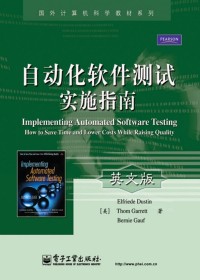
Implementing automated software testing how to save time and lower costs while raising quality
副标题:无
作 者:(美)Elfriede Dustin,(美)Thom Garrent,(美)Bernie Gauf著
分类号:
ISBN:9787121129506
微信扫一扫,移动浏览光盘
简介
在新软件开发的过程中,测试占据的时间和成本百分比越来越大。采用自动化软件测试(AST)方法,开发人员和软件测试人员可以优化软件测试生命周期,从而减少成本。随着技术和开发变得越来越复杂,AST变得更加不可或缺了。本书《自动化软件测试实施指南》(英文版)以经过验证的实践和自动化测试生命周期方法学(ATLM)为基础,提供了更新的实践,为成功实施AST提供了完整的指导。
在本书中,三位权威专家Elfriede Dustin、Thom Garrett和Bernie Gauf详细阐释了AST,系统地回顾了AST的组成元素、能力以及限制。他们利用在防御系统和商业中部署AST的经验,给出了整个AST的实施过程——确定最佳时间、关键的成功因素、主要隐患,以及避免这些隐患的解决方案。
目录
《自动化软件测试实施指南(英文版)》
contents
foreword by admiral edmund p. giambastiani, jr. .15.
foreword by dr. william nylin, jr. .17.
preface .19.
acknowledgments .23.
about the authors .24.
part one what is automated software testing and why shoul we automate? 1
1 what is effective automated software testing (ast)? 3
1.1 automated software testing definition 4
1.2 automated software testing recipes 5
1.3 advances in ast technologies 8
1.4 automating various software testing types 11
1.5 providing ast-based production support 16
1.6 automating standards assessments 18
2 why automate? 23
2.1 the challenges of testing software today 24
2.2 reducing the time and cost of software testing 26
2.3 impacting software quality 38
2.4 improvements to your software test program 42
.3 the business case
3.1 definition of the business case 51
3.2 identifying the business needs 53
3.3 justifying automation in terms of cost and benefits 55
3.4 risks 65
3.5 other considerations 67
4 why automated software testing fails and pitfalls to avoid 69
4.1 r&d does not generally focus on automated or manual testing efforts 71
4.2 ast myths and realities 74
4.3 lack of software development consideration for ast 83
4.4 the forest for the trees-not knowing which tool to pick 91
4.5 lack of automaton standards across tool vendors 94
4.6 lack of business case 97
part two how to automate: top six keys for automation payoff 99
5 key 1: know your requirements 101
5.1 understand the ast support requirements 102
5.2 additional information in support of ast requirements 114
5.3 when information is not available 116
5.4 start implementing your requirements traceability matrix(rtm) 124
6 key 2: develop the automated test strategy 129
6.1 the ast strategy document 131
6.2 scope and automated test objectives 132
6.3 identify the approach 139
6.4 automated software test framework(astf) 146
6.5 ast environment/configuration 150
6.6 automating the rtm 159
6.7 automated defect tracking 164
7 key 3: test the automated software test framework (astf) 167
7.1 verify that the astf meets specified requirements and that features behave as expected 169
7.2 peer-review all astf-related artifacts, including design,development, and test cases 170
7.3 verify requirements and coverage 182
7.4 hold a customer review 183
8 key 4: continuously track progress--and adjust accordingly 187
8.1 ast program tracking and defect prevention 188
8.2 ast metrics 192
8.3 root cause analysis 205
9 key 5: implement ast processes 209
9.1 ast phases and milestones 211
9.2 ast phase 1: requirements gathering-analyze automated testing needs 212
9.3 ast phase 2: test case design and development 215
9.4 ast phase 3: automated software testing framework (astf) test script development 216
9.5 ast phase 4: automated test execution and results reporting 217
9.6 ast phase 5: program review and assessment 218
9.7 virtual quality gates 219
9.8 process measurement 220
10. key 6: put the right people on the project-know the skill sets required 223
10.1 program management 232
10.2 systems engineering 236
10.3 software development 239
10.4 configuration management 242
10.5 quality assurance 244
10.6 subject matter experts(smes) 246
appendices
a process checklist 251
a.1 ast phase 1: requirements gathering-analyze automated testing needs 252
a.2 ast phase 2: test case design and development 253
a.3 ast phase 3: automated software testing framework (astf) and test script development 254
a.4 ast phase 4: automated test execution and results reporting 255
a.5 ast phase 5: program review and assessment 256
b. ast applied to various testing types 257
b.1 security testing 257
b.2 soak testing 261
b.3 concurrency testing 263
b.4 performance testing 265
b.5 code coverage testing 266
b.6 unit testing 271
c the right tool for the job 275
c.1 requirements management (rm) 276
c.2 unit testing frameworks--example evaluation 278
c.3 configuration management--example evaluation 284
c.4 defect tracking--example evaluation 292
c.5 security testing 299
c.6 automated software testing framework (astf)-example evaluation 306
c.7 other stl support tools 316
d case study: an automated software testing framework(astf) example 321
d.1 key design features 323
d.2 test manager 325
d.3 more on automated test case and test code generation 326
d.4 results reporting 328
d.5 automated defect reporting 328
contributing authors 331
index 333
contents
foreword by admiral edmund p. giambastiani, jr. .15.
foreword by dr. william nylin, jr. .17.
preface .19.
acknowledgments .23.
about the authors .24.
part one what is automated software testing and why shoul we automate? 1
1 what is effective automated software testing (ast)? 3
1.1 automated software testing definition 4
1.2 automated software testing recipes 5
1.3 advances in ast technologies 8
1.4 automating various software testing types 11
1.5 providing ast-based production support 16
1.6 automating standards assessments 18
2 why automate? 23
2.1 the challenges of testing software today 24
2.2 reducing the time and cost of software testing 26
2.3 impacting software quality 38
2.4 improvements to your software test program 42
.3 the business case
3.1 definition of the business case 51
3.2 identifying the business needs 53
3.3 justifying automation in terms of cost and benefits 55
3.4 risks 65
3.5 other considerations 67
4 why automated software testing fails and pitfalls to avoid 69
4.1 r&d does not generally focus on automated or manual testing efforts 71
4.2 ast myths and realities 74
4.3 lack of software development consideration for ast 83
4.4 the forest for the trees-not knowing which tool to pick 91
4.5 lack of automaton standards across tool vendors 94
4.6 lack of business case 97
part two how to automate: top six keys for automation payoff 99
5 key 1: know your requirements 101
5.1 understand the ast support requirements 102
5.2 additional information in support of ast requirements 114
5.3 when information is not available 116
5.4 start implementing your requirements traceability matrix(rtm) 124
6 key 2: develop the automated test strategy 129
6.1 the ast strategy document 131
6.2 scope and automated test objectives 132
6.3 identify the approach 139
6.4 automated software test framework(astf) 146
6.5 ast environment/configuration 150
6.6 automating the rtm 159
6.7 automated defect tracking 164
7 key 3: test the automated software test framework (astf) 167
7.1 verify that the astf meets specified requirements and that features behave as expected 169
7.2 peer-review all astf-related artifacts, including design,development, and test cases 170
7.3 verify requirements and coverage 182
7.4 hold a customer review 183
8 key 4: continuously track progress--and adjust accordingly 187
8.1 ast program tracking and defect prevention 188
8.2 ast metrics 192
8.3 root cause analysis 205
9 key 5: implement ast processes 209
9.1 ast phases and milestones 211
9.2 ast phase 1: requirements gathering-analyze automated testing needs 212
9.3 ast phase 2: test case design and development 215
9.4 ast phase 3: automated software testing framework (astf) test script development 216
9.5 ast phase 4: automated test execution and results reporting 217
9.6 ast phase 5: program review and assessment 218
9.7 virtual quality gates 219
9.8 process measurement 220
10. key 6: put the right people on the project-know the skill sets required 223
10.1 program management 232
10.2 systems engineering 236
10.3 software development 239
10.4 configuration management 242
10.5 quality assurance 244
10.6 subject matter experts(smes) 246
appendices
a process checklist 251
a.1 ast phase 1: requirements gathering-analyze automated testing needs 252
a.2 ast phase 2: test case design and development 253
a.3 ast phase 3: automated software testing framework (astf) and test script development 254
a.4 ast phase 4: automated test execution and results reporting 255
a.5 ast phase 5: program review and assessment 256
b. ast applied to various testing types 257
b.1 security testing 257
b.2 soak testing 261
b.3 concurrency testing 263
b.4 performance testing 265
b.5 code coverage testing 266
b.6 unit testing 271
c the right tool for the job 275
c.1 requirements management (rm) 276
c.2 unit testing frameworks--example evaluation 278
c.3 configuration management--example evaluation 284
c.4 defect tracking--example evaluation 292
c.5 security testing 299
c.6 automated software testing framework (astf)-example evaluation 306
c.7 other stl support tools 316
d case study: an automated software testing framework(astf) example 321
d.1 key design features 323
d.2 test manager 325
d.3 more on automated test case and test code generation 326
d.4 results reporting 328
d.5 automated defect reporting 328
contributing authors 331
index 333
Implementing automated software testing how to save time and lower costs while raising quality
- 名称
- 类型
- 大小
光盘服务联系方式: 020-38250260 客服QQ:4006604884
云图客服:
用户发送的提问,这种方式就需要有位在线客服来回答用户的问题,这种 就属于对话式的,问题是这种提问是否需要用户登录才能提问
Video Player
×
Audio Player
×
pdf Player
×
