

简介
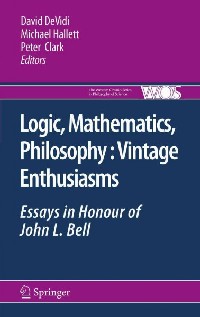
The volume includes twenty-five research papers presented as gifts to John L. Bell to celebrate his 60th birthday by colleagues, former students, friends and admirers. Like Bell鈥檚 own work, the contributions cross boundaries into several inter-related fields. The contributions are new work by highly respected figures, several of whom are among the key figures in their fields. Some examples: in foundations of maths and logic (William Lawvere, Peter Aczel, Graham Priest, Giovanni Sambin); analytical philosophy (Michael Dummett, William Demopoulos), philosophy of science (Michael Redhead, Frank Arntzenius), philosophy of mathematics (Michael Hallett, John Mayberry, Daniel Isaacson) and decision theory and foundations of ecomonics (Ken Bimore). Most articles are contributions to current philosophical debates, but contributions also include some new mathematical results, important historical surveys, and a translation by Wilfrid Hodges of a key work of arabic logic.
目录
Preface 7
Contents 11
Contributors 14
Part I History and Philosophy of Mathematics and Logic 16
1 On Logicist Conceptions of Functions and Classes 17
William Demopoulos 17
1 Introduction 17
2 The Tractarian Background to Ramsey's Extensional Propositional Functions 21
3 Infinity Without Extensional Propositional Functions 22
4 Infinity with Extensional Propositional Functions 25
5 Extensional Propositional Functions and Logicism 29
Bibliography 31
2 Metaphysical Necessity 33
Michael Dummett 33
3 Ibn S谋na and Conflict in Logic 49
Wilfrid Hodges 49
1 To John 49
2 De Interpretatione Chapter 14 50
2.1 The Text Translated Below 50
2.2 Ways of Teaching 51
2.3 Summary of Aristotle's Text 52
3 Ibn S谋na's Semantics 54
3.1 Ideas 54
3.2 Attachments 56
3.3 Meanings of Sentences 59
4 Conflict and Contrariety 60
4.1 Types of Opposition 60
4.2 Aristotle's Question in PH14 61
4.3 The Quickest Contradiction 62
5 The ``Well-Known Commentator'' 63
5.1 Ibn S谋na's Outrageous Analysis 63
5.2 Why? 65
5.3 Who Was the ``Well-Known Commentator''? 65
6 Translation 67
7 Notes 74
Bibliography 81
4 A Minimalist Foundation at Work 82
Giovanni Sambin 82
1 Foundations as a Choice of Abstraction Level 83
1.1 Different Constructive Foundations and Their Incompatibility 83
1.2 The Minimalist Foundation of Constructive Mathematics 85
2 A Minimalist Foundation at Work 90
2.1 Dynamics Between Two Sets 91
2.2 The Definition of Basic Topology 96
3 A Different Topology in Different Foundations 98
4 Benefits of the Minimalist Foundation 102
4.1 Effective Computations and Ideal Structures in One Framework 102
4.2 Creation of New Mathematics 103
4.3 Pluralism as a Source of Richness 106
Bibliography 108
5 The Municipal By-Laws of Thought 110
David DeVidi 110
1 JLB 110
2 The Problem 111
3 The Obvious Approach? 113
4 An Uninteresting Plurality? 115
5 What Makes It Logic? 118
6 The Systems Disagree 120
7 The Systems Are Correct 123
8 Conclusion 124
Bibliography 124
Part II Truth, Consistency and Paradox 126
6 Truth and the Liar 127
Colin Howson 127
1 Introduction 127
2 The Liar Paradox 129
3 Groundedness 137
4 The Strengthened Liar 139
5 Conclusion 144
Bibliography 145
7 Necessary and Sufficient Conditions for Undecidability of the G枚del Sentence and its Truth 147
Daniel Isaacson 147
1 Introduction 147
2 Soundness and Consistency 148
3 Truth of the G枚del Sentence 150
4 G枚del's Notion of 蠅-Consistency 151
5 Kreisel's Notions of n-Consistency 155
5.1 The Notion of 1-Consistency 155
5.2 The Notion of 2-Consistency 158
5.3 Properties of 3-Consistency 160
5.4 Expressing Consistency, 蠅-Consistency, 1-Consistency, and 2-Consistency 160
6 Consistency of S {ConS} 162
7 Comparing G枚del's Incompleteness Theorems with Rosser's Theorem 164
Bibliography 164
8 Paraconsistent Set Theory 165
Graham Priest 165
1 Introduction: For JLB 165
2 Paraconsistent Set Theory: Background 167
3 The Material Strategy 168
4 The Relevant Strategy 170
5 The Model-Theoretic Strategy 175
6 Metatheory of Paraconsistent Logic 177
7 Conclusion: The Shock of the New 179
Bibliography 180
9 Paradox, ZF, and the Axiom of Foundation 182
Adam Rieger 182
1 182
2 183
3 184
4 186
5 188
6 189
7 190
8 191
9 195
10 196
Bibliography 196
10 Absoluteness and the Skolem Paradox 199
Michael Hallett 199
1 Introduction 199
2 ``Impredicative'' Extensions 201
3 The Paradox Internalised 210
4 Absoluteness, Consistency and Independence 217
5 Conclusion 225
Bibliography 225
Part III Logic, Set Theory and Category Theory 229
11 Equalisers of Frames in Constructive Set Theory 230
Peter Aczel 230
1 Introduction 230
2 Proof of Lemma 2 232
3 Proof of Lemma 3 234
Bibliography 237
12 Analogy and Its Surprises: An Eyewitness's Reflections on the Emergence of Real Algebraic Geometry 238
Max Dickmann 238
1 Introduction 238
2 The Late Development of Real Algebraic Geometry 239
3 The Sparse Pieces of a Puzzle 241
3.1 The (Slow) Progress of Real Geometry 241
4 The Puzzle Solved: Invention of the Real Spectrum 244
4.1 Zariski Spectra, Grothendieck Topologies and 茅tale Schemes 244
4.2 ``Real'' Variations on Grothendieck's Theme 247
5 The Inception of Real Algebraic Geometry 249
5.1 Preliminary Remarks 249
5.2 A Simplification 250
5.3 The Geometric Case 250
5.4 Connectedness 252
5.5 Dimension 253
5.6 The Implicit Function Theorem 253
5.7 The Real Spectrum as a Ringed Space 254
5.8 Idempotency of the Real Spectrum and the Substitution Lemma 254
5.9 A Beautiful Application: The Br枚cker--Scheiderer Theorem 255
Bibliography 256
13 Euler's Continuum Functorially Vindicated 257
F. William Lawvere 257
Bibliography 262
14 Natural Numbers and Infinitesimals 263
J.P. Mayberry 263
1 G枚del on Nonstandard Analysis 263
2 Natural Numbers or Finite Sets? 265
3 Euclidean Arithmetic 268
4 Arithmetical Functions and Relations 272
5 Simply Infinite Systems in Euclidean Arithmetic 274
6 Rational Numbers 282
7 Real Numbers 283
8 The Calculus 286
9 A Finitary Version of the Reals 291
10 Conclusions 292
Bibliography 294
15 Logic in Category Theory 295
Alberto Peruzzi 295
1 Motivations 295
2 Perspective Remarks 296
3 The Working Mathematician's Path to Logic 307
4 Layers of Logical Structure 312
5 Further Connections with Type Theoriesand Concluding Remarks 322
Bibliography 329
Part IV Philosophy of Science 333
16 Gunk, Topology and Measure 334
Frank Arntzenius 334
1 Introduction 334
2 The Possibility of Motion and Determinism 335
3 Cutting Things in Half 336
4 Paradoxes of Size 337
5 Quantum Mechanics and Points 338
6 Contact Between Objects 340
7 Now What? 341
8 The Topological Approach to Pointless Spaces 341
9 Objects in a Pointless Topology 344
10 Fields in a Pointless Topology 345
11 The Measure-Theoretic Approach to Pointless Spaces 348
Bibliography 350
17 Pitholes in Space-Time: Structure and Ontology of Physical Geometry 351
Robert DiSalle 351
1 Introduction: The Philosophy of Space-Timeand the Foundations of Mathematics 351
2 Origins of an Ontological Problem 352
3 The Ontological Problem in Its Present State 354
4 The Structure of Space-Time and the Ontologyof the Space-Time Manifold 358
5 Conclusion: Structure from a Pithole 364
Bibliography 365
18 A Silly Answer to a Psillos Question 367
Elaine Landry 367
1 A Psillos Question 368
2 A Category-Theoretic Answer to the Mathematical Structuralist 370
3 Why This Answer Is Silly for a Scientific Structuralist 374
4 An Answer for the Methodological Scientific Structuralist 379
Bibliography 385
19 The Vacuum in Antiquity and in Modern Physics 387
Michael Redhead 387
20 Falsifiability, Empirical Content and the Duhem-Quine Problem 391
Elie Zahar 391
1 Historical Background 391
2 Induction and Direct Proof 392
3 Indirect Method and Crucial Experiments 393
4 Indirect Method and the Duhem-Quine Problem 394
5 Kripke's Challenge 396
6 Quine's Holism and the Analytic-Synthetic Distinction 400
7 Empirical Content and the Duhem-Quine Problem 403
8 Is There a Bayesian Solution of the Duhem-Quine Problem? 406
9 Conclusion 409
Bibliography 410
Part V Decision Theory and Epistemology 411
21 Can Knowledge Be Justified True Belief? 412
Ken Binmore 412
1 Fallibilism or Skepticism? 412
2 Small World Assumptions 413
3 Justification 414
4 What Is an Event? 415
5 All-Encompassing Worlds 416
6 Conclusion 416
Bibliography 417
22 The Stochastic Concept of Economic Equilibrium: A Radical Alternative 418
Mosh茅 Machover 418
1 Introduction 418
1.1 The Equilibrium Price--Profit Equation 419
1.2 The Uniformity Assumption 420
1.3 The Transformation Problem 421
2 Stochastic Equilibrium 422
2.1 Equilibrium in Statistical Mechanics 423
2.2 Economic Equilibrium 424
3 Methodological Comments 425
Bibliography 426
23 Collective Choice as Information Theory: Towards a Theory of Gravitas 427
George Wilmers 427
1 What Can We Learn from a Council of Elders? 427
2 The Notion of Gravitas: A Preliminary Discussion 428
3 Axioms for Gravitas 432
4 Polarity Free Entropy (PFE) 437
5 Conclusions and Open Problems 438
Bibliography 442
24 Scientific Knowledge and Structural Knowledge 443
Peter Clark 443
1 Introduction 443
2 The Modest Defence of Scientific Structural Realism 445
3 Ontic Structural Realism 448
Bibliography 450
Part VI Aesthetics 452
25 Musing on Music 453
Richard Feist 453
1 Introduction: Boethius on Music 453
2 Formalized Music and the Renaissance 455
3 The Turning Point in Aesthetics: Representation 457
4 The Nineteenth Century 458
5 The Twentieth and Twenty-First Centuries 460
6 Representation 463
7 Summary and Conclusion 466
Bibliography 467
26 Inscrutable Harmonies: The Continuous and the Discrete as Reflected in the Playing of Jascha Heifetz and Glenn Gould 469
Joel Bennhall 469
Publications of John L. Bell 474
Name Index 481
Contents 11
Contributors 14
Part I History and Philosophy of Mathematics and Logic 16
1 On Logicist Conceptions of Functions and Classes 17
William Demopoulos 17
1 Introduction 17
2 The Tractarian Background to Ramsey's Extensional Propositional Functions 21
3 Infinity Without Extensional Propositional Functions 22
4 Infinity with Extensional Propositional Functions 25
5 Extensional Propositional Functions and Logicism 29
Bibliography 31
2 Metaphysical Necessity 33
Michael Dummett 33
3 Ibn S谋na and Conflict in Logic 49
Wilfrid Hodges 49
1 To John 49
2 De Interpretatione Chapter 14 50
2.1 The Text Translated Below 50
2.2 Ways of Teaching 51
2.3 Summary of Aristotle's Text 52
3 Ibn S谋na's Semantics 54
3.1 Ideas 54
3.2 Attachments 56
3.3 Meanings of Sentences 59
4 Conflict and Contrariety 60
4.1 Types of Opposition 60
4.2 Aristotle's Question in PH14 61
4.3 The Quickest Contradiction 62
5 The ``Well-Known Commentator'' 63
5.1 Ibn S谋na's Outrageous Analysis 63
5.2 Why? 65
5.3 Who Was the ``Well-Known Commentator''? 65
6 Translation 67
7 Notes 74
Bibliography 81
4 A Minimalist Foundation at Work 82
Giovanni Sambin 82
1 Foundations as a Choice of Abstraction Level 83
1.1 Different Constructive Foundations and Their Incompatibility 83
1.2 The Minimalist Foundation of Constructive Mathematics 85
2 A Minimalist Foundation at Work 90
2.1 Dynamics Between Two Sets 91
2.2 The Definition of Basic Topology 96
3 A Different Topology in Different Foundations 98
4 Benefits of the Minimalist Foundation 102
4.1 Effective Computations and Ideal Structures in One Framework 102
4.2 Creation of New Mathematics 103
4.3 Pluralism as a Source of Richness 106
Bibliography 108
5 The Municipal By-Laws of Thought 110
David DeVidi 110
1 JLB 110
2 The Problem 111
3 The Obvious Approach? 113
4 An Uninteresting Plurality? 115
5 What Makes It Logic? 118
6 The Systems Disagree 120
7 The Systems Are Correct 123
8 Conclusion 124
Bibliography 124
Part II Truth, Consistency and Paradox 126
6 Truth and the Liar 127
Colin Howson 127
1 Introduction 127
2 The Liar Paradox 129
3 Groundedness 137
4 The Strengthened Liar 139
5 Conclusion 144
Bibliography 145
7 Necessary and Sufficient Conditions for Undecidability of the G枚del Sentence and its Truth 147
Daniel Isaacson 147
1 Introduction 147
2 Soundness and Consistency 148
3 Truth of the G枚del Sentence 150
4 G枚del's Notion of 蠅-Consistency 151
5 Kreisel's Notions of n-Consistency 155
5.1 The Notion of 1-Consistency 155
5.2 The Notion of 2-Consistency 158
5.3 Properties of 3-Consistency 160
5.4 Expressing Consistency, 蠅-Consistency, 1-Consistency, and 2-Consistency 160
6 Consistency of S {ConS} 162
7 Comparing G枚del's Incompleteness Theorems with Rosser's Theorem 164
Bibliography 164
8 Paraconsistent Set Theory 165
Graham Priest 165
1 Introduction: For JLB 165
2 Paraconsistent Set Theory: Background 167
3 The Material Strategy 168
4 The Relevant Strategy 170
5 The Model-Theoretic Strategy 175
6 Metatheory of Paraconsistent Logic 177
7 Conclusion: The Shock of the New 179
Bibliography 180
9 Paradox, ZF, and the Axiom of Foundation 182
Adam Rieger 182
1 182
2 183
3 184
4 186
5 188
6 189
7 190
8 191
9 195
10 196
Bibliography 196
10 Absoluteness and the Skolem Paradox 199
Michael Hallett 199
1 Introduction 199
2 ``Impredicative'' Extensions 201
3 The Paradox Internalised 210
4 Absoluteness, Consistency and Independence 217
5 Conclusion 225
Bibliography 225
Part III Logic, Set Theory and Category Theory 229
11 Equalisers of Frames in Constructive Set Theory 230
Peter Aczel 230
1 Introduction 230
2 Proof of Lemma 2 232
3 Proof of Lemma 3 234
Bibliography 237
12 Analogy and Its Surprises: An Eyewitness's Reflections on the Emergence of Real Algebraic Geometry 238
Max Dickmann 238
1 Introduction 238
2 The Late Development of Real Algebraic Geometry 239
3 The Sparse Pieces of a Puzzle 241
3.1 The (Slow) Progress of Real Geometry 241
4 The Puzzle Solved: Invention of the Real Spectrum 244
4.1 Zariski Spectra, Grothendieck Topologies and 茅tale Schemes 244
4.2 ``Real'' Variations on Grothendieck's Theme 247
5 The Inception of Real Algebraic Geometry 249
5.1 Preliminary Remarks 249
5.2 A Simplification 250
5.3 The Geometric Case 250
5.4 Connectedness 252
5.5 Dimension 253
5.6 The Implicit Function Theorem 253
5.7 The Real Spectrum as a Ringed Space 254
5.8 Idempotency of the Real Spectrum and the Substitution Lemma 254
5.9 A Beautiful Application: The Br枚cker--Scheiderer Theorem 255
Bibliography 256
13 Euler's Continuum Functorially Vindicated 257
F. William Lawvere 257
Bibliography 262
14 Natural Numbers and Infinitesimals 263
J.P. Mayberry 263
1 G枚del on Nonstandard Analysis 263
2 Natural Numbers or Finite Sets? 265
3 Euclidean Arithmetic 268
4 Arithmetical Functions and Relations 272
5 Simply Infinite Systems in Euclidean Arithmetic 274
6 Rational Numbers 282
7 Real Numbers 283
8 The Calculus 286
9 A Finitary Version of the Reals 291
10 Conclusions 292
Bibliography 294
15 Logic in Category Theory 295
Alberto Peruzzi 295
1 Motivations 295
2 Perspective Remarks 296
3 The Working Mathematician's Path to Logic 307
4 Layers of Logical Structure 312
5 Further Connections with Type Theoriesand Concluding Remarks 322
Bibliography 329
Part IV Philosophy of Science 333
16 Gunk, Topology and Measure 334
Frank Arntzenius 334
1 Introduction 334
2 The Possibility of Motion and Determinism 335
3 Cutting Things in Half 336
4 Paradoxes of Size 337
5 Quantum Mechanics and Points 338
6 Contact Between Objects 340
7 Now What? 341
8 The Topological Approach to Pointless Spaces 341
9 Objects in a Pointless Topology 344
10 Fields in a Pointless Topology 345
11 The Measure-Theoretic Approach to Pointless Spaces 348
Bibliography 350
17 Pitholes in Space-Time: Structure and Ontology of Physical Geometry 351
Robert DiSalle 351
1 Introduction: The Philosophy of Space-Timeand the Foundations of Mathematics 351
2 Origins of an Ontological Problem 352
3 The Ontological Problem in Its Present State 354
4 The Structure of Space-Time and the Ontologyof the Space-Time Manifold 358
5 Conclusion: Structure from a Pithole 364
Bibliography 365
18 A Silly Answer to a Psillos Question 367
Elaine Landry 367
1 A Psillos Question 368
2 A Category-Theoretic Answer to the Mathematical Structuralist 370
3 Why This Answer Is Silly for a Scientific Structuralist 374
4 An Answer for the Methodological Scientific Structuralist 379
Bibliography 385
19 The Vacuum in Antiquity and in Modern Physics 387
Michael Redhead 387
20 Falsifiability, Empirical Content and the Duhem-Quine Problem 391
Elie Zahar 391
1 Historical Background 391
2 Induction and Direct Proof 392
3 Indirect Method and Crucial Experiments 393
4 Indirect Method and the Duhem-Quine Problem 394
5 Kripke's Challenge 396
6 Quine's Holism and the Analytic-Synthetic Distinction 400
7 Empirical Content and the Duhem-Quine Problem 403
8 Is There a Bayesian Solution of the Duhem-Quine Problem? 406
9 Conclusion 409
Bibliography 410
Part V Decision Theory and Epistemology 411
21 Can Knowledge Be Justified True Belief? 412
Ken Binmore 412
1 Fallibilism or Skepticism? 412
2 Small World Assumptions 413
3 Justification 414
4 What Is an Event? 415
5 All-Encompassing Worlds 416
6 Conclusion 416
Bibliography 417
22 The Stochastic Concept of Economic Equilibrium: A Radical Alternative 418
Mosh茅 Machover 418
1 Introduction 418
1.1 The Equilibrium Price--Profit Equation 419
1.2 The Uniformity Assumption 420
1.3 The Transformation Problem 421
2 Stochastic Equilibrium 422
2.1 Equilibrium in Statistical Mechanics 423
2.2 Economic Equilibrium 424
3 Methodological Comments 425
Bibliography 426
23 Collective Choice as Information Theory: Towards a Theory of Gravitas 427
George Wilmers 427
1 What Can We Learn from a Council of Elders? 427
2 The Notion of Gravitas: A Preliminary Discussion 428
3 Axioms for Gravitas 432
4 Polarity Free Entropy (PFE) 437
5 Conclusions and Open Problems 438
Bibliography 442
24 Scientific Knowledge and Structural Knowledge 443
Peter Clark 443
1 Introduction 443
2 The Modest Defence of Scientific Structural Realism 445
3 Ontic Structural Realism 448
Bibliography 450
Part VI Aesthetics 452
25 Musing on Music 453
Richard Feist 453
1 Introduction: Boethius on Music 453
2 Formalized Music and the Renaissance 455
3 The Turning Point in Aesthetics: Representation 457
4 The Nineteenth Century 458
5 The Twentieth and Twenty-First Centuries 460
6 Representation 463
7 Summary and Conclusion 466
Bibliography 467
26 Inscrutable Harmonies: The Continuous and the Discrete as Reflected in the Playing of Jascha Heifetz and Glenn Gould 469
Joel Bennhall 469
Publications of John L. Bell 474
Name Index 481
- 名称
- 类型
- 大小
光盘服务联系方式: 020-38250260 客服QQ:4006604884
云图客服:
用户发送的提问,这种方式就需要有位在线客服来回答用户的问题,这种 就属于对话式的,问题是这种提问是否需要用户登录才能提问
Video Player
×
Audio Player
×
pdf Player
×
