

简介
Summary:
Publisher Summary 1
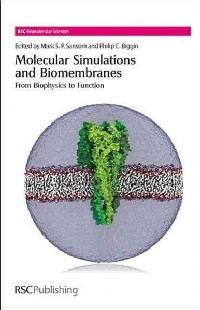
In their preface editors Sansom and Biggin (biochemistry, U. of Oxford, UK) discuss the increasingly important role that simulations are playing in the study of the biophysics and function of membranes and their proteins, and the increasing importance of a diversity of multi-scale simulation approaches to accommodate such investigations. They see simulation studies in the future having a major impact on fundamental biomedical science and on areas such as pharmacology and bionanotechnology of membranes. Ten chapters (each with references; contributors are based in the UK, France, and the US) discuss methods and parameters for membrane simulations, lateral pressure profiles in lipid membranes, coarse-grained molecular dynamics simulations, models for peptide folding and insertion, membrane sculpting by N-BAR domains, computational approaches to ionotropic glutamate receptors, and active transport across the cellular membrane, among other topics. The book is attractively produced, with color illustrations. It is distributed in the US by Springer-Verlag. Annotation 漏2011 Book News, Inc., Portland, OR (booknews.com)
目录
Chapter 1 Methods and Parameters for Membrane Simulations D. Peter Tieleman p. 1
1.1 Introduction p. 1
1.2 Force Fields/Descriptions of Interactions p. 4
1.2.1 Current Atomistic Force Fields p. 5
1.2.2 Development of Force Field Parameters p. 6
1.2.3 Issues with Combining Force Fields p. 7
1.3 Starting Structures p. 7
1.3.1 Bilayers p. 8
1.3.2 Membrane Proteins p. 9
1.3.3 Embedding Proteins in Bilayers p. 9
1.4 Sampling p. 11
1.4.1 Improving Sampling p. 14
1.4.2 Coarse Graining p. 14
1.5 Pressure Coupling p. 16
1.6 Electrostatics p. 18
1.7 Periodicity p. 19
1.8 Future Developments p. 20
Acknowledgements p. 21
References p. 21
Chapter 2 Lateral Pressure Profiles in Lipid Membranes: Dependence on Molecular Composition O. H. Samuli Ollila and Ilpo Vattulainen p. 26
2.1 Introduction p. 26
2.2 Theoretical Concepts p. 31
2.2.1 Lateral Pressure Profile p. 31
2.2.2 Calculation of Lateral Pressure Profile from Simulation p. 32
2.2.3 Elastic Properties p. 33
2.2.4 Interplay of Pressure Profile and Membrane Protein Activation p. 34
2.3 Gauging Pressure Profile p. 35
2.4 Dependence of Pressure Profiles on Molecular Composition p. 38
2.4.1 Dependence on Unsaturation Level p. 38
2.4.2 Effects of Different Sterols in Two-component Membranes p. 39
2.4.3 Pressure Profiles in Three-component Bilayers p. 41
2.4.4 Implications of Anesthetics on Pressure Profile p. 43
2.4.5 Elastic Properties Calculated from Lateral Pressure Profile p. 45
2.4.6 Free Energy of Protein Activation and Lateral Pressure Profile p. 48
2.5 Concluding Remarks p. 50
2.6 Abbreviations p. 51
Acknowledgements p. 51
References p. 51
Chapter 3 Coarse-grained Molecular Dynamics Simulations of Membrane Proteins Sarah Rouse and Timothy Carpenter and Mark S. P. Sansom p. 56
3.1 Introduction p. 56
3.2 Coarse-grained Simulations: Methodology p. 57
3.2.1 CG-MD and Lipid Bilayers p. 57
3.2.2 CG-MD and Membrane Peptides and Proteins p. 59
3.3 Evaluation of CG-MD: Model Membrane Peptides p. 61
3.4 Simulation Studies of Membrane Peptide Oligomerization p. 64
3.4.1 Glycophorin A p. 64
3.4.2 Influenza M2 Channels p. 66
3.5 Coarse-grained MD: Larger Systems p. 67
3.5.1 Vesicle Simulations p. 67
3.5.2 More Complex Membrane Proteins p. 69
3.6 Concluding Remarks and Future Directions p. 73
Acknowledgements p. 73
References p. 73
Chapter 4 Passive Permeation Across Lipid Bilayers: a Literature Review Mario Orsi and Jonathan W. Essex p. 76
4.1 Introduction p. 76
4.2 Experimental Methods p. 78
4.2.1 Water and Small Organic Molecules p. 78
4.2.2 Drugs p. 78
4.3 The Solubility-Diffusion Model p. 80
4.3.1 The z-Constraint Method p. 81
4.4 Small Molecules p. 82
4.5 Drugs p. 83
4.6 Fullerene p. 85
4.7 Discussion p. 87
4.8 Conclusions p. 87
References p. 88
Chapter 5 Implicit Membrane Models For Peptide Folding and Insertion Studies Martin B. Ulmschneider and Jakob P. Ulmschneider p. 91
5.1 Introduction p. 91
5.2 Implicit Membrane Models p. 94
5.2.1 Overview p. 94
5.2.2 Implicit Membrane Models for Studying Membrane Protein Folding p. 95
5.2.3 The Generalized Born Model p. 96
5.2.4 Non-polar Interactions p. 99
5.2.5 Accuracy and Partitioning Properties p. 100
5.2.6 Transmembrane and Surface-bound Helices, Insertion Energy Landscape p. 102
5.2.7 Thermodynamic Analysis p. 102
5.3 Simulating Peptide Folding and Partitioning p. 104
5.3.1 Summary p. 104
5.3.2 Transbilayer Peptide Folding p. 104
5.3.3 Peptide Adsorption, Insertion and Folding p. 111
5.3.4 Comparison with Explicit Methods p. 124
5.3.5 Sampling Performance p. 128
5.3.6 Conclusions p. 134
Acknowledgements p. 135
References p. 135
Chapter 6 Multi-scale Simulations of Membrane Sculpting by N-BAR Domains Ying Yin and Anton Arkhipov and Klaus Schulten p. 146
6.1 Introduction p. 146
6.2 Methods p. 148
6.3 All-atom Simulations p. 150
6.4 Residue-based Coarse-grained Simulations p. 151
6.5 Shape-based Coarse-grained Simulations p. 152
6.6 Continuum Elastic Membrane Model p. 157
6.7 Results and Discussion p. 159
6.8 Simulations of a Single N-BAR Domain p. 159
6.9 Comparison of RBCG and SBCG Simulations for Systems with Six N-BAR Domains p. 161
6.10 Effect of Different N-BAR Domain Lattices on Membrane Curvatures p. 164
6.11 Comparing All-atom and SBCG Simulations of an N-BAR Domain Lattice p. 167
6.12 Complete Membrane Tubulation by Lattices of BAR Domains p. 169
6.13 Elastic Membrane Computations p. 169
6.14 Conclusion p. 172
Acknowledgements p. 173
References p. 173
Chapter 7 Continuum Electrostatics and Modeling of K + Channels Janice L. Robertson and Vishwanath Jogini and Beno卯t Roux p. 177
7.1 Introduction p. 177
7.2 Theory and Methods p. 180
7.2.1 The Poisson-Boltzmann (PB) Equation p. 180
7.2.2 Calculation of Electrostatic Free Energies and Decomposition p. 181
7.2.3 The Modified PB Equation for Treatment of Transmembrane Voltage p. 182
7.3 Applications p. 184
7.3.1 Electrostatics in the Intracellular Vestibule of K + Channels p. 184
7.3.2 Long-pore Electrostatics in K + Channels p. 191
7.3.3 K + Channels and the Transmembrane Potential p. 195
7.4 Conclusion p. 200
References p. 201
Chapter 8 Computational Approaches to Ionotropic Glutamate Receptors Ranjit Vijayan and Bogdan Iorga and Philip C. Biggin p. 203
8.1 Introduction p. 203
8.2 The Amino-terminal Domain p. 205
8.3 The Ligand-binding Domain (LBD) p. 207
8.3.1 Selectivity and Modulation p. 207
8.3.2 Dynamics p. 209
8.4 The Transmembrane Domain p. 216
8.5 Conclusion p. 218
Acknowledgements p. 218
References p. 218
Chapter 9 Molecular Dynamics Studies of Outer Membrane Proteins: a Story of Barrels Syma Khalid and Marc Baaden p. 225
9.1 Introduction p. 225
9.2 Outer Membrane Proteins p. 226
9.3 Simple Barrels p. 227
9.3.1 OmpA and Its Homologues p. 227
9.3.2 Simple OMPs in Diverse Environments p. 230
9.4. Leaking Barrels p. 232
9.5 Transporting Barrels p. 232
9.5.1 TonB-dependent Transporters p. 233
9.5.2 Autotransporters p. 235
9.5.3 TolC p. 237
9.6 Reacting Barrels p. 239
9.7 Technological Barrels p. 241
9.8 Conclusion p. 243
Acknowledgements p. 244
References p. 244
Chapter 10 Molecular Mechanisms of Active Transport Across the Cellular Membrane Po-Chao Wen and Zhijian Huang and Giray Enkavi and Yi Wang and James Gumbart and Emad Tajkhorshid p. 248
10.1 Introduction p. 248
10.2 Computational Methodology p. 250
10.2.1 Electrostatic Potential Calculation p. 251
10.2.2 Net Charge Density Distribution Calculation p. 251
10.3 ATP-driven Transport in ABC Transporters p. 252
10.4 Ion-driven Neurotransmitter Uptake by the Glutamate Transporter p. 258
10.5 Substrate Binding and Selectivity in Glycerol-3-Phosphate Transporter p. 263
10.6 Membrane Potential-driven Nucleotide Exchange in ADP/ATP Carrier p. 268
10.7 Mechanically Driven Transport Across the Outer Membrane p. 272
10.8 Conclusion p. 277
Acknowledgements p. 278
References p. 278
Chapter 11 Molecular Dynamics Studies of the Interactions Between Carbon Nanotubes and Biomembranes E. Jayne Wallace and Mark S. P. Sansom p. 287
11.1 Introduction p. 287
11.1.1 Carbon Nanotube Structure p. 288
11.1.2 Experimental Techniques for Studying CNTs in a Biological Environment p. 289
11.2 Molecular Dynamics Simulations p. 289
11.2.1 Methodology p. 290
11.2.2 Parameterization of CNT Models p. 290
11.3 CNT Interactions with Lipids and Related Molecules p. 292
11.4 Interaction of CNTs with Lipid Bilayers p. 296
11.5 CNTs as Nanopores p. 298
11.5.1 Transport of Water and Ions Through CNT Nanopores p. 299
11.5.2 Nanopores as Nanosyringes p. 301
11.6 Conclusion p. 302
References p. 302
Subject Index p. 306
1.1 Introduction p. 1
1.2 Force Fields/Descriptions of Interactions p. 4
1.2.1 Current Atomistic Force Fields p. 5
1.2.2 Development of Force Field Parameters p. 6
1.2.3 Issues with Combining Force Fields p. 7
1.3 Starting Structures p. 7
1.3.1 Bilayers p. 8
1.3.2 Membrane Proteins p. 9
1.3.3 Embedding Proteins in Bilayers p. 9
1.4 Sampling p. 11
1.4.1 Improving Sampling p. 14
1.4.2 Coarse Graining p. 14
1.5 Pressure Coupling p. 16
1.6 Electrostatics p. 18
1.7 Periodicity p. 19
1.8 Future Developments p. 20
Acknowledgements p. 21
References p. 21
Chapter 2 Lateral Pressure Profiles in Lipid Membranes: Dependence on Molecular Composition O. H. Samuli Ollila and Ilpo Vattulainen p. 26
2.1 Introduction p. 26
2.2 Theoretical Concepts p. 31
2.2.1 Lateral Pressure Profile p. 31
2.2.2 Calculation of Lateral Pressure Profile from Simulation p. 32
2.2.3 Elastic Properties p. 33
2.2.4 Interplay of Pressure Profile and Membrane Protein Activation p. 34
2.3 Gauging Pressure Profile p. 35
2.4 Dependence of Pressure Profiles on Molecular Composition p. 38
2.4.1 Dependence on Unsaturation Level p. 38
2.4.2 Effects of Different Sterols in Two-component Membranes p. 39
2.4.3 Pressure Profiles in Three-component Bilayers p. 41
2.4.4 Implications of Anesthetics on Pressure Profile p. 43
2.4.5 Elastic Properties Calculated from Lateral Pressure Profile p. 45
2.4.6 Free Energy of Protein Activation and Lateral Pressure Profile p. 48
2.5 Concluding Remarks p. 50
2.6 Abbreviations p. 51
Acknowledgements p. 51
References p. 51
Chapter 3 Coarse-grained Molecular Dynamics Simulations of Membrane Proteins Sarah Rouse and Timothy Carpenter and Mark S. P. Sansom p. 56
3.1 Introduction p. 56
3.2 Coarse-grained Simulations: Methodology p. 57
3.2.1 CG-MD and Lipid Bilayers p. 57
3.2.2 CG-MD and Membrane Peptides and Proteins p. 59
3.3 Evaluation of CG-MD: Model Membrane Peptides p. 61
3.4 Simulation Studies of Membrane Peptide Oligomerization p. 64
3.4.1 Glycophorin A p. 64
3.4.2 Influenza M2 Channels p. 66
3.5 Coarse-grained MD: Larger Systems p. 67
3.5.1 Vesicle Simulations p. 67
3.5.2 More Complex Membrane Proteins p. 69
3.6 Concluding Remarks and Future Directions p. 73
Acknowledgements p. 73
References p. 73
Chapter 4 Passive Permeation Across Lipid Bilayers: a Literature Review Mario Orsi and Jonathan W. Essex p. 76
4.1 Introduction p. 76
4.2 Experimental Methods p. 78
4.2.1 Water and Small Organic Molecules p. 78
4.2.2 Drugs p. 78
4.3 The Solubility-Diffusion Model p. 80
4.3.1 The z-Constraint Method p. 81
4.4 Small Molecules p. 82
4.5 Drugs p. 83
4.6 Fullerene p. 85
4.7 Discussion p. 87
4.8 Conclusions p. 87
References p. 88
Chapter 5 Implicit Membrane Models For Peptide Folding and Insertion Studies Martin B. Ulmschneider and Jakob P. Ulmschneider p. 91
5.1 Introduction p. 91
5.2 Implicit Membrane Models p. 94
5.2.1 Overview p. 94
5.2.2 Implicit Membrane Models for Studying Membrane Protein Folding p. 95
5.2.3 The Generalized Born Model p. 96
5.2.4 Non-polar Interactions p. 99
5.2.5 Accuracy and Partitioning Properties p. 100
5.2.6 Transmembrane and Surface-bound Helices, Insertion Energy Landscape p. 102
5.2.7 Thermodynamic Analysis p. 102
5.3 Simulating Peptide Folding and Partitioning p. 104
5.3.1 Summary p. 104
5.3.2 Transbilayer Peptide Folding p. 104
5.3.3 Peptide Adsorption, Insertion and Folding p. 111
5.3.4 Comparison with Explicit Methods p. 124
5.3.5 Sampling Performance p. 128
5.3.6 Conclusions p. 134
Acknowledgements p. 135
References p. 135
Chapter 6 Multi-scale Simulations of Membrane Sculpting by N-BAR Domains Ying Yin and Anton Arkhipov and Klaus Schulten p. 146
6.1 Introduction p. 146
6.2 Methods p. 148
6.3 All-atom Simulations p. 150
6.4 Residue-based Coarse-grained Simulations p. 151
6.5 Shape-based Coarse-grained Simulations p. 152
6.6 Continuum Elastic Membrane Model p. 157
6.7 Results and Discussion p. 159
6.8 Simulations of a Single N-BAR Domain p. 159
6.9 Comparison of RBCG and SBCG Simulations for Systems with Six N-BAR Domains p. 161
6.10 Effect of Different N-BAR Domain Lattices on Membrane Curvatures p. 164
6.11 Comparing All-atom and SBCG Simulations of an N-BAR Domain Lattice p. 167
6.12 Complete Membrane Tubulation by Lattices of BAR Domains p. 169
6.13 Elastic Membrane Computations p. 169
6.14 Conclusion p. 172
Acknowledgements p. 173
References p. 173
Chapter 7 Continuum Electrostatics and Modeling of K + Channels Janice L. Robertson and Vishwanath Jogini and Beno卯t Roux p. 177
7.1 Introduction p. 177
7.2 Theory and Methods p. 180
7.2.1 The Poisson-Boltzmann (PB) Equation p. 180
7.2.2 Calculation of Electrostatic Free Energies and Decomposition p. 181
7.2.3 The Modified PB Equation for Treatment of Transmembrane Voltage p. 182
7.3 Applications p. 184
7.3.1 Electrostatics in the Intracellular Vestibule of K + Channels p. 184
7.3.2 Long-pore Electrostatics in K + Channels p. 191
7.3.3 K + Channels and the Transmembrane Potential p. 195
7.4 Conclusion p. 200
References p. 201
Chapter 8 Computational Approaches to Ionotropic Glutamate Receptors Ranjit Vijayan and Bogdan Iorga and Philip C. Biggin p. 203
8.1 Introduction p. 203
8.2 The Amino-terminal Domain p. 205
8.3 The Ligand-binding Domain (LBD) p. 207
8.3.1 Selectivity and Modulation p. 207
8.3.2 Dynamics p. 209
8.4 The Transmembrane Domain p. 216
8.5 Conclusion p. 218
Acknowledgements p. 218
References p. 218
Chapter 9 Molecular Dynamics Studies of Outer Membrane Proteins: a Story of Barrels Syma Khalid and Marc Baaden p. 225
9.1 Introduction p. 225
9.2 Outer Membrane Proteins p. 226
9.3 Simple Barrels p. 227
9.3.1 OmpA and Its Homologues p. 227
9.3.2 Simple OMPs in Diverse Environments p. 230
9.4. Leaking Barrels p. 232
9.5 Transporting Barrels p. 232
9.5.1 TonB-dependent Transporters p. 233
9.5.2 Autotransporters p. 235
9.5.3 TolC p. 237
9.6 Reacting Barrels p. 239
9.7 Technological Barrels p. 241
9.8 Conclusion p. 243
Acknowledgements p. 244
References p. 244
Chapter 10 Molecular Mechanisms of Active Transport Across the Cellular Membrane Po-Chao Wen and Zhijian Huang and Giray Enkavi and Yi Wang and James Gumbart and Emad Tajkhorshid p. 248
10.1 Introduction p. 248
10.2 Computational Methodology p. 250
10.2.1 Electrostatic Potential Calculation p. 251
10.2.2 Net Charge Density Distribution Calculation p. 251
10.3 ATP-driven Transport in ABC Transporters p. 252
10.4 Ion-driven Neurotransmitter Uptake by the Glutamate Transporter p. 258
10.5 Substrate Binding and Selectivity in Glycerol-3-Phosphate Transporter p. 263
10.6 Membrane Potential-driven Nucleotide Exchange in ADP/ATP Carrier p. 268
10.7 Mechanically Driven Transport Across the Outer Membrane p. 272
10.8 Conclusion p. 277
Acknowledgements p. 278
References p. 278
Chapter 11 Molecular Dynamics Studies of the Interactions Between Carbon Nanotubes and Biomembranes E. Jayne Wallace and Mark S. P. Sansom p. 287
11.1 Introduction p. 287
11.1.1 Carbon Nanotube Structure p. 288
11.1.2 Experimental Techniques for Studying CNTs in a Biological Environment p. 289
11.2 Molecular Dynamics Simulations p. 289
11.2.1 Methodology p. 290
11.2.2 Parameterization of CNT Models p. 290
11.3 CNT Interactions with Lipids and Related Molecules p. 292
11.4 Interaction of CNTs with Lipid Bilayers p. 296
11.5 CNTs as Nanopores p. 298
11.5.1 Transport of Water and Ions Through CNT Nanopores p. 299
11.5.2 Nanopores as Nanosyringes p. 301
11.6 Conclusion p. 302
References p. 302
Subject Index p. 306
- 名称
- 类型
- 大小
光盘服务联系方式: 020-38250260 客服QQ:4006604884
云图客服:
用户发送的提问,这种方式就需要有位在线客服来回答用户的问题,这种 就属于对话式的,问题是这种提问是否需要用户登录才能提问
Video Player
×
Audio Player
×
pdf Player
×
