

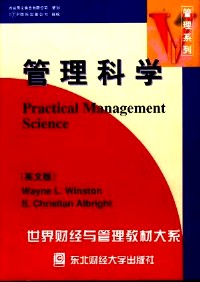
Practical management science
副标题:无
作 者:[美]威尼·L.温斯顿(Wayne L. Winston),[美]S.克利斯第安·阿布莱特(S. Christian Albright)著
分类号:
ISBN:9787810443869
微信扫一扫,移动浏览光盘
简介
本书旨在改变传统上对数量方法应用的怀疑态度,在此作者为广大师生提供了一种成功地学习管理科学的新方法、新途径--利用案例和电子表格建立的全新模型。它涉及财务、营销、作业管理等问题,适合作管理类专业的本科生、研究生及工商管理硕士的教材。
关于管理科学的教学争议已经存在许多年了,很多认为要想掌握其本质内容必须进行大量的真实案例的练习,作者在支持这种观点的同时,亦在本书中对某些实际应用进行了适当的改动。毕竟在学生们了解了诸如美国航空公司这样成功的管理案例之后,会发现管理科学(MS)的重要意义所在,但这只停留在 知其然,而不知其所以然 的状态上。
本书中所使用的这种方法,即通过电子表格来分析一个企业所面临的问题并作出决策,适合于每个经济类的学生,它将使读者在财务、营销及作业管理中获得收益,并使以下四种能力得以发展及完善:解决问题的能力、专业的学科方法、敏锐的洞察能力、熟练的电子表格技能。
.......
目录
Bfief Contents
1 IntroducNontoModeling
2 Introducfion to Lineer Programming
3 Linear Progfamming Fomulonons
4 Networh Models
5 IntegerProgrammingModGls
6 NonllnearProgrammingModels
7 Muitiple-Objective Decision Making
8 DecisjonMakingUnderUncertointy
9 Deterministic Inventoru Models
10 Probabilistic Inventory Models
11 OueueingModels
12 Simulation
13 SimulaNon with Add-ins
14 Forecasting Models
Index
1 Introduction to modeling
1.1 A Waiting Line Example
1.2 The Seven-Step Modeling Process
1.3 Successful Management Science Applications
1.4 Why Study Management Science?
1.5 Conclusion
References
2 IntroducNon to Linear Programming
2.1 Introduction
2.2 A Brief History of Linear Programming
2.3 Introduction to LP Modeling
2.4 The Linear Assumptions
2.5 Graphical Solution Method
2.6 Solver Reports and Sensitivity Analysis
2.7 Sensitivity Analysis with Graphs
2.8 Infeasibility and Unboundedness
2.9 A Multiperiod Production Problem
2.10 A Decision Support System
2.11 Conclusion
Review Problems
Appendix: What's Best! for Lotus
Case Study: Shelby Shelving
References
3 Linear Progromming Formulations
3.1 Introduction
3.2 Static Workforce Scheduling
3.3 Blending Problems
3.4 Production Process Models
3.5 Aggregate Planning Models
3.6 Dynamic Workforce Planning Models
3.7 A Dynamic Financial Model
3.8 Data Envelopment Analysis (DEA)
3.9 Conclusion
Review Problems
Case Study: Lakefield Corporation's Oil Trading Desk
Case Study: Foreign Currency Trading
References
4 Nefworh models
4.1 Introduction
4.2 The Transportation Model
4.3 A Dynamic Inventory Model
4.4 The Assigmnent Model
4.5 The Critical Path Model (CPM)
4.6 The Minimum Cost Network Flow Model
4.7 The Maximum Flow Model
4.8 The Shortest Path Model
4.9 Conclusion
Review Problems
Case Study: Optimized Motor Carrier Selection at Westvaco
References
5 Integer Programming Models
5.1 Introduction
5.2 Capital Budgeting Models
5.3 The Fixed-Charge Model
5.4 The Lockbox Problem
5.5 The Warehouse Location Problem
5.6 Set Covering Problems
5.7 Either-Or Constraints
5.8 Condusion
Review Problems
Case Study: Giant Motor Company 1
References
6 llonlinear Programmlng Models
6.1 Introduction
6.2 Basic Ideas of Nonlinear Optmuzation
6.3 Managerial Economics Applications
6.4 Salesforce Allocation
6.5 Facility Location Models
6.6 Improving Product Quality
6.7 Estimatmg the Beta of a Stock
6.8 Rating Sports Teams
6.9 Finding Implied Stock Volatilities
6.10 Portfolio Optimization
6.11 Portfolio Optimization: The Scenario Approach
6.12 Portfolio Optimization with Transaction Costs
6.13 Conclusion
Review Problems
Case Study: GMS Stock Hedging
Case Study: Durham Asset Management
References
7 Mulfiple-Obiective Oecision making
7.1 Introduction
7.2 Goal Programming
7.3 Pareto Optimality and Tr-ade-off Curves
7.4 The Analytic Hierarchy Process
7.5 Conclusion
Review Problems
Case Study: Play Time Toy Company
References
8 Decision Mahing Under Uncertainru
8.1 Introduction
8.2 Elements of a Decision Analysis
8.3 Assessing Probabilities (Optional)
8.4 Decision Analysis Examples
8.5 Bayes' Rule
8.6 Incorporating Attitudes Toward Risk
8.7 Conclusion
Review Problems
Case Study: Giant Motor Company ll
References
9 Deterministic invenloru Models
9.1 Introduction
9.2 Categories of Inventory Models
9.3 Costs Involved in Inventory Models
9.4 The Basic EOQ Model
9.5 EOQ Models with Quantity Discounts
9.6 EOQ Model with Shortages Allowed
9.7 Reducing the Setup Cost
9.8 Synchronizing Orders for Several Products
9.9 Conclusion
Review Problems
Case Study: Subway Token Hoarding
References
10 Pfobabilistic Invenhoru) Models
l0.1 Introduction
l0.2 The Newsvendor Model
l0.3 Analysis of (R, Q) Policies
lO.4 A Conclusion
Review Problems
Case Study: Retail Pricing Using Retailer
References
11 Queueing Models
11.1 Introduction
11.2 Elements of Queueing Models
11.3 Short-Run Versus Steady-State Behavior
11.4 The Exponential Distribution
11.5 Important Queueing Relationships
11.6 The Basic Single-Server Model
11.7 A Multiple-Server Model
11.8 Variations of the Basic Models
11.9 TheErlangLossModel
11.10 Conclusion
Review Problems
Case Study: The Catalog Company Problem
References
12 Simulotion
12.1 Introduction
12.2 Actual Applications of Simulation
12.3 Random Numbers
12.4 Introduction to Spreadsheet Simulation
12.5 Generating Other Distributions
12.6 Simulation and Bidding
12.7 Deming's Funnel Experiment
12.8 Simulating the Length of a Project
12.9 Investing in the Stock Market
12.10 Simulating Cash Flows
12.11 Queueing Simulation
12.12 Conclusion
Revie Problems
Case Study: Ski Jacket Production
Case Study: The College Fund Investment Decision
Case Study: Ebony Bath Soap
Case Study: Bond Investment Strategy
Refer ences
13 Slmulation With Rdd-ins
13.1 Introduction
13.2 Simulating an Income Statement
13.3 The Newsvendor Model with (a)RISK
13.4 Financial Planning Simulations
13.5 A Component Redundancy Simulation
13.6 Simulating the Game of Craps
13.7 A Cash Balance Simulation
13.8 Simulating Stock Prices and Options
13.9 Simulating Correlated Values
13.10 A Market Share Simulation
13.11 Conclusion
Review Problems
References
14 Forecastino Models
14.1 Introduction
14.2 Time Series Notation
14.3 Moving-Average Method
14.4 Simple Exponential Smoothing
14.5 Holt's Method for Trend
14.6 Winter's Method for Seasonality
14.7 Simple Linear Regression
14.8 Fitting Nonlinear Relationships
14.9 Multiple Regression
14.10 Categorical Independent Variables
14.11 Multiplicative Models
14.12 Conclusion
Review Problems
Reference
Index
1 IntroducNontoModeling
2 Introducfion to Lineer Programming
3 Linear Progfamming Fomulonons
4 Networh Models
5 IntegerProgrammingModGls
6 NonllnearProgrammingModels
7 Muitiple-Objective Decision Making
8 DecisjonMakingUnderUncertointy
9 Deterministic Inventoru Models
10 Probabilistic Inventory Models
11 OueueingModels
12 Simulation
13 SimulaNon with Add-ins
14 Forecasting Models
Index
1 Introduction to modeling
1.1 A Waiting Line Example
1.2 The Seven-Step Modeling Process
1.3 Successful Management Science Applications
1.4 Why Study Management Science?
1.5 Conclusion
References
2 IntroducNon to Linear Programming
2.1 Introduction
2.2 A Brief History of Linear Programming
2.3 Introduction to LP Modeling
2.4 The Linear Assumptions
2.5 Graphical Solution Method
2.6 Solver Reports and Sensitivity Analysis
2.7 Sensitivity Analysis with Graphs
2.8 Infeasibility and Unboundedness
2.9 A Multiperiod Production Problem
2.10 A Decision Support System
2.11 Conclusion
Review Problems
Appendix: What's Best! for Lotus
Case Study: Shelby Shelving
References
3 Linear Progromming Formulations
3.1 Introduction
3.2 Static Workforce Scheduling
3.3 Blending Problems
3.4 Production Process Models
3.5 Aggregate Planning Models
3.6 Dynamic Workforce Planning Models
3.7 A Dynamic Financial Model
3.8 Data Envelopment Analysis (DEA)
3.9 Conclusion
Review Problems
Case Study: Lakefield Corporation's Oil Trading Desk
Case Study: Foreign Currency Trading
References
4 Nefworh models
4.1 Introduction
4.2 The Transportation Model
4.3 A Dynamic Inventory Model
4.4 The Assigmnent Model
4.5 The Critical Path Model (CPM)
4.6 The Minimum Cost Network Flow Model
4.7 The Maximum Flow Model
4.8 The Shortest Path Model
4.9 Conclusion
Review Problems
Case Study: Optimized Motor Carrier Selection at Westvaco
References
5 Integer Programming Models
5.1 Introduction
5.2 Capital Budgeting Models
5.3 The Fixed-Charge Model
5.4 The Lockbox Problem
5.5 The Warehouse Location Problem
5.6 Set Covering Problems
5.7 Either-Or Constraints
5.8 Condusion
Review Problems
Case Study: Giant Motor Company 1
References
6 llonlinear Programmlng Models
6.1 Introduction
6.2 Basic Ideas of Nonlinear Optmuzation
6.3 Managerial Economics Applications
6.4 Salesforce Allocation
6.5 Facility Location Models
6.6 Improving Product Quality
6.7 Estimatmg the Beta of a Stock
6.8 Rating Sports Teams
6.9 Finding Implied Stock Volatilities
6.10 Portfolio Optimization
6.11 Portfolio Optimization: The Scenario Approach
6.12 Portfolio Optimization with Transaction Costs
6.13 Conclusion
Review Problems
Case Study: GMS Stock Hedging
Case Study: Durham Asset Management
References
7 Mulfiple-Obiective Oecision making
7.1 Introduction
7.2 Goal Programming
7.3 Pareto Optimality and Tr-ade-off Curves
7.4 The Analytic Hierarchy Process
7.5 Conclusion
Review Problems
Case Study: Play Time Toy Company
References
8 Decision Mahing Under Uncertainru
8.1 Introduction
8.2 Elements of a Decision Analysis
8.3 Assessing Probabilities (Optional)
8.4 Decision Analysis Examples
8.5 Bayes' Rule
8.6 Incorporating Attitudes Toward Risk
8.7 Conclusion
Review Problems
Case Study: Giant Motor Company ll
References
9 Deterministic invenloru Models
9.1 Introduction
9.2 Categories of Inventory Models
9.3 Costs Involved in Inventory Models
9.4 The Basic EOQ Model
9.5 EOQ Models with Quantity Discounts
9.6 EOQ Model with Shortages Allowed
9.7 Reducing the Setup Cost
9.8 Synchronizing Orders for Several Products
9.9 Conclusion
Review Problems
Case Study: Subway Token Hoarding
References
10 Pfobabilistic Invenhoru) Models
l0.1 Introduction
l0.2 The Newsvendor Model
l0.3 Analysis of (R, Q) Policies
lO.4 A Conclusion
Review Problems
Case Study: Retail Pricing Using Retailer
References
11 Queueing Models
11.1 Introduction
11.2 Elements of Queueing Models
11.3 Short-Run Versus Steady-State Behavior
11.4 The Exponential Distribution
11.5 Important Queueing Relationships
11.6 The Basic Single-Server Model
11.7 A Multiple-Server Model
11.8 Variations of the Basic Models
11.9 TheErlangLossModel
11.10 Conclusion
Review Problems
Case Study: The Catalog Company Problem
References
12 Simulotion
12.1 Introduction
12.2 Actual Applications of Simulation
12.3 Random Numbers
12.4 Introduction to Spreadsheet Simulation
12.5 Generating Other Distributions
12.6 Simulation and Bidding
12.7 Deming's Funnel Experiment
12.8 Simulating the Length of a Project
12.9 Investing in the Stock Market
12.10 Simulating Cash Flows
12.11 Queueing Simulation
12.12 Conclusion
Revie Problems
Case Study: Ski Jacket Production
Case Study: The College Fund Investment Decision
Case Study: Ebony Bath Soap
Case Study: Bond Investment Strategy
Refer ences
13 Slmulation With Rdd-ins
13.1 Introduction
13.2 Simulating an Income Statement
13.3 The Newsvendor Model with (a)RISK
13.4 Financial Planning Simulations
13.5 A Component Redundancy Simulation
13.6 Simulating the Game of Craps
13.7 A Cash Balance Simulation
13.8 Simulating Stock Prices and Options
13.9 Simulating Correlated Values
13.10 A Market Share Simulation
13.11 Conclusion
Review Problems
References
14 Forecastino Models
14.1 Introduction
14.2 Time Series Notation
14.3 Moving-Average Method
14.4 Simple Exponential Smoothing
14.5 Holt's Method for Trend
14.6 Winter's Method for Seasonality
14.7 Simple Linear Regression
14.8 Fitting Nonlinear Relationships
14.9 Multiple Regression
14.10 Categorical Independent Variables
14.11 Multiplicative Models
14.12 Conclusion
Review Problems
Reference
Index
Practical management science
- 名称
- 类型
- 大小
光盘服务联系方式: 020-38250260 客服QQ:4006604884
云图客服:
用户发送的提问,这种方式就需要有位在线客服来回答用户的问题,这种 就属于对话式的,问题是这种提问是否需要用户登录才能提问
Video Player
×
Audio Player
×
pdf Player
×
