

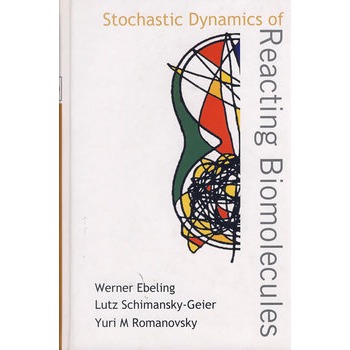
反应生物分子的随机动力学STOCHASTIC DYNAMICS OF REACTING BIOMOLECULES
副标题:无
作 者:Werner Ebeling 著
分类号:
ISBN:9789812381620
微信扫一扫,移动浏览光盘
简介
This is a book about the physical processes in reacting complex molecules, particularly biomolecules. In the past decade scientists from different fields such as medicine, biology, chemistry and physics have collected a huge amount of data about the structure, dynamics and functioning of biomolecules. Great progress has been achieved in exploring the structure of complex molecules. However, there is still a lack of understanding of the dynamics and functioning of biological macromolecules. In particular this refers to enzymes, which are the basic molecular machines working in living systems. This book contributes to the exploration of the physical mechanisms of these processes, focusing on critical aspects such as the role of nonlinear excitations and of stochastic effects. An extensive range of original results has been obtained in the last few years by the authors, and these results are presented together with a comprehensive survey of the state of the art in the field.
目录
Preface
Chapter 1 Introduction to the reaction theory and cluster dynamics of enzymes
W. Ebeling, A. Netrebko, Yu. Romanovsky
1.1 Arrhenius law and basic ideas of reaction theory
1.2 Breaking of the peptide and ester bonds
1.3 Basic principles and methods of protein dynamics
1.4 Effects of coupling and resonances on transition rates
1.5 Basic variables. Block and cluster models
1.6 The problems under consideration
Chapter 2 Tools of Stochastic Dynamics
L. Schimansky-Geier and P. Talkner
2.1 Introduction
2.2 Fluctuations in statistical physics
2.2.1 The canonical distribution
2.2.2 Einstein's formula
2.2.3 Fluctuations around equilibrium
2.2.4 Perrin's pendulum
2.2.5 General approach
2.3 Linear relaxation processes
2.4 Correlations and spectra
2.5 Linear response
2.5.1 Colored noise
2.5.2 Harmonic noise
2.5.3 Fluctuation dissipation theorem
2.5.4 Nyquist theorem. White noise
2.5.5 White noise and the Wiener process
2.6 Brownian Motion
2.6.1 Einstein's relation
2.6.2 Brownian motion as Markovian dynamics
2.6.3 Langevin's approach
2.6.4 The overdamped limit
2.6.5 Generalized Langevin equations
2.7 The Fokker-Planck equation
2.7.1 Kolmogorov's forward and backward equations
2.7.2 Moments of the transition probabilities
2.8 The bistable oscillator
2.9 The escape problem
2.9.1 Transition state theory
2.9.2 Kramers' rate formulae
2.9.2.1 Moderate to strong damping
2.9.2.2 Weak damping and energy diffusion
2.9.3 Transition rates in multidimensional landscapes
2.10 Pontryagin's equation
2.10.1 Boundary conditions for the forward and the backward equation
2.10.2 The first passage time distribution
2.10.3 Splitting probability
2.10.4 Examples
2.10.4.1 The splitting probability
2.10.4.2 The mean first passage time
Chapter 3 Motion of test particles in a 2-d potential landscape O.A. Chichigina, A. V.Netrebko, and N. V.Netrebko
3.1 Formulation of the mathematical model
3.2 Lyapunov spectra for the conservative system. Toda area for the land-scape with two minima
3.3 Stratonovich method of calculating escape times in the chaotic regime and some applications. Dynamic model of the cluster dissociation
3.3.1 The role of a dynamic theory of cluster dissociation
3.3.2 The simplest dissociation model
3.3.3 The calculation of the rate of cluster dissociation using dynamic theory
3.3.4 Mean time of escape from a potential well under the action of nois Metastable approximation
3.4 Test particle motion in a three-minima potential landscape
……
Chapter 4 Microscopic Simulations of activation and Dissociation
Chapter 5 Excitations on rings of molecules
Chapter 6 Fermi resonance and Kramers problem in 2-d forec field
Chapter 7 Molecular seissors.Cluster model of acetylcholinesterase
Chapter 8 Dynamics of proton transfer in the active site of chymotrypsin
Chapter 9 On the damping of cluster oscillations in proteim molecules
Chapter 10 Protein dynamics and new approaches to the molecul
Chapter 11 Conclusions
List of authors
Index
Chapter 1 Introduction to the reaction theory and cluster dynamics of enzymes
W. Ebeling, A. Netrebko, Yu. Romanovsky
1.1 Arrhenius law and basic ideas of reaction theory
1.2 Breaking of the peptide and ester bonds
1.3 Basic principles and methods of protein dynamics
1.4 Effects of coupling and resonances on transition rates
1.5 Basic variables. Block and cluster models
1.6 The problems under consideration
Chapter 2 Tools of Stochastic Dynamics
L. Schimansky-Geier and P. Talkner
2.1 Introduction
2.2 Fluctuations in statistical physics
2.2.1 The canonical distribution
2.2.2 Einstein's formula
2.2.3 Fluctuations around equilibrium
2.2.4 Perrin's pendulum
2.2.5 General approach
2.3 Linear relaxation processes
2.4 Correlations and spectra
2.5 Linear response
2.5.1 Colored noise
2.5.2 Harmonic noise
2.5.3 Fluctuation dissipation theorem
2.5.4 Nyquist theorem. White noise
2.5.5 White noise and the Wiener process
2.6 Brownian Motion
2.6.1 Einstein's relation
2.6.2 Brownian motion as Markovian dynamics
2.6.3 Langevin's approach
2.6.4 The overdamped limit
2.6.5 Generalized Langevin equations
2.7 The Fokker-Planck equation
2.7.1 Kolmogorov's forward and backward equations
2.7.2 Moments of the transition probabilities
2.8 The bistable oscillator
2.9 The escape problem
2.9.1 Transition state theory
2.9.2 Kramers' rate formulae
2.9.2.1 Moderate to strong damping
2.9.2.2 Weak damping and energy diffusion
2.9.3 Transition rates in multidimensional landscapes
2.10 Pontryagin's equation
2.10.1 Boundary conditions for the forward and the backward equation
2.10.2 The first passage time distribution
2.10.3 Splitting probability
2.10.4 Examples
2.10.4.1 The splitting probability
2.10.4.2 The mean first passage time
Chapter 3 Motion of test particles in a 2-d potential landscape O.A. Chichigina, A. V.Netrebko, and N. V.Netrebko
3.1 Formulation of the mathematical model
3.2 Lyapunov spectra for the conservative system. Toda area for the land-scape with two minima
3.3 Stratonovich method of calculating escape times in the chaotic regime and some applications. Dynamic model of the cluster dissociation
3.3.1 The role of a dynamic theory of cluster dissociation
3.3.2 The simplest dissociation model
3.3.3 The calculation of the rate of cluster dissociation using dynamic theory
3.3.4 Mean time of escape from a potential well under the action of nois Metastable approximation
3.4 Test particle motion in a three-minima potential landscape
……
Chapter 4 Microscopic Simulations of activation and Dissociation
Chapter 5 Excitations on rings of molecules
Chapter 6 Fermi resonance and Kramers problem in 2-d forec field
Chapter 7 Molecular seissors.Cluster model of acetylcholinesterase
Chapter 8 Dynamics of proton transfer in the active site of chymotrypsin
Chapter 9 On the damping of cluster oscillations in proteim molecules
Chapter 10 Protein dynamics and new approaches to the molecul
Chapter 11 Conclusions
List of authors
Index
反应生物分子的随机动力学STOCHASTIC DYNAMICS OF REACTING BIOMOLECULES
- 名称
- 类型
- 大小
光盘服务联系方式: 020-38250260 客服QQ:4006604884
云图客服:
用户发送的提问,这种方式就需要有位在线客服来回答用户的问题,这种 就属于对话式的,问题是这种提问是否需要用户登录才能提问
Video Player
×
Audio Player
×
pdf Player
×
