

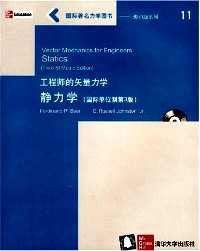
Vector mechanics for engineers : statics / 3rd SI Metric ed.
副标题:无
作 者:Ferdinand P. Beer, E. Russell Johnston, Jr. ; with the collaboration of Elliot R. Risenberg ; SI...
分类号:
ISBN:9787894940186
微信扫一扫,移动浏览光盘
简介
《工程师的矢量力学》是美国高校采用得最多的“工程力学”著名教材之一,本书是其第1册——静力学部分。本书特点是:(1)阐述由浅入深、循序渐进。将“质点力学”和‘刚体力学”明确分离。(2)基于矢量运算来讲述牛顿力学,推导过程简明清晰,结论具有一般性。(3)基于作者丰富的教学经验对教材内容和讲解顺序作了精心的安排。(4)附有1400余道习题供学生自学练习。本书概念清晰、推理严谨、论述简明易懂、例题典型实用,是一本优秀的工程力学教材,可作为我国高等理工院校理论力学和工程力学课程的英文教材或主要参考书。
目录
Preface
List of Symbols
INTRODUCTION
1.1 What Is Mechanics?
1.2 Fundamental Concepts and Principles
1.3 Systems of Units
1.4 Method of Problem Solution
1.5 Numerical Accuracy
2 STATICS OF PARTICLES
2.1 Introduction
Forces in a Plane
2.2 Force on a Particle,Resultant of Two Forces
2.3 Vectors
2.4 Addition of Vectors
2.5 Resultant of Several Concurrent Forces
2.6 Resolution of a Force into Components
2.7 Rectangular Components of a Force,Unit Vectors
2.8 Addition of Forces by Summing x and y Components
2.9 Equilibrium of a Particle
2.10 Newton's First Law of Motion
2.11 Problems Involving the Equilibrium of a Particle,Free-Body Diagrams
Forces in Space
2.12 Rectangular Components of a Force in Space
2.13 Force Defined by Its Magnitude and Two Points on Its Line of Action
2.14 Addition of Concurrent Forces in Space
2.15 Equilibrium of a Particle in Space
Review and Summary for Chapter 2
Review Problems
3 RIGID BODIES:DQUIVALENT SYSTEMS OF FORCES
3.1 Introduction
3.2 External and Internal Forces
3.3 Principle of Transmissibiity Equivalent forces
3.4 Vector Product of Two Vectors
3.5 Vector Products Expressed in Terms of Rectangular Components
3.6 Moment of a Force about a Point
3.7 Varignon's Theorem
3.8 Rectangular Components of the Moment of a Force
3.9 Scalar Product of Two Vectors
3.10 Mixed Triple Product of Three Vectors
3.11 Moment of a Force about a Given Axis
3.12 Moment of a Couple
3.13 Equivalent Couples
3.14 Addition of Couples
3.15 Couples Can Be Represented by Vectors
3.16 Resolution of a Given Force Into a force at O and a Couple
3.17 Reduction of a System of Forces to One Force and One Couple
3.18 Equivalent Systems of Forces
3.19 Equipollent Systems of Vectors
3.20 Further Reduction of a System of Forces
3.21 Reduction of a System of Forces to a Wrench
Review and Summary for Chapter 3
Review Problems
4 EQUILIBRIUM OF RIGID BODIES
4.1 Introduction
4.2 Free-Body Diagram
Equilibrium in Two Dimensions
4.3 Reactions at Supports and Connections for a Two-Dimensional Structure
4.4 Equilibrium of a Rigid Body in Two Dimensions
4.5 Statically Indeterminate Reactions.Partial Constraints
4.6 Equilibrium of a Two-Force Body
4.7 Equilibrium of a Three-force Body
Equilibrium in Three Dimensions
4.8 Equilibrium of a Rigid Body in Three Dimensions
4.9 Reactions at Supports and Connections for a Three-Dimensional Structure
Review and Summary for Chapter 4
Review Problems
5 DISTRIBUTED FORCES:CENTROIDS AND CENTERS OF GRAVITY
5.1 Introduction
Areas and Lines
5.2 Center of Gravity of a Two-Dimensional Body
5.3 Centroids of Areas and Lines
5.4 First Moments of Areas and Lines
5.5 Composite Plates and Wires
5.6 Determination of Centroids by Integration
5.7 Theorems of Pappus-Guldinus
*5.8 Distributed Loads on Beams
*5.9 Forces on Submerged Surfaces
5.10 Center of Gravity of a Three-Dimensional Body.Centroid of a Volume
5.11 Composite Bodies
5.12 Determination of Centroids of Volumes by Integration
Review and Summary for Chapter 5
Review Problems
6 ANALYSIS OF STRUCTURES
6.1 Introduction
Trusses
6.2 Definition of a Truss
6.3 Simple Trusses
6.4 Analysis of Trusses by the Method of Joints
*6.5 Joints under Special Loading Conditions
*6.6 Space Trusses
6.7 Analysis of Trusses by the Method of Sections
*6.8 Trusses Made of Several Simple Trusses
Frames and Machines
6.9 Structures Containing Multiforce Members
6.10 Analysis of a Frame
6.11 Frames Which Cease to Be Rigid When Detached form Their Supports
6.12 Machines
Review and Summary for Chapter 6
Review Problems
7 FORCES IN BEAMS AND CABLES
*7.1 Introduction
*7.2 Internal Forces in Members
Beams
*7.3 Various Types of Loading and Support
*7.4 Shear and Bending Moment in a Beam
*7.5 Shear and Bending-Moment Diagrams
*7.6 Relations among Load,Shear,and Bending Moment
Cables
*7.7 Cables with Concentrated Loads
*7.8 Cables with Distributed Loads
*7.9 Parabolic Cable
*7.10 Catenary
Review and Summary for Chapter 7
Review Problems
8 FRICTION
8.1 Introduction
8.2 The Laws of Dry Fiction.Coefficients of Friction
8.3 Angles of Friction
8.4 Problems Involving Dry Friction
8.5 Wedges
8.6 Square-Threaded Screws
*8.7 Journal Bearings.Axle Friction
*8.8 Thrust Bearings.Disk Friction
*8.9 Wheel Friction.Rolling Resistance
*8.10 Belt Friction
Review and Summary for Chapter 8
Review Problems
9 DISTRIBUTED FORCES:MOMENTS OF INERTIA
9.1 Introduction
Moments of Inertia of Areas
9.2 Second Moment,or Moment of Inertia,of an Area
9.3 Determination of the Moment of Inertia of an Area by Integration
9.4 Polar Moment of Inertia
9.5 Radius of Gyration of an Area
9.6 Parallel-Axis Theorem
9.7 Moments of Inertia of Composite Areas
*9.8 Product of Inertia
*9.9 Principal Axes and Principal Moments of Inertia
*9.10 Mohr's Circle for Moments and Products of Inertia
Moments of Inertia of Masses
9.11 Moment of Inertia of a Mass
9.12 Parallel-Axis Theorem
9.13 Moments of Inertial of Thin Plates
9.14 Determination of the Moment of Inertia of a Three-Dimensional Body by Integration
9.15 Moments of Inertia of Composite Bodies
*9.16 Moment of Inertia of a Body with Respect to an Arbitrary Axis through O.Mass Products of Inertia
*9.17 Ellipsoid of Inertia.Principal Axes of Inertia
*9.18 Determination of the Principal Axes and Principal Moments of Inertia of a Body of Arbitrary Shape
Review and Summary for Chapter 9
Review Problems
10 METHOD OF VIRTUAL WORK
*10.1 Introduction
*10.2 Work of a Force
*10.3 Principle of Virtual Work
*10.4 Applications of the Principle of Virtual Work
*10.5 Real Machines.Mechanical Efficiency
*10.6 Work of a Force during a Finite Displacement
*10.7 Potential Energy
*10.8 Potential Energy and Equilibrium
*10.9 Stability of Equilibrium
Review and Summary for Chapter 10
Review Problems
Appendix U.S.CUSTOMARY UNITS AND CONVERSIONS TO SI
A.1 U.S.Customary Units
A.2 Conversion from One System of Units to Another
Index
Answers to Problems
List of Symbols
INTRODUCTION
1.1 What Is Mechanics?
1.2 Fundamental Concepts and Principles
1.3 Systems of Units
1.4 Method of Problem Solution
1.5 Numerical Accuracy
2 STATICS OF PARTICLES
2.1 Introduction
Forces in a Plane
2.2 Force on a Particle,Resultant of Two Forces
2.3 Vectors
2.4 Addition of Vectors
2.5 Resultant of Several Concurrent Forces
2.6 Resolution of a Force into Components
2.7 Rectangular Components of a Force,Unit Vectors
2.8 Addition of Forces by Summing x and y Components
2.9 Equilibrium of a Particle
2.10 Newton's First Law of Motion
2.11 Problems Involving the Equilibrium of a Particle,Free-Body Diagrams
Forces in Space
2.12 Rectangular Components of a Force in Space
2.13 Force Defined by Its Magnitude and Two Points on Its Line of Action
2.14 Addition of Concurrent Forces in Space
2.15 Equilibrium of a Particle in Space
Review and Summary for Chapter 2
Review Problems
3 RIGID BODIES:DQUIVALENT SYSTEMS OF FORCES
3.1 Introduction
3.2 External and Internal Forces
3.3 Principle of Transmissibiity Equivalent forces
3.4 Vector Product of Two Vectors
3.5 Vector Products Expressed in Terms of Rectangular Components
3.6 Moment of a Force about a Point
3.7 Varignon's Theorem
3.8 Rectangular Components of the Moment of a Force
3.9 Scalar Product of Two Vectors
3.10 Mixed Triple Product of Three Vectors
3.11 Moment of a Force about a Given Axis
3.12 Moment of a Couple
3.13 Equivalent Couples
3.14 Addition of Couples
3.15 Couples Can Be Represented by Vectors
3.16 Resolution of a Given Force Into a force at O and a Couple
3.17 Reduction of a System of Forces to One Force and One Couple
3.18 Equivalent Systems of Forces
3.19 Equipollent Systems of Vectors
3.20 Further Reduction of a System of Forces
3.21 Reduction of a System of Forces to a Wrench
Review and Summary for Chapter 3
Review Problems
4 EQUILIBRIUM OF RIGID BODIES
4.1 Introduction
4.2 Free-Body Diagram
Equilibrium in Two Dimensions
4.3 Reactions at Supports and Connections for a Two-Dimensional Structure
4.4 Equilibrium of a Rigid Body in Two Dimensions
4.5 Statically Indeterminate Reactions.Partial Constraints
4.6 Equilibrium of a Two-Force Body
4.7 Equilibrium of a Three-force Body
Equilibrium in Three Dimensions
4.8 Equilibrium of a Rigid Body in Three Dimensions
4.9 Reactions at Supports and Connections for a Three-Dimensional Structure
Review and Summary for Chapter 4
Review Problems
5 DISTRIBUTED FORCES:CENTROIDS AND CENTERS OF GRAVITY
5.1 Introduction
Areas and Lines
5.2 Center of Gravity of a Two-Dimensional Body
5.3 Centroids of Areas and Lines
5.4 First Moments of Areas and Lines
5.5 Composite Plates and Wires
5.6 Determination of Centroids by Integration
5.7 Theorems of Pappus-Guldinus
*5.8 Distributed Loads on Beams
*5.9 Forces on Submerged Surfaces
5.10 Center of Gravity of a Three-Dimensional Body.Centroid of a Volume
5.11 Composite Bodies
5.12 Determination of Centroids of Volumes by Integration
Review and Summary for Chapter 5
Review Problems
6 ANALYSIS OF STRUCTURES
6.1 Introduction
Trusses
6.2 Definition of a Truss
6.3 Simple Trusses
6.4 Analysis of Trusses by the Method of Joints
*6.5 Joints under Special Loading Conditions
*6.6 Space Trusses
6.7 Analysis of Trusses by the Method of Sections
*6.8 Trusses Made of Several Simple Trusses
Frames and Machines
6.9 Structures Containing Multiforce Members
6.10 Analysis of a Frame
6.11 Frames Which Cease to Be Rigid When Detached form Their Supports
6.12 Machines
Review and Summary for Chapter 6
Review Problems
7 FORCES IN BEAMS AND CABLES
*7.1 Introduction
*7.2 Internal Forces in Members
Beams
*7.3 Various Types of Loading and Support
*7.4 Shear and Bending Moment in a Beam
*7.5 Shear and Bending-Moment Diagrams
*7.6 Relations among Load,Shear,and Bending Moment
Cables
*7.7 Cables with Concentrated Loads
*7.8 Cables with Distributed Loads
*7.9 Parabolic Cable
*7.10 Catenary
Review and Summary for Chapter 7
Review Problems
8 FRICTION
8.1 Introduction
8.2 The Laws of Dry Fiction.Coefficients of Friction
8.3 Angles of Friction
8.4 Problems Involving Dry Friction
8.5 Wedges
8.6 Square-Threaded Screws
*8.7 Journal Bearings.Axle Friction
*8.8 Thrust Bearings.Disk Friction
*8.9 Wheel Friction.Rolling Resistance
*8.10 Belt Friction
Review and Summary for Chapter 8
Review Problems
9 DISTRIBUTED FORCES:MOMENTS OF INERTIA
9.1 Introduction
Moments of Inertia of Areas
9.2 Second Moment,or Moment of Inertia,of an Area
9.3 Determination of the Moment of Inertia of an Area by Integration
9.4 Polar Moment of Inertia
9.5 Radius of Gyration of an Area
9.6 Parallel-Axis Theorem
9.7 Moments of Inertia of Composite Areas
*9.8 Product of Inertia
*9.9 Principal Axes and Principal Moments of Inertia
*9.10 Mohr's Circle for Moments and Products of Inertia
Moments of Inertia of Masses
9.11 Moment of Inertia of a Mass
9.12 Parallel-Axis Theorem
9.13 Moments of Inertial of Thin Plates
9.14 Determination of the Moment of Inertia of a Three-Dimensional Body by Integration
9.15 Moments of Inertia of Composite Bodies
*9.16 Moment of Inertia of a Body with Respect to an Arbitrary Axis through O.Mass Products of Inertia
*9.17 Ellipsoid of Inertia.Principal Axes of Inertia
*9.18 Determination of the Principal Axes and Principal Moments of Inertia of a Body of Arbitrary Shape
Review and Summary for Chapter 9
Review Problems
10 METHOD OF VIRTUAL WORK
*10.1 Introduction
*10.2 Work of a Force
*10.3 Principle of Virtual Work
*10.4 Applications of the Principle of Virtual Work
*10.5 Real Machines.Mechanical Efficiency
*10.6 Work of a Force during a Finite Displacement
*10.7 Potential Energy
*10.8 Potential Energy and Equilibrium
*10.9 Stability of Equilibrium
Review and Summary for Chapter 10
Review Problems
Appendix U.S.CUSTOMARY UNITS AND CONVERSIONS TO SI
A.1 U.S.Customary Units
A.2 Conversion from One System of Units to Another
Index
Answers to Problems
Vector mechanics for engineers : statics / 3rd SI Metric ed.
- 名称
- 类型
- 大小
光盘服务联系方式: 020-38250260 客服QQ:4006604884
云图客服:
用户发送的提问,这种方式就需要有位在线客服来回答用户的问题,这种 就属于对话式的,问题是这种提问是否需要用户登录才能提问
Video Player
×
Audio Player
×
pdf Player
×
亲爱的云图用户,
光盘内的文件都可以直接点击浏览哦
无需下载,在线查阅资料!
