

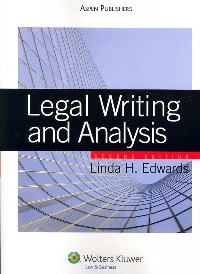
Legal writing and analysis / 2nd ed.
副标题:无
分类号:
ISBN:9780735562295
微信扫一扫,移动浏览光盘
简介
Summary:
Publisher Summary 1
For students, Edwards (Mercer U.) details the process of writing legal memos, professional correspondence, and legal briefs. The volume follows the traditional legal writing course syllabus. After explaining the legal system and lawyer's roles, she covers working with raw material for analysis, organizational formats for communicating the analysis of a legal question (IRAC or CRAC structures), the components of documents, citation and style, and oral arguments. Core chapters are followed by optional chapters for more in-depth study. Sample letters, memos, and briefs are included in the appendices. This edition contains an additional format option for drafting a Question Presented, it has been reorganized, and citation and quotation material has been revised to match current editions of the ALWD Citation Manual and the Bluebook. Annotation 漏2007 Book News, Inc., Portland, OR (booknews.com)
目录
Table Of Contents:
Preface xvii
Acknowledgments xix
Part One: Lawyers and the Legal Landscape 1(28)
Overview of the Lawyer's Role 3(10)
Writing and a Lawyer's Roles 3(2)
Overview of a Civil Case 5(3)
Ethical Duties 8(1)
Legal Citation 9(4)
Plagiarism 9(2)
When to Cite 11(2)
The Legal System, the Common Law Process, and Kinds of Authority 13(16)
The Structure of Court Systems 13(2)
The Federal Court System 13(1)
State Court Systems 14(1)
The Functions of Trial and Appellate Courts 15(2)
The Functions of Trial Courts 15(1)
The Functions of Appellate Courts 16(1)
The Common Law Process 17(6)
Stare Decisis 17(1)
Holdings 18(1)
The Breadth of Holdings 19(2)
Holdings Versus Dicta 21(2)
The Weight of Authority 23(6)
Primary Authority Versus Secondary Authority 23(2)
Mandatory Authority Versus Persuasive Authority 25(1)
Other Characteristics Affecting the Persuasive Value of Cases 26(3)
Part Two: Reading and Analyzing the Law 29(34)
Briefing and Synthesizing Cases 31(14)
Introduction to Case Briefing 31(1)
A Format for Case Briefing 32(4)
Synthesizing Cases 36(9)
Using Consistent Cases 37(1)
Reconciling Seemingly Inconsistent Cases 37(8)
Interpreting Statutes 45(10)
Reading Statutes 45(4)
Identifying Issues 49(2)
Interpreting the Statute's Language 51(1)
Canons of Construction 52(3)
Forms of Legal Reasoning 55(8)
Rule-Based Reasoning 55(1)
Analogical Reasoning (Analogizing and Distinguishing Cases) 56(2)
Policy-Based Reasoning 58(1)
Principle-Based Reasoning 59(1)
Custom-Based Reasoning 59(1)
Narrative 60(3)
Part Three: Writing the Discussion of a Legal Question 63(62)
The Writing Process and Law-Trained Readers 65(12)
The Writing Process 65(4)
Law-Trained Readers 69(8)
Focus on the Reader 69(1)
Attention Levels 70(1)
Road Maps 71(1)
Readers as Commentators 72(1)
Judges as Readers 72(2)
Law Professors as Readers 74(3)
Large-Scale Organization: Creating an Annotated Outline 77(12)
Rule Structures 77(6)
Creating an Annotated Outline 83(6)
The First Level: The Legal Questions You Have Been Asked to Address 83(1)
The Second Level: Governing Rules 83(1)
The Third Level and Beyond: The Rule's Structure 84(1)
Omitting Issues Not in Dispute 85(1)
Uncertainty About Which Rule Your Jurisdiction Will Adopt 85(1)
Annotating Your Outline 86(3)
Small-Scale Organization: Explaining the Law 89(12)
An Overview of the Paradigm for Legal Analysis 89(1)
Stating the Conclusion 90(1)
Stating the Governing Rule 91(1)
Explaining the Rule: Five Components 92(1)
Guidelines for Rule Explanation 93(2)
Organizing a Pure Question of Law 95(6)
Small-Scale Organization: Applying the Law 101(8)
Two Approaches to Writing the Application Section 101(1)
Content of Rule Application 102(1)
Common Trouble Spots in Rule Application Sections 103(4)
Evaluating Your Draft 107(2)
Discussing Multiple Issues: Putting It All Together 109(8)
Ordering for Your Reader 109(2)
Accounting for Elements Not at Issue 109(1)
Selecting an Order for the Remaining Issues 110(1)
Umbrella Sections 111(3)
The Conclusion 114(1)
Editing Subsection Lengths 114(1)
Variations of the Multi-Issue Paradigm 115(2)
Deepening Your Analysis 117(8)
Major Forms of Reasoning in Rule Explanation: Policy and Principle 117(3)
The Major Form of Reasoning in Rule Application: Analogical Reasoning 120(5)
Deciding Which Similarities and Differences Are Significant 120(1)
Choosing a Format for Your Case Comparison 121(1)
Short-Form Case Comparison 121(1)
Long-Form Case Comparison 122(3)
Part Four: Predictive Writing 125(32)
Writing an Office Memo 127(16)
The Function of an Office Memo 127(1)
An Overview of the Memo Format 127(2)
Drafting the Heading 129(1)
Drafting the Question Presented 129(4)
Drafting the Brief Answer 133(3)
Drafting the Fact Statement 136(4)
Fact Selection 136(1)
Organization 137(3)
Drafting the Conclusion 140(3)
Writing Professional Letters 143(14)
General Characteristics of Professional Letter Writing 143(3)
Letters to Clients 146(5)
General Considerations 146(1)
Retainer Letters 147(3)
Advice Letters 150(1)
Status Letter 151(1)
Letters to Other Lawyers 151(3)
General Considerations 151(2)
Demand Letters and Responses 153(1)
Confirming Letters 153(1)
Transmittal Letters 154(3)
Part Five: The Shift to Advocacy 157(82)
Introduction to Brief-Writing 159(12)
Ethics and the Advocate's Craft 159(3)
Judges, Briefs, and Persuasion 162(2)
The Components of a Trial-Level Brief 164(3)
The Components of an Appellate Brief 167(4)
Questions Presented and Point Headings 171(14)
Writing the Question Presented 171(4)
Point Headings 175(10)
Identifying Point Headings 175(2)
Drafting Point Headings 177(3)
Editing Point Headings for Readability and Persuasion 180(1)
Editing for Readability 180(2)
Editing for Persuasion 182(1)
Identifying Subheadings 183(2)
Writing the Argument Section 185(10)
Arguments for Different Kinds of Legal Issues 185(4)
A Pure Question of Law 185(1)
An Issue of Statutory Interpretation 186(1)
An Issue of Common Law Case Synthesis 186(1)
A Case of First Impression on Your Jurisdiction 187(1)
Seeking a Change in the Law 188(1)
An Issue Applying Law to Fact 188(1)
Honing Your Argument for the Court's Rule 189(1)
The Trial Judge 189(1)
Appellate Judges and the Appellate Process 189(1)
Suggestions and Reminders 190(3)
Rebutting Your Opponent's Arguments 193(2)
Standards of Review 195(8)
Categories of Trial Court Decisions 195(4)
Advocating a More Favorable Standard of Review 199(1)
Conforming Headings to the Standard of Review 200(3)
Writing a Fact Statement 203(18)
Fact Ethics, Readers, and the Conventions of Fact Statements 204(2)
Fact Ethics 204(1)
The Conventions of a Statement of Facts 204(2)
Developing a Theory of the Case and Selecting Facts 206(2)
Developing a Theory of the Case 206(1)
Selecting and Citing to Facts 207(1)
Organization 208(1)
Formats 208(1)
Procedural History 209(1)
Techniques for Persuasion 209(12)
General Principles 209(1)
Large-Scale Organization 210(1)
Paragraph Organization 211(1)
Techniques with Sentences 212(1)
Other Small-Scale Techniques 213(8)
Using Legal Theory to Sharpen Your Arguments 221(18)
Natural Law 222(2)
Formalism 224(2)
Legal Realism 226(3)
Legal Process 229(2)
Fundamental Rights 231(2)
Law and Economics 233(1)
Critical Legal Theory 234(2)
The Jurisprudence of Legal Writing 236(3)
Part Six: Style and Formalities 239(46)
Citations and Quotations 241(26)
Citation in Legal Writing 241(2)
Citation Form 243(17)
Using the ALWD Citation Manual 243(1)
Sections of the Manual 243(2)
How to Locate the Rules You Need 245(1)
Using the Bluebook 245(1)
Sections of the Bluebook 245(1)
How to Locate the Rules You Need 246(1)
Several Key Concepts 246(1)
Introduction to Citation Form 247(2)
Matching the Citation to the Text 249(2)
Citing with Style and Grace 251(1)
Editing Citation Form 252(8)
Quotations 260(7)
When Quotation Marks Are Required 260(2)
Choosing to Use Quotation Marks 262(1)
Overquoting 262(1)
The Mechanics of Quoting 263(2)
Editing Quotations 265(2)
Paragraphs, Sentences, and Style 267(18)
Paragraphing 267(3)
Choose Strong Subjects and Verbs 270(5)
Active Voice 270(2)
Nominalizations 272(1)
Throat-Clearing 273(1)
Sentences Beginning with Forms of ``It Is'' or ``There Is'' 274(1)
Avoiding Wordiness 275(2)
Revise Phrases That Can Be Replaced by a Single Word 275(1)
Avoid Legalese 276(1)
Avoid Redundancies 277(1)
Avoid Intensifies 277(1)
Other Characteristics of Good Style 277(3)
Keeping the Subject and Verb Close Together 277(1)
Avoiding Long Sentences 278(1)
Unnecessary Variations 279(1)
Parallelism 279(1)
Gender-Neutral Writing 280(5)
Techniques for Nouns: Elimination or Substitution 281(1)
Techniques for Pronouns 281(1)
Techniques for Proper Names and Titles 282(3)
Part Seven: Oral Advocacy 285(14)
Oral Argument 287(12)
The Purpose of Oral Argument 287(1)
Formalities and Organization of Oral Argument 288(3)
Preliminary Formalities 288(1)
The Appellant's Argument 288(1)
Argument of Co-Counsel for the Appellant 289(1)
The Appellee's Argument 289(1)
Argument of Co-Counsel for the Appellee 290(1)
Concluding the Argument 290(1)
Rebuttal 290(1)
The Content of Argument 291(2)
The Standard of Review 291(1)
The Burden of Proof 291(1)
The Trial-Level Procedural Posture 291(1)
Themes 292(1)
Preparation 293(1)
The Record 293(1)
Outline Your Argument 293(1)
Prepare Your Folder 293(1)
Script the Entire Opening, the Conclusion, and Your Prepared Rebuttal 294(1)
Practice 294(1)
Visit the Courtroom 294(1)
Handling Questions from the Bench 294(3)
Anticipate Questions 294(1)
Attitude 295(1)
Recognize Types of Questions 295(1)
Listen Carefully to the Question 295(1)
Clarify the Question 296(1)
Begin with a Clear, Direct Answer 296(1)
Returning to Your Prepared Presentation 296(1)
Handling Questions on Your Co-Counsel's Issue 296(1)
Handling a Question for Which You Do Not Have an Answer 296(1)
Agreeing When You Can 297(1)
Referring to Earlier Questions or Comments from the Bench 297(1)
Presentation 297(2)
Dress 297(1)
Body, Hands, and Eyes 297(1)
Voice 298(1)
References 298(1)
Nervousness 298(1)
Appendices 299(48)
Appendix A Sample Office Memorandum 301(6)
Appendix B Sample Trial-Level Brief 307(6)
Appendix C Sample Appellate Brief 313(16)
Appendix D Sample Letters 329(8)
Appendix E Cases 337(10)
Index 347
Preface xvii
Acknowledgments xix
Part One: Lawyers and the Legal Landscape 1(28)
Overview of the Lawyer's Role 3(10)
Writing and a Lawyer's Roles 3(2)
Overview of a Civil Case 5(3)
Ethical Duties 8(1)
Legal Citation 9(4)
Plagiarism 9(2)
When to Cite 11(2)
The Legal System, the Common Law Process, and Kinds of Authority 13(16)
The Structure of Court Systems 13(2)
The Federal Court System 13(1)
State Court Systems 14(1)
The Functions of Trial and Appellate Courts 15(2)
The Functions of Trial Courts 15(1)
The Functions of Appellate Courts 16(1)
The Common Law Process 17(6)
Stare Decisis 17(1)
Holdings 18(1)
The Breadth of Holdings 19(2)
Holdings Versus Dicta 21(2)
The Weight of Authority 23(6)
Primary Authority Versus Secondary Authority 23(2)
Mandatory Authority Versus Persuasive Authority 25(1)
Other Characteristics Affecting the Persuasive Value of Cases 26(3)
Part Two: Reading and Analyzing the Law 29(34)
Briefing and Synthesizing Cases 31(14)
Introduction to Case Briefing 31(1)
A Format for Case Briefing 32(4)
Synthesizing Cases 36(9)
Using Consistent Cases 37(1)
Reconciling Seemingly Inconsistent Cases 37(8)
Interpreting Statutes 45(10)
Reading Statutes 45(4)
Identifying Issues 49(2)
Interpreting the Statute's Language 51(1)
Canons of Construction 52(3)
Forms of Legal Reasoning 55(8)
Rule-Based Reasoning 55(1)
Analogical Reasoning (Analogizing and Distinguishing Cases) 56(2)
Policy-Based Reasoning 58(1)
Principle-Based Reasoning 59(1)
Custom-Based Reasoning 59(1)
Narrative 60(3)
Part Three: Writing the Discussion of a Legal Question 63(62)
The Writing Process and Law-Trained Readers 65(12)
The Writing Process 65(4)
Law-Trained Readers 69(8)
Focus on the Reader 69(1)
Attention Levels 70(1)
Road Maps 71(1)
Readers as Commentators 72(1)
Judges as Readers 72(2)
Law Professors as Readers 74(3)
Large-Scale Organization: Creating an Annotated Outline 77(12)
Rule Structures 77(6)
Creating an Annotated Outline 83(6)
The First Level: The Legal Questions You Have Been Asked to Address 83(1)
The Second Level: Governing Rules 83(1)
The Third Level and Beyond: The Rule's Structure 84(1)
Omitting Issues Not in Dispute 85(1)
Uncertainty About Which Rule Your Jurisdiction Will Adopt 85(1)
Annotating Your Outline 86(3)
Small-Scale Organization: Explaining the Law 89(12)
An Overview of the Paradigm for Legal Analysis 89(1)
Stating the Conclusion 90(1)
Stating the Governing Rule 91(1)
Explaining the Rule: Five Components 92(1)
Guidelines for Rule Explanation 93(2)
Organizing a Pure Question of Law 95(6)
Small-Scale Organization: Applying the Law 101(8)
Two Approaches to Writing the Application Section 101(1)
Content of Rule Application 102(1)
Common Trouble Spots in Rule Application Sections 103(4)
Evaluating Your Draft 107(2)
Discussing Multiple Issues: Putting It All Together 109(8)
Ordering for Your Reader 109(2)
Accounting for Elements Not at Issue 109(1)
Selecting an Order for the Remaining Issues 110(1)
Umbrella Sections 111(3)
The Conclusion 114(1)
Editing Subsection Lengths 114(1)
Variations of the Multi-Issue Paradigm 115(2)
Deepening Your Analysis 117(8)
Major Forms of Reasoning in Rule Explanation: Policy and Principle 117(3)
The Major Form of Reasoning in Rule Application: Analogical Reasoning 120(5)
Deciding Which Similarities and Differences Are Significant 120(1)
Choosing a Format for Your Case Comparison 121(1)
Short-Form Case Comparison 121(1)
Long-Form Case Comparison 122(3)
Part Four: Predictive Writing 125(32)
Writing an Office Memo 127(16)
The Function of an Office Memo 127(1)
An Overview of the Memo Format 127(2)
Drafting the Heading 129(1)
Drafting the Question Presented 129(4)
Drafting the Brief Answer 133(3)
Drafting the Fact Statement 136(4)
Fact Selection 136(1)
Organization 137(3)
Drafting the Conclusion 140(3)
Writing Professional Letters 143(14)
General Characteristics of Professional Letter Writing 143(3)
Letters to Clients 146(5)
General Considerations 146(1)
Retainer Letters 147(3)
Advice Letters 150(1)
Status Letter 151(1)
Letters to Other Lawyers 151(3)
General Considerations 151(2)
Demand Letters and Responses 153(1)
Confirming Letters 153(1)
Transmittal Letters 154(3)
Part Five: The Shift to Advocacy 157(82)
Introduction to Brief-Writing 159(12)
Ethics and the Advocate's Craft 159(3)
Judges, Briefs, and Persuasion 162(2)
The Components of a Trial-Level Brief 164(3)
The Components of an Appellate Brief 167(4)
Questions Presented and Point Headings 171(14)
Writing the Question Presented 171(4)
Point Headings 175(10)
Identifying Point Headings 175(2)
Drafting Point Headings 177(3)
Editing Point Headings for Readability and Persuasion 180(1)
Editing for Readability 180(2)
Editing for Persuasion 182(1)
Identifying Subheadings 183(2)
Writing the Argument Section 185(10)
Arguments for Different Kinds of Legal Issues 185(4)
A Pure Question of Law 185(1)
An Issue of Statutory Interpretation 186(1)
An Issue of Common Law Case Synthesis 186(1)
A Case of First Impression on Your Jurisdiction 187(1)
Seeking a Change in the Law 188(1)
An Issue Applying Law to Fact 188(1)
Honing Your Argument for the Court's Rule 189(1)
The Trial Judge 189(1)
Appellate Judges and the Appellate Process 189(1)
Suggestions and Reminders 190(3)
Rebutting Your Opponent's Arguments 193(2)
Standards of Review 195(8)
Categories of Trial Court Decisions 195(4)
Advocating a More Favorable Standard of Review 199(1)
Conforming Headings to the Standard of Review 200(3)
Writing a Fact Statement 203(18)
Fact Ethics, Readers, and the Conventions of Fact Statements 204(2)
Fact Ethics 204(1)
The Conventions of a Statement of Facts 204(2)
Developing a Theory of the Case and Selecting Facts 206(2)
Developing a Theory of the Case 206(1)
Selecting and Citing to Facts 207(1)
Organization 208(1)
Formats 208(1)
Procedural History 209(1)
Techniques for Persuasion 209(12)
General Principles 209(1)
Large-Scale Organization 210(1)
Paragraph Organization 211(1)
Techniques with Sentences 212(1)
Other Small-Scale Techniques 213(8)
Using Legal Theory to Sharpen Your Arguments 221(18)
Natural Law 222(2)
Formalism 224(2)
Legal Realism 226(3)
Legal Process 229(2)
Fundamental Rights 231(2)
Law and Economics 233(1)
Critical Legal Theory 234(2)
The Jurisprudence of Legal Writing 236(3)
Part Six: Style and Formalities 239(46)
Citations and Quotations 241(26)
Citation in Legal Writing 241(2)
Citation Form 243(17)
Using the ALWD Citation Manual 243(1)
Sections of the Manual 243(2)
How to Locate the Rules You Need 245(1)
Using the Bluebook 245(1)
Sections of the Bluebook 245(1)
How to Locate the Rules You Need 246(1)
Several Key Concepts 246(1)
Introduction to Citation Form 247(2)
Matching the Citation to the Text 249(2)
Citing with Style and Grace 251(1)
Editing Citation Form 252(8)
Quotations 260(7)
When Quotation Marks Are Required 260(2)
Choosing to Use Quotation Marks 262(1)
Overquoting 262(1)
The Mechanics of Quoting 263(2)
Editing Quotations 265(2)
Paragraphs, Sentences, and Style 267(18)
Paragraphing 267(3)
Choose Strong Subjects and Verbs 270(5)
Active Voice 270(2)
Nominalizations 272(1)
Throat-Clearing 273(1)
Sentences Beginning with Forms of ``It Is'' or ``There Is'' 274(1)
Avoiding Wordiness 275(2)
Revise Phrases That Can Be Replaced by a Single Word 275(1)
Avoid Legalese 276(1)
Avoid Redundancies 277(1)
Avoid Intensifies 277(1)
Other Characteristics of Good Style 277(3)
Keeping the Subject and Verb Close Together 277(1)
Avoiding Long Sentences 278(1)
Unnecessary Variations 279(1)
Parallelism 279(1)
Gender-Neutral Writing 280(5)
Techniques for Nouns: Elimination or Substitution 281(1)
Techniques for Pronouns 281(1)
Techniques for Proper Names and Titles 282(3)
Part Seven: Oral Advocacy 285(14)
Oral Argument 287(12)
The Purpose of Oral Argument 287(1)
Formalities and Organization of Oral Argument 288(3)
Preliminary Formalities 288(1)
The Appellant's Argument 288(1)
Argument of Co-Counsel for the Appellant 289(1)
The Appellee's Argument 289(1)
Argument of Co-Counsel for the Appellee 290(1)
Concluding the Argument 290(1)
Rebuttal 290(1)
The Content of Argument 291(2)
The Standard of Review 291(1)
The Burden of Proof 291(1)
The Trial-Level Procedural Posture 291(1)
Themes 292(1)
Preparation 293(1)
The Record 293(1)
Outline Your Argument 293(1)
Prepare Your Folder 293(1)
Script the Entire Opening, the Conclusion, and Your Prepared Rebuttal 294(1)
Practice 294(1)
Visit the Courtroom 294(1)
Handling Questions from the Bench 294(3)
Anticipate Questions 294(1)
Attitude 295(1)
Recognize Types of Questions 295(1)
Listen Carefully to the Question 295(1)
Clarify the Question 296(1)
Begin with a Clear, Direct Answer 296(1)
Returning to Your Prepared Presentation 296(1)
Handling Questions on Your Co-Counsel's Issue 296(1)
Handling a Question for Which You Do Not Have an Answer 296(1)
Agreeing When You Can 297(1)
Referring to Earlier Questions or Comments from the Bench 297(1)
Presentation 297(2)
Dress 297(1)
Body, Hands, and Eyes 297(1)
Voice 298(1)
References 298(1)
Nervousness 298(1)
Appendices 299(48)
Appendix A Sample Office Memorandum 301(6)
Appendix B Sample Trial-Level Brief 307(6)
Appendix C Sample Appellate Brief 313(16)
Appendix D Sample Letters 329(8)
Appendix E Cases 337(10)
Index 347
Legal writing and analysis / 2nd ed.
- 名称
- 类型
- 大小
光盘服务联系方式: 020-38250260 客服QQ:4006604884
云图客服:
用户发送的提问,这种方式就需要有位在线客服来回答用户的问题,这种 就属于对话式的,问题是这种提问是否需要用户登录才能提问
Video Player
×
Audio Player
×
pdf Player
×
