

简介
Summary:
Publisher Summary 1
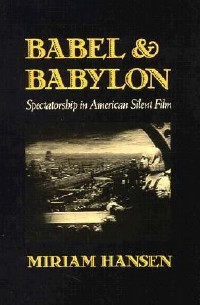
Although cinema was invented in the mid-1890s, it was a decade more before the concept of a "film spectator" emerged. As the cinema began to separate itself from the commercial entertainments in whose context films initially had been shown--vaudeville, dime museums, fairgrounds--a particular concept of its spectator was developed on the level of film style, as a means of predicting the reception of films on a mass scale. In Babel and BabylonMiriam Hansen offers an original perspective on American film by tying the emergence of spectatorship to the historical transformation of the public sphere.Hansen builds a critical framework for understanding the cultural formation of spectatorship, drawing on the Frankfurt School's debates on mass culture and the public sphere. Focusing on exemplary moments in the American silent era, she explains how the concept of the spectator evolved as a crucial part of the classical Hollywood paradigm--as one of the new industry's strategies to integrate ethnically, socially, and sexually differentiated audiences into a modern culture of consumption. In this process, Hansen argues, the cinema might also have provided the conditions of an alternative public sphere for particular social groups, such as recent immigrants and women, by furnishing an intersubjective context in which they could recognize fragments of their own experience.After tracing the emergence of spectatorship as an institution, Hansen pursues the question of reception through detailed readings of a single film, D. W. Griffith's Intolerance(1916), and of the cult surrounding a single star, Rudolph Valentino. In each case the classical construction of spectatorship is complicated by factors of gender and sexuality, crystallizing around the fear and desire of the female consumer.Babel and Babylonrecasts the debate on early American cinema--and by implication on American film as a whole. It is a model study in the field of Cinema Studies, mediating the concerns of recent film theory with those of recent film history.
目录
Table Of Contents:
Introduction: Cinema Spectatorship and Public Life 1(20)
I Rebuilding the Tower of Babel: The Emergence of Spectatorship 21(106)
A Cinema in Search of a Spectator: Film-Viewer Relations before Hollywood 23(37)
Early Audiences: Myths and Models 60(30)
Chameleon and Catalyst: The Cinema as an Alternative Public Sphere 90(37)
II Babel in Babylon: D. W. Griffith's Intolerance (1916) 127(116)
Reception, Textual System, and Self-Definition 129(12)
``A Radiant Crazy-Quilt'': Patterns of Narration and Address 141(23)
Genesis, Causes, Concepts of History 164(9)
Film History, Archaeology, Universal Language 173(15)
Hieroglyphics, Figurations of Writing 188(11)
Riddles of Maternity 199(19)
Crisis of Femininity, Fantasies of Rescue 218(25)
III The Return of Babylon: Rudolph Valentino and Female Spectatorship (1921-1926) 243(54)
Male Star, Female Fans 245(24)
Patterns of Vision, Scenarios of Identification 269(28)
Notes 297(69)
Illustration Credits 366(1)
Index 367
Introduction: Cinema Spectatorship and Public Life 1(20)
I Rebuilding the Tower of Babel: The Emergence of Spectatorship 21(106)
A Cinema in Search of a Spectator: Film-Viewer Relations before Hollywood 23(37)
Early Audiences: Myths and Models 60(30)
Chameleon and Catalyst: The Cinema as an Alternative Public Sphere 90(37)
II Babel in Babylon: D. W. Griffith's Intolerance (1916) 127(116)
Reception, Textual System, and Self-Definition 129(12)
``A Radiant Crazy-Quilt'': Patterns of Narration and Address 141(23)
Genesis, Causes, Concepts of History 164(9)
Film History, Archaeology, Universal Language 173(15)
Hieroglyphics, Figurations of Writing 188(11)
Riddles of Maternity 199(19)
Crisis of Femininity, Fantasies of Rescue 218(25)
III The Return of Babylon: Rudolph Valentino and Female Spectatorship (1921-1926) 243(54)
Male Star, Female Fans 245(24)
Patterns of Vision, Scenarios of Identification 269(28)
Notes 297(69)
Illustration Credits 366(1)
Index 367
- 名称
- 类型
- 大小
光盘服务联系方式: 020-38250260 客服QQ:4006604884
云图客服:
用户发送的提问,这种方式就需要有位在线客服来回答用户的问题,这种 就属于对话式的,问题是这种提问是否需要用户登录才能提问
Video Player
×
Audio Player
×
pdf Player
×
