

简介
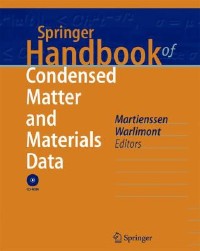
"Springer Handbook of Condensed Matter and Materials Data provides a concise compilation of data and functional relationships from the fields of solid-state physics and materials in one 1400-page volume. The data, encapsulated in 900 tables and 1000 illustrations, have been selected and extracted primarily from the extensive high-quality data collection Landolt-Bornstein and also from other systematic data sources and recent publications of physical and technical property data. Many chapters are authored by Landolt-Bornstein editors, including this Springer Handbook's editors."--BOOK JACKET.
目录
General Tables
covers the fundamentals of the physics of condensed matter
Fundamental physical constants are qualitatively described and recently recommended numerical values are presented
A short review of The International System of Units (SI) is given and the concepts of base physical quantities and derived physical quantities on which the SI is founded is explained
A number of non-SI units which are still in use are also discussed
Periodic solids, which represent the major proportion of condensed matter are used to introduce briefly the basics of modern crystallography
A coherent introduction to the formalism required is given and the basic concepts and technical terms are briefly explained
The Fundamental Constants
The International System of Units
Rudiments of Crystallography
The Elements
The Elements provides tables of the physical and physicochemical properties of the elements
Emphasis is placed on properties of the elements in the condensed state
The tables are structured according to the Periodic Table
Most of the tables deal with the properties of elements of one particular group of the Periodic Table
Only the elements of the first period (hydrogen and helium), the lanthanides, and the actinides are arranged according to the periods
This synoptic representation is intended to provide a transparent overview of the trends in the data
Classes of Materials
Classes of Materials starts with the selective treatment of metals that are applied as base and alloying elements of metallic materials
According to common usage, the treatment of metallic materials is based on single elements and of groups of metals with common dominating features
The next class of materials discussed are ceramics
Detailed groupings and definitions of technical ceramics are given and traditional ceramics and cements, silicate ceramics, refractory ceramics, oxide ceramics, and non-oxide ceramics are treated
The physical and physicochemical properties of those polymers, copolymers, and polymer blends which are widely used for scientific applications and in industry are described in the next chapter
The last chapter serves as a source of data and commercial product information on glasses as engineering materials of practical importance
Metals.- Magnesium and Magnesium Alloys.- Aluminium and Aluminium Alloys.- Titanium and Titanium Alloys.- Zirconium and Zirconium Alloys.- Iron and Steels.- Cobalt and Cobalt Alloys.- Nickel and Nickel Superalloys.- Copper and Copper Alloys.- Refractory Metals.- Noble Metals.- Lead and Lead Alloys
Ceramics
Polymers
Glasses
Functional Materials
covering functional materials is organized in a two-step approach
The first step corresponds to searching for the substance of interest, that is, the relevant group of substances
The second step corresponds to the physical property of interest
The subsections are characterized by the groups of the Periodic Table to which the constituent elements belong
For each group of substances, the physical properties are organized into four classes
These are: A Crystal Structure, Mechanical and Thermal Properties; B Electronic Properties; C Transport Properties; D Electromagnetic and Optical Properties
These property classes are further subdivided into individual properties
Materials covered are semiconductors, superconductors, magnetic materials, dielectrics and electrooptics, and ferro- and antiferroelectrics
Semiconductors
Superconductors
Magnetic Materials
Dielectrics and Electrooptics
Ferroelectrics
Special Structures
covers special structures such as liquid crystals, solid surfaces and mesoscopic and nanostructured materials
The chapter on liquid crystals covers physical properties of the most common liquid crystalline substances as well as some liquid crystalline mixtures
Data compiled in the chapter on solid surfaces refer to atomically clean and well characteriz
covers the fundamentals of the physics of condensed matter
Fundamental physical constants are qualitatively described and recently recommended numerical values are presented
A short review of The International System of Units (SI) is given and the concepts of base physical quantities and derived physical quantities on which the SI is founded is explained
A number of non-SI units which are still in use are also discussed
Periodic solids, which represent the major proportion of condensed matter are used to introduce briefly the basics of modern crystallography
A coherent introduction to the formalism required is given and the basic concepts and technical terms are briefly explained
The Fundamental Constants
The International System of Units
Rudiments of Crystallography
The Elements
The Elements provides tables of the physical and physicochemical properties of the elements
Emphasis is placed on properties of the elements in the condensed state
The tables are structured according to the Periodic Table
Most of the tables deal with the properties of elements of one particular group of the Periodic Table
Only the elements of the first period (hydrogen and helium), the lanthanides, and the actinides are arranged according to the periods
This synoptic representation is intended to provide a transparent overview of the trends in the data
Classes of Materials
Classes of Materials starts with the selective treatment of metals that are applied as base and alloying elements of metallic materials
According to common usage, the treatment of metallic materials is based on single elements and of groups of metals with common dominating features
The next class of materials discussed are ceramics
Detailed groupings and definitions of technical ceramics are given and traditional ceramics and cements, silicate ceramics, refractory ceramics, oxide ceramics, and non-oxide ceramics are treated
The physical and physicochemical properties of those polymers, copolymers, and polymer blends which are widely used for scientific applications and in industry are described in the next chapter
The last chapter serves as a source of data and commercial product information on glasses as engineering materials of practical importance
Metals.- Magnesium and Magnesium Alloys.- Aluminium and Aluminium Alloys.- Titanium and Titanium Alloys.- Zirconium and Zirconium Alloys.- Iron and Steels.- Cobalt and Cobalt Alloys.- Nickel and Nickel Superalloys.- Copper and Copper Alloys.- Refractory Metals.- Noble Metals.- Lead and Lead Alloys
Ceramics
Polymers
Glasses
Functional Materials
covering functional materials is organized in a two-step approach
The first step corresponds to searching for the substance of interest, that is, the relevant group of substances
The second step corresponds to the physical property of interest
The subsections are characterized by the groups of the Periodic Table to which the constituent elements belong
For each group of substances, the physical properties are organized into four classes
These are: A Crystal Structure, Mechanical and Thermal Properties; B Electronic Properties; C Transport Properties; D Electromagnetic and Optical Properties
These property classes are further subdivided into individual properties
Materials covered are semiconductors, superconductors, magnetic materials, dielectrics and electrooptics, and ferro- and antiferroelectrics
Semiconductors
Superconductors
Magnetic Materials
Dielectrics and Electrooptics
Ferroelectrics
Special Structures
covers special structures such as liquid crystals, solid surfaces and mesoscopic and nanostructured materials
The chapter on liquid crystals covers physical properties of the most common liquid crystalline substances as well as some liquid crystalline mixtures
Data compiled in the chapter on solid surfaces refer to atomically clean and well characteriz
- 名称
- 类型
- 大小
光盘服务联系方式: 020-38250260 客服QQ:4006604884
云图客服:
用户发送的提问,这种方式就需要有位在线客服来回答用户的问题,这种 就属于对话式的,问题是这种提问是否需要用户登录才能提问
Video Player
×
Audio Player
×
pdf Player
×
亲爱的云图用户,
光盘内的文件都可以直接点击浏览哦
无需下载,在线查阅资料!
