

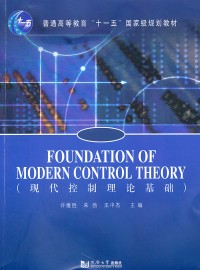
简介
《现代控制理论基础(英文版)》分为三部分共十章。第一部分为线性系统的状态空间分析和综合,包括第一章至第四章。第一章为动态系统的状态空间描述。第二章为线性系统状态方程的解。第三章为能控性和能观测性。第四章为状态反馈控制系统的设计。
第二部分为线性离散控制系统,包括第五章至第八章。第五章主要讲述离散采样系统、数字系统及计算机系统的概念。第六章着重阐述离散系统研究的基本数学方法,包括采样定理、z变换和控制系统的脉冲传递函数。第七章讲述线性离散控制系统的分析,包括系统的稳定性、稳态响应特性。第八章讨论了线性离散系统的设计,包括数字控制器直接设计方法、连续时间控制器的离散实现。
第三部分为非线性系统的分析和综合,包括第九章至第十二章。第九章首先讨论了非线性系统的特点、分类、常见环节和表现。第十章至第十二章分别详细阐述了三种用于分析系统稳定性的方法,即描述函数法、相平面分析法和李亚普诺夫方法。描述函数法通过线性化的方法研究系统的稳定性,适用于系统非线性很小的情况。相平面方法仅适用于二阶系统的稳定性分析。李亚普诺夫方法既适用于线性系统,又适用于非线性系统,是一种比较普遍的研究方法。
在内容的编排上,《现代控制理论基础(英文版)》考虑到学生的学习习惯,注意讲清重要的概念及其物理意义,而将严格的数学证明放在扩展内容中。这样既便于引导优秀学生进行较深入的理论推演,也便于大多数同学的课堂教学。实践证明,这样的安排是受同学欢迎的,也取得了较好的教学效果。
目录
Section Ⅰ State Space Analysis and Synthesis of Linear Systems
State Space Description of Dynamic Systems
1.1 Introduction
1.2 State and state space
1.3 State space description of dynamic systems
1.4 Canonical form of SISO state space representation
1.4.1 Controllable canonical form
1.4.2 Observable canonical form
1.4.3 Diagonal form and Jordan canonical form
1.5 Some examples of developing state space descriptions
1.6 Equivalent state equations
1.6.1 Similarity transformation
1.6.2 An application of similarity transformation--
Diagonal form and Jordan form
1.7 Relationship between I/O description and state-space
description
1.7.1 Transfer function from state-space description
1.7.2 State-space representations from transfer functions--
Realizations
Problems
Solution of State Equations of Linear Systems
2.1 Introduction
2.2 Solution of linear homogeneous state equation
2.3 Properties and calculations of the matrix exponential function
2.3.1 Properties of □
2.3.2 Calculation of □
2.4 Solution of state equations
2.5 State transition matrix of linear time-invariant systems
Problems
Controllability and Observability
3.1 Introduction
3.2 Controllability
3.2.1 Definition of complete state controllability
3.2.2 Controllability criterion for time-invariant systems with arbitrary eigenvalues
3.2.3 Controllability criterion for time-invariant systems with distinct □genvalues
3.2.4 Controllability criterions for time-invariant systems with
multi-eigenvalues
3.3 Observability
3.3.1 Definition of complete state observability
3.3.2 Observability criterion for time-invariant systems with arbitrary eigenvalues
3.3.3 Observability criterion for time-invariant systems with distinct eigenvalues
3.3.4 Observability criterion for time-invariant systems with multi-eigenvalues
3.4 Principle of duality
3.5 Obtaining the controllable and observable canonical
forms for SISO systems
3.5.1 Controllable canonical form of SISO systems
3.5.2 Observable canonical form of SISO systems
3.6 Canonical decomposition
3.6.1 Decomposition according to controllability
3.6.2 Decomposition according to observability
3.6.3 Canonical structure of system
Extensions and Proofs
Problems
Desigh of State Feedback Control Systems
4.1 Introduction
4.2 State feedback
4.2.1 State feedback scheme
4 2 2 The effect of state feedback on system properties
4.3 Pole assignment using state feedback
4.3.1 Description of pole assignment problem
4.3.2 Necessary and sufficient condition for arbitrary pole assignment
4.3 3 Pole assignment via control canonical form of state equations
4.3.4 Pole assignment via Ackermann's formula
4.3.5 Direct calculation of gains by comparing characteristic equations
4.4 Design of state observers
4.5 Feedback from estimated states
Problems
Section Ⅱ Linear Discrete-time Systems
5 Discrete-time Systems and Computer Control Systems
5.1 Introduction
5.2 Sample-data control and computer control systems
5.3 Related theories
5.4 Sampling process and sample theorem
5.5 The z transform
5.6 The computation of z transform and the z transform of elementary functions
5.7 Important properties of the z transform
5.8 The inverse z transform
5.9 Difference equation
5.10 The z transform method for solving difference equations
5.11 The model of a discrete-time control system and the pulse transfer function
5.12 The difference equation and pulse transfer function
Problems
Analysis and Design of Discrete-Time Control Systems
6.1 Introduction
6.2 Mapping between the s plane and the z plane
6.3 Stability analysis of closed-loop systems in the z plane
6.4 Steady-state response analysis
6.5 The dynamic analysis for the control system in the z plane
6.6 The design of the discrete-time compensator
6.6.1 Dead-beat control with intersampling ripples
6.6.2 Dead-beat control without intersampling ripples
6.6.3 Shortcomings of the Dead-beat control
6.7 Realization of digital controller
Problems
Section Ⅲ Nonlinear Systems
Introduction to Nonlinear Control Systems
7.1 Introduction
7.2 Common nonlinear elements
7.3 Properties of nonlinear systems
7.3.1 Classification of nonlinearities
7.3.2 Some common nonlinear system behaviors
7.4 Approaches to the analysis of nonlinear control systems
Describing Function Analysis
8.1 Introduction
8.2 Describing function fundamentals
8.2.1 Basic assumptions
8.2.2 Basic definitions
8.2.3 Computing describing functions
8.3 Describing functions of common nonlinearities
8.4 Describing function analysis of nonlinear system
8.4.1 Prediction and stability of self oscillations
8.4.2 Plot of curves of G(□) and -□
8.4.3 Reliability of the describing function method
8.5 Conclusion
Problems
Phase Plane Analysis
9.1 Introduction
9.2 Basic ideas of phase plane analysis
9.3 Characteristics of phase plane trajectories
9.4 Constructing phase portraits
9.4.1 The method of isoclines
9.4.2 Analytical method
9.5 Phase plane analysis of nonlinear systems
9.5.1 Linearization of nonlinear system
9.5.2 Phase trajectories for linear systems
9.6 Conclusions
Problems
10 Lyapunov Stability Theory
10.1 Introduction
10.2 Equilibrium states and concepts of stability
10.2.1 Equilibrium state
10.2.2 Concepts of lyapunov stability
10.3 Lyapunov's linearization method
10.4 Lyapunov's direct method
10.4.1 Basic idea
10.4.2 Some concepts of singular scalar functions
10.4.3 Lyapunov's stability theorems
10.5 Construction of Lyapunov function
10.5.1 Lyapunov equation
10.5.2 The variable gradient method (Schultz-Gilbson method)
10.5.3 Aiserman method
10.6 Conclusions
Problems
References
State Space Description of Dynamic Systems
1.1 Introduction
1.2 State and state space
1.3 State space description of dynamic systems
1.4 Canonical form of SISO state space representation
1.4.1 Controllable canonical form
1.4.2 Observable canonical form
1.4.3 Diagonal form and Jordan canonical form
1.5 Some examples of developing state space descriptions
1.6 Equivalent state equations
1.6.1 Similarity transformation
1.6.2 An application of similarity transformation--
Diagonal form and Jordan form
1.7 Relationship between I/O description and state-space
description
1.7.1 Transfer function from state-space description
1.7.2 State-space representations from transfer functions--
Realizations
Problems
Solution of State Equations of Linear Systems
2.1 Introduction
2.2 Solution of linear homogeneous state equation
2.3 Properties and calculations of the matrix exponential function
2.3.1 Properties of □
2.3.2 Calculation of □
2.4 Solution of state equations
2.5 State transition matrix of linear time-invariant systems
Problems
Controllability and Observability
3.1 Introduction
3.2 Controllability
3.2.1 Definition of complete state controllability
3.2.2 Controllability criterion for time-invariant systems with arbitrary eigenvalues
3.2.3 Controllability criterion for time-invariant systems with distinct □genvalues
3.2.4 Controllability criterions for time-invariant systems with
multi-eigenvalues
3.3 Observability
3.3.1 Definition of complete state observability
3.3.2 Observability criterion for time-invariant systems with arbitrary eigenvalues
3.3.3 Observability criterion for time-invariant systems with distinct eigenvalues
3.3.4 Observability criterion for time-invariant systems with multi-eigenvalues
3.4 Principle of duality
3.5 Obtaining the controllable and observable canonical
forms for SISO systems
3.5.1 Controllable canonical form of SISO systems
3.5.2 Observable canonical form of SISO systems
3.6 Canonical decomposition
3.6.1 Decomposition according to controllability
3.6.2 Decomposition according to observability
3.6.3 Canonical structure of system
Extensions and Proofs
Problems
Desigh of State Feedback Control Systems
4.1 Introduction
4.2 State feedback
4.2.1 State feedback scheme
4 2 2 The effect of state feedback on system properties
4.3 Pole assignment using state feedback
4.3.1 Description of pole assignment problem
4.3.2 Necessary and sufficient condition for arbitrary pole assignment
4.3 3 Pole assignment via control canonical form of state equations
4.3.4 Pole assignment via Ackermann's formula
4.3.5 Direct calculation of gains by comparing characteristic equations
4.4 Design of state observers
4.5 Feedback from estimated states
Problems
Section Ⅱ Linear Discrete-time Systems
5 Discrete-time Systems and Computer Control Systems
5.1 Introduction
5.2 Sample-data control and computer control systems
5.3 Related theories
5.4 Sampling process and sample theorem
5.5 The z transform
5.6 The computation of z transform and the z transform of elementary functions
5.7 Important properties of the z transform
5.8 The inverse z transform
5.9 Difference equation
5.10 The z transform method for solving difference equations
5.11 The model of a discrete-time control system and the pulse transfer function
5.12 The difference equation and pulse transfer function
Problems
Analysis and Design of Discrete-Time Control Systems
6.1 Introduction
6.2 Mapping between the s plane and the z plane
6.3 Stability analysis of closed-loop systems in the z plane
6.4 Steady-state response analysis
6.5 The dynamic analysis for the control system in the z plane
6.6 The design of the discrete-time compensator
6.6.1 Dead-beat control with intersampling ripples
6.6.2 Dead-beat control without intersampling ripples
6.6.3 Shortcomings of the Dead-beat control
6.7 Realization of digital controller
Problems
Section Ⅲ Nonlinear Systems
Introduction to Nonlinear Control Systems
7.1 Introduction
7.2 Common nonlinear elements
7.3 Properties of nonlinear systems
7.3.1 Classification of nonlinearities
7.3.2 Some common nonlinear system behaviors
7.4 Approaches to the analysis of nonlinear control systems
Describing Function Analysis
8.1 Introduction
8.2 Describing function fundamentals
8.2.1 Basic assumptions
8.2.2 Basic definitions
8.2.3 Computing describing functions
8.3 Describing functions of common nonlinearities
8.4 Describing function analysis of nonlinear system
8.4.1 Prediction and stability of self oscillations
8.4.2 Plot of curves of G(□) and -□
8.4.3 Reliability of the describing function method
8.5 Conclusion
Problems
Phase Plane Analysis
9.1 Introduction
9.2 Basic ideas of phase plane analysis
9.3 Characteristics of phase plane trajectories
9.4 Constructing phase portraits
9.4.1 The method of isoclines
9.4.2 Analytical method
9.5 Phase plane analysis of nonlinear systems
9.5.1 Linearization of nonlinear system
9.5.2 Phase trajectories for linear systems
9.6 Conclusions
Problems
10 Lyapunov Stability Theory
10.1 Introduction
10.2 Equilibrium states and concepts of stability
10.2.1 Equilibrium state
10.2.2 Concepts of lyapunov stability
10.3 Lyapunov's linearization method
10.4 Lyapunov's direct method
10.4.1 Basic idea
10.4.2 Some concepts of singular scalar functions
10.4.3 Lyapunov's stability theorems
10.5 Construction of Lyapunov function
10.5.1 Lyapunov equation
10.5.2 The variable gradient method (Schultz-Gilbson method)
10.5.3 Aiserman method
10.6 Conclusions
Problems
References
Foundation of modern control theory
- 名称
- 类型
- 大小
光盘服务联系方式: 020-38250260 客服QQ:2410046007
云图客服:
用户发送的提问,这种方式就需要有位在线客服来回答用户的问题,这种 就属于对话式的,问题是这种提问是否需要用户登录才能提问
Video Player
×
Audio Player
×
pdf Player
×
