

简介
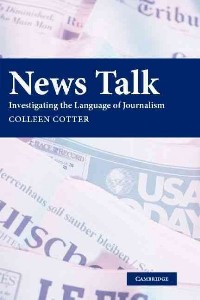
"Written by a former news reporter and editor, News Talk gives us an insider's view of the media, showing how journalists select and construct their news stories. Colleen Cotter goes behind the scenes, revealing how language is chosen and shaped by news staff into the stories we read and hear. Tracing news stories from start to finish, she shows how the actions of journalists and editors - and the limitations of news writing formulas - may distort a story that was prepared with the most determined effort to be fair and accurate. Using insights from both linguistics and journalism, News Talk is a remarkable picture of a hidden world and its working practices on both sides of the Atlantic. It will interest those involved in language study, media and communication studies and those who want to understand how media shape our language and our view of the world."--BOOK JACKET.
目录
Cover 1
Half-title 3
Title 5
Copyright 6
Dedication 7
Contents 9
Figures and Tables 12
Acknowledgements 13
Introduction 17
Goals and objectives 17
Approach 18
Data 21
Chapter organization 23
My background 26
Part I The process and practice of everyday journalism 29
1 An interactional and ethnographic approach to news media language 31
1.1 Contradictory perceptions about news media behaviors 33
1.2 The ethnographic advantage 35
1.2.1 Past approaches to news language 36
1.3 Exploring news and news language from the perspective of the practitioner 39
1.4 Influences on media language and discourse 40
1.5 Characteristics and tendencies of media language 42
1.6 Conclusion: process and practice \u2013 underexplored dimensions 45
2 Craft and community: Reading the ways of journalists 46
2.1 Articulating primary values 47
2.1.1 Discursive and ideological motivations 47
2.1.2 Privileging \u201ccraft\u201d 47
The craft principle 48
2.1.3 Intersecting communities 50
2.2 The craft ethos 52
2.2.1 Reporting \u2013 with respect to craft 54
2.2.2 Writing \u2013 with respect to craft 56
2.2.3 The \u201ccredibility\u201d dimension 58
2.3 The community factor 59
2.3.1 Professional responsibilities 59
2.3.2 Local values 61
2.3.3 The audience as co-participant: community of coverage 63
2.4 Conclusion: locating and understanding news priorities 63
3 The ways reporters learn to report and editors learn to edit 65
3.1 \u201cWays of speaking\u201d 66
3.1.1 Primary skills 66
3.1.2 Other journalistic competencies 67
3.1.3 Interactional skills 67
3.2 Socialization into news culture 68
3.2.1 News process 69
3.2.2 Roles and participant relationships 73
Complexities 74
3.2.3 Values: journalistic distinctions 75
Reporting priorities 75
Firewalls 76
Boundary blurring 77
3.3 Loci of learning 77
3.4 Conclusion: the apprentice model and journalistic practice 79
Part II Conceptualizing the news 81
4 News values and their significance in text and practice 83
4.1 Determining \u201cnewsworthiness\u201d 84
4.1.1 What are news values? 84
4.1.2 \u201cInsider\u201d coverage calculations 87
4.2 News values govern journalistic practice 88
4.2.1 Decision-making heuristic 88
4.2.2 News values and the news process 91
4.3 News judgment and \u201cinstinct\u201d 93
4.3.1 \u201cInstinct\u201d critiques 93
4.3.2 Discursive outcomes 95
4.3.3 The scope factor 96
4.4 Similarity and variation 98
4.4.1 News value universals 98
4.4.2 Interpretation and variation: in-group vs. out-group assessments 100
4.5 Conclusion: the role of news values 101
4.5.1 News values as \u201cemic\u201d coordinators 101
4.5.2 Summary: the importance of news values 103
5 The \u201cstory meeting\u201d: Deciding what\u2019s fit to print 104
5.1 What happens at a story meeting: The Oakland Tribune 106
5.1.1 How it works 107
5.1.2 Participant roles and newsroom hierarchy 108
5.1.3 Page One and story hierarchy (the news that\u2019s fit to print) 109
5.1.4 Key features and outcome of meetings 109
5.2 Role of news values in story meetings 110
5.2.1 How news values come into play 111
5.2.2 When news values conflict 112
5.3 Other news-community values 113
5.3.1 Text values (rhetorical skill) 114
5.3.2 Local priority emphasis (proximity) 114
5.4 Boundaries and norms of professional behavior 116
5.4.1 Politics 116
5.4.2 Popular culture 120
5.4.3 The Managing Editor as arbiter 121
5.5 Conclusion: news priorities in relation to practice 122
5.5.1 Co-occurring variables and boundaries 122
5.5.2 Locating news priorities 123
5.5.3 Summary: speech events in the newsroom 125
6 The interaction-based nature of journalism 126
6.1 Interaction through practice 127
6.1.1 Characterizing interaction 127
6.1.2 Attention to audience 129
6.1.3 Addressee-oriented goals of newswriting and reporting 134
6.2 The supremacy of the local 135
6.2.1 News values and \u201cthe local\u201d 136
6.2.2 \u201cLocal\u201d news in relation to news organization \u201cscope\u201d 137
Local stories 138
National stories 138
International stories 138
General news 138
6.2.3 Scope and variation 138
6.3 Loci of interaction 141
6.3.1 Interactivity vs. interaction 142
6.4 The pseudo-relationship between news media and community 144
6.4.1 The pseudo-event (Boorstin) and the pseudo-relationship (Cotter) 145
6.4.2 The pseudo-dyad and news language 146
6.5 Conclusion: identifying interaction in the journalistic context 147
Part III Constructing the story: texts and contexts 149
7 Story design and the dictates of the \u201clead\u201d 151
7.1 Principles of newswriting 152
7.1.1 Performance factors 154
7.2 Story design 155
7.2.1 Goals of design \u2013 attention and apprehension 155
7.2.2 The inverted pyramid 156
7.2.3 Background and context 156
7.2.4 Types of news stories 158
7.2.5 Attribution 161
7.2.6 Quotes 164
7.3 The lead 167
7.3.1 Importance and purpose of the lead 167
7.3.2 Types of lead 168
\u201cSecond-day leads\u201d and breaking news 173
Complex leads 175
Lead \u201cextensions\u201d 176
7.3.3 The well-formed lead 177
Maximal Relevance 178
Order 179
Good leads 179
7.3.4 Mastering techniques of lead writing 180
Clarity and detail 181
Ordering conventions 182
Length 182
\u201cBad ledes\u201d 183
7.4 Conclusion: the importance of craft 185
8 \u201cBoilerplate\u201d: Simplifying stories, anchoring text, altering meaning 187
8.1 News discourse rules and boilerplate 188
8.1.1 Simplification and distance 189
8.1.2 Providing background 191
8.2 Features of boilerplate 192
8.3 Implications of boilerplate 196
8.3.1 Given and new status 196
8.3.2 The neutral authority model 197
8.3.3 Contingencies in the story process 197
8.3.4 Partial representation of an event 198
8.3.5 Evaluation in \u201cneutral\u201d text 200
8.4 Conclusion: responsibility and \u201cneutral\u201d text production 201
9 Style and standardization in news language 203
9.1 Background: language standardization 204
9.2 Language standardization in the news context 206
9.2.1 Journalistic and discursive standardization 208
9.3 Journalists and language: complaints, values, and injunctions 210
9.3.1 The \u201ccomplaint tradition\u201d 210
9.3.2 News language and craft ideologies 211
9.3.3 Journalistic language values: prescribing precision 212
9.3.4 Complaints about usage from the public 214
9.4 Changes and innovation in news style 217
9.4.1 Genre innovations: the NPR case 218
9.4.2 The standard across radio contexts 219
Commercial radio \u2013 centralization requirements 219
Raidi贸 na Life \u2013 target ideal 221
How the standard prevails 224
9.4.3 Communicative need vs. prescriptive requirement (connectives) 224
9.5 Conclusion: language awareness and journalistic identity 227
Part IV Decoding the discourse 231
10 The impact of the news process on media language 233
10.1 Delivering the news 233
10.1.1 Arranging the news 234
10.1.2 News genres and iterativity 234
10.1.3 Real-world constraints 234
10.2 Coherence of the text 235
10.3 Linguists as \u201cexperts\u201d in news stories 236
10.3.1 Journalistic skepticism and discursive distance 237
10.3.2 Levels of skepticism and reference 240
10.3.3 Trying to co-function as a linguist and journalist 243
10.3.4 (De)constructing expertise 244
Conclusion and key points 246
Elements of practice 247
Reporters as writers 248
News language and linguistics 248
Future research 248
Final words \u2013 for now 249
Epilogue 251
Appendices 253
Appendix 1: Story samples 255
A. TYPICAL NEWS STORY DESIGN 255
B. BRITE 257
C. COLUMN 259
D. FEATURE STORY 260
Appendix 2: Outline guide for the analysis of news media language 263
1. USAGE NORMS AND EXPECTATIONS 263
2. USAGE AND SOCIAL EVALUATION (SOCIAL FACTORS) 263
3. USAGE AT THE DISCOURSE LEVEL (STRUCTURAL FACTORS) 264
4. THE EFFECTS OF GENRE 264
5. THE AUDIENCE 264
6. THE WAYS JOURNALISTS WORK 264
7. PRESCRIPTION AND STANDARDIZATION 265
8. VARIATION IN MEDIA LANGUAGE 265
9. THE \u201cETHNOGRAPHIC ADVANTAGE\u201d 265
10. NEWS MEDIA DISCOURSE 265
Appendix 3: Society of Professional Journalists Code of Ethics 267
Glossary of news and linguistic terms (a supplement to discussion within the chapters) 268
NEWSROOM TERMINOLOGY 268
LINGUISTIC TERMS FOR JOURNALISTS AND OTHERS 270
References 275
Index 288
Half-title 3
Title 5
Copyright 6
Dedication 7
Contents 9
Figures and Tables 12
Acknowledgements 13
Introduction 17
Goals and objectives 17
Approach 18
Data 21
Chapter organization 23
My background 26
Part I The process and practice of everyday journalism 29
1 An interactional and ethnographic approach to news media language 31
1.1 Contradictory perceptions about news media behaviors 33
1.2 The ethnographic advantage 35
1.2.1 Past approaches to news language 36
1.3 Exploring news and news language from the perspective of the practitioner 39
1.4 Influences on media language and discourse 40
1.5 Characteristics and tendencies of media language 42
1.6 Conclusion: process and practice \u2013 underexplored dimensions 45
2 Craft and community: Reading the ways of journalists 46
2.1 Articulating primary values 47
2.1.1 Discursive and ideological motivations 47
2.1.2 Privileging \u201ccraft\u201d 47
The craft principle 48
2.1.3 Intersecting communities 50
2.2 The craft ethos 52
2.2.1 Reporting \u2013 with respect to craft 54
2.2.2 Writing \u2013 with respect to craft 56
2.2.3 The \u201ccredibility\u201d dimension 58
2.3 The community factor 59
2.3.1 Professional responsibilities 59
2.3.2 Local values 61
2.3.3 The audience as co-participant: community of coverage 63
2.4 Conclusion: locating and understanding news priorities 63
3 The ways reporters learn to report and editors learn to edit 65
3.1 \u201cWays of speaking\u201d 66
3.1.1 Primary skills 66
3.1.2 Other journalistic competencies 67
3.1.3 Interactional skills 67
3.2 Socialization into news culture 68
3.2.1 News process 69
3.2.2 Roles and participant relationships 73
Complexities 74
3.2.3 Values: journalistic distinctions 75
Reporting priorities 75
Firewalls 76
Boundary blurring 77
3.3 Loci of learning 77
3.4 Conclusion: the apprentice model and journalistic practice 79
Part II Conceptualizing the news 81
4 News values and their significance in text and practice 83
4.1 Determining \u201cnewsworthiness\u201d 84
4.1.1 What are news values? 84
4.1.2 \u201cInsider\u201d coverage calculations 87
4.2 News values govern journalistic practice 88
4.2.1 Decision-making heuristic 88
4.2.2 News values and the news process 91
4.3 News judgment and \u201cinstinct\u201d 93
4.3.1 \u201cInstinct\u201d critiques 93
4.3.2 Discursive outcomes 95
4.3.3 The scope factor 96
4.4 Similarity and variation 98
4.4.1 News value universals 98
4.4.2 Interpretation and variation: in-group vs. out-group assessments 100
4.5 Conclusion: the role of news values 101
4.5.1 News values as \u201cemic\u201d coordinators 101
4.5.2 Summary: the importance of news values 103
5 The \u201cstory meeting\u201d: Deciding what\u2019s fit to print 104
5.1 What happens at a story meeting: The Oakland Tribune 106
5.1.1 How it works 107
5.1.2 Participant roles and newsroom hierarchy 108
5.1.3 Page One and story hierarchy (the news that\u2019s fit to print) 109
5.1.4 Key features and outcome of meetings 109
5.2 Role of news values in story meetings 110
5.2.1 How news values come into play 111
5.2.2 When news values conflict 112
5.3 Other news-community values 113
5.3.1 Text values (rhetorical skill) 114
5.3.2 Local priority emphasis (proximity) 114
5.4 Boundaries and norms of professional behavior 116
5.4.1 Politics 116
5.4.2 Popular culture 120
5.4.3 The Managing Editor as arbiter 121
5.5 Conclusion: news priorities in relation to practice 122
5.5.1 Co-occurring variables and boundaries 122
5.5.2 Locating news priorities 123
5.5.3 Summary: speech events in the newsroom 125
6 The interaction-based nature of journalism 126
6.1 Interaction through practice 127
6.1.1 Characterizing interaction 127
6.1.2 Attention to audience 129
6.1.3 Addressee-oriented goals of newswriting and reporting 134
6.2 The supremacy of the local 135
6.2.1 News values and \u201cthe local\u201d 136
6.2.2 \u201cLocal\u201d news in relation to news organization \u201cscope\u201d 137
Local stories 138
National stories 138
International stories 138
General news 138
6.2.3 Scope and variation 138
6.3 Loci of interaction 141
6.3.1 Interactivity vs. interaction 142
6.4 The pseudo-relationship between news media and community 144
6.4.1 The pseudo-event (Boorstin) and the pseudo-relationship (Cotter) 145
6.4.2 The pseudo-dyad and news language 146
6.5 Conclusion: identifying interaction in the journalistic context 147
Part III Constructing the story: texts and contexts 149
7 Story design and the dictates of the \u201clead\u201d 151
7.1 Principles of newswriting 152
7.1.1 Performance factors 154
7.2 Story design 155
7.2.1 Goals of design \u2013 attention and apprehension 155
7.2.2 The inverted pyramid 156
7.2.3 Background and context 156
7.2.4 Types of news stories 158
7.2.5 Attribution 161
7.2.6 Quotes 164
7.3 The lead 167
7.3.1 Importance and purpose of the lead 167
7.3.2 Types of lead 168
\u201cSecond-day leads\u201d and breaking news 173
Complex leads 175
Lead \u201cextensions\u201d 176
7.3.3 The well-formed lead 177
Maximal Relevance 178
Order 179
Good leads 179
7.3.4 Mastering techniques of lead writing 180
Clarity and detail 181
Ordering conventions 182
Length 182
\u201cBad ledes\u201d 183
7.4 Conclusion: the importance of craft 185
8 \u201cBoilerplate\u201d: Simplifying stories, anchoring text, altering meaning 187
8.1 News discourse rules and boilerplate 188
8.1.1 Simplification and distance 189
8.1.2 Providing background 191
8.2 Features of boilerplate 192
8.3 Implications of boilerplate 196
8.3.1 Given and new status 196
8.3.2 The neutral authority model 197
8.3.3 Contingencies in the story process 197
8.3.4 Partial representation of an event 198
8.3.5 Evaluation in \u201cneutral\u201d text 200
8.4 Conclusion: responsibility and \u201cneutral\u201d text production 201
9 Style and standardization in news language 203
9.1 Background: language standardization 204
9.2 Language standardization in the news context 206
9.2.1 Journalistic and discursive standardization 208
9.3 Journalists and language: complaints, values, and injunctions 210
9.3.1 The \u201ccomplaint tradition\u201d 210
9.3.2 News language and craft ideologies 211
9.3.3 Journalistic language values: prescribing precision 212
9.3.4 Complaints about usage from the public 214
9.4 Changes and innovation in news style 217
9.4.1 Genre innovations: the NPR case 218
9.4.2 The standard across radio contexts 219
Commercial radio \u2013 centralization requirements 219
Raidi贸 na Life \u2013 target ideal 221
How the standard prevails 224
9.4.3 Communicative need vs. prescriptive requirement (connectives) 224
9.5 Conclusion: language awareness and journalistic identity 227
Part IV Decoding the discourse 231
10 The impact of the news process on media language 233
10.1 Delivering the news 233
10.1.1 Arranging the news 234
10.1.2 News genres and iterativity 234
10.1.3 Real-world constraints 234
10.2 Coherence of the text 235
10.3 Linguists as \u201cexperts\u201d in news stories 236
10.3.1 Journalistic skepticism and discursive distance 237
10.3.2 Levels of skepticism and reference 240
10.3.3 Trying to co-function as a linguist and journalist 243
10.3.4 (De)constructing expertise 244
Conclusion and key points 246
Elements of practice 247
Reporters as writers 248
News language and linguistics 248
Future research 248
Final words \u2013 for now 249
Epilogue 251
Appendices 253
Appendix 1: Story samples 255
A. TYPICAL NEWS STORY DESIGN 255
B. BRITE 257
C. COLUMN 259
D. FEATURE STORY 260
Appendix 2: Outline guide for the analysis of news media language 263
1. USAGE NORMS AND EXPECTATIONS 263
2. USAGE AND SOCIAL EVALUATION (SOCIAL FACTORS) 263
3. USAGE AT THE DISCOURSE LEVEL (STRUCTURAL FACTORS) 264
4. THE EFFECTS OF GENRE 264
5. THE AUDIENCE 264
6. THE WAYS JOURNALISTS WORK 264
7. PRESCRIPTION AND STANDARDIZATION 265
8. VARIATION IN MEDIA LANGUAGE 265
9. THE \u201cETHNOGRAPHIC ADVANTAGE\u201d 265
10. NEWS MEDIA DISCOURSE 265
Appendix 3: Society of Professional Journalists Code of Ethics 267
Glossary of news and linguistic terms (a supplement to discussion within the chapters) 268
NEWSROOM TERMINOLOGY 268
LINGUISTIC TERMS FOR JOURNALISTS AND OTHERS 270
References 275
Index 288
- 名称
- 类型
- 大小
光盘服务联系方式: 020-38250260 客服QQ:4006604884
云图客服:
用户发送的提问,这种方式就需要有位在线客服来回答用户的问题,这种 就属于对话式的,问题是这种提问是否需要用户登录才能提问
Video Player
×
Audio Player
×
pdf Player
×
