

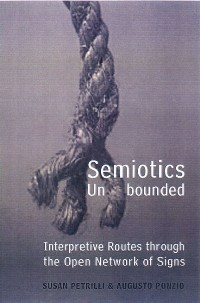
Semiotics unbounded : interpretive routes through the open network of signs /
副标题:无
作 者:Susan Petrilli and Augusto Ponzio.
分类号:
ISBN:9780802087652
微信扫一扫,移动浏览光盘
简介
The more human knowledge increases, the more signs grow and, with this expansion, the more the boundaries of the science that studies signs also grows. In "Semiotics Unbounded," Susan Petrilli and Augusto Ponzio explain the explosion of the sign network in the era of global communication and discuss the important theoretical responses offered by semiotics. Providing a much-needed introductory guide to the subject, Petrilli and Ponzio explore the ever-growing frontiers of semiotics through the thought of prominent sign scholars such as Charles Peirce, Victoria Welby, Mikhail Bakhtin, Charles Morris, and Thomas Sebeok.In an era of global communication, a global approach is necessary, and what may seem to be the whole, is only a part ? a view being at once globalizing and open. Each and every sign is never self-sufficient and closed but exists always in a relation of otherness. This is true of the signs forming animals and human beings, individuals and communities, and involves the implication of all living beings in the life of all others. "Semiotics Unbounded" offers a new and original survey of the science of signs, evaluating it in relation to the problems of our time, not only of a scientific order, but also the problems concerning everyday social life.
目录
Table Of Contents:
Preface xvii
Introduction: An Excursion into Semiotics 3(1)
Two Meanings of Semiotics 3(3)
Protagonist: The Sign 6(2)
Stooge: The Interpretant 8(2)
Pragmatism as Pragmaticism 10(2)
The Verbal Sign's Influence on Semiotics 12(2)
Signification and Significance 14(2)
Signification and Denotatum 16(2)
Beyond the Verbal Sign Paradigm 18(1)
Subject and Alterity 19(3)
Word and Dialogue 22(3)
Dialogue and Inference 25(3)
Inferences and Categories: Semiotics, Logic, Ontology 28(5)
PART ONE: SEMIOTICS AND SEMIOTICIANS 33(308)
An Itinerary: From Peirce to Others 35(45)
Problems on Peirce's Desk 35(12)
Semiosis, Interpretation, and the Quasi-Interpreter 35(3)
Sign Displacement, Identity, and Otherness 38(2)
Knowledge in the Gnoseological Sense, but also as Responsible Awareness 40(1)
Interpretation and Representation 41(4)
The General Character of Peirce's Sign Model 45(2)
More Problems in Focus: Subjects, Bodies, and Signs 47(12)
The Dialogic Self 47(3)
Personal Identity and the Doctrine of Synechism 50(2)
Consciousness, Body, World 52(5)
Private Worlds and Public Worlds 57(1)
Habit and the Play of Musement 58(1)
Neglected but Foundational Aspects of Peirce's Semiotics 59(21)
Three Evolutionary Modes in the Cosmos 60(2)
Axiological Problems as Semiotic Problems 62(2)
Love and Logic 64(6)
Agapic Comprehension and Welby's Mother-Sense 70(4)
Looking from Peirce's Perspective 74(5)
Biographical Note 79(1)
About Welby 80(58)
Why `Significs'? A Contribution to Theory of Meaning, and More 80(10)
A Lady Significian 81(2)
Three Levels of Meaning 83(4)
Significance, Translation, Interpretation 87(1)
A Method in Mental Exercise 88(2)
Critique of `Plain Meaning' 90(1)
Departure: Exegesis and Holy Scripture 90(12)
The Problem of Meaning and Interpretation of the Holy Scriptures 91(1)
For a Dialogue between Religion and Science, a Question of Method 92(3)
Light, Love, and Progress in Knowledge 95(4)
From Exegesis to the Translative Method 99(3)
Reading Significs as `Biosensifics' 102(36)
Sense and Its Organic Basis 102(3)
The Plasticity of Language and Evolutionary Development of Consciousness 105(4)
Signs and Evolution of Life: A Research Program 109(9)
Organism and Environment in Cultural Evolution 118(5)
The Biological Basis of Signifying Processes 123(11)
Biographical Note 134(4)
About Bakhtin 138(29)
Philosophy of Language as Critique of Dialogic Reason 138(15)
Philosophy of Literature and Philosophy of Language 138(2)
Semiotics and Philosophy of Language 140(1)
Bakhtin's Sign Model 141(3)
Bakhtinian Dialogue 144(4)
Bakhtinian Dialogism and Biosemiotics 148(3)
For a Critique of Dialogic Reason 151(2)
An Interdisciplinary Perspective and Detotalizing Method 153(14)
From the Boundaries of Art Criticism 154(3)
Signs and Signals 157(1)
On Ideology 158(1)
The Unconscious and Ideology 159(3)
The Question of Values 162(3)
A Dialogic Method 165(1)
Biographical Note 166(1)
About Morris 167(36)
Behaviouristic Semiotics and Pragmaticist Semiotics 167(9)
Sidelights 167(2)
Morris and Peirce 169(2)
Returning to Peirce 171(1)
From Scientific Empiricism Onward 172(1)
Morris's Behaviouristics 173(3)
Semiotics and Biology 176(10)
Criteria, not Definitions 176(3)
Biological Terminology to Talk about Signs 179(2)
Biology and Symbolism at the Origin of Morris's Research 181(1)
Behaviour Involving Symbols 182(2)
General Linguistic Symbols and Verbal Linguistic Symbols 184(2)
Sign, Dimensions of Semiosis, Denotatum, and Language 186(17)
The Most Recalcitrant Term: Sign 186(5)
Misunderstandings over the Dimensions of Semiosis 191(2)
Designatum and Denotatum 193(2)
Language and General Linguistics 195(5)
Human and Non-Human Signs 200(1)
Biographical Notes 201(2)
About Sebeok 203(29)
Modelling Systems Theory and Global Semiotics 203(8)
Semiosic Phenomena as Modelling Processes 203(2)
Critique of the Pars Pro Toto Error 205(1)
Semiosic Boundaries 206(2)
Sebeok's Semiosic Universe 208(1)
Global Semiotics 209(2)
Semiotics and Semiosis 211(7)
Three Aspects of the Unifying Function of Semiotics 211(2)
Semiosis and Semiotics: `Semiotics,' Another Meaning 213(1)
To Live and to Lie 214(1)
Origin of Language and Speech 215(1)
Iconicity and Language 216(2)
Sebeok's Works and the Destiny of Semiosis 218(5)
A Tetralogy 218(1)
Semiotics as a Doctrine of Signs and Metasemiosis 219(1)
From the Non-Human Interpreter Sign to the Human Interpreter Verb 220(1)
European and American Semiotics: A Dialogue 221(1)
The Destiny of Semiosis after Life 222(1)
Sebeok's Semiotics and Education 223(9)
The Role of Signs in the Educational Process 223(1)
Implications of Sebeok's Work for Education 224(2)
Education to Mutual Adjustment of Language and Speech 226(1)
Semiotics and Foresight of `Proximal Development' 227(2)
Global Semiotics and Education to Responsibility for Life 229(1)
Biographical Notes 230(2)
About Rossi-Landi 232(66)
Rossi-Landi's Philosophy of Language 233(23)
His Semiotic Studies 233(2)
Common Speech Theory 235(6)
Language as the A Priori 241(4)
Language as Work and Trade 245(3)
Language as a Human Prerogative 248(2)
Linguistic Work and Linguistic Use 250(1)
On the Homology between Verbal and Non-Verbal Human Communication 251(3)
Ideology and Linguistic Alienation 254(1)
Social Reproduction 255(1)
On the Tracks of a Multiform Research Itinerary 256(13)
From Common Speech to Common Semiosis 256(3)
For a `Homological Method' 259(1)
Morris in Rossi-Landi's Interpretation 260(4)
The Correspondence between Morris and Rossi-Landi 264(4)
On Sign and Non-Sign Materiality 268(1)
Communication, Mass Media, and Critique of Ideology 269(14)
The Homination Process in Relation to Linguistic and Non-Linguistic Production 269(2)
For a Critique of Linguistic and Ideological Alienation in a Semiotical Key 271(5)
Social Planning and Multimedial Communication 276(3)
Cultural Capital and Social Alienation 279(2)
The Role of Signs in Neocapitalist Society 281(2)
Rossi-Landi between `Ideologie' and `Scienze Umane' 283(15)
Doctrine of Ideologies and Semiotics of Social Communication Programs 283(3)
The Pars Pro Toto Fallacy 286(2)
Ideology and False Consciousness 288(3)
Semiotics and Critique of the Humanities 291(1)
Research and Disalienating Praxis 292(2)
The New Concept of Work in Neocapitalist Society 294(1)
Further Developments in Rossi-Landi's Meditations on Ideology 295(2)
Biographical Note 297(1)
About Eco 298(43)
From Decodification to Interpretation 299(25)
Eco's Contribution to the Transition from Decodification Semiotics to Interpretation Semiotics in Italy 299(5)
Peirce in Italy 304(6)
Aporias in the Effort to Solve the Opposition between Communication and Signification 310(4)
Meaning and Referent: Aporias in the Effort to Solve the Opposition between Referentialism and Non-Referentialism in Semiotics 314(6)
Sign Production and Ideology 320(2)
Extending the Boundaries of Semiotics 322(2)
Interpretation and Responsive Understanding 324(17)
On Sign Models between Semiotics and Philosophy of Language 324(5)
Interpretation and Dialogism in the Study of Signs 329(11)
Biographical Note 340(1)
PART TWO: MODELLING, WRITING, AND OTHERNESS 341(88)
Modelling and Otherness 343(34)
Modelling, Communication, and Dialogism 343(13)
Model and Modelling 343(1)
Reformulating Thure von Uexkull's Typology of Semiosis 344(1)
From `Substitution' to `Interpretation' 345(2)
Centrality of the Interpretant in the `Semiosic Matrix' 347(2)
The Dialogic Nature of Sign and Semiosis 349(1)
Dialogue and the `Functional Cycle' 350(2)
Dialogism and Biosemiosis 352(1)
The Biological Basis of Bakhtinian Dialogue and the `Great Experience' 353(1)
Rabelais's World as the World's Biosemiotic Consciousness 354(2)
Identity, Otherness, and Primal Sense as a Modelling Device 356(16)
Primal Sense or Mother-Sense 356(2)
Primal Sense, Modelling, and Creativity 358(6)
Primal Sense, Otherness, and Criticism 364(2)
Identity, Primal Sense, and the Logic of Love 366(3)
`Ident' as Otherness, Intercorporeity, and Dialogism 369(3)
Writing as a Modelling Device 372(5)
Writing and Transcription 372(2)
Writing and Language 374(1)
Literary Writing and the Creativity of Language 375(2)
Writing and Dialogue 377(52)
Dialogue, Otherness, and Writing 377(19)
Dialogue 377(3)
Otherness, Dialogue, Intercorporeity 380(4)
Dialogism, Otherness, and Signs 384(4)
Writing 388(2)
Orality, Writing, and Otherness 390(6)
Dialogue and Carnivalized Writing 396(4)
Different Degrees of Dialogism 396(1)
The `Time of Festivity' and the `Great Time' of Writing 397(1)
The Carnivalesque in Writing 398(1)
Writing in the Bakhtinian Perspective 399(1)
Dialogue and Polyphony in the Writing of Novels and Drama 400(15)
Representation and Depiction 400(3)
The Author's Word and Polyphony in the Novel 403(3)
Dialogue and the Body 406(5)
Dramatization and Polyphony in the Word of Novel and Drama 411(4)
Storytelling in the Era of Global Communication: Black Writing
Oraliture 415(14)
Two Different Types of Communication 415(2)
`Oraliture' and Writing 417(1)
Texts That Are Distant From Each Other 418(3)
Brer Rabbit Stories 421(3)
The Novel and the Genres of African Oral Literature 424(4)
Biographical Note 428(1)
PART THREE: PREDICATIVE JUDGMENT, ARGUMENTATION, AND COMMUNICATION 429(130)
Understanding and Misunderstanding 431(47)
Semiogenealogy of Predicative Judgment 431(27)
Semiotics as Constitutive Phenomenology 431(3)
Four Different Aspects of the Phenomenology of the Object 434(3)
Semiotics as Transcendental Logic: The Question of the Ground 437(3)
Similarity, the Ground, and the Immediate Object 440(2)
Similarity and the Image 442(3)
Genesis of Predicative Judgment 445(4)
Metalinguistics and the Precategorial Level 449(2)
The `I-do' 451(4)
`As if' and Predication as Acting 455(3)
Objective Misunderstanding and Mystifications of Language 458(20)
The `Maladies of Language' 458(1)
Ambiguity, `Precision,' and the `Panacea of Definition' 459(4)
Equivocation and Figurative Language 463(3)
The Fallacy of Invariable `Plain, Obvious, Common Sense Meaning' 466(3)
The Fallacy of `Universal Language': Common Speech 469(2)
Critical Commonsensism and Pragmaticism 471(2)
Generality and Vagueness 473(5)
Closed Community and Open Community in Global Communication 478(57)
Logic, Argumentation and Dialogue in Global Communication 478(13)
Critique of the Reason of Global Communication 478(2)
Dialogue, Theory of Semiosis, and Theory of Argumentation 480(4)
Signs of Rhetorical Tricks 484(2)
For a Critique of Television Communication in a Semiotical Key 486(3)
Dialogue and Lying 489(1)
Television and Keeping a Good Conscience 490(1)
Argumentative Logic at the Helsinki Conference and Communication--Production Ideology 491(11)
Communication--Production and War 491(3)
A Semiotic Analysis of the Helsinki Final Act 494(1)
Argumentative Loci and Weak Points in the Helsinki Final Act 494(2)
`Nation' as Identity and as Difference 496(2)
Mutual Recognition Based on Convention and Assimilating the Other 498(1)
A Third Way of Understanding the Relations among Nation-States 499(3)
The Sign Machine: Linguistic Work and Global Communication 502(15)
Semiosis, Communication, and Machines 503(2)
A Machine Capable of Semiotics 505(2)
Human-Machine Interactivity 507(1)
Human Intelligence as a Resource 508(3)
The Intelligent Machine, Linguistic Work, and the Work Market 511(4)
Language, Modelling, Alterity, and the Open Community 515(2)
Otherness and Communication: From the Closed Community to the Open Community 517(18)
A Narrow Concept of Communication 517(1)
Being and Communication 518(2)
Persistence in Communication--Production as Persistence in the Same Social System 520(1)
Ontology of Communication--Being 521(2)
Communication and Language 523(2)
The Communication--Ontology Relation in Today's Global Communication--Production System 525(2)
Beyond the Being of Communication 527(1)
Sociality as Closed Community and Indifferent Labour 528(3)
Communion, or Sociality Regulated by Otherness 531(2)
Biographical Notes 533(2)
Global Communication, Biosemiotics, and Semioethics 535(24)
Semioethics, Community, and Otherness 535(15)
Global Communication and Global Semiotics 536(2)
Responsibility and Semioethics 538(2)
Identity and Alterity: On Subjectivity and Reasonableness 540(5)
Signs of Humanity and Humanity of Signs 545(4)
Semiotics as an Attitude and the Critical Work of Semioethics 549(1)
Bioethics, Semiotics of Life, and Global Communication 550(9)
Bioethics and Global Semiotics 550(2)
Being and Sign: A Foundational and Critical Approach to Bioethics 552(2)
Bioethics and Global Communication 554(5)
Glossary 559(6)
Bibliography 565(48)
Index 613
Preface xvii
Introduction: An Excursion into Semiotics 3(1)
Two Meanings of Semiotics 3(3)
Protagonist: The Sign 6(2)
Stooge: The Interpretant 8(2)
Pragmatism as Pragmaticism 10(2)
The Verbal Sign's Influence on Semiotics 12(2)
Signification and Significance 14(2)
Signification and Denotatum 16(2)
Beyond the Verbal Sign Paradigm 18(1)
Subject and Alterity 19(3)
Word and Dialogue 22(3)
Dialogue and Inference 25(3)
Inferences and Categories: Semiotics, Logic, Ontology 28(5)
PART ONE: SEMIOTICS AND SEMIOTICIANS 33(308)
An Itinerary: From Peirce to Others 35(45)
Problems on Peirce's Desk 35(12)
Semiosis, Interpretation, and the Quasi-Interpreter 35(3)
Sign Displacement, Identity, and Otherness 38(2)
Knowledge in the Gnoseological Sense, but also as Responsible Awareness 40(1)
Interpretation and Representation 41(4)
The General Character of Peirce's Sign Model 45(2)
More Problems in Focus: Subjects, Bodies, and Signs 47(12)
The Dialogic Self 47(3)
Personal Identity and the Doctrine of Synechism 50(2)
Consciousness, Body, World 52(5)
Private Worlds and Public Worlds 57(1)
Habit and the Play of Musement 58(1)
Neglected but Foundational Aspects of Peirce's Semiotics 59(21)
Three Evolutionary Modes in the Cosmos 60(2)
Axiological Problems as Semiotic Problems 62(2)
Love and Logic 64(6)
Agapic Comprehension and Welby's Mother-Sense 70(4)
Looking from Peirce's Perspective 74(5)
Biographical Note 79(1)
About Welby 80(58)
Why `Significs'? A Contribution to Theory of Meaning, and More 80(10)
A Lady Significian 81(2)
Three Levels of Meaning 83(4)
Significance, Translation, Interpretation 87(1)
A Method in Mental Exercise 88(2)
Critique of `Plain Meaning' 90(1)
Departure: Exegesis and Holy Scripture 90(12)
The Problem of Meaning and Interpretation of the Holy Scriptures 91(1)
For a Dialogue between Religion and Science, a Question of Method 92(3)
Light, Love, and Progress in Knowledge 95(4)
From Exegesis to the Translative Method 99(3)
Reading Significs as `Biosensifics' 102(36)
Sense and Its Organic Basis 102(3)
The Plasticity of Language and Evolutionary Development of Consciousness 105(4)
Signs and Evolution of Life: A Research Program 109(9)
Organism and Environment in Cultural Evolution 118(5)
The Biological Basis of Signifying Processes 123(11)
Biographical Note 134(4)
About Bakhtin 138(29)
Philosophy of Language as Critique of Dialogic Reason 138(15)
Philosophy of Literature and Philosophy of Language 138(2)
Semiotics and Philosophy of Language 140(1)
Bakhtin's Sign Model 141(3)
Bakhtinian Dialogue 144(4)
Bakhtinian Dialogism and Biosemiotics 148(3)
For a Critique of Dialogic Reason 151(2)
An Interdisciplinary Perspective and Detotalizing Method 153(14)
From the Boundaries of Art Criticism 154(3)
Signs and Signals 157(1)
On Ideology 158(1)
The Unconscious and Ideology 159(3)
The Question of Values 162(3)
A Dialogic Method 165(1)
Biographical Note 166(1)
About Morris 167(36)
Behaviouristic Semiotics and Pragmaticist Semiotics 167(9)
Sidelights 167(2)
Morris and Peirce 169(2)
Returning to Peirce 171(1)
From Scientific Empiricism Onward 172(1)
Morris's Behaviouristics 173(3)
Semiotics and Biology 176(10)
Criteria, not Definitions 176(3)
Biological Terminology to Talk about Signs 179(2)
Biology and Symbolism at the Origin of Morris's Research 181(1)
Behaviour Involving Symbols 182(2)
General Linguistic Symbols and Verbal Linguistic Symbols 184(2)
Sign, Dimensions of Semiosis, Denotatum, and Language 186(17)
The Most Recalcitrant Term: Sign 186(5)
Misunderstandings over the Dimensions of Semiosis 191(2)
Designatum and Denotatum 193(2)
Language and General Linguistics 195(5)
Human and Non-Human Signs 200(1)
Biographical Notes 201(2)
About Sebeok 203(29)
Modelling Systems Theory and Global Semiotics 203(8)
Semiosic Phenomena as Modelling Processes 203(2)
Critique of the Pars Pro Toto Error 205(1)
Semiosic Boundaries 206(2)
Sebeok's Semiosic Universe 208(1)
Global Semiotics 209(2)
Semiotics and Semiosis 211(7)
Three Aspects of the Unifying Function of Semiotics 211(2)
Semiosis and Semiotics: `Semiotics,' Another Meaning 213(1)
To Live and to Lie 214(1)
Origin of Language and Speech 215(1)
Iconicity and Language 216(2)
Sebeok's Works and the Destiny of Semiosis 218(5)
A Tetralogy 218(1)
Semiotics as a Doctrine of Signs and Metasemiosis 219(1)
From the Non-Human Interpreter Sign to the Human Interpreter Verb 220(1)
European and American Semiotics: A Dialogue 221(1)
The Destiny of Semiosis after Life 222(1)
Sebeok's Semiotics and Education 223(9)
The Role of Signs in the Educational Process 223(1)
Implications of Sebeok's Work for Education 224(2)
Education to Mutual Adjustment of Language and Speech 226(1)
Semiotics and Foresight of `Proximal Development' 227(2)
Global Semiotics and Education to Responsibility for Life 229(1)
Biographical Notes 230(2)
About Rossi-Landi 232(66)
Rossi-Landi's Philosophy of Language 233(23)
His Semiotic Studies 233(2)
Common Speech Theory 235(6)
Language as the A Priori 241(4)
Language as Work and Trade 245(3)
Language as a Human Prerogative 248(2)
Linguistic Work and Linguistic Use 250(1)
On the Homology between Verbal and Non-Verbal Human Communication 251(3)
Ideology and Linguistic Alienation 254(1)
Social Reproduction 255(1)
On the Tracks of a Multiform Research Itinerary 256(13)
From Common Speech to Common Semiosis 256(3)
For a `Homological Method' 259(1)
Morris in Rossi-Landi's Interpretation 260(4)
The Correspondence between Morris and Rossi-Landi 264(4)
On Sign and Non-Sign Materiality 268(1)
Communication, Mass Media, and Critique of Ideology 269(14)
The Homination Process in Relation to Linguistic and Non-Linguistic Production 269(2)
For a Critique of Linguistic and Ideological Alienation in a Semiotical Key 271(5)
Social Planning and Multimedial Communication 276(3)
Cultural Capital and Social Alienation 279(2)
The Role of Signs in Neocapitalist Society 281(2)
Rossi-Landi between `Ideologie' and `Scienze Umane' 283(15)
Doctrine of Ideologies and Semiotics of Social Communication Programs 283(3)
The Pars Pro Toto Fallacy 286(2)
Ideology and False Consciousness 288(3)
Semiotics and Critique of the Humanities 291(1)
Research and Disalienating Praxis 292(2)
The New Concept of Work in Neocapitalist Society 294(1)
Further Developments in Rossi-Landi's Meditations on Ideology 295(2)
Biographical Note 297(1)
About Eco 298(43)
From Decodification to Interpretation 299(25)
Eco's Contribution to the Transition from Decodification Semiotics to Interpretation Semiotics in Italy 299(5)
Peirce in Italy 304(6)
Aporias in the Effort to Solve the Opposition between Communication and Signification 310(4)
Meaning and Referent: Aporias in the Effort to Solve the Opposition between Referentialism and Non-Referentialism in Semiotics 314(6)
Sign Production and Ideology 320(2)
Extending the Boundaries of Semiotics 322(2)
Interpretation and Responsive Understanding 324(17)
On Sign Models between Semiotics and Philosophy of Language 324(5)
Interpretation and Dialogism in the Study of Signs 329(11)
Biographical Note 340(1)
PART TWO: MODELLING, WRITING, AND OTHERNESS 341(88)
Modelling and Otherness 343(34)
Modelling, Communication, and Dialogism 343(13)
Model and Modelling 343(1)
Reformulating Thure von Uexkull's Typology of Semiosis 344(1)
From `Substitution' to `Interpretation' 345(2)
Centrality of the Interpretant in the `Semiosic Matrix' 347(2)
The Dialogic Nature of Sign and Semiosis 349(1)
Dialogue and the `Functional Cycle' 350(2)
Dialogism and Biosemiosis 352(1)
The Biological Basis of Bakhtinian Dialogue and the `Great Experience' 353(1)
Rabelais's World as the World's Biosemiotic Consciousness 354(2)
Identity, Otherness, and Primal Sense as a Modelling Device 356(16)
Primal Sense or Mother-Sense 356(2)
Primal Sense, Modelling, and Creativity 358(6)
Primal Sense, Otherness, and Criticism 364(2)
Identity, Primal Sense, and the Logic of Love 366(3)
`Ident' as Otherness, Intercorporeity, and Dialogism 369(3)
Writing as a Modelling Device 372(5)
Writing and Transcription 372(2)
Writing and Language 374(1)
Literary Writing and the Creativity of Language 375(2)
Writing and Dialogue 377(52)
Dialogue, Otherness, and Writing 377(19)
Dialogue 377(3)
Otherness, Dialogue, Intercorporeity 380(4)
Dialogism, Otherness, and Signs 384(4)
Writing 388(2)
Orality, Writing, and Otherness 390(6)
Dialogue and Carnivalized Writing 396(4)
Different Degrees of Dialogism 396(1)
The `Time of Festivity' and the `Great Time' of Writing 397(1)
The Carnivalesque in Writing 398(1)
Writing in the Bakhtinian Perspective 399(1)
Dialogue and Polyphony in the Writing of Novels and Drama 400(15)
Representation and Depiction 400(3)
The Author's Word and Polyphony in the Novel 403(3)
Dialogue and the Body 406(5)
Dramatization and Polyphony in the Word of Novel and Drama 411(4)
Storytelling in the Era of Global Communication: Black Writing
Oraliture 415(14)
Two Different Types of Communication 415(2)
`Oraliture' and Writing 417(1)
Texts That Are Distant From Each Other 418(3)
Brer Rabbit Stories 421(3)
The Novel and the Genres of African Oral Literature 424(4)
Biographical Note 428(1)
PART THREE: PREDICATIVE JUDGMENT, ARGUMENTATION, AND COMMUNICATION 429(130)
Understanding and Misunderstanding 431(47)
Semiogenealogy of Predicative Judgment 431(27)
Semiotics as Constitutive Phenomenology 431(3)
Four Different Aspects of the Phenomenology of the Object 434(3)
Semiotics as Transcendental Logic: The Question of the Ground 437(3)
Similarity, the Ground, and the Immediate Object 440(2)
Similarity and the Image 442(3)
Genesis of Predicative Judgment 445(4)
Metalinguistics and the Precategorial Level 449(2)
The `I-do' 451(4)
`As if' and Predication as Acting 455(3)
Objective Misunderstanding and Mystifications of Language 458(20)
The `Maladies of Language' 458(1)
Ambiguity, `Precision,' and the `Panacea of Definition' 459(4)
Equivocation and Figurative Language 463(3)
The Fallacy of Invariable `Plain, Obvious, Common Sense Meaning' 466(3)
The Fallacy of `Universal Language': Common Speech 469(2)
Critical Commonsensism and Pragmaticism 471(2)
Generality and Vagueness 473(5)
Closed Community and Open Community in Global Communication 478(57)
Logic, Argumentation and Dialogue in Global Communication 478(13)
Critique of the Reason of Global Communication 478(2)
Dialogue, Theory of Semiosis, and Theory of Argumentation 480(4)
Signs of Rhetorical Tricks 484(2)
For a Critique of Television Communication in a Semiotical Key 486(3)
Dialogue and Lying 489(1)
Television and Keeping a Good Conscience 490(1)
Argumentative Logic at the Helsinki Conference and Communication--Production Ideology 491(11)
Communication--Production and War 491(3)
A Semiotic Analysis of the Helsinki Final Act 494(1)
Argumentative Loci and Weak Points in the Helsinki Final Act 494(2)
`Nation' as Identity and as Difference 496(2)
Mutual Recognition Based on Convention and Assimilating the Other 498(1)
A Third Way of Understanding the Relations among Nation-States 499(3)
The Sign Machine: Linguistic Work and Global Communication 502(15)
Semiosis, Communication, and Machines 503(2)
A Machine Capable of Semiotics 505(2)
Human-Machine Interactivity 507(1)
Human Intelligence as a Resource 508(3)
The Intelligent Machine, Linguistic Work, and the Work Market 511(4)
Language, Modelling, Alterity, and the Open Community 515(2)
Otherness and Communication: From the Closed Community to the Open Community 517(18)
A Narrow Concept of Communication 517(1)
Being and Communication 518(2)
Persistence in Communication--Production as Persistence in the Same Social System 520(1)
Ontology of Communication--Being 521(2)
Communication and Language 523(2)
The Communication--Ontology Relation in Today's Global Communication--Production System 525(2)
Beyond the Being of Communication 527(1)
Sociality as Closed Community and Indifferent Labour 528(3)
Communion, or Sociality Regulated by Otherness 531(2)
Biographical Notes 533(2)
Global Communication, Biosemiotics, and Semioethics 535(24)
Semioethics, Community, and Otherness 535(15)
Global Communication and Global Semiotics 536(2)
Responsibility and Semioethics 538(2)
Identity and Alterity: On Subjectivity and Reasonableness 540(5)
Signs of Humanity and Humanity of Signs 545(4)
Semiotics as an Attitude and the Critical Work of Semioethics 549(1)
Bioethics, Semiotics of Life, and Global Communication 550(9)
Bioethics and Global Semiotics 550(2)
Being and Sign: A Foundational and Critical Approach to Bioethics 552(2)
Bioethics and Global Communication 554(5)
Glossary 559(6)
Bibliography 565(48)
Index 613
Semiotics unbounded : interpretive routes through the open network of signs /
- 名称
- 类型
- 大小
光盘服务联系方式: 020-38250260 客服QQ:4006604884
云图客服:
用户发送的提问,这种方式就需要有位在线客服来回答用户的问题,这种 就属于对话式的,问题是这种提问是否需要用户登录才能提问
Video Player
×
Audio Player
×
pdf Player
×
