

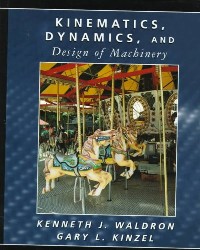
简介
"Waldron and Kinzel bring over 25 years of outstanding research contributions and teaching experiences to provide a very modern approach to the study of mechanisms and machines. Their unique backgrounds are reflected in the text, in that they provide an integrated treatment to a set of seemingly diverse topics, such as planar mechanisms, spatial mechanisms and robotics. Their emphasis on both analytical and graphical methods sets the stage so that students can readily transform problems into computer algorithms."--BOOK JACKET.
目录
Table Of Contents:
Chapter 1: Introduction 1(50)
1.1 Historic Perspective 1(1)
1.2 Kinematics 2(1)
1.3 Design: Analysis and Synthesis 2(1)
1.4 Mechanisms 3(3)
1.5 Planar Linkages 6(3)
1.6 Visualization 9(1)
1.7 Constraint Analysis 10(7)
1.8 Constraint Analysis of Spatial Linkages 17(5)
1.9 Idle Degrees of Freedom 22(2)
1.10 Overconstrained Linkages 24(4)
1.11 Uses of the Mobility Criterion 28(1)
1.12 Inversion 28(1)
1.13 Reference Frames 29(1)
1.14 Motion Limits 30(1)
1.15 Actuation 30(5)
1.16 Coupler-Driven Linkages 35(1)
1.17 Motion Limits for Slider-Crank Mechanism 36(2)
1.18 Interference 38(4)
1.19 Chapter 1 Exercise Problems 42(9)
Chapter 2: Graphical Position, Velocity, and Acceleration Analysis 51(104)
2.1 Introduction 51(1)
2.2 Graphical Position Analysis 52(1)
2.3 Planar Velocity Polygons 52(3)
2.4 Graphical Acceleration Analysis 55(2)
2.5 Graphical Analysis of a Four-Bar Mechanism 57(7)
2.6 Graphical Analysis of a Slider-Crank Mechanism 64(3)
2.7 The Velocity Image Theorem 67(2)
2.8 The Acceleration Image Theorem 69(5)
2.9 Solution by Inversion 74(4)
2.10 Reference Frames 78(2)
2.11 General Velocity and Acceleration Equations 80(4)
2.11.1 Velocity Equations 80(2)
2.11.2 Acceleration Equations 82(1)
2.11.3 "Chain Rule" for Positions, Velocities, and Accelerations 82(1)
2.11.3.1 Positions, Velocities, and Accelerations of Points 83(1)
2.11.3.2 Relative Angular Velocities 83(1)
2.11.3.3 Relative Angular Accelerations 84(1)
2.12 Special Cases for the Velocity and Acceleration Equations 84(2)
2.12.1 Points P and Q fixed to B 85(1)
2.12.2 P and Q Are Coincident 85(1)
2.12.3 P and Q Are Coincident and in Rolling Contact 86(1)
2.13 Linkages with Rotating Sliding Joints 86(4)
2.14 Rolling Contact 90(9)
2.14.1 Basic Kinematic Relationships for Rolling Contact 91(6)
2.14.2 Modeling Rolling Contact Using a Virtual Linkage 97(2)
2.15 Cam Contact 99(7)
2.15.1 Direct Approach to the Analysis of Cam Contact 99(4)
2.15.2 Analysis of Cam Contact Using Equivalent Linkages 103(3)
2.16 General Coincident Points 106(8)
2.16.1 Velocity Analyses Involving General Coincident Points 107(2)
2.16.2 Acceleration Analyses Involving General Coincident Points 109(5)
2.17 Instant Centers of Velocity 114(19)
2.17.1 Introduction 114(1)
2.17.2 Definition 114(1)
2.17.3 Existence Proof 115(1)
2.17.4 Location of an Instant Center from the Directions of Two Velocities 116(1)
2.17.5 Instant Center at a Revolute Joint 117(1)
2.17.6 Instant Center of a Curved Slider 117(1)
2.17.7 Instant Center of a Prismatic Joint 117(1)
2.17.8 Instant Center of a Rolling Contact Pair 118(1)
2.17.9 Instant Center of a General Cam-Pair Contact 118(1)
2.17.10 Centrodes 118(3)
2.17.11 The Kennedy-Aronholdt Theorem 121(2)
2.17.12 Circle Diagram as a Strategy for Finding Instant Centers 123(1)
2.17.13 Using Instant Centers, the Rotating Radius Method 124(9)
2.18 Finding Instant Centers Using Drafting Programs 133(1)
2.19 Chapter 2 Exercise Problems 133(22)
Chapter 3: Analytical Linkage Analysis 155(81)
3.1 Introduction 155(1)
3.2 Position, Velocity, and Acceleration Representations 156(3)
3.2.1 Position Representation 156(1)
3.2.2 Velocity Representation 156(2)
3.2.3 Acceleration Representation 158(1)
3.2.4 Special Cases 158(1)
3.2.5 Mechanisms to Be Considered 159(1)
3.3 Analytical Closure Equations for Four-Bar Linkages 159(8)
3.3.1 Solution of Closure Equations for Four-Bar Linkages When Link 2 Is the Driver 160(2)
3.3.2 Analysis When the Coupler (Link 3) Is the Driving Link 162(1)
3.3.3 Velocity Equations for Four-Bar Linkages 163(1)
3.3.4 Acceleration Equations for Four-Bar Linkages 164(3)
3.4 Analytical Equations for a Rigid Body After the Kinematic Properties of Two Points Are Known 167(3)
3.5 Analytical Equations for Slider-Crank Mechanisms 170(11)
3.5.1 Solution to Position Equations When Theta(2) Is Input 172(2)
3.5.2 Solution to Position Equations When r(1) Is Input 174(1)
3.5.3 Solution to Position Equations When Theta(3) Is Input 175(1)
3.5.4 Velocity Equations for Slider-Crank Mechanism 176(1)
3.5.5 Acceleration Equations for Slider-Crank Mechanism 177(4)
3.6 Analytical Equations for the Slider-Crank Inversion 181(10)
3.6.1 Solution to Position Equations When Theta(2) Is Input 183(1)
3.6.2 Solution to Position Equations When Theta(3) Is Input 184(1)
3.6.3 Solution to Position Equations When r(3) Is Input 185(1)
3.6.4 Velocity Equations for the Slider-Crank Inversion 185(2)
3.6.5 Acceleration Equations for the Slider-Crank Inversion 187(4)
3.7 Analytical Equations for an RPRP Mechanism 191(7)
3.7.1 Solution of Closure Equations When Theta(2) Is Known 192(1)
3.7.2 Solution of Closure Equations When r(4) Is Known 193(2)
3.7.3 Solution of Closure Equations When r(3) Is Known 195(1)
3.7.4 Velocity and Acceleration Equations for RPRP Mechanism 196(2)
3.8 Analytical Equations for an RRPP Mechanism 198(5)
3.8.1 Solution When Theta(2) Is Known 199(1)
3.8.2 Solution When r(1) Is Known 199(2)
3.8.3 Solution When r(3) Is Known 201(2)
3.9 Analytical Equations for Elliptic Trammel 203(4)
3.9.1 Analysis When Theta(3) Is Known 204(1)
3.9.2 Analysis When r(1) Is Known 204(3)
3.10 Analytical Equations for Oldham Mechanism 207(5)
3.10.1 Analysis When Theta(2) Is Known 208(1)
3.10.2 Analysis When r(2) Is Known 209(3)
3.11 Closure or Loop Equation Approach for Compound Mechanisms 212(9)
3.11.1 Handling Points Not on the Vector Loops 214(1)
3.11.2 Solving the Position Equations 215(1)
3.11.2.1 Compound Linkage as a Series of Simple Mechanisms 216(2)
3.11.2.2 General Cases in Which Two Equations in Two Unknowns Result 218(1)
3.11.2.2.1 Case 1, r(p) and Theta(p) Unknown 219(1)
3.11.2.2.2 Case 2, r(p) and Theta(m) Unknown 220(1)
3.11.2.2.3 Case 3, r(p) and r(m) Unknown 220(1)
3.11.2.2.4 Case 4, Theta(p) and Theta(m) Unknown 220(1)
3.12 Closure Equations for Mechanisms with Higher Pairs 221(5)
3.13 Notational Differences: Vectors and Complex Numbers 226(3)
3.14 Chapter 3 Exercise Problems 229(7)
Chapter 4: Planar Linkage Design 236(60)
4.1 Introduction 236(3)
4.2 Motion Generation 239(20)
4.2.1 Introduction 239(1)
4.2.2 Two Positions 240(2)
4.2.3 Three Positions with Selected Moving Pivots 242(2)
4.2.4 Synthesis of a Crank with Chosen Fixed Pivots 244(1)
4.2.5 Design of Slider Cranks and Elliptic Trammels 244(3)
4.2.6 Order Problem and Change of Branch 247(4)
4.2.7 Analytical Approach to Rigid Body Guidance 251(1)
4.2.7.1 Coordinate Transformations 252(3)
4.2.7.2 Finding Poles 255(1)
4.2.7.2.1 Two Parallel Positions 256(1)
4.2.7.2.2 Lines A(i)A(j) and B(i)B(j) Are Parallel 256(1)
4.2.7.2.3 Two Successive Positions Coincident 257(1)
4.2.7.3 Finding the Center of a Circle on Which Three Points Lie 257(1)
4.2.7.4 Image Pole 257(1)
4.2.7.5 Crank Design Given Circle Point 258(1)
4.2.7.6 Crank Design Given Center Point 258(1)
4.2.7.7 Design of a Slider 258(1)
4.2.7.8 Implementing the Analytical Approach to Rigid Body Guidance 259(1)
4.3 Function Generation 259(10)
4.3.1 Function Generation using a Four-Bar Linkage 260(1)
4.3.1.1 Solution by Matrices 261(1)
4.3.1.2 Unscaling the Solution 262(1)
4.3.2 Design Procedure When y = y(x) Is to Be Generated 262(1)
4.3.3 Selection of Design Positions 263(1)
4.3.4 Summary of Solution Procedure 264(4)
4.3.5 Graphical Approach to Function Generation 268(1)
4.4 Synthesis of Crank-Rocker Linkages for Specified-Rocker Amplitude 269(8)
4.4.1 Extreme Rocker Positions and Simple Analytical Solution 269(1)
4.4.2 The Rocker Amplitude Problem: Graphical Approach 270(3)
4.4.3 Optimal Synthesis Approach Based on the Specification of O(2)-O(4) 273(1)
4.4.3.1 Alternative Graphical Design Procedure 273(1)
4.4.3.2 Analytical Design Procedure 274(3)
4.4.3.3 Use of Analytical Design Procedure for Optimization 277(1)
4.5 Path Synthesis 277(9)
4.5.1 Design of Six-Bar Linkages Using Coupler Curves 279(5)
4.5.2 Four-Bar Cognate Linkages 284(2)
4.6 References 286(1)
4.7 Chapter 4 Exercise Problems 287(9)
Chapter 5: Special Mechanisms 296(36)
5.1 Special Planar Mechanisms 296(13)
5.1.1 Introduction 296(1)
5.1.2 Approximate Straight Line Mechanisms 296(1)
5.1.2.1 Watt's Straight Line Mechanism 297(1)
5.1.2.2 Chebyschev's Straight Line Mechanism 298(1)
5.1.2.3 Roberts' Straight Line Mechanism 298(1)
5.1.2.4 Other Approximate Straight Line Mechanisms 298(1)
5.1.3 Exact Straight Line Mechanisms 299(2)
5.1.4 Pantographs 301(1)
5.1.4.1 The Planar Collinear Pantograph 301(2)
5.1.4.2 Skew Pantographs 303(3)
5.1.4.3 Roberts' Theorem 306(3)
5.2 Spherical Linkages 309(7)
5.2.1 Introduction 309(3)
5.2.2 Gimbals 312(1)
5.2.3 Universal Joints 312(1)
5.2.3.1 Properties of the Universal Joint 312(2)
5.2.3.2 Dual Universal Joints 314(2)
5.3 Constant-Velocity Couplings 316(2)
5.3.1 Geometric Requirements of Constant-Velocity Couplings 317(1)
5.3.2 Practical Constant-Velocity Couplings 317(1)
5.4 Automotive Steering and Suspension Mechanisms 318(6)
5.4.1 Introduction 318(1)
5.4.2 Steering Mechanisms 319(4)
5.4.3 Suspension Mechanisms 323(1)
5.5 Indexing Mechanisms 324(5)
5.5.1 Geneva Mechanisms 324(5)
5.6 Chapter 5 Exercise Problems 329(3)
Chapter 6: Profile Cam Design 332(58)
6.1 Introduction 332(1)
6.2 Cam-Follower Systems 333(1)
6.3 Synthesis of Motion Programs 334(2)
6.4 Analysis of Different Types of Follower Displacement Functions 336(1)
6.5 Uniform Motion 337(1)
6.6 Parabolic Motion 338(4)
6.7 Harmonic Time-Motion Programs 342(3)
6.8 Cycloidal Time-Motion Programs 345(1)
6.9 General Polynomial Time-Motion Programs 346(3)
6.10 Determining the Cam Profile 349(36)
6.10.1 Graphical Cam Profile Layout 350(10)
6.10.2 Analytical Determination of Cam Profile 360(1)
6.10.2.1 Analytical Determination of Cam Profile for an Offset, Radial Roller Follower 361(4)
6.10.2.2 Cam Radius of Curvature 365(3)
6.10.2.3 Analytical Determination of the Cam Profile for a Radial Flat-Faced Follower 368(5)
6.10.2.4 Analytical Determination of a Cam Profile for an Oscillating Cylindrical Follower 373(4)
6.10.2.5 Analytical Determination of a Cam Profile for a Flat-Faced Follower That Oscillates 377(8)
6.11 Chapter 6 Exercise Problems 385(5)
Chapter 7: Spatial Linkage Analysis 390(36)
7.1 Spatial Mechanisms 390(6)
7.1.1 Introduction 390(1)
7.1.2 Velocity and Acceleration Relationships 390(6)
7.2 Robotic Mechanisms 396(2)
7.3 Direct Position Kinematics of Serial Chains 398(8)
7.3.1 Introduction 398(1)
7.3.2 Concatenation of Transformations 399(4)
7.3.3 Homogeneous Transformations 403(3)
7.4 Inverse Position Kinematics 406(1)
7.5 Rate Kinematics 406(6)
7.5.1 Introduction 406(1)
7.5.2 Direct Rate Kinematics 407(4)
7.5.3 Inverse Rate Kinematics 411(1)
7.6 Closed-Loop Linkages 412(3)
7.7 Lower Pair Joints 415(4)
7.8 Motion Platforms 419(2)
7.8.1 Mechanisms Actuated in Parallel 419(1)
7.8.2 The Stewart Platform 419(2)
7.8.3 The 3-2-1 Platform 421(1)
7.9 Chapter 7 Exercise Problems 421(5)
Chapter 8: Spur Gears 426(37)
8.1 Introduction 426(1)
8.2 Spur Gears 427(1)
8.3 Condition for Constant-Velocity Ratio 428(1)
8.4 Involutes 429(3)
8.5 Gear Terminology and Standards 432(3)
8.5.1 Terminology 432(2)
8.5.2 Standards 434(1)
8.6 Contact Ratio 435(4)
8.7 Involutometry 439(3)
8.8 Internal Gears 442(1)
8.9 Gear Manufacturing 443(4)
8.10 Interference and Undercutting 447(3)
8.11 Nonstandard Gearing 450(4)
8.12 Cartesian Coordinates of an Involute Tooth Generated with a Rack 454(6)
8.12.1 Coordinate Systems 454(3)
8.12.2 Gear Equations 457(3)
8.13 References 460(1)
8.14 Chapter 8 Exercise Problems 460(3)
Chapter 9: Helical, Bevel, and Worm Gears 463(33)
9.1 Helical Gears 463(14)
9.1.1 Helical-Gear Terminology 464(3)
9.1.2 Helical-Gear Manufacturing 467(2)
9.1.3 Minimum Tooth Number to Avoid Undercutting 469(1)
9.1.4 Helical Gears with Parallel Shafts 470(1)
9.1.4.1 Velocity Ratio and Center Distance 470(1)
9.1.4.2 Minimum Face Width 471(1)
9.1.4.3 Contact Ratio 471(4)
9.1.4.4 Designing for Axial Force 475(1)
9.1.5 Crossed Helical Gears 475(2)
9.2 Worm Gears 477(5)
9.2.1 Worm Gear Nomenclature 479(3)
9.3 Involute Bevel Gears 482(10)
9.3.1 Tredgold's Approximation for Bevel Gears 484(1)
9.3.2 Additional Nomenclature for Bevel Gears 485(1)
9.3.3 Crown Bevel Gears and Face Gears 486(1)
9.3.4 Miter Gears 487(1)
9.3.5 Angular Bevel Gears 487(2)
9.3.6 Zerol Bevel Gears 489(1)
9.3.7 Spiral Bevel Gears 490(2)
9.3.8 Hypoid Gears 492(1)
9.4 References 492(1)
9.5 Chapter 9 Exercise Problems 493(3)
Chapter 10: Gear Trains 496(30)
10.1 Gear Trains 496(1)
10.2 Direction of Rotation 496(1)
10.3 Simple Gear Trains 497(2)
10.3.1 Simple Reversing Mechanism 499(1)
10.4 Compound Gear Trains 499(7)
10.4.1 Concentric Gear Trains 503(3)
10.5 Planetary Gear Trains 506(14)
10.5.1 Planetary Gear Nomenclature 506(3)
10.5.2 Analysis of Planetary Gear Trains Using Equations 509(7)
10.5.3 Analysis of Planetary Gear Trains Using Tabular Method 516(1)
10.5.3.1 Overview 516(1)
10.5.3.2 Procedure 517(3)
10.6 References 520(1)
10.7 Chapter 10 Exercise Problems 520(6)
Chapter 11: Static Force Analysis of Mechanisms 526(49)
11.1 Introduction 526(1)
11.2 Forces, Moments, and Couples 527(1)
11.3 Static Equilibrium 528(1)
11.4 Free-Body Diagrams 529(3)
11.5 Graphical Force Analysis 532(7)
11.6 Analytical Approach to Force Analysis 539(6)
11.6.1 Transmission Angle in a Four-Bar Linkage 542(3)
11.7 Friction Considerations 545(7)
11.7.1 Friction in Cam Contact 545(1)
11.7.2 Friction in Slider Joints 546(2)
11.7.3 Friction in Revolute Joints 548(4)
11.8 In-Plane and Out-of-Plane Force Systems 552(4)
11.9 Conservation of Energy and Power 556(4)
11.10 Virtual Work 560(2)
11.11 Gear Loads 562(6)
11.11.1 Spur Gears 562(2)
11.11.2 Helical Gears 564(2)
11.11.3 Worm Gears 566(1)
11.11.4 Straight Bevel Gears 567(1)
11.12 Chapter 11 Exercise Problems 568(7)
Chapter 12: Dynamic Force Analysis 575(22)
12.1 Introduction 575(1)
12.2 Problems Soluble via Particle Kinetics 576(9)
12.2.1 Dynamic Equilibrium of Systems of Particles 577(5)
12.2.2 Conservation of Energy 582(1)
12.2.3 Conservation of Momentum 582(3)
12.3 Dynamic Equilibrium of Systems of Rigid Bodies 585(5)
12.4 Flywheels 590(3)
12.5 Chapter 12 Exercise Problems 593(4)
Chapter 13: Shaking Forces and Balancing 597(34)
13.1 Introduction 597(1)
13.2 Single-Plane (Static) Balancing 598(3)
13.3 Multiplane (Dynamic) Balancing 601(6)
13.4 Balancing Reciprocating Masses 607(6)
13.4.1 Expression for Lumped Mass Distribution 607(4)
13.4.2 Analytical Approach to Balancing a Slider-Crank Mechanism 611(1)
13.4.2.1 Approximate Expression for Piston Acceleration 612(1)
13.5 Expressions for Inertial Forces 613(3)
13.6 Balancing Multicylinder Machines 616(8)
13.6.1 Balancing a Three-Cylinder In-Line Engine 620(2)
13.6.2 Balancing an Eight-Cylinder V Engine 622(2)
13.7 Chapter 13 Exercise Problems 624(7)
Index 631(9)
Photo Credits 640
Chapter 1: Introduction 1(50)
1.1 Historic Perspective 1(1)
1.2 Kinematics 2(1)
1.3 Design: Analysis and Synthesis 2(1)
1.4 Mechanisms 3(3)
1.5 Planar Linkages 6(3)
1.6 Visualization 9(1)
1.7 Constraint Analysis 10(7)
1.8 Constraint Analysis of Spatial Linkages 17(5)
1.9 Idle Degrees of Freedom 22(2)
1.10 Overconstrained Linkages 24(4)
1.11 Uses of the Mobility Criterion 28(1)
1.12 Inversion 28(1)
1.13 Reference Frames 29(1)
1.14 Motion Limits 30(1)
1.15 Actuation 30(5)
1.16 Coupler-Driven Linkages 35(1)
1.17 Motion Limits for Slider-Crank Mechanism 36(2)
1.18 Interference 38(4)
1.19 Chapter 1 Exercise Problems 42(9)
Chapter 2: Graphical Position, Velocity, and Acceleration Analysis 51(104)
2.1 Introduction 51(1)
2.2 Graphical Position Analysis 52(1)
2.3 Planar Velocity Polygons 52(3)
2.4 Graphical Acceleration Analysis 55(2)
2.5 Graphical Analysis of a Four-Bar Mechanism 57(7)
2.6 Graphical Analysis of a Slider-Crank Mechanism 64(3)
2.7 The Velocity Image Theorem 67(2)
2.8 The Acceleration Image Theorem 69(5)
2.9 Solution by Inversion 74(4)
2.10 Reference Frames 78(2)
2.11 General Velocity and Acceleration Equations 80(4)
2.11.1 Velocity Equations 80(2)
2.11.2 Acceleration Equations 82(1)
2.11.3 "Chain Rule" for Positions, Velocities, and Accelerations 82(1)
2.11.3.1 Positions, Velocities, and Accelerations of Points 83(1)
2.11.3.2 Relative Angular Velocities 83(1)
2.11.3.3 Relative Angular Accelerations 84(1)
2.12 Special Cases for the Velocity and Acceleration Equations 84(2)
2.12.1 Points P and Q fixed to B 85(1)
2.12.2 P and Q Are Coincident 85(1)
2.12.3 P and Q Are Coincident and in Rolling Contact 86(1)
2.13 Linkages with Rotating Sliding Joints 86(4)
2.14 Rolling Contact 90(9)
2.14.1 Basic Kinematic Relationships for Rolling Contact 91(6)
2.14.2 Modeling Rolling Contact Using a Virtual Linkage 97(2)
2.15 Cam Contact 99(7)
2.15.1 Direct Approach to the Analysis of Cam Contact 99(4)
2.15.2 Analysis of Cam Contact Using Equivalent Linkages 103(3)
2.16 General Coincident Points 106(8)
2.16.1 Velocity Analyses Involving General Coincident Points 107(2)
2.16.2 Acceleration Analyses Involving General Coincident Points 109(5)
2.17 Instant Centers of Velocity 114(19)
2.17.1 Introduction 114(1)
2.17.2 Definition 114(1)
2.17.3 Existence Proof 115(1)
2.17.4 Location of an Instant Center from the Directions of Two Velocities 116(1)
2.17.5 Instant Center at a Revolute Joint 117(1)
2.17.6 Instant Center of a Curved Slider 117(1)
2.17.7 Instant Center of a Prismatic Joint 117(1)
2.17.8 Instant Center of a Rolling Contact Pair 118(1)
2.17.9 Instant Center of a General Cam-Pair Contact 118(1)
2.17.10 Centrodes 118(3)
2.17.11 The Kennedy-Aronholdt Theorem 121(2)
2.17.12 Circle Diagram as a Strategy for Finding Instant Centers 123(1)
2.17.13 Using Instant Centers, the Rotating Radius Method 124(9)
2.18 Finding Instant Centers Using Drafting Programs 133(1)
2.19 Chapter 2 Exercise Problems 133(22)
Chapter 3: Analytical Linkage Analysis 155(81)
3.1 Introduction 155(1)
3.2 Position, Velocity, and Acceleration Representations 156(3)
3.2.1 Position Representation 156(1)
3.2.2 Velocity Representation 156(2)
3.2.3 Acceleration Representation 158(1)
3.2.4 Special Cases 158(1)
3.2.5 Mechanisms to Be Considered 159(1)
3.3 Analytical Closure Equations for Four-Bar Linkages 159(8)
3.3.1 Solution of Closure Equations for Four-Bar Linkages When Link 2 Is the Driver 160(2)
3.3.2 Analysis When the Coupler (Link 3) Is the Driving Link 162(1)
3.3.3 Velocity Equations for Four-Bar Linkages 163(1)
3.3.4 Acceleration Equations for Four-Bar Linkages 164(3)
3.4 Analytical Equations for a Rigid Body After the Kinematic Properties of Two Points Are Known 167(3)
3.5 Analytical Equations for Slider-Crank Mechanisms 170(11)
3.5.1 Solution to Position Equations When Theta(2) Is Input 172(2)
3.5.2 Solution to Position Equations When r(1) Is Input 174(1)
3.5.3 Solution to Position Equations When Theta(3) Is Input 175(1)
3.5.4 Velocity Equations for Slider-Crank Mechanism 176(1)
3.5.5 Acceleration Equations for Slider-Crank Mechanism 177(4)
3.6 Analytical Equations for the Slider-Crank Inversion 181(10)
3.6.1 Solution to Position Equations When Theta(2) Is Input 183(1)
3.6.2 Solution to Position Equations When Theta(3) Is Input 184(1)
3.6.3 Solution to Position Equations When r(3) Is Input 185(1)
3.6.4 Velocity Equations for the Slider-Crank Inversion 185(2)
3.6.5 Acceleration Equations for the Slider-Crank Inversion 187(4)
3.7 Analytical Equations for an RPRP Mechanism 191(7)
3.7.1 Solution of Closure Equations When Theta(2) Is Known 192(1)
3.7.2 Solution of Closure Equations When r(4) Is Known 193(2)
3.7.3 Solution of Closure Equations When r(3) Is Known 195(1)
3.7.4 Velocity and Acceleration Equations for RPRP Mechanism 196(2)
3.8 Analytical Equations for an RRPP Mechanism 198(5)
3.8.1 Solution When Theta(2) Is Known 199(1)
3.8.2 Solution When r(1) Is Known 199(2)
3.8.3 Solution When r(3) Is Known 201(2)
3.9 Analytical Equations for Elliptic Trammel 203(4)
3.9.1 Analysis When Theta(3) Is Known 204(1)
3.9.2 Analysis When r(1) Is Known 204(3)
3.10 Analytical Equations for Oldham Mechanism 207(5)
3.10.1 Analysis When Theta(2) Is Known 208(1)
3.10.2 Analysis When r(2) Is Known 209(3)
3.11 Closure or Loop Equation Approach for Compound Mechanisms 212(9)
3.11.1 Handling Points Not on the Vector Loops 214(1)
3.11.2 Solving the Position Equations 215(1)
3.11.2.1 Compound Linkage as a Series of Simple Mechanisms 216(2)
3.11.2.2 General Cases in Which Two Equations in Two Unknowns Result 218(1)
3.11.2.2.1 Case 1, r(p) and Theta(p) Unknown 219(1)
3.11.2.2.2 Case 2, r(p) and Theta(m) Unknown 220(1)
3.11.2.2.3 Case 3, r(p) and r(m) Unknown 220(1)
3.11.2.2.4 Case 4, Theta(p) and Theta(m) Unknown 220(1)
3.12 Closure Equations for Mechanisms with Higher Pairs 221(5)
3.13 Notational Differences: Vectors and Complex Numbers 226(3)
3.14 Chapter 3 Exercise Problems 229(7)
Chapter 4: Planar Linkage Design 236(60)
4.1 Introduction 236(3)
4.2 Motion Generation 239(20)
4.2.1 Introduction 239(1)
4.2.2 Two Positions 240(2)
4.2.3 Three Positions with Selected Moving Pivots 242(2)
4.2.4 Synthesis of a Crank with Chosen Fixed Pivots 244(1)
4.2.5 Design of Slider Cranks and Elliptic Trammels 244(3)
4.2.6 Order Problem and Change of Branch 247(4)
4.2.7 Analytical Approach to Rigid Body Guidance 251(1)
4.2.7.1 Coordinate Transformations 252(3)
4.2.7.2 Finding Poles 255(1)
4.2.7.2.1 Two Parallel Positions 256(1)
4.2.7.2.2 Lines A(i)A(j) and B(i)B(j) Are Parallel 256(1)
4.2.7.2.3 Two Successive Positions Coincident 257(1)
4.2.7.3 Finding the Center of a Circle on Which Three Points Lie 257(1)
4.2.7.4 Image Pole 257(1)
4.2.7.5 Crank Design Given Circle Point 258(1)
4.2.7.6 Crank Design Given Center Point 258(1)
4.2.7.7 Design of a Slider 258(1)
4.2.7.8 Implementing the Analytical Approach to Rigid Body Guidance 259(1)
4.3 Function Generation 259(10)
4.3.1 Function Generation using a Four-Bar Linkage 260(1)
4.3.1.1 Solution by Matrices 261(1)
4.3.1.2 Unscaling the Solution 262(1)
4.3.2 Design Procedure When y = y(x) Is to Be Generated 262(1)
4.3.3 Selection of Design Positions 263(1)
4.3.4 Summary of Solution Procedure 264(4)
4.3.5 Graphical Approach to Function Generation 268(1)
4.4 Synthesis of Crank-Rocker Linkages for Specified-Rocker Amplitude 269(8)
4.4.1 Extreme Rocker Positions and Simple Analytical Solution 269(1)
4.4.2 The Rocker Amplitude Problem: Graphical Approach 270(3)
4.4.3 Optimal Synthesis Approach Based on the Specification of O(2)-O(4) 273(1)
4.4.3.1 Alternative Graphical Design Procedure 273(1)
4.4.3.2 Analytical Design Procedure 274(3)
4.4.3.3 Use of Analytical Design Procedure for Optimization 277(1)
4.5 Path Synthesis 277(9)
4.5.1 Design of Six-Bar Linkages Using Coupler Curves 279(5)
4.5.2 Four-Bar Cognate Linkages 284(2)
4.6 References 286(1)
4.7 Chapter 4 Exercise Problems 287(9)
Chapter 5: Special Mechanisms 296(36)
5.1 Special Planar Mechanisms 296(13)
5.1.1 Introduction 296(1)
5.1.2 Approximate Straight Line Mechanisms 296(1)
5.1.2.1 Watt's Straight Line Mechanism 297(1)
5.1.2.2 Chebyschev's Straight Line Mechanism 298(1)
5.1.2.3 Roberts' Straight Line Mechanism 298(1)
5.1.2.4 Other Approximate Straight Line Mechanisms 298(1)
5.1.3 Exact Straight Line Mechanisms 299(2)
5.1.4 Pantographs 301(1)
5.1.4.1 The Planar Collinear Pantograph 301(2)
5.1.4.2 Skew Pantographs 303(3)
5.1.4.3 Roberts' Theorem 306(3)
5.2 Spherical Linkages 309(7)
5.2.1 Introduction 309(3)
5.2.2 Gimbals 312(1)
5.2.3 Universal Joints 312(1)
5.2.3.1 Properties of the Universal Joint 312(2)
5.2.3.2 Dual Universal Joints 314(2)
5.3 Constant-Velocity Couplings 316(2)
5.3.1 Geometric Requirements of Constant-Velocity Couplings 317(1)
5.3.2 Practical Constant-Velocity Couplings 317(1)
5.4 Automotive Steering and Suspension Mechanisms 318(6)
5.4.1 Introduction 318(1)
5.4.2 Steering Mechanisms 319(4)
5.4.3 Suspension Mechanisms 323(1)
5.5 Indexing Mechanisms 324(5)
5.5.1 Geneva Mechanisms 324(5)
5.6 Chapter 5 Exercise Problems 329(3)
Chapter 6: Profile Cam Design 332(58)
6.1 Introduction 332(1)
6.2 Cam-Follower Systems 333(1)
6.3 Synthesis of Motion Programs 334(2)
6.4 Analysis of Different Types of Follower Displacement Functions 336(1)
6.5 Uniform Motion 337(1)
6.6 Parabolic Motion 338(4)
6.7 Harmonic Time-Motion Programs 342(3)
6.8 Cycloidal Time-Motion Programs 345(1)
6.9 General Polynomial Time-Motion Programs 346(3)
6.10 Determining the Cam Profile 349(36)
6.10.1 Graphical Cam Profile Layout 350(10)
6.10.2 Analytical Determination of Cam Profile 360(1)
6.10.2.1 Analytical Determination of Cam Profile for an Offset, Radial Roller Follower 361(4)
6.10.2.2 Cam Radius of Curvature 365(3)
6.10.2.3 Analytical Determination of the Cam Profile for a Radial Flat-Faced Follower 368(5)
6.10.2.4 Analytical Determination of a Cam Profile for an Oscillating Cylindrical Follower 373(4)
6.10.2.5 Analytical Determination of a Cam Profile for a Flat-Faced Follower That Oscillates 377(8)
6.11 Chapter 6 Exercise Problems 385(5)
Chapter 7: Spatial Linkage Analysis 390(36)
7.1 Spatial Mechanisms 390(6)
7.1.1 Introduction 390(1)
7.1.2 Velocity and Acceleration Relationships 390(6)
7.2 Robotic Mechanisms 396(2)
7.3 Direct Position Kinematics of Serial Chains 398(8)
7.3.1 Introduction 398(1)
7.3.2 Concatenation of Transformations 399(4)
7.3.3 Homogeneous Transformations 403(3)
7.4 Inverse Position Kinematics 406(1)
7.5 Rate Kinematics 406(6)
7.5.1 Introduction 406(1)
7.5.2 Direct Rate Kinematics 407(4)
7.5.3 Inverse Rate Kinematics 411(1)
7.6 Closed-Loop Linkages 412(3)
7.7 Lower Pair Joints 415(4)
7.8 Motion Platforms 419(2)
7.8.1 Mechanisms Actuated in Parallel 419(1)
7.8.2 The Stewart Platform 419(2)
7.8.3 The 3-2-1 Platform 421(1)
7.9 Chapter 7 Exercise Problems 421(5)
Chapter 8: Spur Gears 426(37)
8.1 Introduction 426(1)
8.2 Spur Gears 427(1)
8.3 Condition for Constant-Velocity Ratio 428(1)
8.4 Involutes 429(3)
8.5 Gear Terminology and Standards 432(3)
8.5.1 Terminology 432(2)
8.5.2 Standards 434(1)
8.6 Contact Ratio 435(4)
8.7 Involutometry 439(3)
8.8 Internal Gears 442(1)
8.9 Gear Manufacturing 443(4)
8.10 Interference and Undercutting 447(3)
8.11 Nonstandard Gearing 450(4)
8.12 Cartesian Coordinates of an Involute Tooth Generated with a Rack 454(6)
8.12.1 Coordinate Systems 454(3)
8.12.2 Gear Equations 457(3)
8.13 References 460(1)
8.14 Chapter 8 Exercise Problems 460(3)
Chapter 9: Helical, Bevel, and Worm Gears 463(33)
9.1 Helical Gears 463(14)
9.1.1 Helical-Gear Terminology 464(3)
9.1.2 Helical-Gear Manufacturing 467(2)
9.1.3 Minimum Tooth Number to Avoid Undercutting 469(1)
9.1.4 Helical Gears with Parallel Shafts 470(1)
9.1.4.1 Velocity Ratio and Center Distance 470(1)
9.1.4.2 Minimum Face Width 471(1)
9.1.4.3 Contact Ratio 471(4)
9.1.4.4 Designing for Axial Force 475(1)
9.1.5 Crossed Helical Gears 475(2)
9.2 Worm Gears 477(5)
9.2.1 Worm Gear Nomenclature 479(3)
9.3 Involute Bevel Gears 482(10)
9.3.1 Tredgold's Approximation for Bevel Gears 484(1)
9.3.2 Additional Nomenclature for Bevel Gears 485(1)
9.3.3 Crown Bevel Gears and Face Gears 486(1)
9.3.4 Miter Gears 487(1)
9.3.5 Angular Bevel Gears 487(2)
9.3.6 Zerol Bevel Gears 489(1)
9.3.7 Spiral Bevel Gears 490(2)
9.3.8 Hypoid Gears 492(1)
9.4 References 492(1)
9.5 Chapter 9 Exercise Problems 493(3)
Chapter 10: Gear Trains 496(30)
10.1 Gear Trains 496(1)
10.2 Direction of Rotation 496(1)
10.3 Simple Gear Trains 497(2)
10.3.1 Simple Reversing Mechanism 499(1)
10.4 Compound Gear Trains 499(7)
10.4.1 Concentric Gear Trains 503(3)
10.5 Planetary Gear Trains 506(14)
10.5.1 Planetary Gear Nomenclature 506(3)
10.5.2 Analysis of Planetary Gear Trains Using Equations 509(7)
10.5.3 Analysis of Planetary Gear Trains Using Tabular Method 516(1)
10.5.3.1 Overview 516(1)
10.5.3.2 Procedure 517(3)
10.6 References 520(1)
10.7 Chapter 10 Exercise Problems 520(6)
Chapter 11: Static Force Analysis of Mechanisms 526(49)
11.1 Introduction 526(1)
11.2 Forces, Moments, and Couples 527(1)
11.3 Static Equilibrium 528(1)
11.4 Free-Body Diagrams 529(3)
11.5 Graphical Force Analysis 532(7)
11.6 Analytical Approach to Force Analysis 539(6)
11.6.1 Transmission Angle in a Four-Bar Linkage 542(3)
11.7 Friction Considerations 545(7)
11.7.1 Friction in Cam Contact 545(1)
11.7.2 Friction in Slider Joints 546(2)
11.7.3 Friction in Revolute Joints 548(4)
11.8 In-Plane and Out-of-Plane Force Systems 552(4)
11.9 Conservation of Energy and Power 556(4)
11.10 Virtual Work 560(2)
11.11 Gear Loads 562(6)
11.11.1 Spur Gears 562(2)
11.11.2 Helical Gears 564(2)
11.11.3 Worm Gears 566(1)
11.11.4 Straight Bevel Gears 567(1)
11.12 Chapter 11 Exercise Problems 568(7)
Chapter 12: Dynamic Force Analysis 575(22)
12.1 Introduction 575(1)
12.2 Problems Soluble via Particle Kinetics 576(9)
12.2.1 Dynamic Equilibrium of Systems of Particles 577(5)
12.2.2 Conservation of Energy 582(1)
12.2.3 Conservation of Momentum 582(3)
12.3 Dynamic Equilibrium of Systems of Rigid Bodies 585(5)
12.4 Flywheels 590(3)
12.5 Chapter 12 Exercise Problems 593(4)
Chapter 13: Shaking Forces and Balancing 597(34)
13.1 Introduction 597(1)
13.2 Single-Plane (Static) Balancing 598(3)
13.3 Multiplane (Dynamic) Balancing 601(6)
13.4 Balancing Reciprocating Masses 607(6)
13.4.1 Expression for Lumped Mass Distribution 607(4)
13.4.2 Analytical Approach to Balancing a Slider-Crank Mechanism 611(1)
13.4.2.1 Approximate Expression for Piston Acceleration 612(1)
13.5 Expressions for Inertial Forces 613(3)
13.6 Balancing Multicylinder Machines 616(8)
13.6.1 Balancing a Three-Cylinder In-Line Engine 620(2)
13.6.2 Balancing an Eight-Cylinder V Engine 622(2)
13.7 Chapter 13 Exercise Problems 624(7)
Index 631(9)
Photo Credits 640
- 名称
- 类型
- 大小
光盘服务联系方式: 020-38250260 客服QQ:4006604884
云图客服:
用户发送的提问,这种方式就需要有位在线客服来回答用户的问题,这种 就属于对话式的,问题是这种提问是否需要用户登录才能提问
Video Player
×
Audio Player
×
pdf Player
×
