

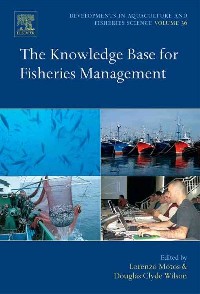
The knowledge base for fisheries management / 1st ed.
副标题:无
作 者:edited by Lorenzo Motos, Douglas Clyde Wilson.
分类号:
ISBN:9780444528506
微信扫一扫,移动浏览光盘
简介
Fisheries are in a state of crisis throughout the world. While there has been some success, truly effective fisheries management seems beyond our grasp. The knowledgeneeded for proper management contains a broad array of facts and connections from statistical stock assessments, to the information that allows government agencies to track compliance with rules and beyond. This book describes the state-of-the-art knowledge about fishery systems. Seldom seen in a scientific publication regardingfisheries science, this book presents a multidisciplinary perspective of fisheries management. Leading fisheries scholars with backgrounds in biology, ecology, economics and sociology ask how management institutions can learn and put their lessons to use. The Knowledge Base for Fisheries Management offers a unique overview of the worldof fisheries management and provides the background to draw conclusions of what is needed to improve management. Covering a wide range of regimes, case studies and professional perspectives, this publication will be an obliged reference to anyone involved on fisheries management, assessment, policy making or fisheries development all over the world. * The only book on the market that analyzes fisheries in a biological, sociological and economic way * Fills a gap, focusing not only on the production of knowledge for fisheries management but also on how it is used in all steps of the management system and the decision making processes * Focuses on the hot topic: scientific knowledge and society-science based policies * Documents disseminated research from many different management systems, both European and world wide.
目录
Foreword p. xv
Acknowledgements p. xvii
List of Contributors p. xix
1 Introduction: The Knowledge Base as Process Douglas Clyde Wilson and Ikerne del Valle and Renee Jessen and Lorenzo Motos p. 1
1.1 The commons and why we need management institutions p. 2
1.2 Defining the problem: The tragedy of the commons p. 3
1.2.1 Implications for the knowledge base p. 7
1.3 The elements of institutional design p. 7
1.4 Institutional design I: Property rights as the basis of good management regimes p. 9
1.4.1 Rights-based approaches and the knowledge base p. 12
1.5 Institutional design II: Community approaches p. 12
1.5.1 Community-based approaches and the knowledge base p. 15
1.6 Institutional processes: A new role for science p. 15
1.7 An overview of the book p. 18
References p. 23
Section 1 Global Experiences with Management Systems relevant to Europe p. 27
2 International Management of Shared Stocks Martin Aranda and Arantza Murillas and Lorenzo Motos p. 29
2.1 Introduction p. 29
2.2 Basic definitions p. 29
2.3 Management objectives p. 30
2.3.1 Objectives of states concerned p. 31
2.3.2 Conflict and other problems p. 31
2.4 Management tools p. 32
2.4.1 Cooperative and non-cooperative management p. 32
2.4.2 Negotiation and arrangements p. 35
2.4.3 Allocation p. 36
2.4.4 Management instruments p. 38
2.5 The production of knowledge p. 40
2.5.1 Cooperative research or the first level of cooperation p. 41
2.5.2 Non-cooperative management and the fear of knowledge sharing p. 43
2.5.3 Biological and ecological knowledge required p. 43
2.5.4 Economic knowledge and costs of cooperation p. 45
2.5.5 Knowledge of technological factors p. 47
2.5.6 Knowledge of social factors p. 47
2.6 Institutional support for knowledge production, advice, communication and decision-making p. 48
2.7 Control, enforcement and compliance p. 49
2.8 Conclusions p. 51
Acknowledgements p. 52
References p. 52
3 Right-Based Fisheries Management Ikerne del Valle and Ellen Hoefnagel and Kepa Astorkiza and Inma Astorkiza p. 55
3.1 Introduction p. 55
3.2 Main features of an ITQ system p. 56
3.3 The knowledge base for ITQs p. 62
3.3.1 The knowledge base for TAC setting: biological objectives p. 63
3.3.2 The knowledge base for ITQs: efficiency and welfare objectives p. 74
3.4 Concluding remarks p. 80
References p. 82
4 The Knowledge Base of Co-Management Ellen Hoefnagel and Amy Burnett and Doug Clyde Wilson p. 85
4.1 Introduction p. 85
4.2 The idea of fisheries co-management p. 86
4.3 Different forms of knowledge p. 88
4.3.1 Tacit vs. discursive knowledge p. 88
4.3.2 Oral vs. written knowledge p. 89
4.3.3 Anecdotal vs. systematic information p. 90
4.4 The knowledge base and worldviews p. 91
4.4.1 Fishers' knowledge p. 93
4.4.2 Knowledge of behaviour p. 93
4.4.3 Shared marine resource knowledge p. 94
4.5 Models of action towards developing a knowledge base for co-management p. 97
4.5.1 The deference model p. 97
4.5.2 The experience-based knowledge model p. 98
4.5.3 The competing constructions model p. 98
4.5.4 Community science p. 100
4.6 Conclusion p. 104
References p. 105
5 Financial Instruments Inma Astorkiza and Kepa Astorkiza and Hans Frost and Erik Lindebo and Ikerne del Valle p. 109
5.1 The theory of taxes and subsidies p. 109
5.1.1 Market failures and taxes p. 109
5.1.2 Definition and types of financial instruments p. 111
5.1.3 Impact of subsidies p. 114
5.1.4 Government positions on subsidies p. 117
5.2 The knowledge base p. 118
5.3 Charges and subsidies around the world p. 122
5.3.1 EU instruments p. 122
5.3.2 Financial instruments in operation outside the EU p. 128
5.4 Conclusion p. 132
5.4.1 Institutional structure p. 133
5.4.2 Management procedures p. 133
5.4.3 Models and data sources p. 134
5.4.4 Scientific advice and communication of advice p. 136
References p. 139
6 Command-and-Control Quota-Based Regimes Martin Aranda and Arantza Murillas and Lorenzo Motos p. 143
6.1 Introduction p. 143
6.2 Portraying command-and-control regimes p. 143
6.3 Management objectives p. 145
6.4 Management tools p. 145
6.4.1 The setting of the TAC p. 146
6.4.2 The allocation of the TAC p. 146
6.5 The production of knowledge p. 147
6.5.1 Knowledge of biological and ecological factors p. 149
6.5.2 Knowledge of social and economic factors p. 151
6.6 Learning from innovative systems: Taking into account users' knowledge p. 153
6.6.1 The DPSIR framework p. 155
6.7 Institutional support for knowledge production, advice and decision-making p. 156
6.8 Control, enforcement, and compliance p. 157
6.9 Conclusions p. 158
Acknowledgements p. 160
References p. 160
7 Effort and Capacity-Based Fisheries Management J. Rasmus Nielsen and Per J. Sparre and Holger Hovgard and Hans Frost and George Tserpes p. 163
7.1 Introduction p. 163
7.2 The knowledge base of effort-based fisheries regulation p. 164
7.3 The example of the demersal gadoid fisheries in the Faeroe islands p. 170
7.3.1 Management objectives p. 171
7.3.2 The regulation framework p. 171
7.3.3 The institutional setup of knowledge production p. 172
7.4 The example of the Australian Northern Prawn mixed fisheries p. 175
7.4.1 Management objectives p. 175
7.4.2 Management instruments p. 177
7.4.3 The production of knowledge p. 179
7.5 The example of the mussel fisheries in Denmark p. 184
7.5.1 Management objectives p. 185
7.5.2 Management instruments p. 185
7.5.3 The production of knowledge p. 187
7.6 The example of the Mediterranean hake mixed fisheries p. 189
7.6.1 Management objectives p. 189
7.6.2 Management instruments p. 189
7.6.3 The institutional setup of knowledge production p. 190
7.7 The example of the North Sea demersal mixed fisheries under the existing eu fishery system p. 192
7.7.1 Management objectives p. 192
7.7.2 Management instruments p. 194
7.7.3 The institutional setup of knowledge production p. 195
7.8 Conclusions p. 203
7.A Introduction to the "MTAC Model" and its use for calculation of maximum number of sea days p. 208
7.A.1 The EU implementation of the precautionary approach of fisheries management p. 208
7.A.2 Mean number of sea days p. 208
7.A.3 The STECF approach to mixed fisheries TACs p. 209
7.A.4 Using the MTAC Model to calculate the number of sea-days p. 212
References p. 212
Section 2 Issues Relevant to the European Level p. 217
8 Fisheries Policy-Making: Production and Use of Knowledge Troels Jacob Hegland p. 219
8.1 Introduction p. 219
8.2 The ICES-EU system p. 220
8.2.1 International Council for the Exploration of the Sea p. 220
8.2.2 European Union p. 222
8.3 Regional fisheries management organisations p. 231
8.3.1 North-West Atlantic Fisheries Organisation p. 232
8.3.2 International Commission for the Conservation of Atlantic Tuna p. 232
8.3.3 General Fisheries Commission for the Mediterranean p. 233
8.4 Elements of reform p. 233
8.5 Conclusion p. 235
Acknowledgements p. 235
References p. 236
9 Participation Kepa Astorkiza and Ikerne del Valle and Inma Astorkiza and Troels Jacob Hegland and Sean Pascoe p. 239
9.1 Decision making theory p. 239
9.1.1 The incorporation of participation in modelling p. 241
9.2 European institutions, participation and knowledge provision p. 242
9.3 Different approaches to the problem: Modes of constructing a collaborative knowledge base p. 244
9.3.1 Deference model p. 245
9.3.2 Experience-based knowledge (EBK) p. 246
9.3.3 Competing constructions p. 250
9.3.4 Science as community p. 255
9.4 Regional advisory councils p. 256
9.4.1 Regional Advisory Councils and Participation p. 256
9.4.2 The knowledge base of the Regional Advisory Councils p. 258
9.5 Concluding remarks p. 263
References p. 264
10 Ecological Side-Effects of Fishing from the Fisheries Management Perspective George Tserpes and P. Peristeraki and J. Rasmus Nielsen p. 267
10.1 Introduction p. 267
10.2 Main ecological side-effects of fishing p. 268
10.2.1 By-catches and discards p. 268
10.2.2 Effects on the population level (changes in size structure and life history parameters) p. 269
10.2.3 Effects on species diversity and genetic structure of communities p. 270
10.2.4 Other effects on community structure p. 271
10.2.5 Impacts on benthos and benthic habitats p. 272
10.2.6 Ghost fishing p. 273
10.2.7 Interaction between seabirds and fisheries p. 274
10.3 Selected examples of EU fisheries having significant ecological side-effects and the related management actions p. 274
10.3.1 Discards in EU fisheries-the case of the North Sea Flatfish Fisheries p. 274
10.3.2 North Sea beam trawl fishery-effects on the benthic community p. 277
10.3.3 Industrial fisheries for sandeel in the North Sea-effects on food resources for seabirds p. 280
10.3.4 Gillnet and mid-water trawl fisheries in the North Sea-Effects on small cetaceans p. 282
10.3.5 Driftnets for large pelagic species in the Mediterranean-effects on marine mammals p. 283
10.3.6 Bottom trawls in the Mediterranean littoral zone-effects on sensitive habitats p. 284
10.4 Current European fisheries management systems and ecological side-effects of fishing p. 285
10.5 Conclusions p. 287
References p. 288
11 Fisheries-Based Management and Advice in Europe Wim Demare p. 295
11.1 Introduction p. 295
11.2 Context of the European Common Fisheries Policy p. 296
11.3 Fishery-based management and advice in the CFP p. 297
11.3.1 The North East Atlantic (NEA) p. 297
11.3.2 The Mediterranean p. 298
11.4 Towards fishery-based advice and management p. 299
11.4.1 The MTAC model p. 299
11.4.2 Data p. 301
11.4:3 Relative stability and alternative management regimes p. 301
Conclusion p. 303
Acknowledgements p. 304
References p. 304
12 The Requirements of an Ecosystem Approach to Fisheries Management Henrik Gislason p. 307
12.1 Introduction p. 307
12.2 The Ecosystem Approach to Fisheries Management-What is it? p. 308
12.2.1 The concept p. 308
12.2.2 Management objectives p. 310
12.2.3 Making high level objectives operational p. 311
12.2.4 Indicators p. 311
12.2.5 Dealing with uncertainty, complexity and subtle change p. 314
12.3 Management tools p. 317
12.3.1 MPAs p. 317
12.3.2 Gear modifications p. 319
12.3.3 Eco-labelling p. 320
12.4 Conclusions p. 323
References p. 324
13 Delivering Complex Scientific Advice to Multiple Stakeholders Douglas Clyde Wilson and Sean Pascoe p. 329
13.1 Introduction p. 329
13.2 Defining the problem p. 331
13.2.1 The precautionary principle and the form of advice p. 331
13.2.2 Creating a useful common picture of the situation p. 332
13.3 The dimensions of the problem of formulating advice p. 335
13.3.1 Multiple scales p. 335
13.3.2 Multiple uses and multiple users p. 338
13.3.3 Multiple objectives p. 339
13.3.4 Multiple costs p. 340
13.4 Modelling reality and the forms of advice p. 341
13.4.1 Dealing with complexity and uncertainty in the provision of advice through models p. 341
13.4.2 Communication knowledge and advice using models p. 344
13.4.3 Use of indicators for communicating and relaying information p. 345
13.5 The development of fisheries management strategies p. 346
13.6 Conclusion p. 350
References p. 351
14 Non-Compliance and Fisheries Policy Formulation Aaron Hatcher and Sean Pascoe p. 355
14.1 Introduction p. 355
14.2 Non-compliance, the knowledge base and fisheries policy formulation p. 356
14.3 Models of individuals' behaviour and non-compliance p. 358
14.4 Empirical studies of compliance in fisheries p. 363
14.5 The relationship between non-compliance and the management regime p. 365
14.6 Modelling non-compliance p. 366
14.7 Conclusions p. 368
References p. 369
Section 3 Scenario Modelling as Support for Fisheries Management System Evaluation p. 375
15 Operational Management Procedures: An Introduction to the Use of Evaluation Frameworks Laurence T. Kell and Jose A.A. De Oliveira and Andre E. Punt and Murdoch K. McAllister and Sakari Kuikka p. 379
15.1 Introduction p. 379
15.2 Rationale p. 381
15.3 Management objectives p. 382
15.4 Description of OMP approach p. 385
15.5 Modelling considerations p. 387
15.5.1 Modelling uncertainty p. 387
15.5.2 Constructing operating models p. 388
15.6 Comparing the OMP and conventional approaches p. 391
15.7 Practical examples p. 393
15.7.1 Icelandic cod p. 393
15.7.2 International Whaling Commission p. 395
15.7.3 South African sardine and anchovy p. 399
15.8 Discussion p. 401
Acknowledgements p. 403
References p. 403
16 Management Strategy Evaluation (MSE) and Management Procedure (MP) Implementations in Practice: A Review of Constraints, Roles and Solutions Martin Aranda and Lorenzo Motos p. 409
16.1 Introduction p. 409
16.2 MSE and MP implementations: The challenges p. 410
16.2.1 Conflicting objectives p. 410
16.2.2 Resistance among decision-makers p. 411
16.2.3 Lack of technical and economic resources p. 412
16.2.4 Stakeholder reluctance p. 413
16.2.5 The communication gap p. 414
16.2.6 The difficulty of including users' knowledge in scientific assessment p. 414
16.3 The role of the different parties during the implementation process p. 415
16.3.1 The role of the institutional setup p. 415
16.3.2 The role of scientists in the process of implementation p. 416
16.3.3 The role of stakeholders: Stakeholders' knowledge inclusion and active participation in the process p. 416
16.4 Finding solutions: Bridging the gap between the parties p. 418
Acknowledgements p. 419
References p. 420
Section 4 Summary and Conclusions p. 423
17 The Role of Science within Modern Management Processes with the Development of Model-Based Evaluation Tools Lorenzo Motos and Douglas Clyde Wilson p. 425
17.1 Introduction p. 425
17.2 Meeting new management challenges p. 426
17.3 The knowledge base for modern management p. 428
17.3.1 Decision-making with uncertain knowledge p. 428
17.3.2 Management option evaluation by scenario modelling p. 429
17.3.3 Towards an integrated management approach p. 430
17.3.4 Constraints for introducing modern management procedures p. 431
17.4 The role of science p. 432
17.4.1 Science for scenario modelling p. 433
17.4.2 Stakeholder participation p. 434
17.5 Conclusion p. 435
Acknowledgements p. 436
References p. 436
Acronyms p. 437
Index p. 443
Acknowledgements p. xvii
List of Contributors p. xix
1 Introduction: The Knowledge Base as Process Douglas Clyde Wilson and Ikerne del Valle and Renee Jessen and Lorenzo Motos p. 1
1.1 The commons and why we need management institutions p. 2
1.2 Defining the problem: The tragedy of the commons p. 3
1.2.1 Implications for the knowledge base p. 7
1.3 The elements of institutional design p. 7
1.4 Institutional design I: Property rights as the basis of good management regimes p. 9
1.4.1 Rights-based approaches and the knowledge base p. 12
1.5 Institutional design II: Community approaches p. 12
1.5.1 Community-based approaches and the knowledge base p. 15
1.6 Institutional processes: A new role for science p. 15
1.7 An overview of the book p. 18
References p. 23
Section 1 Global Experiences with Management Systems relevant to Europe p. 27
2 International Management of Shared Stocks Martin Aranda and Arantza Murillas and Lorenzo Motos p. 29
2.1 Introduction p. 29
2.2 Basic definitions p. 29
2.3 Management objectives p. 30
2.3.1 Objectives of states concerned p. 31
2.3.2 Conflict and other problems p. 31
2.4 Management tools p. 32
2.4.1 Cooperative and non-cooperative management p. 32
2.4.2 Negotiation and arrangements p. 35
2.4.3 Allocation p. 36
2.4.4 Management instruments p. 38
2.5 The production of knowledge p. 40
2.5.1 Cooperative research or the first level of cooperation p. 41
2.5.2 Non-cooperative management and the fear of knowledge sharing p. 43
2.5.3 Biological and ecological knowledge required p. 43
2.5.4 Economic knowledge and costs of cooperation p. 45
2.5.5 Knowledge of technological factors p. 47
2.5.6 Knowledge of social factors p. 47
2.6 Institutional support for knowledge production, advice, communication and decision-making p. 48
2.7 Control, enforcement and compliance p. 49
2.8 Conclusions p. 51
Acknowledgements p. 52
References p. 52
3 Right-Based Fisheries Management Ikerne del Valle and Ellen Hoefnagel and Kepa Astorkiza and Inma Astorkiza p. 55
3.1 Introduction p. 55
3.2 Main features of an ITQ system p. 56
3.3 The knowledge base for ITQs p. 62
3.3.1 The knowledge base for TAC setting: biological objectives p. 63
3.3.2 The knowledge base for ITQs: efficiency and welfare objectives p. 74
3.4 Concluding remarks p. 80
References p. 82
4 The Knowledge Base of Co-Management Ellen Hoefnagel and Amy Burnett and Doug Clyde Wilson p. 85
4.1 Introduction p. 85
4.2 The idea of fisheries co-management p. 86
4.3 Different forms of knowledge p. 88
4.3.1 Tacit vs. discursive knowledge p. 88
4.3.2 Oral vs. written knowledge p. 89
4.3.3 Anecdotal vs. systematic information p. 90
4.4 The knowledge base and worldviews p. 91
4.4.1 Fishers' knowledge p. 93
4.4.2 Knowledge of behaviour p. 93
4.4.3 Shared marine resource knowledge p. 94
4.5 Models of action towards developing a knowledge base for co-management p. 97
4.5.1 The deference model p. 97
4.5.2 The experience-based knowledge model p. 98
4.5.3 The competing constructions model p. 98
4.5.4 Community science p. 100
4.6 Conclusion p. 104
References p. 105
5 Financial Instruments Inma Astorkiza and Kepa Astorkiza and Hans Frost and Erik Lindebo and Ikerne del Valle p. 109
5.1 The theory of taxes and subsidies p. 109
5.1.1 Market failures and taxes p. 109
5.1.2 Definition and types of financial instruments p. 111
5.1.3 Impact of subsidies p. 114
5.1.4 Government positions on subsidies p. 117
5.2 The knowledge base p. 118
5.3 Charges and subsidies around the world p. 122
5.3.1 EU instruments p. 122
5.3.2 Financial instruments in operation outside the EU p. 128
5.4 Conclusion p. 132
5.4.1 Institutional structure p. 133
5.4.2 Management procedures p. 133
5.4.3 Models and data sources p. 134
5.4.4 Scientific advice and communication of advice p. 136
References p. 139
6 Command-and-Control Quota-Based Regimes Martin Aranda and Arantza Murillas and Lorenzo Motos p. 143
6.1 Introduction p. 143
6.2 Portraying command-and-control regimes p. 143
6.3 Management objectives p. 145
6.4 Management tools p. 145
6.4.1 The setting of the TAC p. 146
6.4.2 The allocation of the TAC p. 146
6.5 The production of knowledge p. 147
6.5.1 Knowledge of biological and ecological factors p. 149
6.5.2 Knowledge of social and economic factors p. 151
6.6 Learning from innovative systems: Taking into account users' knowledge p. 153
6.6.1 The DPSIR framework p. 155
6.7 Institutional support for knowledge production, advice and decision-making p. 156
6.8 Control, enforcement, and compliance p. 157
6.9 Conclusions p. 158
Acknowledgements p. 160
References p. 160
7 Effort and Capacity-Based Fisheries Management J. Rasmus Nielsen and Per J. Sparre and Holger Hovgard and Hans Frost and George Tserpes p. 163
7.1 Introduction p. 163
7.2 The knowledge base of effort-based fisheries regulation p. 164
7.3 The example of the demersal gadoid fisheries in the Faeroe islands p. 170
7.3.1 Management objectives p. 171
7.3.2 The regulation framework p. 171
7.3.3 The institutional setup of knowledge production p. 172
7.4 The example of the Australian Northern Prawn mixed fisheries p. 175
7.4.1 Management objectives p. 175
7.4.2 Management instruments p. 177
7.4.3 The production of knowledge p. 179
7.5 The example of the mussel fisheries in Denmark p. 184
7.5.1 Management objectives p. 185
7.5.2 Management instruments p. 185
7.5.3 The production of knowledge p. 187
7.6 The example of the Mediterranean hake mixed fisheries p. 189
7.6.1 Management objectives p. 189
7.6.2 Management instruments p. 189
7.6.3 The institutional setup of knowledge production p. 190
7.7 The example of the North Sea demersal mixed fisheries under the existing eu fishery system p. 192
7.7.1 Management objectives p. 192
7.7.2 Management instruments p. 194
7.7.3 The institutional setup of knowledge production p. 195
7.8 Conclusions p. 203
7.A Introduction to the "MTAC Model" and its use for calculation of maximum number of sea days p. 208
7.A.1 The EU implementation of the precautionary approach of fisheries management p. 208
7.A.2 Mean number of sea days p. 208
7.A.3 The STECF approach to mixed fisheries TACs p. 209
7.A.4 Using the MTAC Model to calculate the number of sea-days p. 212
References p. 212
Section 2 Issues Relevant to the European Level p. 217
8 Fisheries Policy-Making: Production and Use of Knowledge Troels Jacob Hegland p. 219
8.1 Introduction p. 219
8.2 The ICES-EU system p. 220
8.2.1 International Council for the Exploration of the Sea p. 220
8.2.2 European Union p. 222
8.3 Regional fisheries management organisations p. 231
8.3.1 North-West Atlantic Fisheries Organisation p. 232
8.3.2 International Commission for the Conservation of Atlantic Tuna p. 232
8.3.3 General Fisheries Commission for the Mediterranean p. 233
8.4 Elements of reform p. 233
8.5 Conclusion p. 235
Acknowledgements p. 235
References p. 236
9 Participation Kepa Astorkiza and Ikerne del Valle and Inma Astorkiza and Troels Jacob Hegland and Sean Pascoe p. 239
9.1 Decision making theory p. 239
9.1.1 The incorporation of participation in modelling p. 241
9.2 European institutions, participation and knowledge provision p. 242
9.3 Different approaches to the problem: Modes of constructing a collaborative knowledge base p. 244
9.3.1 Deference model p. 245
9.3.2 Experience-based knowledge (EBK) p. 246
9.3.3 Competing constructions p. 250
9.3.4 Science as community p. 255
9.4 Regional advisory councils p. 256
9.4.1 Regional Advisory Councils and Participation p. 256
9.4.2 The knowledge base of the Regional Advisory Councils p. 258
9.5 Concluding remarks p. 263
References p. 264
10 Ecological Side-Effects of Fishing from the Fisheries Management Perspective George Tserpes and P. Peristeraki and J. Rasmus Nielsen p. 267
10.1 Introduction p. 267
10.2 Main ecological side-effects of fishing p. 268
10.2.1 By-catches and discards p. 268
10.2.2 Effects on the population level (changes in size structure and life history parameters) p. 269
10.2.3 Effects on species diversity and genetic structure of communities p. 270
10.2.4 Other effects on community structure p. 271
10.2.5 Impacts on benthos and benthic habitats p. 272
10.2.6 Ghost fishing p. 273
10.2.7 Interaction between seabirds and fisheries p. 274
10.3 Selected examples of EU fisheries having significant ecological side-effects and the related management actions p. 274
10.3.1 Discards in EU fisheries-the case of the North Sea Flatfish Fisheries p. 274
10.3.2 North Sea beam trawl fishery-effects on the benthic community p. 277
10.3.3 Industrial fisheries for sandeel in the North Sea-effects on food resources for seabirds p. 280
10.3.4 Gillnet and mid-water trawl fisheries in the North Sea-Effects on small cetaceans p. 282
10.3.5 Driftnets for large pelagic species in the Mediterranean-effects on marine mammals p. 283
10.3.6 Bottom trawls in the Mediterranean littoral zone-effects on sensitive habitats p. 284
10.4 Current European fisheries management systems and ecological side-effects of fishing p. 285
10.5 Conclusions p. 287
References p. 288
11 Fisheries-Based Management and Advice in Europe Wim Demare p. 295
11.1 Introduction p. 295
11.2 Context of the European Common Fisheries Policy p. 296
11.3 Fishery-based management and advice in the CFP p. 297
11.3.1 The North East Atlantic (NEA) p. 297
11.3.2 The Mediterranean p. 298
11.4 Towards fishery-based advice and management p. 299
11.4.1 The MTAC model p. 299
11.4.2 Data p. 301
11.4:3 Relative stability and alternative management regimes p. 301
Conclusion p. 303
Acknowledgements p. 304
References p. 304
12 The Requirements of an Ecosystem Approach to Fisheries Management Henrik Gislason p. 307
12.1 Introduction p. 307
12.2 The Ecosystem Approach to Fisheries Management-What is it? p. 308
12.2.1 The concept p. 308
12.2.2 Management objectives p. 310
12.2.3 Making high level objectives operational p. 311
12.2.4 Indicators p. 311
12.2.5 Dealing with uncertainty, complexity and subtle change p. 314
12.3 Management tools p. 317
12.3.1 MPAs p. 317
12.3.2 Gear modifications p. 319
12.3.3 Eco-labelling p. 320
12.4 Conclusions p. 323
References p. 324
13 Delivering Complex Scientific Advice to Multiple Stakeholders Douglas Clyde Wilson and Sean Pascoe p. 329
13.1 Introduction p. 329
13.2 Defining the problem p. 331
13.2.1 The precautionary principle and the form of advice p. 331
13.2.2 Creating a useful common picture of the situation p. 332
13.3 The dimensions of the problem of formulating advice p. 335
13.3.1 Multiple scales p. 335
13.3.2 Multiple uses and multiple users p. 338
13.3.3 Multiple objectives p. 339
13.3.4 Multiple costs p. 340
13.4 Modelling reality and the forms of advice p. 341
13.4.1 Dealing with complexity and uncertainty in the provision of advice through models p. 341
13.4.2 Communication knowledge and advice using models p. 344
13.4.3 Use of indicators for communicating and relaying information p. 345
13.5 The development of fisheries management strategies p. 346
13.6 Conclusion p. 350
References p. 351
14 Non-Compliance and Fisheries Policy Formulation Aaron Hatcher and Sean Pascoe p. 355
14.1 Introduction p. 355
14.2 Non-compliance, the knowledge base and fisheries policy formulation p. 356
14.3 Models of individuals' behaviour and non-compliance p. 358
14.4 Empirical studies of compliance in fisheries p. 363
14.5 The relationship between non-compliance and the management regime p. 365
14.6 Modelling non-compliance p. 366
14.7 Conclusions p. 368
References p. 369
Section 3 Scenario Modelling as Support for Fisheries Management System Evaluation p. 375
15 Operational Management Procedures: An Introduction to the Use of Evaluation Frameworks Laurence T. Kell and Jose A.A. De Oliveira and Andre E. Punt and Murdoch K. McAllister and Sakari Kuikka p. 379
15.1 Introduction p. 379
15.2 Rationale p. 381
15.3 Management objectives p. 382
15.4 Description of OMP approach p. 385
15.5 Modelling considerations p. 387
15.5.1 Modelling uncertainty p. 387
15.5.2 Constructing operating models p. 388
15.6 Comparing the OMP and conventional approaches p. 391
15.7 Practical examples p. 393
15.7.1 Icelandic cod p. 393
15.7.2 International Whaling Commission p. 395
15.7.3 South African sardine and anchovy p. 399
15.8 Discussion p. 401
Acknowledgements p. 403
References p. 403
16 Management Strategy Evaluation (MSE) and Management Procedure (MP) Implementations in Practice: A Review of Constraints, Roles and Solutions Martin Aranda and Lorenzo Motos p. 409
16.1 Introduction p. 409
16.2 MSE and MP implementations: The challenges p. 410
16.2.1 Conflicting objectives p. 410
16.2.2 Resistance among decision-makers p. 411
16.2.3 Lack of technical and economic resources p. 412
16.2.4 Stakeholder reluctance p. 413
16.2.5 The communication gap p. 414
16.2.6 The difficulty of including users' knowledge in scientific assessment p. 414
16.3 The role of the different parties during the implementation process p. 415
16.3.1 The role of the institutional setup p. 415
16.3.2 The role of scientists in the process of implementation p. 416
16.3.3 The role of stakeholders: Stakeholders' knowledge inclusion and active participation in the process p. 416
16.4 Finding solutions: Bridging the gap between the parties p. 418
Acknowledgements p. 419
References p. 420
Section 4 Summary and Conclusions p. 423
17 The Role of Science within Modern Management Processes with the Development of Model-Based Evaluation Tools Lorenzo Motos and Douglas Clyde Wilson p. 425
17.1 Introduction p. 425
17.2 Meeting new management challenges p. 426
17.3 The knowledge base for modern management p. 428
17.3.1 Decision-making with uncertain knowledge p. 428
17.3.2 Management option evaluation by scenario modelling p. 429
17.3.3 Towards an integrated management approach p. 430
17.3.4 Constraints for introducing modern management procedures p. 431
17.4 The role of science p. 432
17.4.1 Science for scenario modelling p. 433
17.4.2 Stakeholder participation p. 434
17.5 Conclusion p. 435
Acknowledgements p. 436
References p. 436
Acronyms p. 437
Index p. 443
The knowledge base for fisheries management / 1st ed.
- 名称
- 类型
- 大小
光盘服务联系方式: 020-38250260 客服QQ:4006604884
云图客服:
用户发送的提问,这种方式就需要有位在线客服来回答用户的问题,这种 就属于对话式的,问题是这种提问是否需要用户登录才能提问
Video Player
×
Audio Player
×
pdf Player
×
