

简介
Summary:
Publisher Summary 1
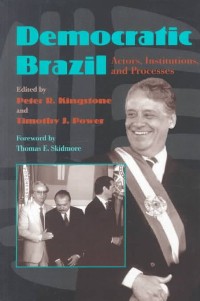
After 21 years of military rule, Brazil returned to democracy in 1985. Over the past decade and a half, Brazilians in the Nova Rep煤blica (New Republic) have struggled with a range of diverse challenges that have tested the durability and quality of the young democracy. How well have they succeeded? To what extent can we say that Brazilian democracy has consolidated? What actors, institutions, and processes have emerged as most salient over the past 15 years? Although Brazil is Latin America's largest country, the world's third largest democracy, and a country with a population and GNP larger than Yeltsin's Russia, more than a decade has passed since the last collaborative effort to examine regime change in Brazil, and no work in English has yet provided a comprehensive appraisal of Brazilian democracy in the period since 1985.Democratic Brazilanalyzes Brazilian democracy in a comprehensive, systematic fashion, covering the full period of the New Republic from Presidents Sarney to Cardoso. Democratic Brazil brings together twelve top scholars, the “next generation of Brazilianists,” with wide-ranging specialties including institutional analysis, state autonomy, federalism and decentralization, economic management and business-state relations, the military, the Catholic Church and the new religious pluralism, social movements, the left, regional integration, demographic change, and human rights and the rule of law. Each chapter focuses on a crucial process or actor in the New Republic, with emphasis on its relationship to democratic consolidation. The volume also contains a comprehensive bibliography on Brazilian politics and society since 1985. Prominent Brazilian historian Thomas Skidmore has contributed a foreword to the volume.Democratic Brazilspeaks to a wide audience, including Brazilianists, Latin Americanists generally, students of comparative democratization, as well as specialists within the various thematic subfields represented by the contributors. Written in a clear, accessible style, the book is ideally suited for use in upper-level undergraduate courses and graduate seminars on Latin American politics and development.
目录
List of Figures and Tables p. vii
Foreword: A New Test for Brazilian Democracy Thomas E. Skidmore p. xi
Acknowledgments p. xix
Introduction: Still Standing or Standing Still? The Brazilian Democratic Regime Since 1985 Peter R. Kingstone and Timothy J. Power p. 3
Part I The Institutional and Policy-Making Context
1 Political Institutions in Democratic Brazil: Politics as a Permanent Constitutional Convention Timothy J. Power p. 17
2 The Brazilian State in the New Democracy Kurt Weyland p. 36
3 Devolving Democracy? Political Decentralization and the New Brazilian Federalism Alfred P. Montero p. 58
4 Reinventing Local Government? Municipalities and Intergovernmental Relations in Democratic Brazil David Samuels p. 77
Part II Critical Actors in the New Democracy
5 Assessing Civil-Military Relations in Postauthoritarian Brazil Wendy Hunter p. 101
6 The Making of a Loyal Opposition: The Workers' Party (PT) and the Consolidation of Democracy in Brazil William R. Nylen p. 126
7 The Catholic Church, Religious Pluralism, and Democracy in Brazil Kenneth P. Serbin p. 144
8 Democratizing Pressures from Below? Social Movements in the New Brazilian Democracy Kathryn Hochstetler p. 167
Part 3 Emerging Processes in the New Democracy
9 Muddling Through Gridlock: Economic Policy Performance, Business Responses, and Democratic Sustainability Peter R. Kingstone p. 185
10 Democracy Looks South: Mercosul and the Politics of Brazilian Trade Strategy Jeffrey Cason p. 204
11 An Ugly Democracy? State Violence and the Rule of Law in Postauthoritarian Brazil Anthony W. Pereira p. 217
12 A New Brazil? The Changing Sociodemographic Context of Brazilian Democracy Timothy J. Power and J. Timmons Roberts p. 236
Notes p. 263
Bibliography p. 289
Contributors p. 327
Index p. 331
Foreword: A New Test for Brazilian Democracy Thomas E. Skidmore p. xi
Acknowledgments p. xix
Introduction: Still Standing or Standing Still? The Brazilian Democratic Regime Since 1985 Peter R. Kingstone and Timothy J. Power p. 3
Part I The Institutional and Policy-Making Context
1 Political Institutions in Democratic Brazil: Politics as a Permanent Constitutional Convention Timothy J. Power p. 17
2 The Brazilian State in the New Democracy Kurt Weyland p. 36
3 Devolving Democracy? Political Decentralization and the New Brazilian Federalism Alfred P. Montero p. 58
4 Reinventing Local Government? Municipalities and Intergovernmental Relations in Democratic Brazil David Samuels p. 77
Part II Critical Actors in the New Democracy
5 Assessing Civil-Military Relations in Postauthoritarian Brazil Wendy Hunter p. 101
6 The Making of a Loyal Opposition: The Workers' Party (PT) and the Consolidation of Democracy in Brazil William R. Nylen p. 126
7 The Catholic Church, Religious Pluralism, and Democracy in Brazil Kenneth P. Serbin p. 144
8 Democratizing Pressures from Below? Social Movements in the New Brazilian Democracy Kathryn Hochstetler p. 167
Part 3 Emerging Processes in the New Democracy
9 Muddling Through Gridlock: Economic Policy Performance, Business Responses, and Democratic Sustainability Peter R. Kingstone p. 185
10 Democracy Looks South: Mercosul and the Politics of Brazilian Trade Strategy Jeffrey Cason p. 204
11 An Ugly Democracy? State Violence and the Rule of Law in Postauthoritarian Brazil Anthony W. Pereira p. 217
12 A New Brazil? The Changing Sociodemographic Context of Brazilian Democracy Timothy J. Power and J. Timmons Roberts p. 236
Notes p. 263
Bibliography p. 289
Contributors p. 327
Index p. 331
- 名称
- 类型
- 大小
光盘服务联系方式: 020-38250260 客服QQ:4006604884
云图客服:
用户发送的提问,这种方式就需要有位在线客服来回答用户的问题,这种 就属于对话式的,问题是这种提问是否需要用户登录才能提问
Video Player
×
Audio Player
×
pdf Player
×
