

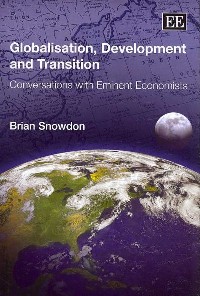
Globalisation, development and transition : conversations with eminent economists /
副标题:无
作 者:by Brian Snowdon
分类号:
ISBN:9781845428501
微信扫一扫,移动浏览光盘
简介
Summary:
Publisher Summary 1
This volume by Snowdon (economics and international business, Northumbria U., UK) is really two books in one. The first is an explanatory survey of the major global economic issues--the causes and consequences of increasing international economic integration and globalization, long-run economic growth and development, the rise and fall of the socialist economies, and the problems of transition to capitalism--that is characterized by an emphasis on the importance of economic history. The second revisits these themes within interviews with prominent economists including Daron Acemoglu, Alberto Alesina, Padma Desai, William Easterly, Stanley Fischer, J谩nos Kornai, Michael Porter, Dani Rodrix, Jeffrey Sachs, Xavier Sala-i-Martin, and Jeffrey Willamson. Annotation 漏2008 Book News, Inc., Portland, OR (booknews.com)
目录
Table Of Contents:
List of figures ix
List of tables xi
Preface xiii
Acknowledgements xvii
1 The fall and rise of globalisation 1
1.1 Introduction 1
1.2 Globalisation v. 'globaphobia' 2
1.3 The gains from trade and good governance 5
1.4 When did globalisation begin? 10
1.5 The 'Great Reversal': international disintegration and recovery 16
1.6 Financial globalisation 20
1.7 The benefits and costs of financial integration 22
1.8 Exchange rate regimes and the 'open-economy trilemma' 28
1.9 The role of the International Monetary Fund 29
1.10 Globalisation and the IMF: some lessons from the 1990's 30
1.11 International labour migration 33
1.12 The 'offshore outsourcing' controversy 40
1.13 The size of nations 42
1.14 Growth, productivity and international competitiveness 43
1.15 Analysing global competitiveness 46
1.16 The Growth Competitiveness Index 47
1.17 The Business Competitiveness Index 50
1.18 The Global Competitiveness Index 53
1.19 Improving competitiveness in developing countries 57
1.20 Conclusion 60
2 Economic development in historical perspective 62
2.1 Introduction 62
2.2 The 'Great Escape' 65
2.3 Alternative measures of 'progress' 72
2.3.1 Income measures 72
2.3.2 Beyond income measures of progress: basic needs, the PQLI and life expectancy 74
2.3.3 The Human Development Index 80
2.3.4 Competitiveness indices 82
2.3.5 Measures of freedom 84
2.3.6 Anthropometrics 88
2.3.7 The economics of obesity 90
2.3.8 The economics of happiness and life satisfaction 95
2.4 The birth of development economics 97
2.5 From the 'clirigiste consensus' to the 'Washington Consensus' and beyond 100
2.6 Growth and development 102
2.7 Growth, development and the role of institutions 105
2.8 Economic history and institutions 107
2.9 Bandits and kleptocrats 109
2.10 Barriers to growth and development 110
2.11 Sub-Saharan Africa's 'growth tragedy' 112
2.12 From 'Marshall Plan' to Millennium Development Goals 120
2.13 2005: a 'pivotal year' in the development debate? 122
2.14 The foreign aid controversy 124
2.15 Aid and poverty traps 130
2.16 Foreign aid: a 'weapon of mass salvation' 138
2.17 Conclusion 139
3 The rise and fall of the socialist system and the trials of transition 142
3.1 Introduction 142
3.2 The legacy of Marx 143
3.3 The rise and fall of the socialist system and the Soviet Union, 1917-91 148
3.4 From 'golden age' growth to slowdown 154
3.5 Western perceptions of the socialist system 158
3.6 Economic analysis under socialism 161
3.7 From glasnost and perestroika to transition 162
3.8 The political economy of transition 164
3.9 A third way: is market socialism feasible? 166
3.10 Alternative paths of transition: the shock therapy v. gradualism debate 170
3.11 The political economy of reform 175
3.12 Conclusion 181
INTERVIEWS
Daron Acemoglu (Massachusetts Institute of Technology, Cambridge, USA) 189
Alberto Alesina (Harvard University, Cambridge, USA) 214
Padma Desai (Columbia University, New York, USA) 234
William Easterly (New York University, USA) 261
Stanley Fischer (Governor of the Bank of Israel) 283
J谩nos Kornai (Institute for Advanced Study, Budapest, Hungary) 305
Michael Porter (Harvard Business School, Boston, USA) 333
Dani Rodrik (Harvard University, Cambridge, USA) 352
Jeffrey Sachs (Columbia University, New York, USA) 374
Xavier Sala-i-Martin (Columbia University, New York, USA) 403
Jeffrey Williamson (Harvard University, Cambridge, USA) 428
Bibliography 455
Index 523
List of figures ix
List of tables xi
Preface xiii
Acknowledgements xvii
1 The fall and rise of globalisation 1
1.1 Introduction 1
1.2 Globalisation v. 'globaphobia' 2
1.3 The gains from trade and good governance 5
1.4 When did globalisation begin? 10
1.5 The 'Great Reversal': international disintegration and recovery 16
1.6 Financial globalisation 20
1.7 The benefits and costs of financial integration 22
1.8 Exchange rate regimes and the 'open-economy trilemma' 28
1.9 The role of the International Monetary Fund 29
1.10 Globalisation and the IMF: some lessons from the 1990's 30
1.11 International labour migration 33
1.12 The 'offshore outsourcing' controversy 40
1.13 The size of nations 42
1.14 Growth, productivity and international competitiveness 43
1.15 Analysing global competitiveness 46
1.16 The Growth Competitiveness Index 47
1.17 The Business Competitiveness Index 50
1.18 The Global Competitiveness Index 53
1.19 Improving competitiveness in developing countries 57
1.20 Conclusion 60
2 Economic development in historical perspective 62
2.1 Introduction 62
2.2 The 'Great Escape' 65
2.3 Alternative measures of 'progress' 72
2.3.1 Income measures 72
2.3.2 Beyond income measures of progress: basic needs, the PQLI and life expectancy 74
2.3.3 The Human Development Index 80
2.3.4 Competitiveness indices 82
2.3.5 Measures of freedom 84
2.3.6 Anthropometrics 88
2.3.7 The economics of obesity 90
2.3.8 The economics of happiness and life satisfaction 95
2.4 The birth of development economics 97
2.5 From the 'clirigiste consensus' to the 'Washington Consensus' and beyond 100
2.6 Growth and development 102
2.7 Growth, development and the role of institutions 105
2.8 Economic history and institutions 107
2.9 Bandits and kleptocrats 109
2.10 Barriers to growth and development 110
2.11 Sub-Saharan Africa's 'growth tragedy' 112
2.12 From 'Marshall Plan' to Millennium Development Goals 120
2.13 2005: a 'pivotal year' in the development debate? 122
2.14 The foreign aid controversy 124
2.15 Aid and poverty traps 130
2.16 Foreign aid: a 'weapon of mass salvation' 138
2.17 Conclusion 139
3 The rise and fall of the socialist system and the trials of transition 142
3.1 Introduction 142
3.2 The legacy of Marx 143
3.3 The rise and fall of the socialist system and the Soviet Union, 1917-91 148
3.4 From 'golden age' growth to slowdown 154
3.5 Western perceptions of the socialist system 158
3.6 Economic analysis under socialism 161
3.7 From glasnost and perestroika to transition 162
3.8 The political economy of transition 164
3.9 A third way: is market socialism feasible? 166
3.10 Alternative paths of transition: the shock therapy v. gradualism debate 170
3.11 The political economy of reform 175
3.12 Conclusion 181
INTERVIEWS
Daron Acemoglu (Massachusetts Institute of Technology, Cambridge, USA) 189
Alberto Alesina (Harvard University, Cambridge, USA) 214
Padma Desai (Columbia University, New York, USA) 234
William Easterly (New York University, USA) 261
Stanley Fischer (Governor of the Bank of Israel) 283
J谩nos Kornai (Institute for Advanced Study, Budapest, Hungary) 305
Michael Porter (Harvard Business School, Boston, USA) 333
Dani Rodrik (Harvard University, Cambridge, USA) 352
Jeffrey Sachs (Columbia University, New York, USA) 374
Xavier Sala-i-Martin (Columbia University, New York, USA) 403
Jeffrey Williamson (Harvard University, Cambridge, USA) 428
Bibliography 455
Index 523
Globalisation, development and transition : conversations with eminent economists /
- 名称
- 类型
- 大小
光盘服务联系方式: 020-38250260 客服QQ:4006604884
云图客服:
用户发送的提问,这种方式就需要有位在线客服来回答用户的问题,这种 就属于对话式的,问题是这种提问是否需要用户登录才能提问
Video Player
×
Audio Player
×
pdf Player
×
