

简介
MIT Press Series On Economic Learning and Social Evolution
---
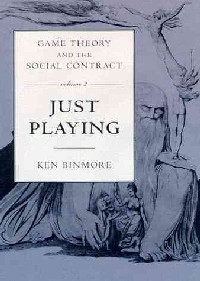
In Volume 1 of Game Theory and the Social Contract, Ken Binmore restated the problems of moral and political philosophy in the language of game theory. In Volume 2, Just Playing, he unveils his own controversial theory, which abandons the metaphysics of Immanuel Kant for the naturalistic approach to morality of David Hume. According to this viewpoint, a fairness norm is a convention that evolved to coordinate behavior on an equilibrium of a society's Game of Life. This approach allows Binmore to mount an evolutionary defense of Rawls's original position that escapes the utilitarian conclusions that follow when orthodox reasoning is applied with the traditional assumptions. Using ideas borrowed from the theory of bargaining and repeated games, Binmore is led instead to a form of egalitarianism that vindicates the intuitions that led Rawls to write his Theory of Justice.
Written for an interdisciplinary audience, Just Playing offers a panoramic tour through a range of new and disturbing insights that game theory brings to anthropology, biology, economics, philosophy, and psychology. It is essential reading for anyone who thinks it likely that ethics evolved along with the human species.
目录
Just Playing
Apology
Contents
Series Foreword
Reading Guide
How much to read?
How far have we got?
Acknowledgment
Introduction: Setting the Scene
0.1 Whither Away?
0.2 The Art of Compromise
0.2.1 Nonsense upon Stilts
0.2.2 Social Contracts
0.2.3 Reform
0.2.4 The Original Position
The Game of Life.
The Game of Morals.
Sympathy and empathy.
0.2.5 Bargaining
The multiperson case.
0.3 Moral Philosophy
Scientific or hortatory?
0.3.1 Traditional Philosophical Categories
0.3.2 Fin de Siècle
0.4 Noncooperative Game Theory
0.4.1 The Ultimatum Game
Pure strategies.
Payoffs.
Nash equilibrium.
Subgame-perfect equilibrium.
0.4.2 Anomalies?
Keeping the logic straight.
Homo sociologicus.
0.5 Cooperative Game Theory
0.5.1 Games in Coalitional Form.
The core.
Stable sets.
0.6 Nash Program
Predicting bargaining outcomes.
Attention to detail.
Gedanken experiments.
Windtunnel models.
Rational bargainers.
Significant details.
Self-policing rules.
Unfinished business.
0.7 Implementation
The Judgment of Solomon.
Designer games.
Implementability criteria.
Implementation and the Nash program.
Chapter 1 Nuances of Negotiation
1.1 Realistic Bargaining Models
1.2 Bargaining Problems
1.2.1 Payoff Regions
Noncooperative payoff regions.
Cooperative payoff regions.
Free disposal.
Transferable utility.
1.2.2 Nash Bargaining Problems
Complex disagreements.
1.2.3 The Bargaining Set
The core.
1.2.4 Dividing the Dollar
Negotiating over payoff flows.
Interest rates.
1.2.5 Edgeworth Box
1.3 Bargaining Solutions
1.3.1 Nash Bargaining Solution
Weighted Nash bargaining solution.
Other characterizations.
Nash solution with outside options.
1.3.2 Kalai-Smorodinsky Solution
1.3.3 Bargaining with Interpersonal Comparison
Weighted utilitarian solution.
Proportional bargaining solution.
When worlds collide.
Fairness and justice.
1.4 Characterizing Bargaining Solutions
1.4.1 The Kalai-Smorodinsky Axioms
Utility calibration axiom.
Symmetry axiom.
Individual monotonicity axiom.
Bargaining and risk-aversion.
Implementing the Kalai-Smorodinsky solution.
1.4.2 The Nash Axioms
Independence of Irrelevant Alternatives.
The Nash solution and risk-aversion.
Implementation.
1.4.3 Renegotiation Axioms
Separable bargaining problems.
Formalizing Renegotiation Consistency.
1.5 Bargaining with Commitment
1.5.1 Nash Demand Game
1.5.2 Fixed and Variable Threats
1.6 Trustless Transactions
1.6.1 Repeated Games
1.6.2 Transitional Arrangements
The Centipede Game and continuous exchange.
Modeling in continuous time.
Renegotiation
1.7 Bargaining without Commitment
1.7.1 The Alternating Offers Game
Proving a special case.
Rubinstein and Nash.
Nash program.
1.7.2 How Realistic is Rubinstein\\u0027s Model?
Reaction times.
Money comes in whole numbers of cents.
Reneging on agreements.
Endogenizing the deadlock payoffs.
Opting out by telephone.
Why subgame-perfection?
1.8 Other Approaches to Bargaining
1.8.1 The Coase Theorem
Social optimality?
1.8.2 Gauthier on Bargaining over a Social Contract
Chapter 2 Evolution in Eden
2.1 The Good, the Right, and the Seemly
2.2 Utilitarianism
2.2.1 Summum Bonum
2.2.2 Ipsedixists
2.2.3 Ideal Observers
2.2.4 Philosopher-King
Political legitimacy.
Kant a utilitarian?
2.2.5 The Social Contract Approach
2.2.6 Rule-Utilitarianism or Act-Utilitarianism?
2.2.7 The Big Picture
Classifying political attitudes.
Egalitarianism.
Modeling unplanned societies?
2.3 Fictitious Postulatum?
2.3.1 Interpersonal Comparison of Utility
Counting perception thresholds.
Zero-one rule.
Bargaining with transaction costs.
Voting.
Cost-benefit analysis.
The Shapley value.
Empathetic preferences
2.4 Evolutionary Ethics
Gott mit uns?
Sociobiology and reductionism.
The moral sense.
2.5 Evolution and Justice
2.5.1 Reciprocity
2.5.2 Kinship
Little birds in their nest agree.
Learned or instinctive behavior?
Hamilton\\u0027s rule.
Extending the family.
Intergenerational transfers.
How many people?
2.5.3 Equilibrium Selection
Kinship and equilibrium selection
Equilibrium selection in humans.
Expanding the circle.
2.5.4 Empathy and Fairness
Insurance contracts and the original position.
Veil of uncertainty.
Symmetric focal points.
From uncertainty to ignorance.
Natura non facit saltus.
Imitation and empathy equilibrium.
2.5.5 The Long and the Short and the Medium
2.6 Nonteleological Utilitarianism
2.6.1 Commitment in Eden
A marriage contract.
Utility theory.
The bargaining problem behind the veil of ignorance.
The state of nature.
Specializing the Game of Life.
Solving the bargaining problem.
2.6.2 Interpersonal Comparison in the Medium Run
2.6.3 Retelling the Rawlsian Story
Gauthier redux?
Garbage in, garbage out.
2.7 Morality as a Short-Run Phenomenon
2.7.1 The Princess and the Pea
Multiple models describing the same behavior.
Naive reductionism?
2.7.2 How Justice Works
2.8 Why Not Utilitarianism?
Enter a cherubim with flaming sword.
Chapter 3 Rationalizing Reciprocity
3.1 Back-scratching
Self-interest.
What will the neighbors say?
Quis custodiet ipsos custodes?
3.2 Rights in a Theory of the Seemly
3.2.1 Rights as Strategies?
3.2.2 Rules for Sustaining an Equilibrium
3.2.3 Moral Responsibility
3.2.4 Free Will
In wand\\u0027ring mazes lost?
Deus ex machina?
Deus in machina?
Counterfactuals.
Mixing metaphors.
3.2.5 Nil Desperandum!
3.3 Folk Theorem
3.3.1 Memes
3.3.2 Finite Automata
3.3.3 Computing Payoffs
3.3.4 Reciprocal Sharing
Casting lots.
Physical transfers.
Insurance deals.
Taking turns.
3.3.5 Crime and Punishment
Minimax.
A more general folk theorem.
Minimal punishments.
Mixed strategies and maximin.
3.3.6 Guardians Who Guard Each Other
3.3.7 Tit for Tat?
Axelrod\\u0027s Olympiad.
Why doesn\\u0027t the tit-for-tat bubble burst?
3.3.8 How Does Cooperation Evolve?
Evolutionary stability.
Evolution and complexity.
Nature a utilitarian?
3.4 Social Contracts in Big Societies
3.4.1 Social Transfers
Anything goes?
3.4.2 Friendship and Coalitions
3.4.3 Police Forces
Detecting cheats.
3.4.4 Punishing the Innocent
Blaming groups for the crimes of individuals.
3.4.5 Leadership and Authority
Neofeudalism and whiggery.
3.5 The Role of the Emotions
3.5.1 Sore Thumbs
3.5.2 Tunnel Vision
Transparent dispositions?
Multiple personalities?
The strategic role of anger.
The Ultimatum Game as a case study.
3.6 Due Process
3.6.1 Anarchy to Statehood
3.6.2 Natural Equilibrium
3.7 Renegotiation
3.7.1 Getting from Here to There
Variable-flow equilibria.
3.7.2 Renegotiation in the Original Position
3.7.3 Making the Punishment Fit the Crime
3.7.4 Renegotiation-Proofness
3.8 What about Moral Values?
3.8.1 Confusing Tastes and Values
By their fruits ye shall know them.
Tastes must be fixed.
Water or diamonds?
Aristotle.
Mill.
Rawls.
Singer.
3.8.2 Das Adam Smith Problem
Private tastes and public values.
3.8.3 Postwelfarism
3.8.4 What Moral Relativism Is Not
Dead gods and supermen.
Teaching children right and wrong.
Chapter 4 Yearning for Utopia
4.1 Introduction
4.2 Envy
Sore thumbs.
The foule sinne of envye.
Compassion and pity.
4.3 Equity in Economics
4.3.1 Envy-Freeness
Divide-and-choose.
The market.
The invisible hand.
Price-takers
Replicating the players.
Equity via the market?
What\\u0027s wrong with envy-freeness?
4.3.2 Welfarism
Cooperative game theory.
The proportional bargaining solution.
Efficiency and equity.
4.4 Equity in Psychology
4.5 Equity in Anthropology
4.5.1 Sharing and Caring
Why share food?
4.5.2 Enforcement in Foraging Societies
Farming versus foraging.
4.5.3 Anarchy in Prehistory?
4.5.4 Kinship in Small Groups
Modern hunter-gatherers.
Prehistoric hunter-gatherers.
Outbreeding and genetic diversity.
Sharing between clans.
4.6 The Game of Morals
4.6.1 Fair Social Contracts
4.6.2 Paradise Lost
4.6.3 Modeling the Original Position
The set of feasible social contracts.
The state of nature.
Bargaining.
Behind the veil of ignorance.
4.6.4 When is Justice Dispensed?
God made them high or lowly?
If at first you don\\u0027t succeed.
Evaluating the status quo.
4.6.5 Rawls Vindicated!
Trustless renegotiation.
Inequitable but fair social contracts.
4.6.6 Interpersonal Comparison in the Medium Run
The result to be proved.
Proving the result.
Ruling out Case 1.
Ruling out Case 3.
Ruling in Case 4.
4.6.7 Consensus and Context
4.6.8 Morality in the Short Run
4.6.9 Egalitarianism versus Utilitarianism
4.6.10 Paradise Regained?
4.7 Worthiness and Power
4.7.1 Will to Power?
Modeling power.
4.7.2 Comparative Statics
4.7.3 To Each According to His Need?
Despair.
Empathizing with need.
What are the needy worth?
4.7.4 Arbeit Macht Frei?
4.7.5 From Each According to His Ability?
4.7.6 The High and the Lowly
The dynamics of social status.
4.7.7 Socialism versus Capitalism
4.8 The Market and the Long Run
Justice or market values?
4.8.1 The Walrasian Bargaining Solution
Core.
Before money.
Bargaining in an economic environment.
Bargaining axioms that characterize Walrasian equilibria.
"Proof".
4.8.2 Misrepresenting Personal Preferences
Their belly prepareth deceit.
Living a lie?
Modeling in the medium and long run.
Playing it cool.
Misrepresenting preferences in exchange economies.
4.8.3 The Concept of a Fair Price
4.8.4 Time Corrupts All
4.9 Unfinished Business
4.9.1 Large Societies and Coalitions
4.9.2 Incomplete Information and Mechanism Design
4.9.3 A Changing Game of Life
4.10 A Perfect Commonwealth?
4.10.1 What is Whiggery?
Future aspirations.
4.10.2 Where is Whiggery?
4.11 Humean and Humane
Appendix A Really Meaning It!
A.1 Naturalism
A.1.1 Causal Reversals
A.2 Modeling Man
Reductionism.
Group selection.
Individual optimization.
A.2.1 Strength of Body
A.2.2 Reason
A.2.3 Passions
A.2.4 Experience
Appendix B Harsanyi Scholarship
B.1 Introduction
B.2 Teleological Utilitarianism
What constitutes utility?
Why add utilities?
Why not maximize your own utility?
B.3 Nonteleological Utilitarianism
Harsanyi\\u0027s original position.
Metaphysical pole-vaulting.
Appendix C Bargaining Theory
C.1 Introduction
C.2 Alternating Offers Game
C.3 Preferences
Notes.
C.4 Stationary Subgame-Perfect Equilibria
Lemma C.1
Proof.
Lemma C.2
Proof.
Lemma C.3
Lemma C.4
Proof.
Lemma C.5
Proof.
C.5 Nonstationary Equilibria
Lemma C.6
Proof.
Lemma C.7
Proof.
Theorem C.1
Proof.
Notes.
C.6 Generalized Nash Bargaining Solutions
Proposition C.1
Proposition C.2
Proof.
C.7 Nash Program
Theorem C.2
Proof.
Theorem C.3
Notes.
Bibliography
Index
A
B
C
D
E
F
G
H
I
J
K
L
M
N
O
P
Q
R
S
T
U
V
W
X
Y
Z
- 名称
- 类型
- 大小
光盘服务联系方式: 020-38250260 客服QQ:4006604884
云图客服:
用户发送的提问,这种方式就需要有位在线客服来回答用户的问题,这种 就属于对话式的,问题是这种提问是否需要用户登录才能提问
Video Player
×
Audio Player
×
pdf Player
×
