

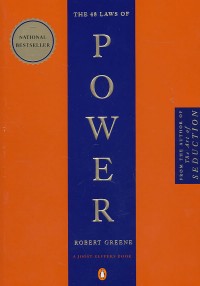
简介
Book Description
Amoral, cunning, ruthless, and instructive, this piercing work distills three thousand years of the history of power in to forty-eight well explicated laws. As attention--grabbing in its design as it is in its content, this bold volume outlines the laws of power in their unvarnished essence, synthesizing the philosophies of Machiavelli, Sun-tzu, Carl von Clausewitz, and other great thinkers. Some laws teach the need for prudence ("Law 1: Never Outshine the Master"), the virtue of stealth ("Law 3: Conceal Your Intentions"), and many demand the total absence of mercy ("Law 15: Crush Your Enemy Totally"), but like it or not, all have applications in real life. Illustrated through the tactics of Queen Elizabeth I, Henry Kissinger, P. T. Barnum, and other famous figures who have wielded--or been victimized by--power, these laws will fascinate any reader interested in gaining, observing, or defending against ultimate control.
Amazon.com
"Learning the game of power requires a certain way of looking at the world, a shifting of perspective," writes Robert Greene. Mastery of one's emotions and the arts of deception and indirection are, he goes on to assert, essential. The 48 laws outlined in this book "have a simple premise: certain actions always increase one's power ... while others decrease it and even ruin us."
The laws cull their principles from many great schemers--and scheming instructors--throughout history, from Sun-Tzu to Talleyrand, from Casanova to con man Yellow Kid Weil. They are straightforward in their amoral simplicity: "Get others to do the work for you, but always take the credit," or "Discover each man's thumbscrew." Each chapter provides examples of the consequences of observance or transgression of the law, along with "keys to power," potential "reversals" (where the converse of the law might also be useful), and a single paragraph cleverly laid out to suggest an image (such as the aforementioned thumbscrew); the margins are filled with illustrative quotations. Practitioners of one-upmanship have been given a new, comprehensive training manual, as up-to-date as it is timeless.
From Publishers Weekly
Greene and Elffers have created an heir to Machiavelli's Prince, espousing principles such as, everyone wants more power; emotions, including love, are detrimental; deceit and manipulation are life's paramount tools. Anyone striving for psychological health will be put off at the start, but the authors counter, saying "honesty is indeed a power strategy," and "genuinely innocent people may still be playing for power." Amoral or immoral, this compendium aims to guide those who embrace power as a ruthless game, and will entertain the rest. Elffers's layout (he is identified as the co-conceiver and designer in the press release) is stylish, with short epigrams set in red at the margins. Each law, with such allusive titles as "Pose as a Friend, Work as a Spy," "Get Others to Do the Work for You, But Always Take the Credit," "Conceal Your Intentions," is demonstrated in four ways?using it correctly, failing to use it, key aspects of the law and when not to use it. Illustrations are drawn from the courts of modern and ancient Europe, Africa and Asia, and devious strategies culled from well-known personae: Machiavelli, Talleyrand, Bismarck, Catherine the Great, Mao, Kissinger, Haile Selassie, Lola Montes and various con artists of our century. These historical escapades make enjoyable reading, yet by the book's conclusion, some protagonists have appeared too many times and seem drained. Although gentler souls will find this book frightening, those whose moral compass is oriented solely to power will have a perfect vade mecum. BOMC and Money Book Club alternates. Author tour.
From Library Journal
Niccolo Machiavelli wrote The Prince (1513) as an amoral guide to practicing power in a dangerous world. Author Greene (formerly at Esquire) and collaborator Joost, the packager of many books for Penguin Studios, including best sellers like The Secret Language of Birthdays, give us an updated version for obtaining and using power today. The book is arranged into 48 laws concentrating on interaction among individuals. Readers are advised not to outshine the boss, not to trust friends too much, to court attention, keep people dependent on you, use selective honesty, distrust the free lunch, and crush enemies. Examples from classical, European, Chinese, and Japanese history illustrate these points, as do hints from American con men like Joseph "Yellow Kid" Weil. Further illustrations are taken from Henry Kissinger, Napoleon, and Haile Selassie. The book's ideas apply to politics, the workplace, and human relationships as a whole. Moral purists will be appalled by it; amoral survivors will like its frank nature. Schools might want to consider this new interpretation for ethics classes. Recommended for all libraries. [For another interpretation of Machiavelli, see Alistair McAlpine's The New Machiavelli: The Art of Politics in Business, reviewed on p. 90?Ed.]?Stephen L. Hupp, Univ. of Pittsburgh at Johnstown Lib., P.
-?Stephen L. Hupp, Univ. of Pittsburgh at Johnstown Lib., PA
From Booklist
Greene is a screenwriter, playwright, and professional researcher. Elffers "packages" books; among his "products" are a book on fruit carving called Play with Your Food (1997) and a book of "personology" profiles called The Secret Language of Birthdays (1994). Greene spent two years compiling and synthesizing this collection of prescriptions for obtaining and wielding power. Besides the obvious inclusion of Machiavelli, Sun-Tzu, and von Clausewitz, there are observations from P. T. Barnum, "Swifty" Lazar, and Clifton Fadiman. In all, hundreds of quotes from 3,000 years of history and lore are included. Each "law" is summarized and a demonstration of its application is provided, supported by the quotes Greene unearthed. The index and bibliography that will come with final publication will make this a usable reference work in addition to one that provides fascinating entertainment.
David Rouse
From Kirkus Reviews
of the ways and means of power. Everyone wants power and everyone is in a constant duplicitous game to gain more power at the expense of others, according to Greene, a screenwriter and former editor at Esquire (Elffers, a book packager, designed the volume, with its attractive marginalia). We live today as courtiers once did in royal courts: we must appear civil while attempting to crush all those around us. This power game can be played well or poorly, and in these 48 laws culled from the history and wisdom of the world's greatest power players are the rules that must be followed to win. These laws boil down to being as ruthless, selfish, manipulative, and deceitful as possible. Each law, however, gets its own chapter: ``Conceal Your Intentions,'' ``Always Say Less Than Necessary,'' ``Pose as a Friend, Work as a Spy,'' and so on. Each chapter is conveniently broken down into sections on what happened to those who transgressed or observed the particular law, the key elements in this law, and ways to defensively reverse this law when it's used against you. Quotations in the margins amplify the lesson being taught. While compelling in the way an auto accident might be, the book is simply nonsense. Rules often contradict each other. We are told, for instance, to ``be conspicuous at all cost,'' then told to ``behave like others.'' More seriously, Greene never really defines ``power,'' and he merely asserts, rather than offers evidence for, the Hobbesian world of all against all in which he insists we live. The world may be like this at times, but often it isn't. To ask why this is so would be a far more useful project. If the authors are serious, this is a silly, distasteful book. If they are not, it's a brilliant satire. (Author tour)
Book Dimension
length: (cm)22.9 width:(cm)16.3
目录
law1
law2
law3
law4
law5
law6
law7
law8
law9
law10
law11
law12
law13
law14
law15
law16
law17
law18
law19
law20
.law21
law22
law23
law24
law25
law26
law27
law28
law29
law30
law31
law32
law33
law34
law35
law36
law37
law38
law39
law40
law41
law42
law43
law44
law45
law46
law47
law48
law2
law3
law4
law5
law6
law7
law8
law9
law10
law11
law12
law13
law14
law15
law16
law17
law18
law19
law20
.law21
law22
law23
law24
law25
law26
law27
law28
law29
law30
law31
law32
law33
law34
law35
law36
law37
law38
law39
law40
law41
law42
law43
law44
law45
law46
law47
law48
- 名称
- 类型
- 大小
光盘服务联系方式: 020-38250260 客服QQ:4006604884
云图客服:
用户发送的提问,这种方式就需要有位在线客服来回答用户的问题,这种 就属于对话式的,问题是这种提问是否需要用户登录才能提问
Video Player
×
Audio Player
×
pdf Player
×
