

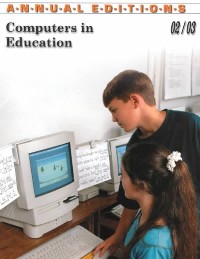
Computers in education / 10th ed.
副标题:无
作 者:editors, John J. Hirschbuhl, Dwight Bishop.
分类号:
ISBN:9780072478808
微信扫一扫,移动浏览光盘
简介
This annually updated reader is a compilation of carefully selected articles from the public press addressing the use of computers and the increasingly important roles they play in our lives. Within the pages of this volume are current, interesting, well-illustrated articles authored by knowledgeable educators, researchers, scientists and writers, providing the latest information on the application of computer technology in schools.
目录
Table Of Contents:
To the Reader iv
Topic Guide 2(2)
Selected World Wide Web Sites 4(2)
UNIT 1 Introduction
Six selections examine the current state of computer implementation of the learning environment and the clash between earlier Industrial Age and present Information Age education.
Overview 6(2)
Lamar Alexander: A Transformative Power 8(3)
Stefanie Sanford
Stefanie Sanford provides an interview that paints Lamar Alexander as a thoughtful leader in the education field for over a quarter of a century. In this interview, he speaks passionately about the role of education and the opportunies that can be available to institutions by simply bringing choice and technology into our nation's school systems.
High-Tech Teaching 11(2)
Felicia E. Halpert
Felicia Halpert explores how children learn when they are asked to find the information they need on the Internet. She explains that they try much harder, spend more time learning, and outperform those who try to learn without using computers. Her conclusion is that when using the Internet students feel in control and take responsibility for their own learning.
Technology & Literacy: Raising the Bar 13(4)
Decker Walker
Decker Walker discusses how the ubiquitous presence of technology that is available to the next generation will raise educational expectations. Walker believes information technology will influence society and education as much as print technology has, and the effect won't take hundreds of years to appear. This article provides a peek at how the next generation of Americans will expect educated people to act.
Early Childhood Classrooms in the 21st Century: Using Computers to Maximize Learning 17(6)
Susan W. Haugland
Susan Haugland states that electronic technology is now used widely at home, at work, and at school. The author believes that the issue of how computers are used with young children is more important than if computers are used at all. She describes four steps that are required to integrate computers into the learning place in order to maximize children's learning.
What Students Want to Learn About Computers 23(4)
Judith O'Donnell Dooling
Judith O'Donnell Dooling reviews a survey of students, parents, and administrators concerning approaches to teaching and learning with computer technology. The key to satisfying the wants and needs of students and parents is the ability of educators to integrate technology into the curriculum as a tool for teaching and learning.
Technology Use in Tomorrow's Schools 27(7)
Barbara Means
Barbara Means discusses how students and teachers have increasing access to almost limitless amounts of information on the World Wide Web. She provides a panorama of how educational use of the computer has evolved from the 1980s to the present. Means also points out that we still fall short of providing a seamless convenient, robust, and reliable technology support structure for all students and teachers.
UNIT 2 Curriculum and Instructional Design
Five articles provide information on employing microcomputer-based software in the classroom.
Overview 32(2)
Project TEAMS: Integrating Technology Into Middle School Instruction 34(5)
Robert A. Reiser
Sarah M. Butzin
This essay describes the Project TEAMS (Technology Enhancing Achievement in Middle School) instructional model and how the instructional approach plays an integral part in the middle school curriculum. The authors point out that, in addition to its emphasis on the use of technology, the TEAMS instructional approach also focuses on the use of active learning and interdisciplinary instruction. A description of the elements of the TEAMS model is provided.
Using the Internet to Improve Student Performance 39(4)
Angela M. Guptill
Angela Guptill details how teachers can use the World Wide Web to draw associations between prior knowledge and new information, collect and classify information, and predict outcomes based on a Web site search. Guptill shows how technological resources have made it possible to develop lessons that promote critical, analytic, higher-order thinking skills, and real-world problem solving that are frequently found on assessments today.
Working With WebQuests: Making the Web Accessible to Students With Disabilities 43(8)
Rebecca Kelly
Rebecca Kelly describes a Web-based teacher-created lesson plan that incorporates research, problem solving, and the application of skill and knowledge. The lesson is especially helpful in meeting the needs of students with disabilities within general education classrooms. The lesson provides multiple representations of information, multiple means of expression, and multiple means of engagement.
Designing Instruction for Emotional Intelligence 51(6)
Richard Goldsworthy
Richard Goldsworthy focuses on the development of instruction that incorporates affective goals, objectives, and strategies into educational programs and practices. The article provides a framework for systematically addressing key areas of social competence in development efforts.
An Illusory Dilemma: Online to Learn or In Line With Standards 57(7)
Judi Harris
Judi Harris makes the case for telecollaboration and teleresearch Internet-supported, curriculum-based learning. She not only describes the processes, but she also details the activity structures that go into the two processes. These approaches seem to help students address many content and process standards at the same time and in engaging, pedagogically sound ways.
UNIT 3 Classroom Applications and Software Evaluations
Six selections provide criteria for the selection and implementation of instructional software in the classroom.
Overview 62(2)
Computers as Mindtools for Engaging Learners in Critical Thinking 64(8)
David H. Jonassen
This article describes whow common computer software applications can be used as interactive knowledge construction mindtools. The authors state that technologies should not support learning by attempting to instruct the learners, but rather they should be used as knowledge construction tools. They describe how learners function as designers and how computers function as mindtools for interpreting and organizing their personal knowledge.
Grounded Constructions and How Technology Can Help 72(9)
Sasha A. Barab
The authors focus on five ways in which technology can be used to foster authentic learner inquiry. They explain how technology can be used to provide a fertile context for which grounded constructions may emerge. They envision using such technological resources as providing multimedia environments to be explored in a context where the learner is engaged in authentic inquiry.
Kids as Computers 81(3)
Sherry J. Roberts
The writer describes how a teacher combines small group design and role-playing with an information-processing model to teach students computer literacy. In this class, the students learned how the information processing cycle works and in the process each group member became a step in the information processing cycle. This model strategy was also the answer to classroom management concerns.
Learning to Use Your Mind Effectively in a Technology-Based Classroom 84(3)
Pamela Keel
Pamela Keel presents the structure of teaching technology using methods that differentiate and allow students to match their research and projects to their personal life experiences. The article outlines the steps needed to achieve the learning objectives.
Strategies of Successful Technology Integration: Part 1 - Streamlining Classroom Management 87(5)
Lynn McNally
Cindy Etchinson
The authors specify seven practical strategies for integrating technology into the classroom in a smooth and effective manner. The approach uses a variety of software applications as classroom management tools. The article details ways for both teachers and students to use technology tools for classroom management in order to provide a shared sense of classroom ownership and responsibility in a collaborative classroom setting.
Concept to Classroom: Web-Based Workshops for Teachers 92(4)
James G. Donlevy
Tia Rice Donlevy
The authors describe a series of free, online workshops developed by Channel 13/WNET New York and Disney Learning Partnerships to help teachers explore issues in education. The workshop topics include exploration of multiple intelligences, constructivism, academic standards, cooperative and collaborative learning, assessment, curriculum redesign, inquiry-based learning, and the role of parents and the community.
UNIT 4 Teacher Training and Resources
Six selections examine the problems associated with staff development and teacher education to ensure teacher computer compentency in the classroom.
Overview 94(2)
Look It Up on the Web: Practical Behavioral Support Information 96(3)
Michael B. Ruef
Cindy Higgins
In this report, the authors focus on the Web in an effort to support teachers in their quest for authoritative resources. They describe the efforts of a panel composed of teachers, family members, researchers, and communication specialists who compiled an annotated list of Web sites providing practical, positively oriented information on challenging behavior. Criteria for selection were: overall aesthetics, navaigability, clarity, and credibility of content.
Stages of Virtuality: Instructor and Student 99(4)
Dee McGonigle
Renee M. Eggers
The authors have identified the typical stages during the instructors' and students' transition into the various aspects of virtual learning. Although this article is geared toward entire courses being offered over the internet, it can also partially apply to traditional courses that have an Internet component.
Online Mentoring 103(3)
Carole Duff
Carole Duff describes how the growth of technology brings new opportunities for mentoring through online tutorials, ask-an-expert coaching, and e-mail linking of students with successful professionals in careers of mutual interest. Ursuline Academy wanted to provide on-the-job experience or guidance to their high schools students, so they established a telemonitoring program that matched 14 upper-level mathematics and computer-science students with women engineers at Texas Instruments.
Evaluating & Using Web-Based Resources 106(5)
Glen Bull
This essay depicts a method for providing guidance to students on how to locate online resources by using a five-step process: identification of potential resources, evaluation of appropriate resources, integration into the research paper, citation of the resource, and verification by the instructor. Teachers examine selected citations and provide appropriate feedback.
Using Computers to Support a Begining Teacher's Professional Development 111(6)
Huann-shyang Line
Houn-Lin Chiu
This study explored the efficacy of promoting a beginning chemistry teacher's curriculum development and teaching practices through the use of computers. The teacher's teaching practices both before and after the Web site treatment were observed and analyzed. The study found that before the treatment the teacher used the textbook as the only resource of his teaching. After the treatment, the teacher was able to develop suitable curricula for the purpose of increasing student involvement.
Using Personal Digital Assistants in Clinical Supervision of Student Teachers 117(5)
Kent J. Crippen
David W. Brooks
Journalizing is an important tool to help student teachers reflect on the nature of the student teaching experience. The communication of journals to student teacher supervisors is enhanced greatly by using e-mail. Certain software tools can be used to enhance journalizing. These tools can be used to faciliate writing field notes during in-class observations by the supervisor. E-mail exchange, however, has supplanted the need for an electronic journalizing tool.
UNIT 5 Multimedia
Five selections demonstrate how educators have harnessed the power of multimedia to improve their students education.
Overview 120(2)
Do It Step-by-Step 122(7)
Michael F. Ruffini
This article guides teachers in developing multimedia projects using a systems approach based on instructional design principles. Michael Ruffini focuses on analyzing the learners, selecting the topics, writing objectives, defining the project type, designing text, cards, and buttons, exploring hyperlink navigation, and evaluating multimedia projects.
MindWorks: Making Scientific Concepts Come Alive 129(5)
Barbara J. Becker
Barbara Becker presents an overview of the goals of the Mind-Works program for science curriculum development. The project hopes to address student motivation, student understanding of the structure and workings of the physical world, and students' and teachers' ideas about the process and culture of scientific activity. The author also discusses the progress of pilot implementation and evaluation.
Designing Instructional Technology From an Emotional Perspective 134(9)
Hermann Astleitner
Detlev Leutner
This article presents strategies for making instructional technology more emotionally sound. The authors discuss how fear, envy, anger, sympathy, and pleasure can be experienced during a learning situation. They also describe 20 general instructional strategies that can be used to decrease negative emotions and increase positive emotions.
Multimedia or Not to Multimedia? That Is the Question for Students With Learning Disabilities 143(9)
Cheryl A. Wissick
J. Emmett Gardner
This article presents instructional factors that teachers should consider when selecting multimedia materials that are appropriate for students with learning disabilities. Specific programs and Web sites that use design features effectively are discussed, and problematic features in multimedia software packages are described, along, with strategies that make appropriate accommodations.
Multimedia Distance Education Interactions 152(8)
Juhani E. Tuovinen
Juhani Tuovinen describes the nature of multimedia interactions in distance education and synthesizes approaches based on distance education theory, cognition research, and multimedia development. The author provides a composite framework for discussion of multimedia and multimodal interactions in distance education context.
UNIT 6 Special Issues
Five selections Discuss the need for Computer equipment in some schools, the status of women in the technology field, the impact of computer use in early child development, and distribution rights of Internet data.
Overview 158(2)
Guerrilla Technology 160(3)
Royal Van Horn
This article provides advice on what to do about schools that are poor and without access to technology. Royal Van Horn points out how to change the situation with very little money. The writer suggests that teachers go on a scavenger hunt to find important unused equipment. Quite often the least obvious places have a wealth of useful equipment. Examples of where to look and what might be found are provided.
Champions of Women in Technology 163(3)
Deborach Radcliff
Deborah Radcliff focuses on the inequity of women in the information technology field. The writer points out that some female IT professionals are spearheading grassroots mentoring and educational organizations that are working to reverse the trend and entice more women into technical jobs. Several programs that focus on this problem are identified and described.
False Promise 166(4)
Katy Kelly
This article declares that a growing number of educators, child development experts, and doctors are beginning to speak out against early computer use, especially when coupled with regular television watching. Too much ``screen time'' at a young age may actually undermine the development of the critical skills that kids need to become successful. It may disminish creativity, imagination, motivation, attention spans, and the desire to persevere.
Symbiosis: University/School Partnerships 170(9)
Rosemary W. Skeele
James K. Darly
The authors state the case for teacher education institutions to experiment with the effective application of computer technology for teaching and learning in their own campus practice. They describe how the Seton Hall faculty have made a commitment to the greater integration of technology into instruction. The authors are trying to articulate a wider vision for technology, making it as essential a tool as the chalkboard.
Who Owns the Courses? Sally M. Johnstone 179(3)
Syllabus
Sally Johnstone makes a case for ignoring intellectual property rights when distributing learning materials over the Internet, and she provides an example of an institution that has already done so. The Point is that the Person who creates the material owns the rights, but those who help produce it have already been paid for doing so.
UNIT 7 The Internet and Computer Networks
Five articles address several issues about the Internet and other networks, including the need to build critical skills that enable students to benefit from using the Net and using the Internet as a ready-reference resource.
Overview 180(2)
Internet 2 and the Next Generation Internet: A Realistic Assessment 182(5)
Cecilia M. Preston
Cecilia Preston describes new developments, such as Internet 2 and the Next Generation Internet (NGI) initiative, as well as other potential advances in high-performance applications that these new electronic resources will create. The article relates these developments to the evolution of the Internet, and it also looks ahead to their anticipated impact beyond the scope of higher education and research communities.
Intelligent Campus Buildings for the Information Age 187(3)
Jack Caloz
Jack Caloz, predicts that a well-designed electronic infrastructure will provide the educational and operational components of intelligent campus buildings in the information age. Caloz claims that the information gathered from the campus networking systems will provide a new, more effective, and less costly educational experience, enriching students, faculty, and the institution simultaneously.
Web Clippings 190(4)
Glen Bull
This article claims that the solution to enhancing your students access to computers and online resources may soon rest in the palms of their hands. These mobile devices can readily access and retrieve Internet-based information. The authors believe this Handheld capability offers a wide range of possibilities for both educational and administrative uses in the classroom.
Avaricious and Envious: Confessions of a Computer-Literate Educator 194(4)
R. W. Burniske
R. W. Burniske asks the questions, Is there more to a computer than technical skill? and Is computer literacy more than a neutral term? The author also ponders the paradox of whether a hunger for computer literacy can invite computer dependency, or if computer literacy is an absolute necessity in the twenty-first century. If you are interested in preserving your humanness in the midst of a technical century, read this article.
Wireless Andrew 198(4)
Michael Fickes
Michael Fickes describes how the use of the Internet and laptops helps students attending Carnegie Mellon University carry out sophisticated research anywhere on campus. The author also provides a description of how the university became a wireless community.
UNIT 8 Distance Learning
Four Articles discuss the value of interactive technologies within a distance learning environment.
Overview 200(2)
IT Teams: Saving the World Through Authentic Challenging Tasks 202(5)
Shayne Russell
Meg Warren
This article describes an award-winning multidisciplinary, multimedia unit on Native Americans that was developed through participation in the Earthwatch Institute programs. It explains the Earthwatch program, collaboration between library media specialists and classroom teachers, and the use of the Big6 process for information problem solving and the development of information literacy skills.
Six Steps to Improving the Quality of Your Electronic Discussion Groups 207(3)
Gregory R. MacKinnon
Lynn Aylward
This paper outlines an approach for post-secondary educators to improve the quality of electronic discussion groups. Using a template of macros constructed in Microsoft Word, the authors explain a system of coding called cognotes, and they discuss an evaluation method where higher order critical thinking skills are given greater value toward higher grades.
Web-Based Portfolios for Technology Education: A Personal Case Study 210(7)
Mark E. Sanders
Students can use Web-based portfolios in technology classes to display classwork and project work. Developing effective Web sites provides an understanding of a range of information-age tools, motivates them to do high-quality work, requires self-assessment and reflection, and teaches design skills.
Seven Tips for Highly Effective Online Courses 217(2)
Leonard Presby
Leonard Presby provides a structure for online tools that are useful in helping students learn quantitative methods and analytical techniques. The author recommends hybrid courses that consist of half online and half in-class delivery. His seven steps provide a recipe for building effective hybrid courses.
Glossary 219(6)
Index 225(3)
Test Your Knowledge Form 228(1)
Article Rating Form 229
To the Reader iv
Topic Guide 2(2)
Selected World Wide Web Sites 4(2)
UNIT 1 Introduction
Six selections examine the current state of computer implementation of the learning environment and the clash between earlier Industrial Age and present Information Age education.
Overview 6(2)
Lamar Alexander: A Transformative Power 8(3)
Stefanie Sanford
Stefanie Sanford provides an interview that paints Lamar Alexander as a thoughtful leader in the education field for over a quarter of a century. In this interview, he speaks passionately about the role of education and the opportunies that can be available to institutions by simply bringing choice and technology into our nation's school systems.
High-Tech Teaching 11(2)
Felicia E. Halpert
Felicia Halpert explores how children learn when they are asked to find the information they need on the Internet. She explains that they try much harder, spend more time learning, and outperform those who try to learn without using computers. Her conclusion is that when using the Internet students feel in control and take responsibility for their own learning.
Technology & Literacy: Raising the Bar 13(4)
Decker Walker
Decker Walker discusses how the ubiquitous presence of technology that is available to the next generation will raise educational expectations. Walker believes information technology will influence society and education as much as print technology has, and the effect won't take hundreds of years to appear. This article provides a peek at how the next generation of Americans will expect educated people to act.
Early Childhood Classrooms in the 21st Century: Using Computers to Maximize Learning 17(6)
Susan W. Haugland
Susan Haugland states that electronic technology is now used widely at home, at work, and at school. The author believes that the issue of how computers are used with young children is more important than if computers are used at all. She describes four steps that are required to integrate computers into the learning place in order to maximize children's learning.
What Students Want to Learn About Computers 23(4)
Judith O'Donnell Dooling
Judith O'Donnell Dooling reviews a survey of students, parents, and administrators concerning approaches to teaching and learning with computer technology. The key to satisfying the wants and needs of students and parents is the ability of educators to integrate technology into the curriculum as a tool for teaching and learning.
Technology Use in Tomorrow's Schools 27(7)
Barbara Means
Barbara Means discusses how students and teachers have increasing access to almost limitless amounts of information on the World Wide Web. She provides a panorama of how educational use of the computer has evolved from the 1980s to the present. Means also points out that we still fall short of providing a seamless convenient, robust, and reliable technology support structure for all students and teachers.
UNIT 2 Curriculum and Instructional Design
Five articles provide information on employing microcomputer-based software in the classroom.
Overview 32(2)
Project TEAMS: Integrating Technology Into Middle School Instruction 34(5)
Robert A. Reiser
Sarah M. Butzin
This essay describes the Project TEAMS (Technology Enhancing Achievement in Middle School) instructional model and how the instructional approach plays an integral part in the middle school curriculum. The authors point out that, in addition to its emphasis on the use of technology, the TEAMS instructional approach also focuses on the use of active learning and interdisciplinary instruction. A description of the elements of the TEAMS model is provided.
Using the Internet to Improve Student Performance 39(4)
Angela M. Guptill
Angela Guptill details how teachers can use the World Wide Web to draw associations between prior knowledge and new information, collect and classify information, and predict outcomes based on a Web site search. Guptill shows how technological resources have made it possible to develop lessons that promote critical, analytic, higher-order thinking skills, and real-world problem solving that are frequently found on assessments today.
Working With WebQuests: Making the Web Accessible to Students With Disabilities 43(8)
Rebecca Kelly
Rebecca Kelly describes a Web-based teacher-created lesson plan that incorporates research, problem solving, and the application of skill and knowledge. The lesson is especially helpful in meeting the needs of students with disabilities within general education classrooms. The lesson provides multiple representations of information, multiple means of expression, and multiple means of engagement.
Designing Instruction for Emotional Intelligence 51(6)
Richard Goldsworthy
Richard Goldsworthy focuses on the development of instruction that incorporates affective goals, objectives, and strategies into educational programs and practices. The article provides a framework for systematically addressing key areas of social competence in development efforts.
An Illusory Dilemma: Online to Learn or In Line With Standards 57(7)
Judi Harris
Judi Harris makes the case for telecollaboration and teleresearch Internet-supported, curriculum-based learning. She not only describes the processes, but she also details the activity structures that go into the two processes. These approaches seem to help students address many content and process standards at the same time and in engaging, pedagogically sound ways.
UNIT 3 Classroom Applications and Software Evaluations
Six selections provide criteria for the selection and implementation of instructional software in the classroom.
Overview 62(2)
Computers as Mindtools for Engaging Learners in Critical Thinking 64(8)
David H. Jonassen
This article describes whow common computer software applications can be used as interactive knowledge construction mindtools. The authors state that technologies should not support learning by attempting to instruct the learners, but rather they should be used as knowledge construction tools. They describe how learners function as designers and how computers function as mindtools for interpreting and organizing their personal knowledge.
Grounded Constructions and How Technology Can Help 72(9)
Sasha A. Barab
The authors focus on five ways in which technology can be used to foster authentic learner inquiry. They explain how technology can be used to provide a fertile context for which grounded constructions may emerge. They envision using such technological resources as providing multimedia environments to be explored in a context where the learner is engaged in authentic inquiry.
Kids as Computers 81(3)
Sherry J. Roberts
The writer describes how a teacher combines small group design and role-playing with an information-processing model to teach students computer literacy. In this class, the students learned how the information processing cycle works and in the process each group member became a step in the information processing cycle. This model strategy was also the answer to classroom management concerns.
Learning to Use Your Mind Effectively in a Technology-Based Classroom 84(3)
Pamela Keel
Pamela Keel presents the structure of teaching technology using methods that differentiate and allow students to match their research and projects to their personal life experiences. The article outlines the steps needed to achieve the learning objectives.
Strategies of Successful Technology Integration: Part 1 - Streamlining Classroom Management 87(5)
Lynn McNally
Cindy Etchinson
The authors specify seven practical strategies for integrating technology into the classroom in a smooth and effective manner. The approach uses a variety of software applications as classroom management tools. The article details ways for both teachers and students to use technology tools for classroom management in order to provide a shared sense of classroom ownership and responsibility in a collaborative classroom setting.
Concept to Classroom: Web-Based Workshops for Teachers 92(4)
James G. Donlevy
Tia Rice Donlevy
The authors describe a series of free, online workshops developed by Channel 13/WNET New York and Disney Learning Partnerships to help teachers explore issues in education. The workshop topics include exploration of multiple intelligences, constructivism, academic standards, cooperative and collaborative learning, assessment, curriculum redesign, inquiry-based learning, and the role of parents and the community.
UNIT 4 Teacher Training and Resources
Six selections examine the problems associated with staff development and teacher education to ensure teacher computer compentency in the classroom.
Overview 94(2)
Look It Up on the Web: Practical Behavioral Support Information 96(3)
Michael B. Ruef
Cindy Higgins
In this report, the authors focus on the Web in an effort to support teachers in their quest for authoritative resources. They describe the efforts of a panel composed of teachers, family members, researchers, and communication specialists who compiled an annotated list of Web sites providing practical, positively oriented information on challenging behavior. Criteria for selection were: overall aesthetics, navaigability, clarity, and credibility of content.
Stages of Virtuality: Instructor and Student 99(4)
Dee McGonigle
Renee M. Eggers
The authors have identified the typical stages during the instructors' and students' transition into the various aspects of virtual learning. Although this article is geared toward entire courses being offered over the internet, it can also partially apply to traditional courses that have an Internet component.
Online Mentoring 103(3)
Carole Duff
Carole Duff describes how the growth of technology brings new opportunities for mentoring through online tutorials, ask-an-expert coaching, and e-mail linking of students with successful professionals in careers of mutual interest. Ursuline Academy wanted to provide on-the-job experience or guidance to their high schools students, so they established a telemonitoring program that matched 14 upper-level mathematics and computer-science students with women engineers at Texas Instruments.
Evaluating & Using Web-Based Resources 106(5)
Glen Bull
This essay depicts a method for providing guidance to students on how to locate online resources by using a five-step process: identification of potential resources, evaluation of appropriate resources, integration into the research paper, citation of the resource, and verification by the instructor. Teachers examine selected citations and provide appropriate feedback.
Using Computers to Support a Begining Teacher's Professional Development 111(6)
Huann-shyang Line
Houn-Lin Chiu
This study explored the efficacy of promoting a beginning chemistry teacher's curriculum development and teaching practices through the use of computers. The teacher's teaching practices both before and after the Web site treatment were observed and analyzed. The study found that before the treatment the teacher used the textbook as the only resource of his teaching. After the treatment, the teacher was able to develop suitable curricula for the purpose of increasing student involvement.
Using Personal Digital Assistants in Clinical Supervision of Student Teachers 117(5)
Kent J. Crippen
David W. Brooks
Journalizing is an important tool to help student teachers reflect on the nature of the student teaching experience. The communication of journals to student teacher supervisors is enhanced greatly by using e-mail. Certain software tools can be used to enhance journalizing. These tools can be used to faciliate writing field notes during in-class observations by the supervisor. E-mail exchange, however, has supplanted the need for an electronic journalizing tool.
UNIT 5 Multimedia
Five selections demonstrate how educators have harnessed the power of multimedia to improve their students education.
Overview 120(2)
Do It Step-by-Step 122(7)
Michael F. Ruffini
This article guides teachers in developing multimedia projects using a systems approach based on instructional design principles. Michael Ruffini focuses on analyzing the learners, selecting the topics, writing objectives, defining the project type, designing text, cards, and buttons, exploring hyperlink navigation, and evaluating multimedia projects.
MindWorks: Making Scientific Concepts Come Alive 129(5)
Barbara J. Becker
Barbara Becker presents an overview of the goals of the Mind-Works program for science curriculum development. The project hopes to address student motivation, student understanding of the structure and workings of the physical world, and students' and teachers' ideas about the process and culture of scientific activity. The author also discusses the progress of pilot implementation and evaluation.
Designing Instructional Technology From an Emotional Perspective 134(9)
Hermann Astleitner
Detlev Leutner
This article presents strategies for making instructional technology more emotionally sound. The authors discuss how fear, envy, anger, sympathy, and pleasure can be experienced during a learning situation. They also describe 20 general instructional strategies that can be used to decrease negative emotions and increase positive emotions.
Multimedia or Not to Multimedia? That Is the Question for Students With Learning Disabilities 143(9)
Cheryl A. Wissick
J. Emmett Gardner
This article presents instructional factors that teachers should consider when selecting multimedia materials that are appropriate for students with learning disabilities. Specific programs and Web sites that use design features effectively are discussed, and problematic features in multimedia software packages are described, along, with strategies that make appropriate accommodations.
Multimedia Distance Education Interactions 152(8)
Juhani E. Tuovinen
Juhani Tuovinen describes the nature of multimedia interactions in distance education and synthesizes approaches based on distance education theory, cognition research, and multimedia development. The author provides a composite framework for discussion of multimedia and multimodal interactions in distance education context.
UNIT 6 Special Issues
Five selections Discuss the need for Computer equipment in some schools, the status of women in the technology field, the impact of computer use in early child development, and distribution rights of Internet data.
Overview 158(2)
Guerrilla Technology 160(3)
Royal Van Horn
This article provides advice on what to do about schools that are poor and without access to technology. Royal Van Horn points out how to change the situation with very little money. The writer suggests that teachers go on a scavenger hunt to find important unused equipment. Quite often the least obvious places have a wealth of useful equipment. Examples of where to look and what might be found are provided.
Champions of Women in Technology 163(3)
Deborach Radcliff
Deborah Radcliff focuses on the inequity of women in the information technology field. The writer points out that some female IT professionals are spearheading grassroots mentoring and educational organizations that are working to reverse the trend and entice more women into technical jobs. Several programs that focus on this problem are identified and described.
False Promise 166(4)
Katy Kelly
This article declares that a growing number of educators, child development experts, and doctors are beginning to speak out against early computer use, especially when coupled with regular television watching. Too much ``screen time'' at a young age may actually undermine the development of the critical skills that kids need to become successful. It may disminish creativity, imagination, motivation, attention spans, and the desire to persevere.
Symbiosis: University/School Partnerships 170(9)
Rosemary W. Skeele
James K. Darly
The authors state the case for teacher education institutions to experiment with the effective application of computer technology for teaching and learning in their own campus practice. They describe how the Seton Hall faculty have made a commitment to the greater integration of technology into instruction. The authors are trying to articulate a wider vision for technology, making it as essential a tool as the chalkboard.
Who Owns the Courses? Sally M. Johnstone 179(3)
Syllabus
Sally Johnstone makes a case for ignoring intellectual property rights when distributing learning materials over the Internet, and she provides an example of an institution that has already done so. The Point is that the Person who creates the material owns the rights, but those who help produce it have already been paid for doing so.
UNIT 7 The Internet and Computer Networks
Five articles address several issues about the Internet and other networks, including the need to build critical skills that enable students to benefit from using the Net and using the Internet as a ready-reference resource.
Overview 180(2)
Internet 2 and the Next Generation Internet: A Realistic Assessment 182(5)
Cecilia M. Preston
Cecilia Preston describes new developments, such as Internet 2 and the Next Generation Internet (NGI) initiative, as well as other potential advances in high-performance applications that these new electronic resources will create. The article relates these developments to the evolution of the Internet, and it also looks ahead to their anticipated impact beyond the scope of higher education and research communities.
Intelligent Campus Buildings for the Information Age 187(3)
Jack Caloz
Jack Caloz, predicts that a well-designed electronic infrastructure will provide the educational and operational components of intelligent campus buildings in the information age. Caloz claims that the information gathered from the campus networking systems will provide a new, more effective, and less costly educational experience, enriching students, faculty, and the institution simultaneously.
Web Clippings 190(4)
Glen Bull
This article claims that the solution to enhancing your students access to computers and online resources may soon rest in the palms of their hands. These mobile devices can readily access and retrieve Internet-based information. The authors believe this Handheld capability offers a wide range of possibilities for both educational and administrative uses in the classroom.
Avaricious and Envious: Confessions of a Computer-Literate Educator 194(4)
R. W. Burniske
R. W. Burniske asks the questions, Is there more to a computer than technical skill? and Is computer literacy more than a neutral term? The author also ponders the paradox of whether a hunger for computer literacy can invite computer dependency, or if computer literacy is an absolute necessity in the twenty-first century. If you are interested in preserving your humanness in the midst of a technical century, read this article.
Wireless Andrew 198(4)
Michael Fickes
Michael Fickes describes how the use of the Internet and laptops helps students attending Carnegie Mellon University carry out sophisticated research anywhere on campus. The author also provides a description of how the university became a wireless community.
UNIT 8 Distance Learning
Four Articles discuss the value of interactive technologies within a distance learning environment.
Overview 200(2)
IT Teams: Saving the World Through Authentic Challenging Tasks 202(5)
Shayne Russell
Meg Warren
This article describes an award-winning multidisciplinary, multimedia unit on Native Americans that was developed through participation in the Earthwatch Institute programs. It explains the Earthwatch program, collaboration between library media specialists and classroom teachers, and the use of the Big6 process for information problem solving and the development of information literacy skills.
Six Steps to Improving the Quality of Your Electronic Discussion Groups 207(3)
Gregory R. MacKinnon
Lynn Aylward
This paper outlines an approach for post-secondary educators to improve the quality of electronic discussion groups. Using a template of macros constructed in Microsoft Word, the authors explain a system of coding called cognotes, and they discuss an evaluation method where higher order critical thinking skills are given greater value toward higher grades.
Web-Based Portfolios for Technology Education: A Personal Case Study 210(7)
Mark E. Sanders
Students can use Web-based portfolios in technology classes to display classwork and project work. Developing effective Web sites provides an understanding of a range of information-age tools, motivates them to do high-quality work, requires self-assessment and reflection, and teaches design skills.
Seven Tips for Highly Effective Online Courses 217(2)
Leonard Presby
Leonard Presby provides a structure for online tools that are useful in helping students learn quantitative methods and analytical techniques. The author recommends hybrid courses that consist of half online and half in-class delivery. His seven steps provide a recipe for building effective hybrid courses.
Glossary 219(6)
Index 225(3)
Test Your Knowledge Form 228(1)
Article Rating Form 229
Computers in education / 10th ed.
- 名称
- 类型
- 大小
光盘服务联系方式: 020-38250260 客服QQ:4006604884
云图客服:
用户发送的提问,这种方式就需要有位在线客服来回答用户的问题,这种 就属于对话式的,问题是这种提问是否需要用户登录才能提问
Video Player
×
Audio Player
×
pdf Player
×
