

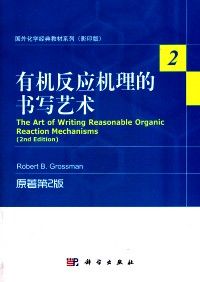
Art of writing reasonable organic reaction mechanisms
副标题:无
分类号:
ISBN:9787030333018
微信扫一扫,移动浏览光盘
简介
每一个满怀抱负的有机化学家都尝试写出合理的有机反应机理,然而市面上的有关机理正确书写的书籍却寥寥无几。格罗斯曼(Grossman,R.B.)编著的《有机反应机理的书写艺术(原著第2版)》将帮助学生和科研人员提高这一重要技能。《有机反应机理的书写艺术(原著第2版)》的突出特点体现在:正确的书写形式,“常见错误提示”,配以大量的难度适宜的问题。其另一个特色是包含过渡金属参与或催化的反应章节。相对新的课题,例如,烯烃复分解反应、芳香环化反应等在《有机反应机理的书写艺术(原著第2版)》中均有所涉及。
全新修订的第2版精彩呈现:更新的反应机理,芳香性的讨论,酸性,立体化学的拓展,重新组织了自由基反应和金属参与或催化的反应等内容,增加了新的问题。
目录
Preface to the Student
Preface to the Instructor
1 The Basics
1.1 Structure and Stability of Organic Compounds
1.1.1 Conventions of Drawing Structures;Grossman’S Rule
1.1.2 Lewis Structures;Resonance Structures
1.1.3 Molecular Shape;Hybridization
1.1.4 Aromaticity
1.2 BrCnsted Acidity and Basicity
1.2.1 PK Values
1.2.2 Tautomerism
1.3 Kinetics and Thermodynamics
1.4 Getting Started in Drawing a Mechanism
1.5 Classes of Overall Transformations
1.6 Classes of Mechanisms
1.6.1 Polar Mechanisms
1.6.2 Free.Radical Mechanisms
1.6.3 Pericyclic Mechanisms
1.6.4 Transition-Metal-Catalyzed and-Mediated Mechanisms
1.7 Summary
Problems
2 Polar Reactions under Basic Conditions
2.1 Substitution and Elimination at C(sp3)—X Bonds.Part I
2.1.1 Substitution by the SN2 Mechanism
2.1.2 Elimination by the E2 and Elcb Mechanisms
2.1.3 Predicting Substitution VS.Elimination
2.2 Addition of Nucleophiles to Electrophilic仃Bonds
2.2.1 Addition to Carbonyl Compounds
2.2.2 Conjugate Addition;The Michael Reaction
2.3 Substitution at C(sp2)一X Bouds
2.3.1 Substitution at Carbonyl C
2.3.2 Substitution at Alkenyl and Aryl C
2.3.3 Metal Insertion;Halogen-Metal Exchange
2.4 Substitution and Elimination at C(sp3)-X Bonds,Part II
2.4.1 Substitution by the SRNl Mechanism
2.4.2 Substitution by the Elimination-Addition Mechanism
2.4.3 Substitution by the One-Electron Transfer Mechanism
2.4.4 Metal Insertion;Halogen一Metal Exchange
2.4.5 Ol-Elimination;Generation and Reactions of Carbenes
2.5 Base-Promoted Rearrangements
2.5.1 Migration from C to C
2.5.2 Migration from C to O or N
2.5.3 Migration from B to C or O
2.6 Two Multistep Reactions
2.6.1 The Swem Oxidation
2.6.2 The Mitsunobu Reaction
2.7 Summary
Problems
3 Polar Reactions Under Acidic Conditions
3.1 Carbocations
3.1.1 CarbOCation Stability
3.1.2 Carbocation Generation;The Role of Protonation
3.1.3 Typical Reactions of Carbocations;Rearrangements
3.2 Substitution and 一Elimination Reactions at C(sp3)一X
3.2.1 Substitution by the SNl and SN2 Mechanisms
3.2.2 Elimination by the E1 Mechanism
3.2.3 Predicting Substitution VS.Elimination
3.3 Electrophilic Addition to Nucleophilic C=C Bonds
3.4 Substitution atNucleophilic C=C Bonds
3.4.1 Electrophilic Aromatic Substitution
3.4.2 Aromatic Substitution of Anilines via Diazonium Salts
3.4.3 Electrophilic Aliphatic Substitution
3.5 Nucleophilic Addition to and Substitution at Electrophilic Bonds
3.5.1 Heteroatom Nucleophiles
3.5.2 Carbon Nucleophiles
3.6 Summary
Problems
4 Pericyclic Reactions
4.1 Introduction
4.1.1 Classes of Pericyclic Reactions
4.1.2 Polyene MOs
4.2 Electrocyclic Reactions
4.2.1 Typical Reactions
4.2.2 StereosF ecificily
4.2.3 Stereoselectivity
4.3 Cycloadditions
4.3.1 Typical Reactions
4.3.2 Regioselectivity
4.3.3 StereosF ecificity
4.3.4 Stereoselectivity
4.4 Sigmatropic Rearrangements
4.4. I Typical Reactions
4.4.2 Stereospecificily
4.4.3 Stereoselectivity
4.5 Ene Reactions
4.6 Summary
Problems
5 Free-Radical Reactions
5.1 Free Radicals
5.1.1 Stability
5.1.2 Generaticn from Closed-Shell Species
5.1.3 Typical Reacticns
5.1.4 Chain vs. Nonchain Mechanisms
5.2 Chain Free-Radical Reactions
5.2.1 Substitution Reactions
5.2.2 Addition and Fragmentation Reactions
5.3 Nonchain Free-Radical Reactions
5.3.1 Photochemical Reactions
5.3.2 Reductions and Oxidations with Metals
5.3.3 Cycloaromatizations
5.4 Miscellaneous Radical Reactions
5.4.1 1,2-Anionic Rearrangements; Lone-Pair Inversion
5.4.2 Triplet Carbenes and Nitrenes
5.5 Summary
Problems
6 Transition-Metal-Mediated and -Catalyzed Reactions
6.1 Introduction to the Chemistry of Transition Metals
6.1.1 Conventicns cf Drawing Structures
6.1.2 Counting Electrons
6.1.3 Typical Reactions
6.1.4 Stoichiometric vs. Catalytic Mechanisms
6.2 Addition Reactions
6.2.1 Late-Metal-Catalyzed Hydrogenation and Hydrometallation (Pd, Pt, Rh)
6.2.2 Hydroformylation (Co, Rh)
6.2.3 Hydrozirconation (Zr)
6.2.4 Alkene Polymerization (Ti, Zr, Sc, and others)
6.2.5 Cyclopropanation, Epoxidation, and Aziridination of Alkenes (Cu, Rh, Mn, Ti)
6.2.6 Dihydroxylation and Aminohydroxylation of Alkenes (Os)
6.2.7 Nucleophilic Addition to Alkenes and Alkynes (Hg, Pd)
6.2.8 Conjugate Addition Reactions (Cu)
6.2.9 Reducfive Coupling Reactions (Ti, Zr)
6.2.10 Pauson-Khand Reaction (Co)
6.2.11 D6tz Reaction (Cr)
6.2.12 Metal-Catalyzed Cycloaddition and Cyclotrimerizafion (Co, Ni, Rh)
6.3 Substitution Reactions
6.3.1 Hydrogenolysis (Pd)
6.3.2 Carbonylation of Alkyl Halides (Pd, Rh)
6.3.3 Heck Reaction (Pd)
6.3.4 Coupling Reactions Between Nucleophiles and C(spg)-x: Kumada, Stille, Suzuki, Negishi,Buchwald-Hartwig,
Sonogashira, and Ullmann Reactions (Ni, Pd, Cu)
6.3.5 Allylic Substitution (Pd)
6.3.6 Pd-Catalyzed Nucleophilic Substitution of Alkenes; Wacker Oxidation
6.3.7 Tebbe Reaction (Ti)
6.3.8 Propargyl Substitution in Co-Alkyne Complexes
6.4 Rearrangement Reactions
6.4.1 Alkene Isomerization (Rh)
6.4.2 Olefin and Alkyne Metathesis (Ru, W, Mo, Ti)
6.5 Elimination Reactions
6.5.1 Oxidation of Alcohols (Cr, Ru)
6.5.2 Decarbonylation of Aldehydes (Rh)
6.6 Summary
Problems
7 Mixed-Mechanism Problems
A Final Word
Index
Art of writing reasonable organic reaction mechanisms
- 名称
- 类型
- 大小
光盘服务联系方式: 020-38250260 客服QQ:4006604884
云图客服:
用户发送的提问,这种方式就需要有位在线客服来回答用户的问题,这种 就属于对话式的,问题是这种提问是否需要用户登录才能提问
Video Player
×
Audio Player
×
pdf Player
×
