

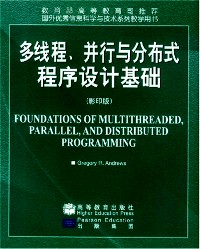
Foundations of Multithreaded, Parallel, and Distributed Programming
副标题:无
分类号:
ISBN:9787040114003
微信扫一扫,移动浏览光盘
简介
20世纪末,以计算机和通信技术为代表的信息科学和技术对世界经济、科技、军事、教育和文化等产生了深刻影响。信息科学技术的迅速普及和应用,带动了世界范围信息产业的蓬勃发展,为许多国家带来了丰厚的回报。
进入21世纪,尤其随着我国加入WTO,信息产业的国际竞争将更加激烈。我国信息产业虽然在20世纪末取得了迅猛发展,但与发达国家相比,甚至与印度、爱尔兰等国家相比,还有很大差距。国家信息化的发展速度和信息产业的国际竞争能力,最终都将取决于信息科学技术人才的质量和数量。引进国外信息科学和技术优
秀教材,在有条件的学校推动开展英语授课或双语教学,是教育部为加快培养大批高质量的信息技术人才采取的一项重要举措。
为此,教育部要求由高等教育出版社首先开展信息科学和技术教材的引进试点工作。同时提出了两点要求,一是要高水平,二是要低价格。在高等教育出版社和信息科学技术引进教材专家组的努力下,经过比较短的时间,第一批引进的20多种教材已经陆续出版。这套教材出版后受到了广泛的好评,其中有不少是世界信息科
学技术领域著名专家、教授的经典之作和反映信息科学技术最新进展的优秀作品,代表了目前世界信息科学技术教育的一流水平,而且价格也是最优惠的,与国内同类自编教材相当。
这项教材引进工作是在教育部高等教育司和高教社的共同组织下,由国内信息科学技术领域的专家、教授广泛参与,在对大量国外教材进行多次过选的基础上,参考了国内和国外著名大学相关专业的课程设置进行系统引进的。其中,John Wiley公司出版的贝尔实验室信息科学研究中心副总裁Silberschatz教授的经典著作《操作系统概念》,是我们经过反复谈判,做了很多努力才得以引进的。 William Stallings先生曾编写了在美国深受欢迎的信息科学技术系列教材,其中有多种教材获得过美国教材和学术著作者协会颁发的计算机科学与工程教材奖,这批引进教材中就有他的两本著作。留美中国学者Jiawei Han先生的《数据挖掘》是该领域中具有里程碑意义的著作。由达特茅斯学院 Thomas Cormen和麻省理工学院、哥伦比亚大学的几位学者共同编著的经典著作《算法导论》,在经历了11年的锤炼之后于2001年出版了第一版。目前任教于美国MassacMsetts大学的James Kurose教授,曾在美国三所高校先后10次获得杰出教师或杰出教学奖,由他主编的《计算机网络》出版后,以其体系新颖、内容先进而倍受欢迎。在努力降低引进教材售价方面,高等教育出版社做了大量和细致的工作。这套引进的教材体现了权威性、系统性、先进性和经济性等特点。
目录
preface
chapter 1: the concurrent computing landscape
1.1 the essence of concurrent programming
l.2 hardware architectures
1.2.1 processors and caches
l.2.2 shared-memory multiprocessors
1.2.3 distributed-memory multicomputers and networks
1.3 applications and programming styles
l.4 iterative parallelism: matrix multiplication
l.5 recursive parallelism: adaptive quadrature
1.6 producers and consumers: unix pipes
l.7 clients and servers: file systems
1.8 peers: distributed matrix multiplication
l.9 summary of programming notation
l.9.1 declarations
l.9.2 sequential statements
l.9.3 concurrent statements, processes, and procedures
1.9.4 comments
historical notes
references
.exercises
part 1: shared-variable programming
chapter 2: processes and synchronization
2.l states, actions, histories, and properties
2.2 parallelization: finding patterns in a file
2.3 synchronization: the maximum of an array
2.4 atomic actions and await statements
2.4.1 fine-grained atomicity
2.4.2 specifying synchronization: the await statement
2.5 producer/consumer synchronization
2.6 a synopsis of axiomatic semantics
2.6.1 formal logical systems
2.6.2 a programming logic
2.6.3 semantics of concurrent execution
2.7 techniques for avoiding interference
2.7.l disjoint variables
2.7.2 weakened assertions
2.7.3 global invariants
2.7.4 synchronization
2.7.5 an example: the array copy probiem revisited
2.8 safety and liveness properties
2.8.l proving safety propertes
2.8.2 scheduling policies and fairness
historical notes
references
exercises
chapter 3: locks and barriers
3.l the critical section problem
3.2 critical sections: spin locks
3.2.1 test and set
3.2.2 test and test and set
3.2.3 implementing await statements
3.3 critical sections: fair solutions
3.3.1 the tie-breaker algorithm
3.3.2 the ticket algorithm
3.3.3 the bakery algorithm
3.4 barrier synchronization
3.4.1 shared counter
3.4.2 flags and coordinators
3.4.3 symmetric barriers
3.5 data parallel algorithms
3'5.1 parallel prefix computations
3.5.2 operations on linked lists
3.5.3 grid computations: jacobi iteration
3.5.4 synchronous multiprocessors
3.6 parallel computing with a bag of tasks
3.6.l matrix multiplication
3.6.2 adaptive quadrature
historical notes
references
exercises
chapter 4: semaphores
4.l syntax and semantics
4.2 basic problems and techniques
4.2.1 critical sections' mutual exclusion
4.2.2 barriers: signaling events
4.2.3 producers and consumers: split binary semaphores
4.2.4 bounded buffers: resource counting
4.3 the dining philosophers
4.4 readers and writers
4.4.1 readers/writers as an exclusion problem
4.4.2 readers/writers using condition synchrnization
4.4.3 the technique of passing the baton
4.4.4 alternative scheduling policies
4.5 resource allocation and scheduling
4.5.1 problem definition and general solution pattern
4.5.2 shortest-job-next allocation
4.6 case study: pthreads
4.6.l wad creation
4.6.2 semaphores
4.6.3 example: a simple producer and consumer
historical notes
references
exercises
chapter 5: monitors
5.l syntax and semantics
5.l.1 mutual exclusion
5.l.2 condition variables
5.1.3 signaling disciplines
5.l.4 additional operations on condition variables
5.2 synchroulzation techniques
5.2.1 bounded buffers: basic condition synchronization
5.2.2 reades and writers: broadcast signal
5.2.3 shortest-job-next allocation: priority wait
5.2.4 interval timer: covering conditions
5.2.5 the sleeping barber: rendezvous
5.3 disk scheduling: program structures
5.3.1 using a separate monitor
5.3.2 using an intermediary
5.3.3 using a nested monitor
5.4 case study: java
5.4.l the threads class
5.4.2 synchronized methods
5.4.3 parallel reades/writers
5.4.4 exclusive reades/writers
5.4.5 true readers/writers
5.5 case study: pthrads
5.5.1 locks and condition variables
5.5.2 example: summing the elements of a matrix
historical notes
references
exercises
chapter 6: implementations
6.1 a single-processor kernel
6.2 a multiprocessor kernel
6.3 implementing semaphores in a kernel
6.4 implementing monitors in a kernel
6.5 implementing monitors using semaphores
historical notes
references
exercises
part 2: distributed programming
chapter 7: message passing
7.1 asynchronous message passing
7.2 filters' a sorting network
7.3 clients and servers
7.3.l active monitors
7.3.2 a self scheduling disk server
7.3.3 file servers: conversational continuity
7.4 interating peers: exchanging vaiues
7.5 synchronous message passing
7.6 case study: csp
7.6.l cornmunication statements
7.6.2 guarded communication
7.6.3 example: the sieve of eratosthenes
7.6.4 occam and modern csp
7.7 case study: linda
7.7.l tuple space and process interaction
7.7.2 example: prime numbers with a bag of tasks
7.8 case study: mpi
7.8.l basic functions
7.8.2 global commnication and synchronization
7.9 case study: java
7.9.1 networks and sockets
7'9.2 example: a remote file reader
historical notes
references
exercises
chapter 8: rpc and rendezvous
8.l remote procedur call
8.l.l synchronization in modules
8.l.2 a time server
8.l.3 caches in a distributed file system
8.1.4 a sorting network of merge filters
8.l.5 interacting peers: exchanging values
8.2 rendezvous
8.2.l input statements
8.2.2 client/server examples
8.2.3 a sorting network of merge filters
8.2.4 interachng peers: exchanging values
8.3 a multiple primitives notation
8.3.l invoking and servicing operations
8.3.2 examples
8.4 readers/writers revisited
8.4.1 encapsulated access
8.4.2 replicated files
8.5 case study: java
8.5.1 remote method invocation
8.5.2 example: a remote database
8.6 case study: ada
8.6.1 tasks
8.6.2 rendezvous
8.6.3 protected types
8.6.4 example: the dining philosophers
8.7 case study: sr
8.7.1 resources and globals
8.7.2 commnication and synchroinzation
8.7.3 example' critical section simulation
historical notes
references
exercises
chapter 9: paradigms for process interaction
9.1 manager/workers (distributed bag of tasks)
9.l.1 sparse matrix multiplication
9.1.2 adaptive quadrature revisited
9.2 heartbeat algorithms
9.2.1 image processing: region labeling
9.2.2 cellular automata: the game of life
9.3 pipeline algorithms
9.3.l a distributed matrix multiplication pipeline
9.3.2 matrix multiplication by blocks
9.4 probe/echo algorithms
9.4.l broadcast in a network
9.4.2 computing the topology of a network
9.5 broadcast algorithms
9.5.1 logical clocks and event ordering
9.5.2 distributed semaphores
9.6 token-passing algorithms
9.6.l distributed mutual exclusion
9.6.2 termination detection in a ring
9.6.3 termination detection in a graph
9.7 replicated servers
9.7.l distributed dining philosophers
9.7.2 decentralized dining philosophers
historical notes
references
exercises
chapter 10: lmpiementations
10.1 asynchronous message passing
10.l.1 shared-memory kernel
l0.1.2 distributed kernel
10.2 synchronous message passing
l0.2.1 direct communication using asynchronous messages
l0.2.2 guarded communication using a clearinghouse
l0.3 rpc and rendezvous
l0.3.l rpc in a kernel
l0.3.2 rendezvous using asynchronous message passing
l0.3.3 multiple primitives in a kernel
l0.4 distributed shared memory
l0.4.l implementation overview
10.4.2 page consistency protocols
historical notes
references
exercises
part 3: parallei programming
chapter 11: scientific computing
1l.1 grid computations
11.l.l laplace's equation
ll.l.2 sequential jacobi iteration
11.1.3 jacobi iteration using shared variables
ll.l.4 jacobi iteration using message passing
ll.l.5 red/black successive over-relaxation (sor)
11.l.6 multigrid methods
ll.2 particle computations
ll.2.l the gravitational n-body problem
ll.2.2 shared-variable program
l1.2.3 message-passing programs
11.2.4 approximate methods
11.3 matrix computations
11.3.l gaussian elimination
11.3.2 lu decomposition
11.3.3 shared-variable program
11.3.4 message-passing program
historical notes
references
exercises
chapter 12: languages, compilers,
libraries, and toois
l2.l parallel programming libraries
12.l.l case study: pthreads
l2.1.2 case study' mpi
l2.l.3 case study: openmp
l2.2 parallelizing compilers
12.2.l dependence analysis
12.2.2 program transformations
l2.3 languagps and models
l2.3.l imperative languages
l2.3.2 coordination languages
12.3.3 data parallel languages
12.3.4 functional languages
l2.3.5 abstract models
12.3.6 case study: high-performance fortran (hpf)
l2.4 parallel programming tools
12.4.1 performance measurement and visualization
l2.4.2 metacomputers and metacomputing
l2.4.3 case study: the globus toolkit
historical notes
references
exercises
glossary
index
chapter 1: the concurrent computing landscape
1.1 the essence of concurrent programming
l.2 hardware architectures
1.2.1 processors and caches
l.2.2 shared-memory multiprocessors
1.2.3 distributed-memory multicomputers and networks
1.3 applications and programming styles
l.4 iterative parallelism: matrix multiplication
l.5 recursive parallelism: adaptive quadrature
1.6 producers and consumers: unix pipes
l.7 clients and servers: file systems
1.8 peers: distributed matrix multiplication
l.9 summary of programming notation
l.9.1 declarations
l.9.2 sequential statements
l.9.3 concurrent statements, processes, and procedures
1.9.4 comments
historical notes
references
.exercises
part 1: shared-variable programming
chapter 2: processes and synchronization
2.l states, actions, histories, and properties
2.2 parallelization: finding patterns in a file
2.3 synchronization: the maximum of an array
2.4 atomic actions and await statements
2.4.1 fine-grained atomicity
2.4.2 specifying synchronization: the await statement
2.5 producer/consumer synchronization
2.6 a synopsis of axiomatic semantics
2.6.1 formal logical systems
2.6.2 a programming logic
2.6.3 semantics of concurrent execution
2.7 techniques for avoiding interference
2.7.l disjoint variables
2.7.2 weakened assertions
2.7.3 global invariants
2.7.4 synchronization
2.7.5 an example: the array copy probiem revisited
2.8 safety and liveness properties
2.8.l proving safety propertes
2.8.2 scheduling policies and fairness
historical notes
references
exercises
chapter 3: locks and barriers
3.l the critical section problem
3.2 critical sections: spin locks
3.2.1 test and set
3.2.2 test and test and set
3.2.3 implementing await statements
3.3 critical sections: fair solutions
3.3.1 the tie-breaker algorithm
3.3.2 the ticket algorithm
3.3.3 the bakery algorithm
3.4 barrier synchronization
3.4.1 shared counter
3.4.2 flags and coordinators
3.4.3 symmetric barriers
3.5 data parallel algorithms
3'5.1 parallel prefix computations
3.5.2 operations on linked lists
3.5.3 grid computations: jacobi iteration
3.5.4 synchronous multiprocessors
3.6 parallel computing with a bag of tasks
3.6.l matrix multiplication
3.6.2 adaptive quadrature
historical notes
references
exercises
chapter 4: semaphores
4.l syntax and semantics
4.2 basic problems and techniques
4.2.1 critical sections' mutual exclusion
4.2.2 barriers: signaling events
4.2.3 producers and consumers: split binary semaphores
4.2.4 bounded buffers: resource counting
4.3 the dining philosophers
4.4 readers and writers
4.4.1 readers/writers as an exclusion problem
4.4.2 readers/writers using condition synchrnization
4.4.3 the technique of passing the baton
4.4.4 alternative scheduling policies
4.5 resource allocation and scheduling
4.5.1 problem definition and general solution pattern
4.5.2 shortest-job-next allocation
4.6 case study: pthreads
4.6.l wad creation
4.6.2 semaphores
4.6.3 example: a simple producer and consumer
historical notes
references
exercises
chapter 5: monitors
5.l syntax and semantics
5.l.1 mutual exclusion
5.l.2 condition variables
5.1.3 signaling disciplines
5.l.4 additional operations on condition variables
5.2 synchroulzation techniques
5.2.1 bounded buffers: basic condition synchronization
5.2.2 reades and writers: broadcast signal
5.2.3 shortest-job-next allocation: priority wait
5.2.4 interval timer: covering conditions
5.2.5 the sleeping barber: rendezvous
5.3 disk scheduling: program structures
5.3.1 using a separate monitor
5.3.2 using an intermediary
5.3.3 using a nested monitor
5.4 case study: java
5.4.l the threads class
5.4.2 synchronized methods
5.4.3 parallel reades/writers
5.4.4 exclusive reades/writers
5.4.5 true readers/writers
5.5 case study: pthrads
5.5.1 locks and condition variables
5.5.2 example: summing the elements of a matrix
historical notes
references
exercises
chapter 6: implementations
6.1 a single-processor kernel
6.2 a multiprocessor kernel
6.3 implementing semaphores in a kernel
6.4 implementing monitors in a kernel
6.5 implementing monitors using semaphores
historical notes
references
exercises
part 2: distributed programming
chapter 7: message passing
7.1 asynchronous message passing
7.2 filters' a sorting network
7.3 clients and servers
7.3.l active monitors
7.3.2 a self scheduling disk server
7.3.3 file servers: conversational continuity
7.4 interating peers: exchanging vaiues
7.5 synchronous message passing
7.6 case study: csp
7.6.l cornmunication statements
7.6.2 guarded communication
7.6.3 example: the sieve of eratosthenes
7.6.4 occam and modern csp
7.7 case study: linda
7.7.l tuple space and process interaction
7.7.2 example: prime numbers with a bag of tasks
7.8 case study: mpi
7.8.l basic functions
7.8.2 global commnication and synchronization
7.9 case study: java
7.9.1 networks and sockets
7'9.2 example: a remote file reader
historical notes
references
exercises
chapter 8: rpc and rendezvous
8.l remote procedur call
8.l.l synchronization in modules
8.l.2 a time server
8.l.3 caches in a distributed file system
8.1.4 a sorting network of merge filters
8.l.5 interacting peers: exchanging values
8.2 rendezvous
8.2.l input statements
8.2.2 client/server examples
8.2.3 a sorting network of merge filters
8.2.4 interachng peers: exchanging values
8.3 a multiple primitives notation
8.3.l invoking and servicing operations
8.3.2 examples
8.4 readers/writers revisited
8.4.1 encapsulated access
8.4.2 replicated files
8.5 case study: java
8.5.1 remote method invocation
8.5.2 example: a remote database
8.6 case study: ada
8.6.1 tasks
8.6.2 rendezvous
8.6.3 protected types
8.6.4 example: the dining philosophers
8.7 case study: sr
8.7.1 resources and globals
8.7.2 commnication and synchroinzation
8.7.3 example' critical section simulation
historical notes
references
exercises
chapter 9: paradigms for process interaction
9.1 manager/workers (distributed bag of tasks)
9.l.1 sparse matrix multiplication
9.1.2 adaptive quadrature revisited
9.2 heartbeat algorithms
9.2.1 image processing: region labeling
9.2.2 cellular automata: the game of life
9.3 pipeline algorithms
9.3.l a distributed matrix multiplication pipeline
9.3.2 matrix multiplication by blocks
9.4 probe/echo algorithms
9.4.l broadcast in a network
9.4.2 computing the topology of a network
9.5 broadcast algorithms
9.5.1 logical clocks and event ordering
9.5.2 distributed semaphores
9.6 token-passing algorithms
9.6.l distributed mutual exclusion
9.6.2 termination detection in a ring
9.6.3 termination detection in a graph
9.7 replicated servers
9.7.l distributed dining philosophers
9.7.2 decentralized dining philosophers
historical notes
references
exercises
chapter 10: lmpiementations
10.1 asynchronous message passing
10.l.1 shared-memory kernel
l0.1.2 distributed kernel
10.2 synchronous message passing
l0.2.1 direct communication using asynchronous messages
l0.2.2 guarded communication using a clearinghouse
l0.3 rpc and rendezvous
l0.3.l rpc in a kernel
l0.3.2 rendezvous using asynchronous message passing
l0.3.3 multiple primitives in a kernel
l0.4 distributed shared memory
l0.4.l implementation overview
10.4.2 page consistency protocols
historical notes
references
exercises
part 3: parallei programming
chapter 11: scientific computing
1l.1 grid computations
11.l.l laplace's equation
ll.l.2 sequential jacobi iteration
11.1.3 jacobi iteration using shared variables
ll.l.4 jacobi iteration using message passing
ll.l.5 red/black successive over-relaxation (sor)
11.l.6 multigrid methods
ll.2 particle computations
ll.2.l the gravitational n-body problem
ll.2.2 shared-variable program
l1.2.3 message-passing programs
11.2.4 approximate methods
11.3 matrix computations
11.3.l gaussian elimination
11.3.2 lu decomposition
11.3.3 shared-variable program
11.3.4 message-passing program
historical notes
references
exercises
chapter 12: languages, compilers,
libraries, and toois
l2.l parallel programming libraries
12.l.l case study: pthreads
l2.1.2 case study' mpi
l2.l.3 case study: openmp
l2.2 parallelizing compilers
12.2.l dependence analysis
12.2.2 program transformations
l2.3 languagps and models
l2.3.l imperative languages
l2.3.2 coordination languages
12.3.3 data parallel languages
12.3.4 functional languages
l2.3.5 abstract models
12.3.6 case study: high-performance fortran (hpf)
l2.4 parallel programming tools
12.4.1 performance measurement and visualization
l2.4.2 metacomputers and metacomputing
l2.4.3 case study: the globus toolkit
historical notes
references
exercises
glossary
index
Foundations of Multithreaded, Parallel, and Distributed Programming
- 名称
- 类型
- 大小
光盘服务联系方式: 020-38250260 客服QQ:4006604884
云图客服:
用户发送的提问,这种方式就需要有位在线客服来回答用户的问题,这种 就属于对话式的,问题是这种提问是否需要用户登录才能提问
Video Player
×
Audio Player
×
pdf Player
×
