

简介
Product Description
A comprehensive overview of Monte Carlo simulation that explores the latest topics, techniques, and real-world applications
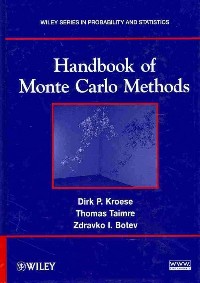
More and more of today’s numerical problems found in engineering and finance are solved through Monte Carlo methods. The heightened popularity of these methods and their continuing development makes it important for researchers to have a comprehensive understanding of the Monte Carlo approach. Handbook of Monte Carlo Methods provides the theory, algorithms, and applications that helps provide a thorough understanding of the emerging dynamics of this rapidly-growing field.
The authors begin with a discussion of fundamentals such as how to generate random numbers on a computer. Subsequent chapters discuss key Monte Carlo topics and methods, including:
Random variable and stochastic process generation
Markov chain Monte Carlo, featuring key algorithms such as the Metropolis-Hastings method, the Gibbs sampler, and hit-and-run
Discrete-event simulation
Techniques for the statistical analysis of simulation data including the delta method, steady-state estimation, and kernel density estimation
Variance reduction, including importance sampling, latin hypercube sampling, and conditional Monte Carlo
Estimation of derivatives and sensitivity analysis
Advanced topics including cross-entropy, rare events, kernel density estimation, quasi Monte Carlo, particle systems, and randomized optimization
The presented theoretical concepts are illustrated with worked examples that use MATLAB?, a related Web site houses the MATLAB? code, allowing readers to work hands-on with the material and also features the author's own lecture notes on Monte Carlo methods. Detailed appendices provide background material on probability theory, stochastic processes, and mathematical statistics as well as the key optimization concepts and techniques that are relevant to Monte Carlo simulation.
Handbook of Monte Carlo Methods is an excellent reference for applied statisticians and practitioners working in the fields of engineering and finance who use or would like to learn how to use Monte Carlo in their research. It is also a suitable supplement for courses on Monte Carlo methods and computational statistics at the upper-undergraduate and graduate levels.
From the Back Cover
A comprehensive overview of Monte Carlo simulation that explores the latest topics, techniques, and real-world applications
More and more of today’s numerical problems found in engineering and finance are solved through Monte Carlo methods. The heightened popularity of these methods and their continuing development makes it important for researchers to have a comprehensive understanding of the Monte Carlo approach. Handbook of Monte Carlo Methods provides the theory, algorithms, and applications that facilitate a thorough understanding of the emerging dynamics of this rapidly growing field.
The authors begin with a discussion of fundamentals such as how to generate random numbers on a computer. Subsequent chapters discuss key Monte Carlo topics and methods, including:
Random variable and stochastic process generation
Markov chain Monte Carlo, featuring key algorithms such as the Metropolis-Hastings method, the Gibbs sampler, and hit-and-run
Discrete-event simulation
Techniques for the statistical analysis of simulation data including the delta method, steady-state estimation, and kernel density estimation
Variance reduction, including importance sampling, Latin hypercube sampling, and conditional Monte Carlo
Estimation or derivatives and sensitivity analysis
Advanced topics including cross-entropy, rare events, kernel density estimation, quasi-Monte Carlo, particle systems, and randomized optimization
The presented theoretical concepts are illustrated with worked examples that use MATLAB?. A related website houses the MATLAB? code, allowing readers to work hands-on with the material and also features the author's own lecture notes on Monte Carlo methods. Detailed appendices provide background on probability theory, stochastic processes, and mathematical statistics as well as the key optimization concepts and techniques that ate relevant to Monte Carlo simulation.
Handbook of Monte Carlo Methods is an excellent reference for applied statisticians and practitioners working in the fields of engineering and finance who use or would like to learn how to use Monte Carlo in their research. It is also a suitable supplement for courses on Monte Carlo methods and computational statistics as the upper-undergraduate and graduate levels.
目录
Chapter Title
1 Uniform Random Number Generation
2 Quasirandom Number Generation
3 Random Variable Generation
4 Probability Distributions
5 Random Process Generation
6 Markov Chain Monte Carlo
7 Discrete Event Simulation
8 Statistical Analysis of Simulation Data
9 Variance Reduction
10 Rare-Event Simulation
11 Sensitivity Analysis
12 Randomized Optimization
13 Cross-Entropy Method
14 Particle Methods
15 Applications to Finance
16 Applications to Network Reliability
17 Applications to Differential Equations
B Elements of Mathematical Statistics
1 Uniform Random Number Generation
2 Quasirandom Number Generation
3 Random Variable Generation
4 Probability Distributions
5 Random Process Generation
6 Markov Chain Monte Carlo
7 Discrete Event Simulation
8 Statistical Analysis of Simulation Data
9 Variance Reduction
10 Rare-Event Simulation
11 Sensitivity Analysis
12 Randomized Optimization
13 Cross-Entropy Method
14 Particle Methods
15 Applications to Finance
16 Applications to Network Reliability
17 Applications to Differential Equations
B Elements of Mathematical Statistics
- 名称
- 类型
- 大小
光盘服务联系方式: 020-38250260 客服QQ:4006604884
云图客服:
用户发送的提问,这种方式就需要有位在线客服来回答用户的问题,这种 就属于对话式的,问题是这种提问是否需要用户登录才能提问
Video Player
×
Audio Player
×
pdf Player
×
