

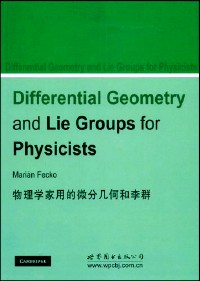
Differential geometry and lie groups for physicists /
副标题:无
作 者:Marian Fecko.
分类号:
ISBN:9787506292672
微信扫一扫,移动浏览光盘
简介
《物理学家用的微分几何和李群》以一种非正式的形式写作,作者给出了1000多例子重在强调对一般理论的深刻理解。微分几何在现代理论物理和应用数学中扮演着越来越重要的角色。《物理学家用的微分几何和李群》给出了在理论物理和应用数学中很重要的几何知识的引入,包括,流形、张量场、微分形式、联络、辛几何、李群作用、族以及自旋。《物理学家用的微分几何和李群》将要为读者很好的学习拉格郎日现代处理方法、哈密顿力学、电磁、规范场,相对论以及万有引力做充足的准备。《物理学家用的微分几何和李群》很适合作为物理、数学以及工程专业的高年级本科生以及研究生的教程,也是一本很难得自学教程。
目录
Preface
Introduction
1 The concept of a manifold
1.1 Topology and continuous maps
1.2 Classes of smoothness of maps of Cartesian spaces
1.3 Smooth structure, smooth manifold
1.4 Smooth maps of manifolds
1.5 A technical description of smooth surfaces in Rn
Summary of Chapter 1
2 Vector and tensor fields
2.1 Curves and functions on M
2.2 Tangent space, vectors and vector fields
2.3 Integral curves of a vector field
2.4 Linear algebra of tensors (multilinear algebra)
2.5 Tensor fields on M
2.6 Metric tensor on a manifold
Summary of Chapter 2
3 Mappings of tensors induced by mappings of manifolds
3.1 Mappings of tensors and tensor fields
3.2 Induced metric tensor
Summary of Chapter 3
4 Lie derivative
4.1 Local flow of a vector field
4.2 Lie transport and Lie derivative
4.3 Properties of the Lie derivative
4.4 Exponent of the Lie derivative
4.5 Geometrical interpretation of the commutator [V, W], non-holonomic frames
4.6 Isometries and conformal transformations, Killing equations
Summary of Chapter 4
5 Exterior algebra
5.1 Motivation: volumes of paraUelepipeds
5.2 p-forms and exterior product
5.3 Exterior algebra AL*
5.4 Interior product iv
5.5 Orientation in L
5.6 Determinant and generalized Kronecker symbols
5.7 The metric volume form
5.8 Hodge (duality) operator*
Summary of Chapter 5
6 Differential calculus of forms
6.1 Forms on a manifold
6.2 Exterior derivative
6.3 Orientability, Hodge operator and volume form on M
6.4 V-valued forms
Summary of Chapter 6
7 Integral calculus of forms
7.1 Quantities under the integral sign regarded as differential forms
7.2 Euclidean simplices and chains
7.3 Simplices and chains on a manifold
7.4 Integral of a form over a chain on a manifold
7.5 Stokes' theorem
7.6 Integral over a domain on an orientable manifold
7.7 Integral over a domain on an orientable Riemannian manifold
7.8 Integral and maps of manifolds
Summary of Chapter 7
8 Particular cases and applications of Stokes' theorem
8.1 Elementary situations
8.2 Divergence of a vector field and Gauss' theorem
8.3 Codifferential and LaPlace-deRhana operator
8.4 Green identities
8.5 Vector analysis in E3
8.6 Functions of complex variables
Summary of Chapter 8
9 Poincare lemma and cohomologies
9.1 Simple examples of closed non-exact forms
9.2 Construction of a potential on contractible manifolds
9.3* Cohomologies and deRham complex
Summary of Chapter 9
10 Lie groups: basic facts
10.1 Automorphisms of various structures and groups
10.2 Lie groups: basic concepts
Summary of Chapter 10
11 Differential geometry on Lie groups
11.1 Left-invariant tensor fields on a Lie group
11.2 Lie algebra g of a group G
11.3 One-parameter subgroups
11.4 Exponential map
11.5 Derived homomorphism of Lie algebras
11.6 Invariant integral on G
11.7 Matrix Lie groups: enjoy simplifications
Summary of Chapter 11
12 Representations of Lie groups and Lie algebras
12.1 Basic concepts
12.2 Irreducible and equivalent representations, Schur's lemma
12.3 Adjoint representation, Killing-Cartan metric
12.4 Basic constructions with groups, Lie algebras and their representations
12.5 Invariant tensors and intertwining operators
12.6* Lie algebra cohomologies
Summary of Chapter 12
13 Actions of Lie groups and Lie algebras on manifolds
13.1 Action of a group, orbit and stabilizer
13.2 The structure of homogeneous spaces, G/H
13.3 Covering homomorphism, coverings SU(2) →SO(3) andSL(2, C)→ L↑+
13.4 Representations of G and g in the space of functions on a G-space, fundamental fields
13.5 Representations of G and g in the space of tensor fields of type p
Summary of Chapter 13
14 Hamiltonian mechanics and symplectic manifolds
14.1 Poisson and symplectic structure on a manifold
14.2 Darboux theorem, canonical transformations and symplectomorphisms
14.3 Poincare-Cartan integral invariants and Liouville's theorem
14.4 Symmetries and conservation laws
14.5* Moment map
14.6* Orbits of the coadjoint action
14.7* Symplectic reduction
Summary of Chapter 14
15 Parallel transport and linear connection on M
15.1 Acceleration and parallel transport
15.2 Parallel transport and covariant derivative
15.3 Compatibility with metric, RLC connection
15.4 Geodesics
15.5 The curvature tensor
15.6 Connection forms and Cartan structure equations
15.7 Geodesic deviation equation (Jacobi's equation)
15.8* Torsion, complete parallelism and fiat connection
Summary of Chapter 15
16 Field theory and the language of forms
16.1 Differential forms in the Minkowski space E1'3
16.2 Maxwell's equations in terms of differential forms
16.3 Gauge transformations, action integral
16.4 Energy-momentum tensor, space-time symmetries and conservation
laws due to them
16.5* Einstein gravitational field equations, Hilbert and Cartan action
16.6* Non-linear sigma models and harmonic maps
Summary of Chapter 16
17 Differential geometry on TM and T*M
17.1 Tangent bundle TM and cotangent bundle T*M
17.2 Concept of a fiber bundle
17.3 The maps Tf and T*f
17.4 Vertical subspace, vertical vectors
17.5 Lifts on TM and T*M
17.6 Canonical tensor fields on TM and T*M
17.7 Identities between the tensor fields introduced here
Summary of Chapter 17
18 Hamiltonian and Lagrangian equations
18.1 Second-order differential equation fields
18.2 Euler-Lagrange field
18.3 Connection between Lagrangian and Hamiltonian mechanics, Legendre map
18.4 Symmetries lifted from the base manifold (configuration space)
18.5 Time-dependent Hamiltonian, action integral
Summary of Chapter 18
19 Linear connection and the frame bundle
19.1 Frame bundle π : LM→M
19.2 Connection form on LM
19.3 k-dimensional distribution D on a manifold.M
19.4 Geometrical interpretation of a connection form: horizontal distribution on LM
19.5 Horizontal distribution on LM and parallel transport on M
19.6 Tensors on M in the language of LM and their parallel transport
Summary of Chapter 19
20 Connection on a principal G-bundle
20.1 Principal G-bundles
21 Gauge theories and connections
22* Spinor fields and the Dirac operator
Appendix A Some relevant algebraic structures
A.I Linear spaces
A.2 Associative algebras
A.3 Lie algebras
A.4 Modules
A.5 Grading
A.6 Categories and functors
Appendix B Starring
Bibliography
Index of (frequently used) symbols
Index
Differential geometry and lie groups for physicists /
- 名称
- 类型
- 大小
光盘服务联系方式: 020-38250260 客服QQ:4006604884
云图客服:
用户发送的提问,这种方式就需要有位在线客服来回答用户的问题,这种 就属于对话式的,问题是这种提问是否需要用户登录才能提问
Video Player
×
Audio Player
×
pdf Player
×
