

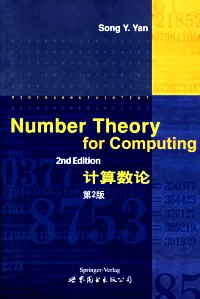
简介
Since the publication of the first edition, I have received many communications from readers all over the world. It is my great pleasure to thank the following people for their comments, corrections and encouragements: Prof. Jim Austin, Prof. Friedrich L. Bauer, Dr. Hassan Daghigh Dr. Deniz Deveci, Mr. Rich Fearn, Prof. Martin Hellman, Prof. Zixin Hou, Mr. Waseem Hus- sain, Dr. Gerard R. Maze, Dr. Paul Maguire, Dr. Helmut Meyn, Mr. Robert Pargeter, Mr. Mok-Kong Shen, Dr. Peter Shiu, Prof. Jonathan P. Sorenson, and Dr. David L. Stern. Special thanks must be given to Prof. Martin Hellman of Stanford University for writing the kind Foreword to this edition and also for his helpful advice and kind guidance, to Dr. Hans WSssner, Mr. Alfred Hofmann, Mrs. Ingeborg Mayer, Mrs. Ulrike Stricker, and Mr. Frank Holzwarth of Springer-Verlag for their kind help and encouragements during the preparation of this edition, and to Dr. Rodney Coleman, Prof. Glyn
目录
1. elementary number theory
1.1 introduction
1.1.1 what is number theory?
1.1.2 applications of number theory
1.1.3 algebraic preliminaries
1.2 theory of divisibility
1.2.1 basic concepts and properties of divisibility
1.2.2 fundamental theorem of arithmetic
1.2.3 mersenne primes and fermat numbers
1.2.4 euclid's algorithm
1.2.5 continued fractions
1.3 diophantine equations
1.3.1 basic concepts of diophantine equations
1.3.2 linear diophantine equations
1.3.3 pell's equations
1.4 arithmetic functions
1.4.1 multiplicative functions
1.4.2 functions (n), (n) and s(n)
1.4.3 perfect, amicable and sociable numbers
1.4.4 functions (n), (n) and (n)
.1.5 distribution of prime numbers
1.5.1 prime distribution function (x)
1.5.2 approximations of (x) by x/inx
1.5.3 approximations of (x) by li(x)
1.5.4 the riemann -function (s)
1.5.5 the nth prime
1.5.6 distribution of twin primes
1.5.7 the arithmetic progression of primes
1.6 theory of congruences
1.6.1 basic concepts and properties of congruences
1.6.2 modular arithmetic
1.6.3 linear congruences
1.6.4 the chinese remainder theorem
1.6.5 high-order congruences
1.6.6 legendre and jacobi symbols
1.6.7 orders and primitive roots
1.6.8 indices and kth power residues
1.7 arithmetic of elliptic curves
1.7.1 basic concepts of elliptic curves
1.7.2 geometric composition laws of elliptic curves
1.7.3 algebraic computation laws for elliptic curves
1.7.4 group laws on elliptic curves
1.7.5 number of points on elliptic curves
1.8 bibliographic notes and further reading
2. computational/algorithmic number theory
2.1 introduction
2.1.1 what is computational/algorithmic number theory?
2.1.2 effective computability
2.1.3 computational complexity
2.1.4 complexity of number-theoretic algorithms
2.1.5 fast modular exponentiations
2.1.6 fast group operations on elliptic curves
2.2 algorithms for primality testing
2.2.1 deterministic and rigorous primality tests
2.2.2 fermat's pseudoprimality test
2.2.3 strong pseudoprimality test
2.2.4 lucas pseudoprimality test
2.2.5 elliptic curve test
2.2.6 historical notes on primality testing
2.3 algorithms for integer factorization
2.3.1 complexity of integer factorization
2.3.2 trial division and fermat method
2.3.3 legendre's congruence
2.3.4 continued fraction method (cfrac)
2.3.5 quadratic and number field sieves (qs/nfs)
2.3.6 polland's "rho" and "p- 1" methods
2.3.7 lenstra's elliptic curve method (ecm)
2.4 algorithms for discrete logarithms
2.4.1 shanks' baby-step giant-step algorithm
2.4.2 silver-pohlig-hellman algorithm
2.4.3 index calculus for discrete logarithms
2.4.4 algorithms for elliptic curve discrete logarithms
2.4.5 algorithm for root finding problem
2.5 quantum number-theoretic algorithms
2.5.1 quantum information and computation
2.5.2 quantum computability and complexity
2.5.3 quantum algorithm for integer factorization
2.5.4 quantum algorithms for discrete logarithms
2.6 miscellaneous algorithms in number theory
2.6.1 algorithms for computing (x)
2.6.2 algorithms for generating amicable pairs
2.6.3 algorithms for verifying goldbach's conjecture
2.6.4 algorithm for finding odd perfect numbers
2.7 bibliographic notes and further reading
3. applied number theory in computing/cryptography
3.1 why applied number theory?
3.2 computer systems design
3.2.1 representing numbers in residue number systems
3.2.2 fast computations in residue number systems
3.2.3 residue computers
3.2.4 complementary arithmetic
3.2.5 hash functions
3.2.6 error detection and correction methods
3.2.7 random number generation
3.3 cryptography and information security
3.3.1 introduction
3.3.2 secret-key cryptography
3.3.3 data/advanced encryption standard (des/aes)
3.3.4 public-key cryptography
3.3.5 discrete logarithm based cryptosystems
3.3.6 rsa public-key cryptosystem
3.3.7 quadratic residuosity cryptosystems
3.3.8 elliptic curve public-key cryptosystems
3.3.9 digital signatures
3.3.10 digital signature standard (dss)
3.3.11 database security
3.3.12 secret sharing
3.3.13 internet/web security and electronic commerce
3.3.14 steganography
3.3.15 quantum cryptography
3.4 bibliographic notes and further reading
bibliography
index
1.1 introduction
1.1.1 what is number theory?
1.1.2 applications of number theory
1.1.3 algebraic preliminaries
1.2 theory of divisibility
1.2.1 basic concepts and properties of divisibility
1.2.2 fundamental theorem of arithmetic
1.2.3 mersenne primes and fermat numbers
1.2.4 euclid's algorithm
1.2.5 continued fractions
1.3 diophantine equations
1.3.1 basic concepts of diophantine equations
1.3.2 linear diophantine equations
1.3.3 pell's equations
1.4 arithmetic functions
1.4.1 multiplicative functions
1.4.2 functions (n), (n) and s(n)
1.4.3 perfect, amicable and sociable numbers
1.4.4 functions (n), (n) and (n)
.1.5 distribution of prime numbers
1.5.1 prime distribution function (x)
1.5.2 approximations of (x) by x/inx
1.5.3 approximations of (x) by li(x)
1.5.4 the riemann -function (s)
1.5.5 the nth prime
1.5.6 distribution of twin primes
1.5.7 the arithmetic progression of primes
1.6 theory of congruences
1.6.1 basic concepts and properties of congruences
1.6.2 modular arithmetic
1.6.3 linear congruences
1.6.4 the chinese remainder theorem
1.6.5 high-order congruences
1.6.6 legendre and jacobi symbols
1.6.7 orders and primitive roots
1.6.8 indices and kth power residues
1.7 arithmetic of elliptic curves
1.7.1 basic concepts of elliptic curves
1.7.2 geometric composition laws of elliptic curves
1.7.3 algebraic computation laws for elliptic curves
1.7.4 group laws on elliptic curves
1.7.5 number of points on elliptic curves
1.8 bibliographic notes and further reading
2. computational/algorithmic number theory
2.1 introduction
2.1.1 what is computational/algorithmic number theory?
2.1.2 effective computability
2.1.3 computational complexity
2.1.4 complexity of number-theoretic algorithms
2.1.5 fast modular exponentiations
2.1.6 fast group operations on elliptic curves
2.2 algorithms for primality testing
2.2.1 deterministic and rigorous primality tests
2.2.2 fermat's pseudoprimality test
2.2.3 strong pseudoprimality test
2.2.4 lucas pseudoprimality test
2.2.5 elliptic curve test
2.2.6 historical notes on primality testing
2.3 algorithms for integer factorization
2.3.1 complexity of integer factorization
2.3.2 trial division and fermat method
2.3.3 legendre's congruence
2.3.4 continued fraction method (cfrac)
2.3.5 quadratic and number field sieves (qs/nfs)
2.3.6 polland's "rho" and "p- 1" methods
2.3.7 lenstra's elliptic curve method (ecm)
2.4 algorithms for discrete logarithms
2.4.1 shanks' baby-step giant-step algorithm
2.4.2 silver-pohlig-hellman algorithm
2.4.3 index calculus for discrete logarithms
2.4.4 algorithms for elliptic curve discrete logarithms
2.4.5 algorithm for root finding problem
2.5 quantum number-theoretic algorithms
2.5.1 quantum information and computation
2.5.2 quantum computability and complexity
2.5.3 quantum algorithm for integer factorization
2.5.4 quantum algorithms for discrete logarithms
2.6 miscellaneous algorithms in number theory
2.6.1 algorithms for computing (x)
2.6.2 algorithms for generating amicable pairs
2.6.3 algorithms for verifying goldbach's conjecture
2.6.4 algorithm for finding odd perfect numbers
2.7 bibliographic notes and further reading
3. applied number theory in computing/cryptography
3.1 why applied number theory?
3.2 computer systems design
3.2.1 representing numbers in residue number systems
3.2.2 fast computations in residue number systems
3.2.3 residue computers
3.2.4 complementary arithmetic
3.2.5 hash functions
3.2.6 error detection and correction methods
3.2.7 random number generation
3.3 cryptography and information security
3.3.1 introduction
3.3.2 secret-key cryptography
3.3.3 data/advanced encryption standard (des/aes)
3.3.4 public-key cryptography
3.3.5 discrete logarithm based cryptosystems
3.3.6 rsa public-key cryptosystem
3.3.7 quadratic residuosity cryptosystems
3.3.8 elliptic curve public-key cryptosystems
3.3.9 digital signatures
3.3.10 digital signature standard (dss)
3.3.11 database security
3.3.12 secret sharing
3.3.13 internet/web security and electronic commerce
3.3.14 steganography
3.3.15 quantum cryptography
3.4 bibliographic notes and further reading
bibliography
index
- 名称
- 类型
- 大小
光盘服务联系方式: 020-38250260 客服QQ:4006604884
云图客服:
用户发送的提问,这种方式就需要有位在线客服来回答用户的问题,这种 就属于对话式的,问题是这种提问是否需要用户登录才能提问
Video Player
×
Audio Player
×
pdf Player
×
