

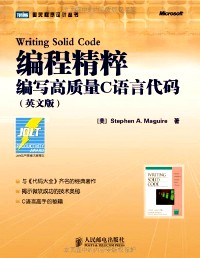
Writing solid code = 编程精粹 : 编写高质量C语言代码 /
副标题:无
分类号:
ISBN:9787115193162
微信扫一扫,移动浏览光盘
简介
软件日趋复杂,编码错误随之而来。要在测试前发现程序的错误,开
发出无错误的程序,关键是弄清楚错误为何产生,又是如何产生。本书给
出了多条编程方面的指导,这些指导看似简单,却是作者多年思考及实践
的结果,是对其编程经验的总结。书中解决问题的思考过程对于程序开发
人员尤显珍贵。
本书适于各层次程序开发人员阅读。
目录
1 A HYPOTHETICAL COMPILER .
If your compiler could detect every bug in your program——no matter the type——and issue an error message, ridding your code of bugs would be simple. Such omniscient compilers don't exist, but by enabling optional compiler warnings, using syntax and portability checkers, and using automated unit tests, you can increase the number of bugs that are detected for you automatically.
2 ASSERT YOURSELF
A good development strategy is to maintain two versions of your program: one that you ship and one that you use to debug the code. By using debugging assertion statements, you can detect bugs caused by bad function arguments, accidental use of undefined behavior, mistaken assumptions made by other programmers, and impossible conditions that nevertheless somehow show up. Debug-only backup algorithms help verify function results and the algorithms used in functions.
3 FORTIFY YOUR SUBSYSTEMS
Assertions wait quietly until bugs show up. Even more powerful are subsystem integrity checks that actively validate subsystems and alert you to bugs before the bugs affect the program. The integrity checks for the standard C memory manager can detect dangling pointers, lost memory blocks, and illegal use of memory that has not been initialized or that has already been released. Integrity checks can also be used to eliminate rare behavior, which is responsible for untested scenarios, and to force subsystem bugs to be reproducible so that they can be tracked down and fixed.
4 STEP THROUGH YOUR CODE
The best way to find bugs is to step through all new code in a debugger. By stepping through each instruction with your focus on the data flow, you can quickly detect problems in your expressions and algorithms. Keeping the focus on the data, not the instructions, gives you a second, very different, view of the code. Stepping through code takes time, but not nearly as much as most programmers would expect it to.
5 CANDY-MACHINE INTERFACES
It's not enough that your functions be bug-free; functions must be easy to use without introducing unexpected bugs. If bug rates are to be reduced, each function needs to have one well-defined purpose, to have explicit single-purpose inputs and outputs, to be readable at the point where it is called, and ideally to never return an error condition. Functions with these attributes are easy to validate using assertions and debug code, and they minimize the amount of error handling code that must be written.
6 RISKY BUSINESS
Given the numerous implementation possibilities for a given function, it should come as no surprise that some implementations will be more errorprone than others. The key to writing robust functions is to exchange risky algorithms and language idioms for alternatives that have proven to be comparably efficient yet much safer. At one extreme this can mean using unambiguous data types; at the other it can mean tossing out an entire design simply because it would be difficult, or impossible, to test.
7 TREACHERIES OF THE TRADE
Some programming practices are so risky they should never be used. Most such practices are obviously risky, but some seem quite safe, even desirable, because they fill a need without apparent hazard. These treacherous coding practices are the wolves in sheep's clothing. Why shouldn't you reference memory you've just released? Why is it risky to pass data in global or static storage? Why should you avoid parasitic functions? Why it is unwise to rely on every nit-picky detail outlined in the ANSI standard?
8 THE REST IS ATTITUDE
A programmer can follow every guidcline in this book, but without the proper attitude and a set of good programming habits, writing bug-free code will be much harder than it needs to be. If a programmer believes that a bug can simply "go away," or that fixing bugs "later" won't be harmful to the product, bugs will persist, ff a programmer regularly "cleans up" code, allows unnecessary flexibility in functions, welcomes every "free" feature that pops out of a design, or simply "tries" haphazard solutions to problems hoping to hit upon something that works, writing bug-free code will be an uphill battle. Having a good set of habits and attitudes is possibly the most important requirement for consistently writing bug-free code.
EPILOGUE WHERE DO YOU GO FROM HERE?
APPENDIX A CODING CHECKLISTS
APPENDIX B MEMORY LOGGING ROUTINES
APPENDIX C ANSWERS
REFERENCES
INDEX
If your compiler could detect every bug in your program——no matter the type——and issue an error message, ridding your code of bugs would be simple. Such omniscient compilers don't exist, but by enabling optional compiler warnings, using syntax and portability checkers, and using automated unit tests, you can increase the number of bugs that are detected for you automatically.
2 ASSERT YOURSELF
A good development strategy is to maintain two versions of your program: one that you ship and one that you use to debug the code. By using debugging assertion statements, you can detect bugs caused by bad function arguments, accidental use of undefined behavior, mistaken assumptions made by other programmers, and impossible conditions that nevertheless somehow show up. Debug-only backup algorithms help verify function results and the algorithms used in functions.
3 FORTIFY YOUR SUBSYSTEMS
Assertions wait quietly until bugs show up. Even more powerful are subsystem integrity checks that actively validate subsystems and alert you to bugs before the bugs affect the program. The integrity checks for the standard C memory manager can detect dangling pointers, lost memory blocks, and illegal use of memory that has not been initialized or that has already been released. Integrity checks can also be used to eliminate rare behavior, which is responsible for untested scenarios, and to force subsystem bugs to be reproducible so that they can be tracked down and fixed.
4 STEP THROUGH YOUR CODE
The best way to find bugs is to step through all new code in a debugger. By stepping through each instruction with your focus on the data flow, you can quickly detect problems in your expressions and algorithms. Keeping the focus on the data, not the instructions, gives you a second, very different, view of the code. Stepping through code takes time, but not nearly as much as most programmers would expect it to.
5 CANDY-MACHINE INTERFACES
It's not enough that your functions be bug-free; functions must be easy to use without introducing unexpected bugs. If bug rates are to be reduced, each function needs to have one well-defined purpose, to have explicit single-purpose inputs and outputs, to be readable at the point where it is called, and ideally to never return an error condition. Functions with these attributes are easy to validate using assertions and debug code, and they minimize the amount of error handling code that must be written.
6 RISKY BUSINESS
Given the numerous implementation possibilities for a given function, it should come as no surprise that some implementations will be more errorprone than others. The key to writing robust functions is to exchange risky algorithms and language idioms for alternatives that have proven to be comparably efficient yet much safer. At one extreme this can mean using unambiguous data types; at the other it can mean tossing out an entire design simply because it would be difficult, or impossible, to test.
7 TREACHERIES OF THE TRADE
Some programming practices are so risky they should never be used. Most such practices are obviously risky, but some seem quite safe, even desirable, because they fill a need without apparent hazard. These treacherous coding practices are the wolves in sheep's clothing. Why shouldn't you reference memory you've just released? Why is it risky to pass data in global or static storage? Why should you avoid parasitic functions? Why it is unwise to rely on every nit-picky detail outlined in the ANSI standard?
8 THE REST IS ATTITUDE
A programmer can follow every guidcline in this book, but without the proper attitude and a set of good programming habits, writing bug-free code will be much harder than it needs to be. If a programmer believes that a bug can simply "go away," or that fixing bugs "later" won't be harmful to the product, bugs will persist, ff a programmer regularly "cleans up" code, allows unnecessary flexibility in functions, welcomes every "free" feature that pops out of a design, or simply "tries" haphazard solutions to problems hoping to hit upon something that works, writing bug-free code will be an uphill battle. Having a good set of habits and attitudes is possibly the most important requirement for consistently writing bug-free code.
EPILOGUE WHERE DO YOU GO FROM HERE?
APPENDIX A CODING CHECKLISTS
APPENDIX B MEMORY LOGGING ROUTINES
APPENDIX C ANSWERS
REFERENCES
INDEX
Writing solid code = 编程精粹 : 编写高质量C语言代码 /
- 名称
- 类型
- 大小
光盘服务联系方式: 020-38250260 客服QQ:4006604884
云图客服:
用户发送的提问,这种方式就需要有位在线客服来回答用户的问题,这种 就属于对话式的,问题是这种提问是否需要用户登录才能提问
Video Player
×
Audio Player
×
pdf Player
×
