

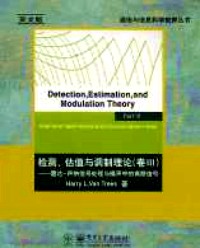
Detection, estimation, and modulation theory. Part III, Radar-sonar signal processing and Gaussia...
副标题:无
分类号:
ISBN:9787505391130
微信扫一扫,移动浏览光盘
简介
本书是一本非常实用的详细介绍检测、估值与调制理沦的教学参考书。本书主要介绍雷达—声纳信号处理以及噪声中的高斯信号。其中包括高斯信号的检测、随机过程参数的估计、雷达—声纳问题、估值问题的特殊种类、多普勒扩展目标与信道、范围扩展目标与信道、双扩展目标与信道等内容。
本书可用做通信与电子、信息与信号处理等专业的高年级本科生、研究牛的教材,也可作为相关人员的参考书。
目录
1 introduction
1.1 review of parts i and ii
1.2 random signals in noise
1.3 signal processing in radar-sonar systems
references
2 detection of gaussian signals in white gaussian noise
2.1 optimum receivers
2.1.1 canonical realization no. 1: estimator-correlator
2.1.2 canonical realization no. 2: filter-correlator receiver
2.1.3 canonical realization no. 3: filter-squarer-integrator (fsi) receiver
2.1.4 canonical realization no. 4: optimum realizable filter receiver
2.1.5 canonical realization no. 4s: state-variable realization
2.1.6 summary: receiver structures
2.2 performance
2.2.1 closed-form expression for (s)
2.2.2 approximate error expressions
2.2.3 an alternative expression for r(s)
2.2.4 performance for a typical system
2.3 summary: simple binary detection
2.4 problems
.references
3 general binary detection: gaussian processes
3.1 model and problem classification
3.2 receiver structures
3.2.1 whitening approach
3.2.2 various implementations of the likelihood ratiotest
3.2.3 summary: receiver structures
3.3 performance
3.4 four special situations
3.4.1 binary symmetric case
3.4.2 non-zero means
3.4.3 stationary"carrier-symmetric" bandpass problems
3.4.4 error probability for the binary symmetric bandpass problem
3.5 general binary case: white noise not necessarily present: singular tests
3.5.1 receiver derivation
3.5.2 performance: general binary case
3.5.3 singularity
3.6 summary: general binary problem
3.7 problems
references
4 speciaicategoriesofdetectionproblerns
4.1 stationary processes: long observation time
4.1.1 simple binary problem
4.1.2 general binary problem
4.1.3 summary: splot problem
4.2 separable kernels
4.2.1 separable kernel model
4.2.2 time diversity
4.2.3 frequency diversity
4.2.4 summary: separable kernels
4.3 low-energy-coherence (lec) case
4.4 summary
4.5 problems
references
5 discussion: detection of gaussian signals
5.1 related topics
5.1.1 m-ary detection: gaussian signals in noise
5.1.2 suboptimum receivers
5.1.3 adaptive receivers
5.1.4 non-gaussian processes
5.1.5 vector gaussian processes
5.2 summary of detection theory
5.3 problems
references
6 estimation of the parameters of a random process
6.1 parameter estimation model
6.2 estimator structure
6.2.1 derivation of the likelihood function
6.2.2 maximum likelihood and maximum a-posteriori probability equations
6.3 performance analysis
6.3.1 a lower bound on the variance
6.3.2 calculation of j(2)(a)
6.3.3 lower bound on the mean-square error
6.3.4 improved performance bounds
6.4 summary
6.5 problems
references
7 special categories of estimation problems
7.1 stationary processes: long observation time
7.1.1 general results
7.1.2 performance of truncated estimates
7.1.3 suboptimum receivers
7.1.4 summary
7.2 finite-state processes
7.3 separable kernels
7.4 low-energy-coherence case
7.5 related topics
7.5.1 multiple-parameter estimation
7.5.2 composite-hypothesis tests
7.6 summary of estimation theory
7.7 problems
references
8 the radar-sonar problem
references
9 detection of slowly fluctuating point targets
9.1 model of a slowly fluctuating point target
9.2 white bandpass noise
9.3 colored bandpass noise
9.4 colored noise with a finite state representation
9.4.1 differential-equation representation of the optimum receiver and its performance: i
9.4.2 differential-equation representation of the optimum receiver and its performance: ii
9.5 optimal signal design
9.6 summary and related issues
9.7 problems
references
10 parameter estimation: slowly fluctuating point targets
10.1 receiver derivation and signal design
10.2 performance of the optimum estimator
10.2.1 local accuracy
10.2.2 global accuracy (or ambiguity)
10.2.3 summary
10.3 properties of time-frequency autocorrelation functions and ambiguity functions
10.4 coded pulse sequences
10.4.1 on-off sequences
10.4.2 constant power, amplitude-modulated waveforms
10.4.3 other coded sequences
10.5 resolution
10.5.1 resolution in a discrete environment: model
10.5.2 conventional receivers
10.5.3 optimum receiver: discrete resolution problem
10.5.4 summary of resolution results
10.6 summary and related topics
10.6.1 summary
10.6.2 related topics
10.7 problems
refereaces
11 doppler-spread targets and channels
11.1 model for doppler-spread target (or channel)
11.2 detection of doppler-spread targets
11.2.1 likelihood ratio test
11.2.2 canonical receiver realizations
11.2.3 performance of the optimum receiver
11.2.4 classes of processes
11.2.5 summary
11.3 communication over doppler-spread channels
11.3.1 binary communications systems: optimum receiver and performance
11.3.2 performance bounds for optimized binary systems
11.3.3 suboptimum receivers
11.3.4 m-ary systems
11.3.5 summary: communication over doppler spread channels
11.4 parameter estimation: doppler-spread targets
11.5 summary: doppler-spread targets and channels
11.6 problems
references
12 range-spread targets and channels
12.1 model and intuitive discussion
12.2 detection of range-spread targets
12.3 time-frequency duality
12.3.1 basic duality concepts
12.3.2 dual targets and channels
12.3.3 applications
12.4 summary: range-spread targets
12.5 problems
references
13 doubly-spread targets and channels
13.1 model for a doubly-spread target
13.1.1 basic model
13.1.2 differential-equation model for a doubly spread target (or channel)
13.1.3 model summary
13.2 detection in the presence of reverberation or clutter (resolution in a dense environment)
13.2.1 conventional receiver
13.2.2 optimum receivers
13.2.3 summary of the reverberation problem
13.3 detection of doubly-spread targets and communication over doubly-spread channels
13.3.1 problem formulation
13.3.2 approximate models for doubly-spread targets and doubly-spread channels
13.3.3 binary communication over doubly-spread channels
13.3.4 detection under lec conditions
13.3.5 related topics
13.3.6 summary of detection of doubly-spread signals
13.4 parameter estimation for doubly-spread targets
13.4.1 estimation under lec conditions
13.4.2 amplitude estimation
13.4.3 estimation of mean range and doppler
13.4.4 summary
13.5 summary of doubly-spread targets and channels
13.6 problems
references
14 discussion
14.1 summary: signal processing in radar and sonar systems
14.2 optimum array processing
14.3 epilogue
references
appendix: complex representation of bandpass signals,systems, and processes
a.1 deterministic signals
a.2 bandpass linear systems
a.2.1 time-lnvariant systems
a.2.2 time-varying systems
a.2.3 state-variable systems
a.3 bandpass random processes
a.3.1 stationary processes
a.3.2 nonstationary processes
a.3.3 complex finite-state processes
a.4 summary
a.5 problems
references
glossary
author index
subject index
1.1 review of parts i and ii
1.2 random signals in noise
1.3 signal processing in radar-sonar systems
references
2 detection of gaussian signals in white gaussian noise
2.1 optimum receivers
2.1.1 canonical realization no. 1: estimator-correlator
2.1.2 canonical realization no. 2: filter-correlator receiver
2.1.3 canonical realization no. 3: filter-squarer-integrator (fsi) receiver
2.1.4 canonical realization no. 4: optimum realizable filter receiver
2.1.5 canonical realization no. 4s: state-variable realization
2.1.6 summary: receiver structures
2.2 performance
2.2.1 closed-form expression for (s)
2.2.2 approximate error expressions
2.2.3 an alternative expression for r(s)
2.2.4 performance for a typical system
2.3 summary: simple binary detection
2.4 problems
.references
3 general binary detection: gaussian processes
3.1 model and problem classification
3.2 receiver structures
3.2.1 whitening approach
3.2.2 various implementations of the likelihood ratiotest
3.2.3 summary: receiver structures
3.3 performance
3.4 four special situations
3.4.1 binary symmetric case
3.4.2 non-zero means
3.4.3 stationary"carrier-symmetric" bandpass problems
3.4.4 error probability for the binary symmetric bandpass problem
3.5 general binary case: white noise not necessarily present: singular tests
3.5.1 receiver derivation
3.5.2 performance: general binary case
3.5.3 singularity
3.6 summary: general binary problem
3.7 problems
references
4 speciaicategoriesofdetectionproblerns
4.1 stationary processes: long observation time
4.1.1 simple binary problem
4.1.2 general binary problem
4.1.3 summary: splot problem
4.2 separable kernels
4.2.1 separable kernel model
4.2.2 time diversity
4.2.3 frequency diversity
4.2.4 summary: separable kernels
4.3 low-energy-coherence (lec) case
4.4 summary
4.5 problems
references
5 discussion: detection of gaussian signals
5.1 related topics
5.1.1 m-ary detection: gaussian signals in noise
5.1.2 suboptimum receivers
5.1.3 adaptive receivers
5.1.4 non-gaussian processes
5.1.5 vector gaussian processes
5.2 summary of detection theory
5.3 problems
references
6 estimation of the parameters of a random process
6.1 parameter estimation model
6.2 estimator structure
6.2.1 derivation of the likelihood function
6.2.2 maximum likelihood and maximum a-posteriori probability equations
6.3 performance analysis
6.3.1 a lower bound on the variance
6.3.2 calculation of j(2)(a)
6.3.3 lower bound on the mean-square error
6.3.4 improved performance bounds
6.4 summary
6.5 problems
references
7 special categories of estimation problems
7.1 stationary processes: long observation time
7.1.1 general results
7.1.2 performance of truncated estimates
7.1.3 suboptimum receivers
7.1.4 summary
7.2 finite-state processes
7.3 separable kernels
7.4 low-energy-coherence case
7.5 related topics
7.5.1 multiple-parameter estimation
7.5.2 composite-hypothesis tests
7.6 summary of estimation theory
7.7 problems
references
8 the radar-sonar problem
references
9 detection of slowly fluctuating point targets
9.1 model of a slowly fluctuating point target
9.2 white bandpass noise
9.3 colored bandpass noise
9.4 colored noise with a finite state representation
9.4.1 differential-equation representation of the optimum receiver and its performance: i
9.4.2 differential-equation representation of the optimum receiver and its performance: ii
9.5 optimal signal design
9.6 summary and related issues
9.7 problems
references
10 parameter estimation: slowly fluctuating point targets
10.1 receiver derivation and signal design
10.2 performance of the optimum estimator
10.2.1 local accuracy
10.2.2 global accuracy (or ambiguity)
10.2.3 summary
10.3 properties of time-frequency autocorrelation functions and ambiguity functions
10.4 coded pulse sequences
10.4.1 on-off sequences
10.4.2 constant power, amplitude-modulated waveforms
10.4.3 other coded sequences
10.5 resolution
10.5.1 resolution in a discrete environment: model
10.5.2 conventional receivers
10.5.3 optimum receiver: discrete resolution problem
10.5.4 summary of resolution results
10.6 summary and related topics
10.6.1 summary
10.6.2 related topics
10.7 problems
refereaces
11 doppler-spread targets and channels
11.1 model for doppler-spread target (or channel)
11.2 detection of doppler-spread targets
11.2.1 likelihood ratio test
11.2.2 canonical receiver realizations
11.2.3 performance of the optimum receiver
11.2.4 classes of processes
11.2.5 summary
11.3 communication over doppler-spread channels
11.3.1 binary communications systems: optimum receiver and performance
11.3.2 performance bounds for optimized binary systems
11.3.3 suboptimum receivers
11.3.4 m-ary systems
11.3.5 summary: communication over doppler spread channels
11.4 parameter estimation: doppler-spread targets
11.5 summary: doppler-spread targets and channels
11.6 problems
references
12 range-spread targets and channels
12.1 model and intuitive discussion
12.2 detection of range-spread targets
12.3 time-frequency duality
12.3.1 basic duality concepts
12.3.2 dual targets and channels
12.3.3 applications
12.4 summary: range-spread targets
12.5 problems
references
13 doubly-spread targets and channels
13.1 model for a doubly-spread target
13.1.1 basic model
13.1.2 differential-equation model for a doubly spread target (or channel)
13.1.3 model summary
13.2 detection in the presence of reverberation or clutter (resolution in a dense environment)
13.2.1 conventional receiver
13.2.2 optimum receivers
13.2.3 summary of the reverberation problem
13.3 detection of doubly-spread targets and communication over doubly-spread channels
13.3.1 problem formulation
13.3.2 approximate models for doubly-spread targets and doubly-spread channels
13.3.3 binary communication over doubly-spread channels
13.3.4 detection under lec conditions
13.3.5 related topics
13.3.6 summary of detection of doubly-spread signals
13.4 parameter estimation for doubly-spread targets
13.4.1 estimation under lec conditions
13.4.2 amplitude estimation
13.4.3 estimation of mean range and doppler
13.4.4 summary
13.5 summary of doubly-spread targets and channels
13.6 problems
references
14 discussion
14.1 summary: signal processing in radar and sonar systems
14.2 optimum array processing
14.3 epilogue
references
appendix: complex representation of bandpass signals,systems, and processes
a.1 deterministic signals
a.2 bandpass linear systems
a.2.1 time-lnvariant systems
a.2.2 time-varying systems
a.2.3 state-variable systems
a.3 bandpass random processes
a.3.1 stationary processes
a.3.2 nonstationary processes
a.3.3 complex finite-state processes
a.4 summary
a.5 problems
references
glossary
author index
subject index
Detection, estimation, and modulation theory. Part III, Radar-sonar signal processing and Gaussia...
- 名称
- 类型
- 大小
光盘服务联系方式: 020-38250260 客服QQ:4006604884
云图客服:
用户发送的提问,这种方式就需要有位在线客服来回答用户的问题,这种 就属于对话式的,问题是这种提问是否需要用户登录才能提问
Video Player
×
Audio Player
×
pdf Player
×
