

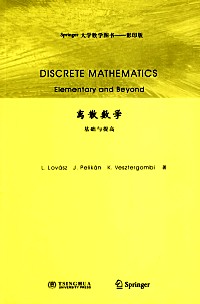
Discrete mathematics : elementary and beyond = 离散数学 : 基础与提高 /
副标题:无
作 者:L. Lovász, J. Pelikán, K. Vesztergombi著.
分类号:O158
ISBN:9787302138266
微信扫一扫,移动浏览光盘
简介
本书包括组合、图论及它们在优化和编码等领域的应用。全书只有约300页,但涵盖了信息领域一些广泛而有趣的应用,及离散数学领域新颖而前沿的研究课题。
本书非常适合计算机科学、信息与计算科学等专业作为“离散数学”引论课程的教材或参考书。
目录
preface.
1 let's count!
1.1 a party
1.2 sets and the like
1.3 the number of subsets
1.4 the approximate number of subsets
1.5 sequences
1.6 permutations
1.7 the number of ordered subsets
1.8 the number of subsets of a given size
2 combinatorial tools
2.1 induction
2.2 comparing and estimating numbers
2.3 inclusion-exclusion
2.4 pigeonholes
2.5 the twin paradox and the good old logarithm
3 binomial coefficients and pascal's triangle
3.1 the binomial theorem
3.2 distributing presents
3.3 anagrams
.3.4 distributing money
3.5 pascal's triangle
3.6 identities in pascal's triangle
3.7 a bird's-eye view of pascal's triangle
3.8 all eagle's-eye view: fine details
4 fibonacci numbers
4.1 fil)onacci's exercise
4.2 lots of identities
4.3 a formula for tire fibonacci numbers
5 combinatorial probability
5.1 events and probabilities
5.2 independent repetition of an experiment
5.3 the law of large numbers
5.4 the law of small numbers and the law of very large numbers
6 integers, divisors, and primes
6.1 divisibility of integers
6.2 primes and their history
6.3 factorization into primes
6.,1 on the set of primes
6.5 fermat's "little" theorem
6.6 the euclidean algorithm
6.7 congruences.
6.8 strange numbers
6.9 number theory and combinatorics
6.10 how to test whether a number is a prime?..
7 graphs
7.1 even and odd degrees
7.2 paths, cycles, and connectivity
7.3 eulerian walks and hamiltonian cycles
8 trees
8.1 how to define trees
8.2 how to grow trees
8.3 how to count trees?
8.4 how to store trees
8.5 the number of unlabeled trees
9 finding the optimum
9.1 finding the best tree
9.2 the traveling salesman problem
10 matchings in graphs
10.1 a dancing problem
10.2 another matching problem
10.3 the main theorem
10.4 how to find a perfect matching
11 combinatorics in geometry
11.1 intersections of diagonals
11.2 counting regions
11.3 convex polygons
12 euler's formula
12.1 a planet under attack
12.2 planar graphs
12.3 euler's formula for polyhedra
13 coloring maps and graphs
13.1 coloring regions with two colors
13.2 coloring graphs with two colors
13.3 coloring graphs with many colors
13.4 map coloring and the four color theorem
14 finite geometries, codes,latin squares,and other pretty creatures
14.1 small exotic worlds
14.2 finite affine and projective planes
14.3 block designs
14.4 steiner systems
14.5 latin squares
14.6 codes
15 a glimpse of complexity and cryptography
15.1 a connecticut class in king arthur's court
15.2 classical cryptography
15.3 how to save the last move in chess
15.4 how to verify a password--without learning it
15.5 how to find these primes
15.6 public key cryptography
16 answers to exercises
index...
1 let's count!
1.1 a party
1.2 sets and the like
1.3 the number of subsets
1.4 the approximate number of subsets
1.5 sequences
1.6 permutations
1.7 the number of ordered subsets
1.8 the number of subsets of a given size
2 combinatorial tools
2.1 induction
2.2 comparing and estimating numbers
2.3 inclusion-exclusion
2.4 pigeonholes
2.5 the twin paradox and the good old logarithm
3 binomial coefficients and pascal's triangle
3.1 the binomial theorem
3.2 distributing presents
3.3 anagrams
.3.4 distributing money
3.5 pascal's triangle
3.6 identities in pascal's triangle
3.7 a bird's-eye view of pascal's triangle
3.8 all eagle's-eye view: fine details
4 fibonacci numbers
4.1 fil)onacci's exercise
4.2 lots of identities
4.3 a formula for tire fibonacci numbers
5 combinatorial probability
5.1 events and probabilities
5.2 independent repetition of an experiment
5.3 the law of large numbers
5.4 the law of small numbers and the law of very large numbers
6 integers, divisors, and primes
6.1 divisibility of integers
6.2 primes and their history
6.3 factorization into primes
6.,1 on the set of primes
6.5 fermat's "little" theorem
6.6 the euclidean algorithm
6.7 congruences.
6.8 strange numbers
6.9 number theory and combinatorics
6.10 how to test whether a number is a prime?..
7 graphs
7.1 even and odd degrees
7.2 paths, cycles, and connectivity
7.3 eulerian walks and hamiltonian cycles
8 trees
8.1 how to define trees
8.2 how to grow trees
8.3 how to count trees?
8.4 how to store trees
8.5 the number of unlabeled trees
9 finding the optimum
9.1 finding the best tree
9.2 the traveling salesman problem
10 matchings in graphs
10.1 a dancing problem
10.2 another matching problem
10.3 the main theorem
10.4 how to find a perfect matching
11 combinatorics in geometry
11.1 intersections of diagonals
11.2 counting regions
11.3 convex polygons
12 euler's formula
12.1 a planet under attack
12.2 planar graphs
12.3 euler's formula for polyhedra
13 coloring maps and graphs
13.1 coloring regions with two colors
13.2 coloring graphs with two colors
13.3 coloring graphs with many colors
13.4 map coloring and the four color theorem
14 finite geometries, codes,latin squares,and other pretty creatures
14.1 small exotic worlds
14.2 finite affine and projective planes
14.3 block designs
14.4 steiner systems
14.5 latin squares
14.6 codes
15 a glimpse of complexity and cryptography
15.1 a connecticut class in king arthur's court
15.2 classical cryptography
15.3 how to save the last move in chess
15.4 how to verify a password--without learning it
15.5 how to find these primes
15.6 public key cryptography
16 answers to exercises
index...
Discrete mathematics : elementary and beyond = 离散数学 : 基础与提高 /
- 名称
- 类型
- 大小
光盘服务联系方式: 020-38250260 客服QQ:4006604884
云图客服:
用户发送的提问,这种方式就需要有位在线客服来回答用户的问题,这种 就属于对话式的,问题是这种提问是否需要用户登录才能提问
Video Player
×
Audio Player
×
pdf Player
×
